

A flatbed is loaded with equipment, and the crew has both chain and webbing on hand. A chain binder is not automatically stronger than a ratchet strap: compare the working load limit (WLL) of the complete tie-down assembly, not the tightening device alone. In 2026, the stronger choice depends on the rated chain or strap, its hooks and anchor points, and how it contacts the load.
- Is a chain binder stronger than a ratchet strap? Not automatically; the complete assembly's working load limit decides.
- TruckNTow's Grade 70 chain-and-binder kit lists a 6,600-pound safe working load; its PROSeries car tie-down lists 3,300 pounds.
- A 7,100-pound binder does not raise the rating of a lower-rated chain or anchor.
- Choose chain for suitable equipment tie-down points; choose webbing where the cargo requires a compatible strap contact point.
Why this matters on a working load
A binder creates tension in chain; a ratchet creates tension in webbing. Neither tightening mechanism tells you what the entire connection can safely restrain. TruckNTow lists a VULCAN folding-handle ratchet binder with a 7,100-pound safe working load, but that figure is not the rating of every chain, hook or anchor you attach to it.
For a 2026 equipment move, check each component's marked rating before assigning a WLL to the tie-down. For a vehicle move, check the vehicle manufacturer's approved attachment points as well: a high-rated chain does not make an unsuitable vehicle connection acceptable.
Is a chain binder stronger than a ratchet strap for loads?
Not by itself. The chain-and-binder setup below has a higher stated safe working load than the listed car tie-down, but that is a comparison of these specific products, not a rule that every chain assembly outrates every strap assembly.
| Listed option | Stated safe working load | Best for | Limitation |
|---|---|---|---|
| VULCAN Grade 70 chain-and-load-binder kit | 6,600 pounds | Loads with suitable chain attachment points | Chain contact and hooks must suit the cargo and anchors. |
| VULCAN PROSeries lasso-style car tie-down with chain anchors | 3,300 pounds | Vehicle hauling using a compatible lasso-style tire tie-down | Webbing needs a clear path away from damaging contact. |
| VULCAN folding-handle ratchet binder | 7,100 pounds for the binder | Tensioning compatible chain | The binder's rating alone does not establish the assembly's WLL. |
The listed kit's 6,600-pound safe working load is twice the listed car tie-down's 3,300-pound rating. That comparison answers which listed assembly has the higher stated rating; it does not say that one tie-down is sufficient for a particular load, or that a binder rated at 7,100 pounds turns a lower-rated chain into a 7,100-pound assembly.
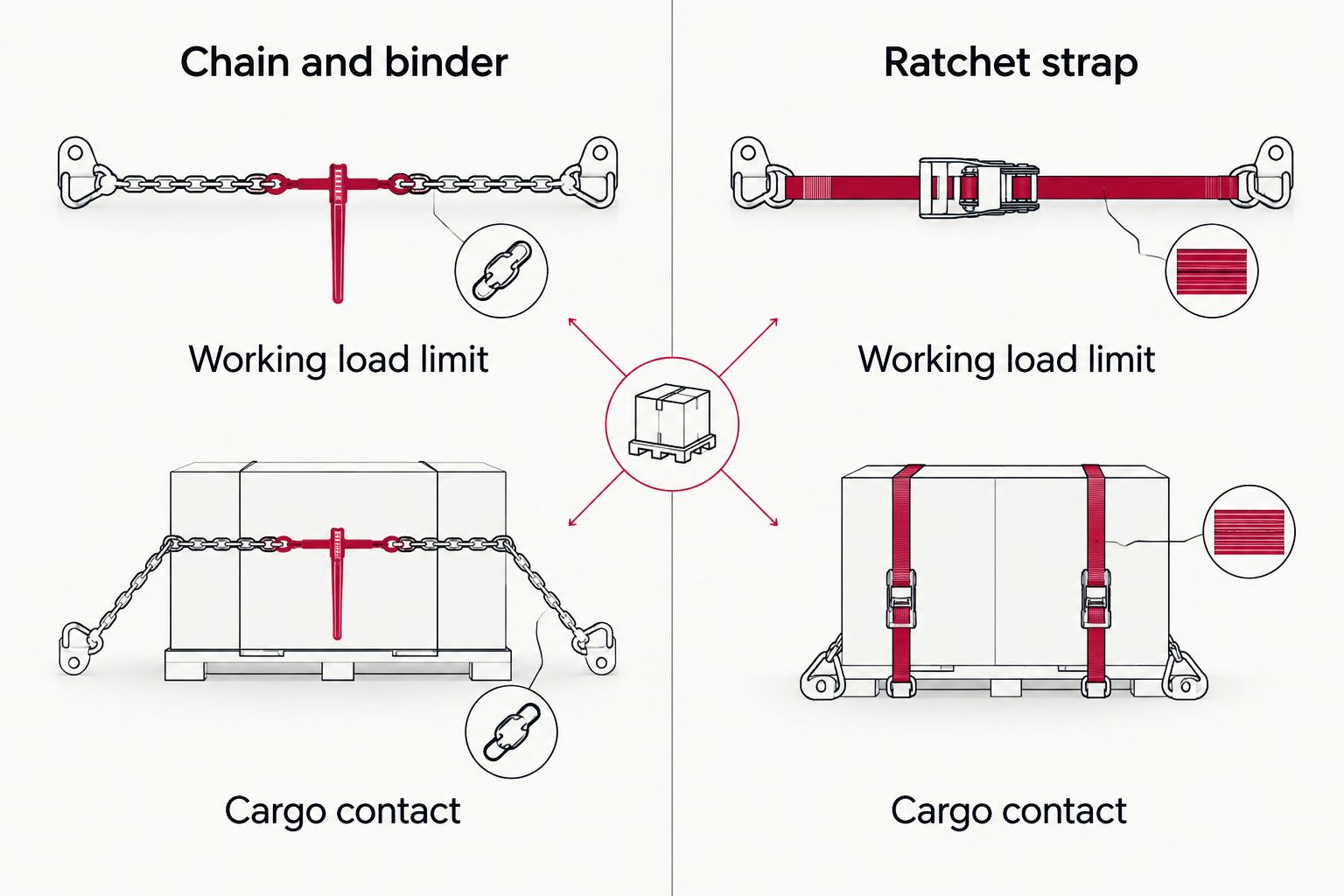
A binder and a strap can also serve different attachment methods on the same trailer. Chain hooks need compatible securement points, while a lasso-style car tie-down is intended to go around a tire; substituting one for the other changes the contact point even when both carry a WLL marking. TruckNTow's Grade 70 chain-and-binder kit is best for suitable chain attachment points; its PROSeries lasso-style tie-down is best for a compatible vehicle tire setup. Neither is the default choice for every load.
What determines the usable strength of each setup?
The number to check in 2026 is the WLL of the assembled, correctly installed tie-down. Work from the load outward instead of starting with the largest number printed on a binder handle or strap package.
- Identify the attachment point. Confirm that the cargo and trailer have securement points appropriate for the chosen hooks or strap arrangement. Do not treat a convenient opening as a rated attachment point without checking its suitability.
- Read each component's marking. Check the chain or webbing, binder or ratchet, end fittings and any connector used between them. A mixed assembly needs particular care because its parts can carry different ratings.
- Use the limiting rating. A 7,100-pound binder paired with a component rated below 7,100 pounds does not remove that lower limit. Check the rated trailer anchor as well; the connection must work as a system.
- Check the route over or around the cargo. Keep webbing clear of cutting and abrasive contact, and make sure chain bears on appropriate points rather than vulnerable vehicle surfaces.
- Assess the full securement arrangement. The WLL of one tie-down is not the same as the capacity of the whole load-securing plan. Account for the number, direction and placement of tie-downs required for the cargo.
Federal Motor Carrier Safety Administration cargo-securement rules in 49 CFR 393.106 and 393.108 govern aggregate WLL and component ratings for covered commercial transport. Under the general aggregate-WLL rule, the tie-downs securing an article or group of articles must provide at least one-half the weight of the article or group; other rules also govern how tie-downs are counted and arranged. Check the applicable cargo-specific requirements before treating that minimum as a complete securement plan.
For example, the listed 6,600-pound chain kit and 7,100-pound binder have different stated ratings. Comparing those figures is useful, but it is not permission to use an unverified trailer anchor, hook or connection. The same check applies to a 3,300-pound vehicle tie-down: its stated rating does not certify every place an operator might connect its chain anchor.
Why chain-binder strength varies from strap strength
In 2026, a category-wide answer fails because the working load limit belongs to the specific equipment and setup. These factors change which option fits the job:
- Marked WLL: The listed TruckNTow chain kit states 6,600 pounds, while the listed PROSeries car tie-down states 3,300 pounds. Those are product figures, not ratings for all chain or webbing.
- Compatible hardware: Binder size, chain size and grade, hooks, ratchet hardware and trailer anchors must work together. A strong tightening device cannot correct an unsuitable connection.
- Cargo attachment points: Equipment with appropriate chain tie-down points presents a different job from a car secured at its tires. Use the cargo's approved securement method.
- Contact surfaces: Edges and abrasion can damage webbing; unsuitable chain contact can damage cargo. Route the tie-down so the material and the load are compatible.
- Condition before use: Cuts, abrasion, damaged stitching, bent or distorted hardware, and damaged chain require an inspection decision before the tie-down goes into service.
- Tie-down geometry: The direction and placement of each tie-down affect the securement arrangement. A higher WLL on one component does not replace an adequate overall layout.
Chain's higher rating in the product comparison is a useful reason to examine it for a suitable equipment load. It is not a reason to run chain across a surface or through an attachment point that cannot take it. Likewise, webbing's lower listed rating does not make the lasso-style setup the wrong choice for a vehicle when that is the compatible attachment method and the complete securement plan meets the job's requirements.
How do you choose between chain and webbing on the job?
Start with the load's approved attachment method, then select equipment with marked ratings that meet the securement plan. On a machine with suitable chain tie-down points, a chain-and-binder assembly gives you a direct way to tension chain. Its drawbacks are the need to match the chain, binder, hooks and anchors, and the risk of unsuitable contact with the cargo.
For a car-hauling setup designed around tire contact, a lasso-style tie-down uses webbing at the tire and chain anchors at the connection points. Its advantage is the attachment method, not an automatic claim of greater strength; its drawbacks include exposure of webbing to abrasion or sharp contact and a lower stated rating than the specific chain kit compared above.
A combination of chain and webbing in one fleet is normal when crews move different cargo. Do not transfer a rating from one piece of equipment to another, and do not select a tie-down by appearance. Before a 2026 departure, the working check is straightforward: identify the cargo point, confirm the trailer point, read the component markings, inspect condition and verify the complete arrangement.
What should you inspect and maintain before reuse?
Inspect the tie-down before each use and keep it clean enough to see damage. Look along the full length of a strap for cuts, worn areas and damaged stitching; inspect chain links, hooks and binder parts for visible damage or distortion. Check the ratchet or binder's operation without placing yourself in the path of a tensioned handle or tie-down.
Store webbing away from sharp hardware that can cut it between jobs, and keep chain and binders positioned so hooks and moving parts do not damage adjacent gear. If a marking is unreadable or a component's condition is in doubt, do not assume the original WLL still applies. Replace or evaluate the affected component under the applicable inspection criteria before using it for a load.
Do not use a binder's 7,100-pound marking to clear a chain assembly for a 7,100-pound job. Confirm the rating and condition of every part in the connection, then secure the cargo by its approved points.
FAQ
Is a chain binder stronger than a ratchet strap?
A chain binder is not automatically stronger than a ratchet strap assembly. Compare the working load limit of the complete, compatible tie-down setup rather than the tightening mechanism alone.
Is the listed chain kit stronger than the listed PROSeries car tie-down?
The listed VULCAN chain-and-binder kit has a 6,600-pound safe working load, compared with 3,300 pounds for the listed PROSeries car tie-down. Those figures apply to the named products, not every chain and strap.
Does a 7,100-pound binder make a chain assembly rated for 7,100 pounds?
No. A binder rated at 7,100 pounds does not raise the rating of a lower-rated chain, hook or anchor in the assembly.
Should I use chain or straps to secure a car?
Use the vehicle's approved securement points and a compatible tie-down arrangement. A lasso-style tire tie-down suits a tire-based setup; a higher-rated chain is not a substitute for an unsuitable attachment point.
Can ratchet straps secure heavy equipment?
Ratchet straps can secure equipment when their marked ratings, attachment points, condition and complete arrangement meet the applicable requirements. Equipment weight alone does not establish whether a particular strap setup is sufficient.
What working load limit should I check before a haul?
Check the marked rating of every component and the WLL of the complete tie-down arrangement. For covered commercial transport, 49 CFR 393.106 and 393.108 set rules for aggregate WLL and component ratings.
One last thing
The higher number on a binder can be the least useful number on the trailer if the chain or anchor connected to it has a lower rating. For your next load, read the markings at both ends of every tie-down before tensioning it; that check tells you more than choosing chain over webbing by habit. Shop TruckNTow's trucking and towing accessories with the load and its attachment points already identified. The right connection starts with a verified rating, not an assumption.