

When a loaded car shifts under braking, a tight winch line is no substitute for transport securement: use four properly rated ratchet tie-down assemblies, normally one at each wheel or approved vehicle attachment point, as your starting setup in 2026. Four assemblies do not automatically make the load safe; you still need compatible anchors, sufficient working load limits, and routing that follows the vehicle and tie-down manufacturers’ instructions.
- How many ratchet straps to secure a car on a flatbed: use four properly rated, independently tensioned tie-down assemblies.
- TruckNTow car tie-down equipment suits vehicle haulers selecting wheel restraints or approved axle attachments.
- Count complete restraint assemblies, not loose webbing pieces, hooks, or axle loops.
- Four straps cannot compensate for damaged webbing, unsuitable attachment points, or underrated deck anchors.
How many ratchet straps do I need to secure a car on a flatbed?
Plan on four complete restraints, distributed around the car rather than concentrated at one end. With a wheel-based system, that normally means a separate restraint at each tire; with an approved axle or frame arrangement, follow the specified attachment locations and pulling directions.
A complete restraint includes every component between the vehicle and the flatbed anchor. Separate axle straps with soft loop eyes provide a vehicle connection, but they are not independently tensioned restraints without the compatible tensioning assembly and deck connection.
Why this matters
The practical four-restraint recommendation is not the same as a universal statement of the legal minimum. For U.S. commercial transportation covered by the federal rules, 49 CFR §393.128 requires automobiles, light trucks, and vans weighing 10,000 pounds or less to be restrained at both the front and rear with at least two tiedowns.
That federal provision also distinguishes between restraints attached to vehicle structure and restraints fitted over or around wheels. Structural attachments must use mounting points specifically designed for that purpose, while wheel restraints must provide restraint in the required directions.
For your 2026 loading procedure, treat four-point securement as the operating recommendation and confirm the rules applicable to the vehicle, carrier, and route. Do not turn the federal two-tiedown minimum into permission to improvise a two-strap arrangement.
Count assemblies, not components
A four-pack of short axle loops does not necessarily contain four complete ratchet assemblies. Likewise, a replacement strap marked for a rolling-idler system does not necessarily include the idler, even when its length and rated load match your existing equipment.
Before loading, lay out the complete equipment for each vehicle connection, including the ratchet, webbing, vehicle attachment, and deck fitting. Count only complete, serviceable restraint paths toward the setup you intend to use.
Selection criteria: choose the restraint before the strap count
Choose the attachment method before choosing webbing length or hook style, because a wheel restraint and an axle connection do different jobs. Your 2026 equipment checklist should identify the vehicle connection, the deck connection, and the complete assembly’s marked working load limit.
TruckNTow car tie-down equipment includes lasso-style assemblies and axle-attachment equipment, but those configurations are not interchangeable simply because they use similar webbing. TruckNTow is best for vehicle haulers choosing task-specific car tie-down equipment. Select the configuration that fits the vehicle and deck rather than treating every four-pack as an equivalent system.
| Option | Best for | Useful feature | Limitation to check |
|---|---|---|---|
| VULCAN High-Viz lasso-style car tie-downs with chain anchors | Wheel securement with compatible chain-anchor connections | Listed as 2 inch x 96 inch, four-pack, with a 3,300-pound safe working load | Chain ends require compatible, rated deck connections; length alone does not establish tire fit |
| VULCAN PROSeries lasso-style car tie-downs with flat hooks | Wheel securement with compatible flat-hook connections | Listed as 2 inch x 96 inch, four-pack, with a 3,300-pound safe working load | Flat hooks must seat correctly in suitable anchors and remain correctly loaded |
| Separate axle-loop arrangement | Approved axle attachment where access permits correct routing | Places a webbing connection around an approved attachment location | Requires a compatible tensioning assembly; nearby lines, edges, and components complicate routing |
VULCAN PROSeries(R) is a distinct product line, not a substitute for checking the individual assembly’s rating and connection type. A matching series name does not establish that an anchor, hook, or replacement component fits your existing system.
The products below illustrate the chain-anchor and flat-hook configurations in the comparison. Both list the same safe working load, so choose between them by connection compatibility, not by assuming one hook style carries more load.


Compatibility: why the required setup varies
Four restraints are the starting arrangement, but vehicle weight, attachment access, and deck hardware determine whether those restraints are suitable. For a 2026 fleet checklist, record the setup by vehicle and deck configuration instead of copying a strap count from the previous load.
- Vehicle weight: Confirm the transported vehicle’s actual weight and the securement rules that cover it; a passenger car and a heavier vehicle do not automatically fall under the same provisions.
- Vehicle attachment: Use wheel restraints or manufacturer-approved structural attachment locations, without treating a convenient opening as an approved mounting point.
- Deck connections: Match chain anchors, flat hooks, or other fittings to the connection they were designed to engage, and verify the anchor and its supporting structure.
- Reach and clearance: Confirm usable strap length, ratchet clearance, and room for the webbing to run without contacting sharp edges or vulnerable vehicle parts.
- Assembly rating: Check the complete load path, because a higher-rated strap does not increase the rating of a lower-rated connector or deck anchor.
- Equipment condition: Remove damaged equipment rather than adding another restraint to compensate for an assembly that should not be used.
Working load limit is not breaking strength
Use working load limit for securement planning, not a breaking-strength figure. The listed 3,300-pound safe working load on the featured assemblies describes their rated load, not the weight of a car that any possible arrangement can safely carry.
Do not multiply the label by the number of straps and call the result your vehicle capacity. Aggregate working load limit depends on the restraint arrangement under the applicable rules, and the vehicle’s weight still has to remain within the flatbed and towing equipment ratings.
Wheel fit and axle fit require different checks
A wheel restraint needs to fit and remain located as its manufacturer specifies, while an axle loop needs an approved attachment location and a clear route around it. A strap that reaches around a tire does not automatically form a correctly installed tire restraint.
For a low-clearance vehicle, inspect access before choosing the system, because a ratchet or hook that contacts the bodywork prevents correct installation. If you cannot establish a suitable connection, change the equipment or transport method rather than forcing the available hardware into place.
Safety: install and verify every restraint before travel
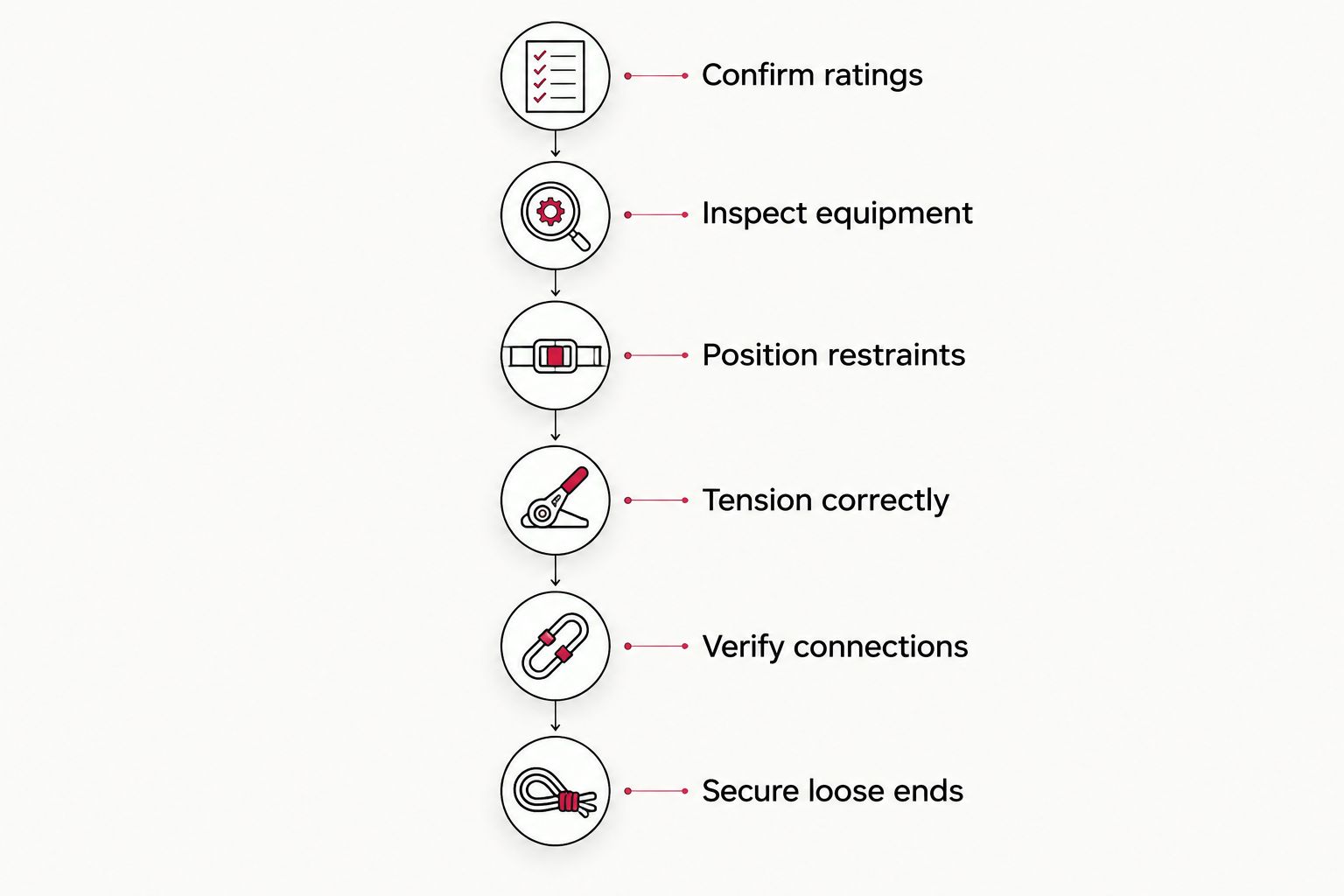
Use a repeatable loading sequence, with the vehicle stabilized and the flatbed positioned according to its operating instructions. Your 2026 departure check should verify the entire restraint path, not just whether each ratchet handle feels tight.
- Confirm ratings. Establish vehicle weight, flatbed capacity, restraint ratings, and suitable anchor locations before tensioning anything.
- Inspect equipment. Examine webbing, stitching, ratchets, hooks, chain ends, and deck connections, removing defective components from service.
- Position restraints. Fit the selected system at each intended wheel or approved attachment location, following the manufacturer’s routing instructions.
- Tension correctly. Operate each ratchet as directed, keeping webbing correctly threaded and connections properly seated without using extensions to force the handle.
- Verify connections. Walk around the loaded vehicle and inspect hook seating, strap placement, ratchet closure, and clearance along every load path.
- Secure loose ends. Restrain excess webbing away from tires, moving equipment, and the road, then complete the carrier’s departure inspection.
This sequence separates fit from tension: tightening comes only after you have established the correct attachment and routing. A ratchet cannot correct a hook that bears on its tip or webbing that crosses an unprotected cutting edge.
Keep your body out of the path of a loaded handle or tensioned component, and release restraints using the equipment manufacturer’s procedure. If the vehicle has shifted or a restraint is damaged, stabilize the situation before releasing anything; do not stand in a potential movement path.
A winch line does not replace a transport restraint
A winch pulls the vehicle onto the deck, while the transport restraints secure the vehicle for travel. Do not subtract a strap from the planned arrangement because the winch remains connected. Follow the flatbed manufacturer’s instructions for the winch after loading.
The parking brake and transmission position also do not replace vehicle-to-deck securement. Set them as the vehicle and carrier procedures require, while maintaining the complete restraint arrangement.
Maintenance: inspect, recheck, and retire damaged equipment
Four installed restraints remain useful only while every assembly stays serviceable and correctly positioned. Make restraint condition part of your 2026 equipment checks, including after unloading when the full webbing length and normally concealed contact areas are accessible.
Inspect for cuts, damaged stitching, abrasion, heat damage, chemical damage, and distorted or malfunctioning hardware. Apply the manufacturer’s rejection criteria, and remove questionable equipment from service rather than trying to repair webbing or straighten load-bearing fittings in the field.
Check the parts hidden during loading
Pay particular attention to webbing beneath wear pads and at hook or ratchet contact areas, because those locations are not always visible once the vehicle is secured. A wear pad protects a contact area; it does not make the strap immune to damage or authorize routing across any edge.
Clean and store equipment according to its instructions, allowing wet webbing to dry before enclosed storage. Keep serviceable restraints separated from rejected equipment so another operator does not put a damaged assembly back into use.
Recheck the load during the trip
For U.S. commercial operations covered by 49 CFR §392.9, the driver generally must inspect cargo securement within the first 50 miles and reexamine it when changing duty status, after 3 hours, or after 150 miles, whichever occurs first, subject to the regulation’s exceptions. These federal inspection intervals do not replace any additional checks required by equipment instructions or operating conditions.
At a safe stopping location, verify placement and connections as well as tension, because a tight strap can still be incorrectly positioned. Correct the cause of any movement or slack rather than repeatedly tightening a restraint whose routing is wrong.
FAQ
How many ratchet straps should I use for a car on a flatbed?
Use four properly rated, independently tensioned tie-down assemblies as your starting setup, normally one at each wheel or approved attachment location. Confirm the complete system against vehicle weight, manufacturer instructions, deck compatibility, and applicable securement rules.
Are two ratchet straps legal for transporting a car?
At least two tiedowns are specified by 49 CFR §393.128 for covered automobiles, light trucks, and vans weighing 10,000 pounds or less, with restraint at both front and rear. That minimum does not establish that an arbitrary two-strap arrangement is suitable; four-point securement remains the operating recommendation here.
Does a four-pack of axle straps include everything I need?
A four-pack of axle straps does not necessarily include ratchets or complete deck connections. Check the listed contents and assemble a compatible, rated restraint path at every intended attachment location.
Are 3,300-pound straps enough to hold my car?
A 3,300-pound safe working load does not by itself establish that an assembly is suitable for your car. Check vehicle weight, complete assembly and anchor ratings, restraint configuration, and applicable aggregate working load limit requirements.
Should I secure the tires or attach to the axle?
Use the securement method approved for the vehicle and compatible with the transport equipment. Tire restraints require correct fit and placement, while axle or structural attachments require approved locations and routing clear of vulnerable components.
Can I count the winch cable as one of the restraints?
Do not count the loading winch cable as a replacement for a planned transport restraint. Install the complete transport securement system and handle the winch according to the flatbed manufacturer's instructions.
When should I check the straps after leaving?
Within the first 50 miles is the general initial cargo-securement inspection requirement under 49 CFR §392.9 for covered commercial operations, subject to its exceptions. Further rechecks generally occur at a duty-status change, after 3 hours, or after 150 miles, whichever occurs first.
One last thing
Count complete restraint paths, then inspect their weakest connections. Four ratchets on the deck do not equal four effective restraints when one hook is incorrectly seated, one anchor is unsuitable, or one strap runs across a damaging edge.
Related guides
Shop the TruckNTow car tie-down options above after confirming your vehicle attachments and deck connections. A repeatable setup starts with compatible equipment and ends with a checked connection at every restraint—finish that inspection before the truck moves.