

When a chain hook needs replacing before a haul, clevis hook working load limit by size must be checked against the exact hook’s grade, markings, and manufacturer rating—not diameter alone. The VULCAN Grade 70 binder chain with clevis grab hooks provides a specific 2026 reference: 5/16-inch chain, 20-foot length, and a listed safe working load of 4,700 pounds for the assembly.
- Clevis hook working load limit by size requires the exact hook rating; chain diameter alone does not establish capacity.
- TruckNTow lists a 5/16-inch VULCAN Grade 70 chain assembly with clevis grab hooks at 4,700 pounds SWL.
- Clevis describes the attachment; grab describes the hook opening. A hook can be both.
- Match chain size, grade, pin, intended use, and component ratings before returning an assembly to service.
Why this matters: A replacement hook can fit through a chain link without being suitable for the assembly, and a larger-looking hook does not establish a higher allowable load. Your selection needs to preserve both the mechanical fit and the documented rating of the complete securement system.
Clevis hook size and working load reference for 2026
Working load limit, or WLL, is the maximum working load assigned by the manufacturer for specified conditions of use. The product reference below uses the term safe working load, or SWL; retain that wording when recording its listed rating rather than treating it as a separately verified standalone-hook specification.
| Reference | Nominal chain size | Grade | Chain length | Listed assembly SWL | Rating scope |
|---|---|---|---|---|---|
| VULCAN binder chain with clevis grab hooks | 5/16 inch | Grade 70 | 20 feet | 4,700 pounds | Complete chain-and-hook assembly; sold as a 2-pack |
| Overall yardstick for this reference | 5/16 inch | Grade 70 | 20 feet | 4,700 pounds | Same assembly reference, not a market average |
The 5/16-inch Grade 70 assembly is rated at 4,700 pounds SWL; that figure does not establish the capacity of every 5/16-inch clevis hook. There is no high-versus-low ranking within this single assembly reference, and the overall row repeats the same yardstick rather than adding another observation.
Source and method: This 2026 reference reproduces the size, grade, length, and assembly SWL stated in the TruckNTow product listing identified above. Its limitation is scope: an assembly rating does not independently certify a replacement hook, establish ratings for other sizes, or authorize overhead lifting.
The 20-foot dimension describes chain length, while 5/16 inch identifies nominal chain size; neither measurement replaces the hook’s own identification. Likewise, the 2-pack designation describes packaging, not permission to combine the listed capacities into a single attachment rating.
Use this reference to recognize a documented transport-chain assembly, then check the equipment actually in your hands. If its markings or construction differ, treat it as a different component until the manufacturer identifies it.
How to use these benchmarks when selecting a hook
TruckNTow is a trucking and towing accessories source for truckers, towers, and vehicle haulers. For hook selection, the useful starting point is a documented assembly with a stated application and rating, not a visual match to a loose hook in the toolbox.
The 4,700-pound assembly reference supports the following selection rules:
- Start with the original specification. For the listed 5/16-inch Grade 70 assembly, identify the specified replacement hook rather than assuming any hook marked 5/16 inch preserves the assembly rating.
- Keep component and assembly ratings separate. A higher-rated replacement does not increase the chain’s rating, while an inadequately rated replacement limits the usable assembly.
- Do not multiply capacity by package quantity. The 2-pack description is not a combined rating for a single securement connection or an entire vehicle.
- Keep length out of the capacity decision. The listed 20-foot length affects reach and routing; it does not turn the assembly SWL into a hook-size formula.
Read the marking before measuring the hook
Find the manufacturer’s identification, size designation, grade information, and capacity marking or corresponding documentation. Record what is actually present, because a chain-size stamp and a load-rating stamp answer different questions.
Nominal hook size generally identifies the chain size the hook is designed to accept, not the throat opening measured with a tape. A throat measurement can help with inspection against the manufacturer’s dimensions, but it cannot establish an unknown hook’s WLL.
For a fleet’s 2026 replacement record, keep the hook identification with the chain assembly identification and the applicable instructions. That gives the next operator a traceable reference instead of an undocumented assumption.
Compare the whole connection
Check the chain, hook, clevis pin, binder, and anchor involved in the load path. The assembly cannot be assigned a working capacity above its lowest-rated applicable component, and loading geometry or manufacturer restrictions can impose further limits.
A stronger hook therefore solves only a hook-capacity problem; it does not correct an underrated binder, damaged chain, or unsuitable anchor. Select the connection as a system, then confirm each component individually.
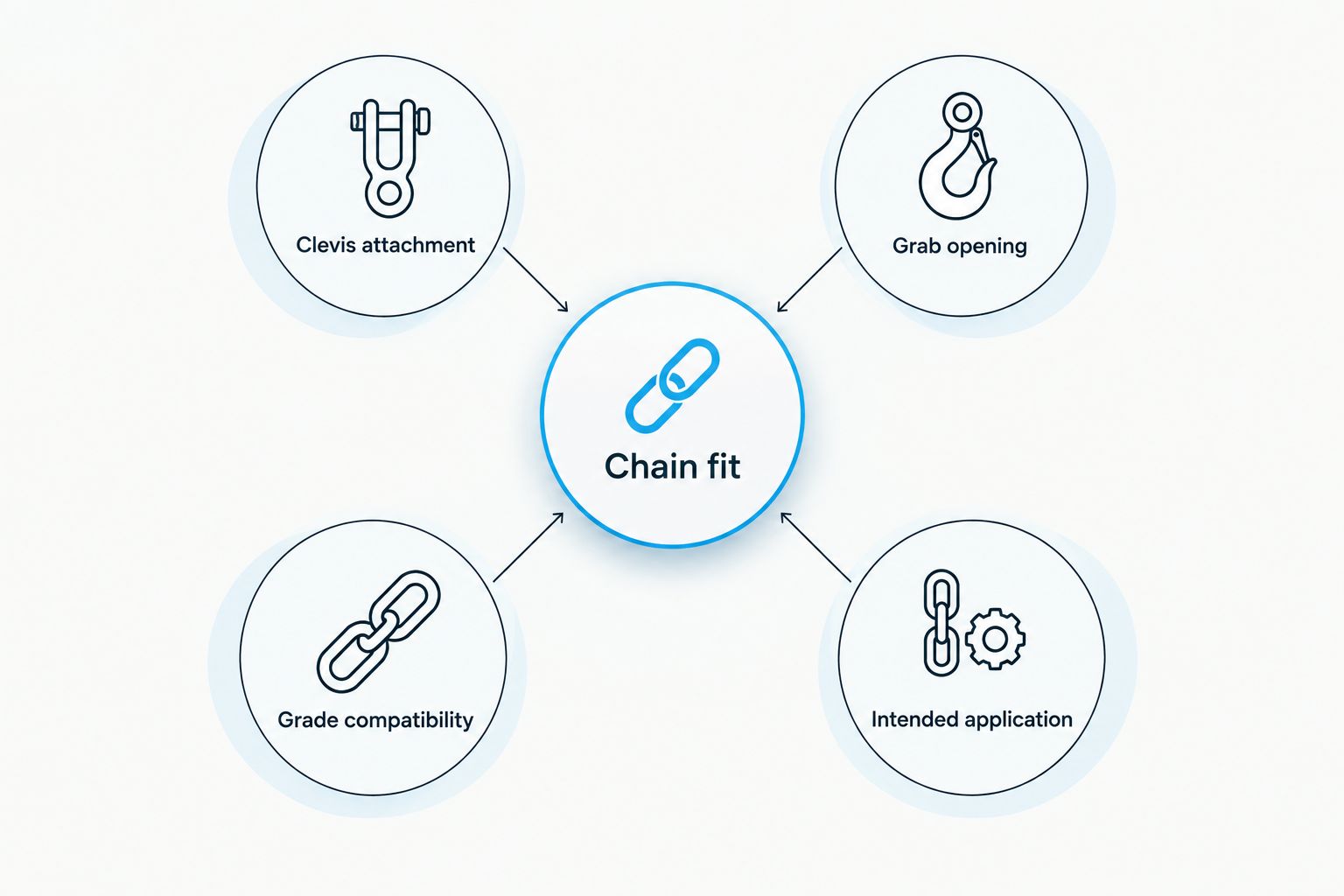
Compatibility: clevis attachment, hook opening, and chain fit
“Clevis” and “grab” are not competing hook categories. Clevis describes the forked, pinned attachment to the chain, while grab describes an opening intended to engage a chain link; a clevis grab hook combines those features.
That distinction matters when ordering replacements because matching only one word can produce the wrong fitting. Specify the attachment style, opening style, nominal chain size, grade compatibility, and intended application together.
| Feature or option | What it describes | Best for | Practical advantage | Limitation |
|---|---|---|---|---|
| Clevis attachment | Forked connection secured by a pin | A chain connection specified for that attachment | Connects the hook to a compatible chain end | Requires the correct pin, retainer, and chain fit |
| Grab opening | Narrow opening that engages a chain link | Holding a selected link in an approved chain arrangement | Provides a defined link-engagement function | Does not accept every attachment shape or loading direction |
| Slip opening | More open hook shape than a grab opening | Connections expressly permitted by that hook’s instructions | Accommodates its specified connection geometry | Is not an automatic substitute for a grab hook |
Check chain seating without forcing the connection
A compatible link must seat as the manufacturer intends, and the clevis pin must assemble with its specified retaining arrangement. Binding, forced installation, or a link bearing against an unintended surface is a reason to stop and verify compatibility.
Do not grind a link or hook, spread the clevis ears, or substitute a hardware-store bolt to make the parts fit. Those changes alter the manufactured connection and do not establish a safe replacement.
Match the use, not just the dimensions
Grade 70 transport chain is not approved for overhead lifting. A hook attached to that chain does not change the chain’s permitted application, even when the hook itself has a higher rating or belongs to a different grade.
The same separation applies between cargo securement and vehicle recovery. A transport assembly’s listed SWL is not blanket approval for shock loading, jerking a stuck vehicle, or using the assembly in a recovery configuration that its manufacturer has not authorized.
The benefit of a documented replacement is traceability; the limitation is that documentation remains specific to the identified component and application. Keep that distinction in your 2026 equipment records rather than labeling every chain-and-hook combination simply as “heavy duty.”
Safety and maintenance: preserve the rated connection
A load rating applies to equipment in suitable condition and used within its instructions. It does not excuse damage, side loading, an incorrect pin, or contact that places force on a part of the hook not intended to carry it.
For a 2026 pre-use check, unload the assembly before inspecting or adjusting the connection. Keep hands out of pinch points, establish the intended load path, and confirm that the hook can remain seated as tension changes.
Inspect the hook, pin, and engaged link
Check the hook body for cracks, distortion, wear, corrosion damage, and evidence of heat exposure or unauthorized repair. Inspect the clevis ears, pin, retaining parts, and chain link together, because damage at their contact surfaces affects the connection even when the hook tip looks intact.
Use the manufacturer’s inspection dimensions and removal criteria rather than applying a generic wear allowance to an unidentified hook. If identification is unreadable or the component cannot be matched to instructions, remove it from service until it can be identified and evaluated.
- Hook body: Look for deformation and damage around the load-bearing surfaces, not only at the tip.
- Clevis pin: Confirm the specified pin is present and inspect it for wear, bending, or damage.
- Retainer: Check that the specified retaining arrangement is intact and installed correctly.
- Chain link: Inspect the link captured by the clevis and any link engaged by a grab opening.
Keep force in the intended direction
Do not assume the full stated rating applies when a hook is side loaded, back loaded, or loaded at its tip. Follow the hook manufacturer’s seating and loading instructions, including any restrictions or capacity reductions for the proposed arrangement.
A latch, where fitted, is a retaining feature rather than the intended load-bearing seat. If the connection bears on the latch or prevents it from operating correctly, correct the arrangement before applying load.
Clean, separate, and document
Remove dirt so that markings and contact surfaces remain visible, then follow the manufacturer’s cleaning and corrosion-protection instructions. Store hooks and chains away from damaging chemicals and conditions that conceal deterioration.
Separate rejected equipment from usable gear and mark its status clearly; leaving a suspect hook in the working chain bin invites reuse. Record replacement details so that a repaired assembly does not lose its component identification between operators.
One last thing: The pin is part of the load path, not incidental hardware. A hook with a readable rating still needs its specified pin and retaining parts before the connection can be evaluated for service.
FAQ
What is the working load limit of a 5/16-inch clevis hook?
The exact hook’s manufacturer rating determines its working load limit; 5/16-inch size alone does not. The VULCAN Grade 70 binder chain with clevis grab hooks referenced here lists 4,700 pounds SWL for the complete assembly, not every standalone hook of that size.
Does a bigger clevis hook always have a higher working load limit?
No, physical size alone does not establish working load limit. Compare the exact manufacturer, hook design, grade, and stated rating rather than assigning capacity by appearance.
Is a clevis hook the same thing as a grab hook?
No, clevis describes the pinned attachment and grab describes the chain-engaging opening. A clevis grab hook has both features, so both terms belong in a replacement specification.
Can I replace a clevis pin with a bolt?
Do not substitute a bolt unless the hook manufacturer explicitly specifies that replacement. Use the designated pin and retaining arrangement, because apparent fit does not establish equivalent performance.
Can I use Grade 70 chain with clevis hooks for overhead lifting?
No, Grade 70 transport chain is not approved for overhead lifting. Adding a different hook does not change the chain’s permitted use.
Does a two-pack of chain assemblies double the hook rating?
No, package quantity does not increase an individual hook or assembly rating. Evaluate each connection and the complete securement arrangement under the applicable instructions and requirements.
What should I do if the hook markings are unreadable?
Remove the hook from service until its identity, rating, and suitability can be established. Measuring its size or comparing it with another hook does not recover the missing rating.
Does a higher-rated hook increase my chain assembly capacity?
No, a higher-rated hook does not increase the capacity of the chain or other components. The complete connection remains limited by its applicable component ratings, condition, configuration, and manufacturer instructions.
Related guides
- Chain grade working load limit benchmarks
- How to load bind with chain binders safely
- How to inspect car hauler chains before a run
Shop the full line of trucking and towing accessories at TruckNTow, and confirm the exact component rating before your next haul. Match the equipment, verify the connection, and put the assembly to work within its documented limits.