

A car with a flat tire blocking a service bay needs controlled repositioning, but use a GoJak vehicle dolly only if the instructions for your exact model permit the tire’s condition and the wheel fits its operating limits. A collapsed sidewall, unseated bead, damaged wheel, or unsuitable floor is a reason to stop and select another handling method; the caster alone does not establish whether the dolly can safely support that vehicle.
- Can you use a GoJak dolly caster on a car with a flat tire? Only with model-approved fit and support.
- GoJak vehicle dollies reposition vehicles; they do not replace tire repair, service stands, or road-towing equipment.
- Inspect the tire, wheel, floor, and complete dolly before lifting; stop if contact or support is uncertain.
- TruckNTow towing accessories serve the transport stage; securement ratings do not establish GoJak lifting capacity.
Can you use a GoJak dolly caster on a car with a flat tire?
A flat tire does not automatically qualify for GoJak use. The decision rests on the complete dolly’s instructions, its rated capacity, its tire-size limits, and the condition of the tire that its rollers must engage. For a blocked vehicle in a repossession setting, the GoJak dolly caster guide for repo work covers the related repositioning scenario.
The distinction between a caster and a vehicle dolly matters. A caster is the swiveling wheel assembly that lets the supported load move across the floor, while the complete dolly includes the frame, rollers, lifting mechanism, and any locking components specified for that model.
Replacing a caster does not change the frame’s lifting capacity or its permitted applications. Likewise, a caster that rolls freely does not prove that the tire is correctly supported between the rollers.
Why this matters
An inflated tire and a deflated tire do not present the same shape to a lifting device. Loss of air changes the sidewall profile and the clearance around the lower part of the wheel, so equipment that fits an inflated tire needs a fresh compatibility check when that tire is flat.
Your 2026 operating checklist should separate permission to lift from permission to move. Correct engagement comes first; the floor, route, and means of controlling the vehicle determine whether repositioning is appropriate after the lift.
| Handling option | Best for | Practical advantage | Limitation |
|---|---|---|---|
| GoJak vehicle dolly | Model-approved repositioning on a suitable level floor | Lets the supported wheel move on casters | Requires compatible tire contact, sufficient clearance, and compliance with the exact model’s instructions |
| Floor jack with approved service stands | Tire replacement or inspection at designated lifting points | Gives access to the affected wheel using the vehicle’s approved lifting procedure | A floor jack alone is not support for working beneath a vehicle |
| Compatible spare-wheel installation | Restoring a usable wheel before movement | Removes reliance on the damaged tire for subsequent handling | Requires a serviceable spare, correct installation, and compliance with vehicle instructions |
| Professional recovery or flatbed handling | Unsafe roadside locations or damage beyond routine tire service | Provides an equipment-specific recovery and transport plan | Requires approved attachment, loading, and securement methods |
Best for does not mean universally suitable. Select the method that fits the vehicle, the damage, and the working surface rather than choosing the equipment already closest to the car.
Check tire condition, model limits, and wheel clearance
Read the model label and operating instructions before setting the dolly around the tire. Similar-looking vehicle movers are not interchangeable, and dimensions or ratings from another model do not establish permission for yours.
For a 2026 equipment check, record the model identification and keep its instructions accessible to the operator. If the label is unreadable or the instructions do not resolve flat-tire use, obtain manufacturer guidance before loading the equipment.
Tire condition
Inspect the tire with the vehicle stationary and secured against unintended movement. Look at both accessible sidewalls, the tread, the bead area, and the relationship between the wheel and the ground; do not put hands underneath an unsupported tire to feel for clearance.
A tire that is merely low on pressure and a tire with a separated bead are different handling problems. Visible separation, exposed cords, loose tread, or a wheel resting against the floor calls for a different plan rather than an improvised attempt to squeeze the assembly between rollers.
Do not inflate a visibly damaged tire simply to make a dolly fit. Tire assessment and inflation require their own safe procedure, especially when the cause of pressure loss is unknown.
Model limits
Check the complete dolly’s rated load, permitted tire dimensions, required operating surface, and restrictions on use. Vehicle weight alone does not tell you the load at an individual wheel, because axle loading and weight distribution are not necessarily equal.
Do not divide the vehicle’s total weight equally among its wheels and treat the result as a verified wheel load. Use appropriate vehicle information and the equipment manufacturer’s selection procedure, and stop if you cannot establish that the application is within the rating.
Wheel clearance
Confirm that the dolly can approach and engage the tire without contacting the rim, bodywork, brake components, or suspension. A flat sidewall can occupy space that was clear when the tire was inflated, so check the actual assembly rather than relying only on the size molded into the tire.
Low bodywork adds another constraint. Do not force the frame under a rocker panel or use the dolly to lift against a body panel when its intended contact is the tire.
Why suitability varies
These factors determine whether the proposed move has an acceptable setup:
- Tire condition: Deflation, bead separation, and structural damage change the available contact surface.
- Model limits: The dolly’s own instructions determine permitted loads, dimensions, and applications.
- Wheel clearance: The frame and rollers need clearance from the rim and nearby vehicle components.
- Floor condition: Casters need a suitable surface without debris, damaging joints, or unexpected level changes.
- Movement route: Tight corners, thresholds, and an obstructed destination change the handling plan.
Passing one check does not cancel a failure elsewhere. A compatible tire on an unsuitable floor still requires another method.
Plan the lift and movement before operating the dolly
A vehicle that lifts successfully can still be difficult to control once its weight rests on casters. Establish the destination and the stopping method before releasing any restraint, and keep everyone out of the vehicle’s intended path.
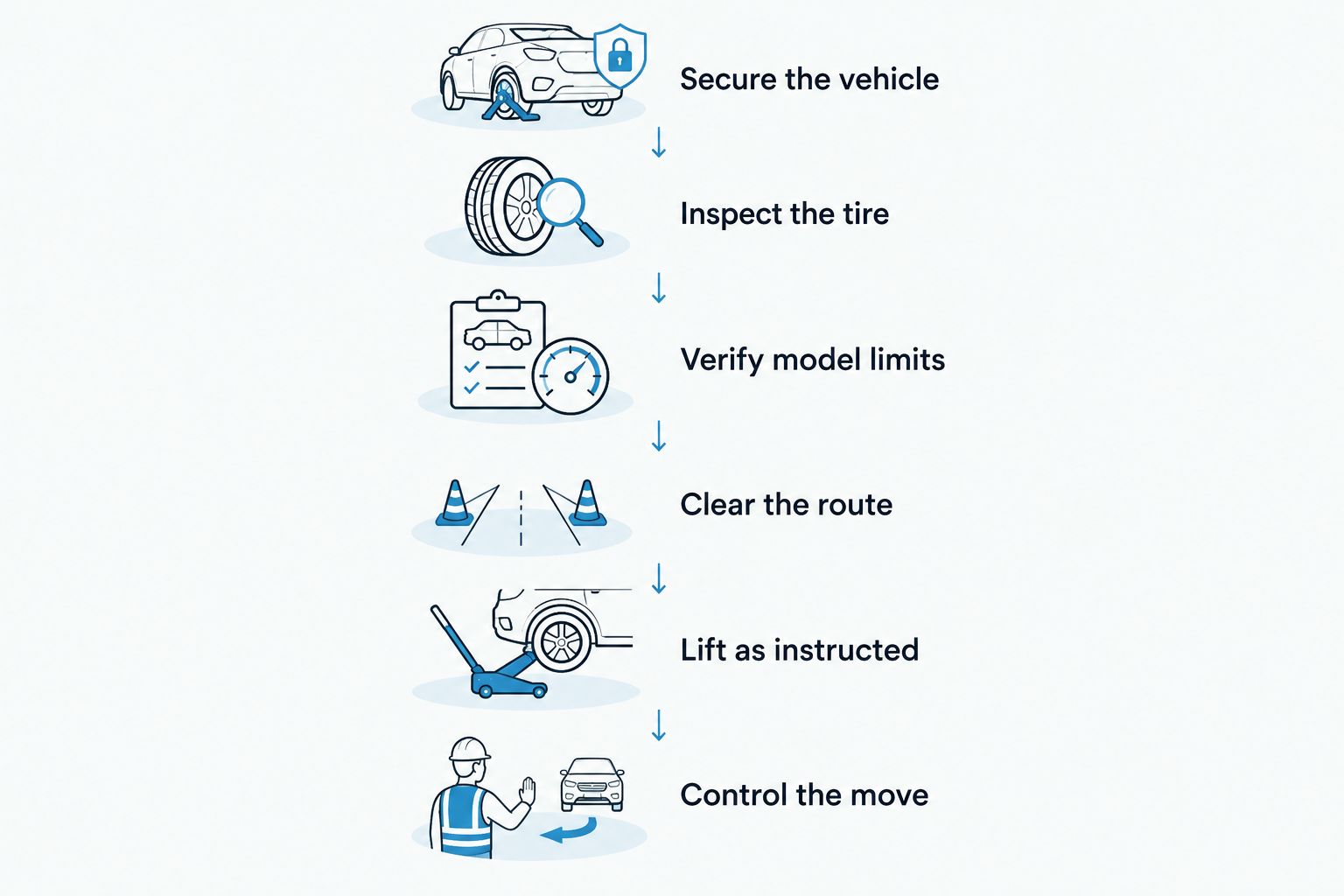
Use this 2026 pre-move sequence as an inspection framework, not as a substitute for the GoJak model’s operating procedure:
- Secure the vehicle. Prevent unintended movement using methods appropriate to the vehicle and the planned task; keep the vehicle secured while inspecting and positioning equipment.
- Inspect the tire. Establish whether the tire and wheel offer the contact and condition permitted by the model instructions.
- Verify model limits. Check capacity, tire dimensions, clearance, and all applicable restrictions before applying load.
- Clear the route. Remove debris, inspect floor joints, and establish a destination on a suitable surface.
- Lift as instructed. Follow the manufacturer’s engagement, lifting, and locking sequence, stopping if contact shifts or components bind.
- Control the move. Maintain deliberate movement and a clear stopping plan, then lower and remove the equipment as instructed.
Assign clear roles if more than one operator is involved. The person controlling movement and the person watching clearance need an agreed stop signal, and either operator should stop the task when contact, stability, or the route becomes uncertain.
Do not use sudden force to overcome a caster caught at a joint or obstruction. Stop, secure the vehicle, and correct the cause rather than pushing harder against equipment that is no longer rolling normally.
Can I move the car if the wheel will not rotate?
A caster-supported wheel does not need to rotate in the same way as a tire rolling directly on the floor, but that does not settle the complete vehicle-handling question. Locked brakes, steering position, drivetrain restrictions, and the wheels left on the ground still affect the plan.
Follow both the vehicle’s handling instructions and the dolly instructions. Do not use the engine to drive the car while it is supported on vehicle-positioning dollies.
Can I use the dolly on a driveway or ramp?
Do not treat a driveway or ramp as equivalent to a suitable level workshop floor. A slope introduces uncontrolled movement risk, while rough surfaces and transitions can obstruct casters; use another handling method unless the exact equipment instructions expressly permit the application.
Can I tow the car on the road with a GoJak underneath it?
A GoJak vehicle-positioning dolly is not a road-towing dolly. Repositioning within its permitted operating conditions and transporting a vehicle behind a tow truck are separate tasks requiring different equipment and procedures.
Inspect, maintain, and separate transport securement from lifting
Before each job, inspect the dolly’s frame, rollers, caster assemblies, fasteners, lifting mechanism, and locking components according to the manufacturer’s instructions. A damaged caster is not merely a steering inconvenience, because its condition affects how the supported load moves across the floor.
Keep inspection requirements in your 2026 maintenance record, including any equipment removed from service. Do not return a dolly to use simply because an unloaded caster spins; inspect the complete assembly and resolve the fault through the approved maintenance procedure.
Remove debris from the rollers and caster area, and follow the specified lubrication and storage instructions. Substitute parts require manufacturer-approved compatibility, not just matching mounting holes or a similar appearance.
Transport securement is a separate decision
Once the car reaches a loading position, select securement for the transport equipment and the vehicle’s condition. A positioning dolly does not secure the vehicle to a carrier, and a tie-down strap does not establish permission to lift a damaged tire.
For that separate stage, TruckNTow lists the VULCAN Car Tie Down With Flat Hooks, Lasso Style, PROSeries. The listed configuration is 2 inches wide by 96 inches long, supplied as a 4-pack, with a stated 3,300-pound safe working load; those specifications belong to the tie-down product, not to a GoJak dolly.
Best for: vehicle haulers evaluating lasso-style securement with flat-hook connections. The practical benefit is a stated strap configuration and working-load rating; the limitation is that hook compatibility, anchor capacity, routing, and tire condition still need checking for the actual transport setup.
TruckNTow is best for truckers, towers, and vehicle haulers shopping for trucking and towing accessories. Use the equipment’s instructions to decide whether a specific strap arrangement is suitable, particularly when a deflated tire changes the shape around which a tire-based restraint fits.
FAQ
Can you use a GoJak dolly caster on a car with a flat tire?
Use a GoJak vehicle dolly only when the exact model’s instructions permit the tire’s condition and the assembly meets its load, fit, and surface requirements. A caster alone does not establish safe lifting compatibility.
Will a GoJak dolly work when the tire is completely collapsed?
Do not assume a GoJak dolly will safely support a completely collapsed tire. Stop if the rollers cannot engage as instructed, the rim contacts the equipment, or tire damage makes support uncertain.
Can I use a GoJak on gravel or a sloping driveway?
Do not use a GoJak outside the surface conditions permitted by its model instructions. Gravel, rough transitions, and slopes introduce caster obstruction or vehicle-control problems.
Can I change a tire while the car is on a GoJak?
Do not treat a GoJak vehicle-positioning dolly as tire-service support. Use the vehicle’s designated lifting points and the approved equipment and procedure for wheel removal.
Do I need to check the load at the affected wheel?
Yes, the load supported by the individual dolly must remain within that model’s rating. Do not assume the vehicle’s weight is distributed equally among its wheels.
Can I tow a car down the road on GoJak dollies?
No, vehicle-positioning dollies are not substitutes for road-towing equipment. Use a transport method approved for the vehicle, its condition, and the recovery equipment.
Does a tie-down strap’s working load tell me the GoJak capacity?
No, a tie-down strap’s working-load rating does not establish a GoJak dolly’s lifting capacity. Check each component’s rating and intended application separately.
One last thing
The overlooked failure point is often the route rather than the initial lift. A clean starting position does not guarantee that the caster can pass a floor joint or threshold near the destination, so inspect the entire path before loading the dolly.
For your 2026 handling plan, keep the decision simple: if model approval, tire support, or movement control is unresolved, stop and change the method. Shop TruckNTow trucking and towing accessories for the separate recovery and securement tasks, and put the right equipment in position before the vehicle moves.