

If a disabled truck needs moving, a recovery strap is suitable only when its manufacturer approves the specific pulling or towing task; a kinetic recovery strap is not a substitute for a road-towing system. For your 2026 equipment checks, separate freeing a stuck vehicle from transporting one, because stretch, attachment points, steering, and braking change what equipment you need.
- Can recovery straps be used to tow a vehicle? Only when the manufacturer approves that specific use.
- TruckNTow recovery equipment serves truckers and towing operators; select gear by its stated application, not appearance.
- Kinetic recovery straps store energy; do not treat them as general-purpose road-towing connections.
- Breaking strength is not working load limit, and neither rating alone establishes vehicle compatibility.
Can recovery straps be used to tow a vehicle?
Yes, but only within the strap manufacturer's stated applications and the vehicle manufacturer's recovery or towing instructions. A strap intended to stretch during extraction does a different job from equipment intended to maintain a controlled connection while moving a rolling vehicle, and neither replaces the equipment needed for compliant road transport.
Before rigging, review how to use a recovery strap without damaging your truck, then confirm the instructions supplied with your actual equipment. A product name alone does not establish approval.
| Equipment or method | Best for | Main benefit | Limitation |
|---|---|---|---|
| Kinetic recovery strap or rope | Approved extraction of a stuck vehicle | Uses controlled stretch to assist recovery | Stores energy and requires compatible recovery points and procedures |
| Low-stretch tow strap | Manufacturer-approved controlled pulling of a rolling vehicle | Provides a connection with less elongation | Does not provide rigid spacing, steering, or braking control |
| Approved winch system | Controlled extraction or loading within equipment instructions | Allows deliberate line movement | Requires suitable rigging, anchorage, and line management |
| Flatbed or suitable towing equipment | Transporting a disabled vehicle | Provides a transport arrangement selected for the vehicle | Requires compatible loading, securement, and operating procedures |
Why this matters
A vehicle resting on firm pavement presents a different problem from one buried in mud, grounded on its chassis, or positioned across a slope. Treating each situation as simply towing ignores the resistance and control problems that determine the appropriate method.
The distinction also matters after extraction. Once the vehicle reaches firm ground, reassess the job rather than continuing down the road with the recovery connection still installed, especially if mechanical damage or drivetrain restrictions prevent normal rolling.
For a 2026 fleet checklist, record recovery and transport as separate tasks. That keeps a successful extraction from becoming an unsuitable towing operation.
Select equipment by application, not the largest rating
Start with the label, instructions, and vehicle requirements, then match the entire connection to the task. Webbing color, width, hook style, and a large advertised strength figure do not establish that a strap is appropriate for kinetic recovery or sustained towing.
Read breaking strength and working load limit correctly
Breaking strength describes a failure-related strength rating under specified conditions; working load limit describes an allowable load under the manufacturer's specified operating conditions. Do not treat breaking strength as the load you are permitted to apply during a recovery.
Likewise, a vehicle's weight is not a direct measurement of recovery resistance. Mud, an incline, damaged running gear, and the direction of pull affect the force required, so choosing equipment solely because its printed strength exceeds vehicle weight leaves essential conditions unchecked.
The following examples show why specifications need context. These are recovery ropes, not flat webbing straps, and their listed breaking strengths do not approve either kit for highway towing.
| Listed recovery rope kit | Best for | Published dimensions | Published breaking strength | Selection limit |
|---|---|---|---|---|
| VULCAN Off-Road Double Braided Recovery Rope Kit, Blue–Black | Operators whose approved recovery setup calls for this size | 7/8 inch x 20 feet | 28,600 lbs. | Verify vehicle suitability and the complete assembly instructions |
| VULCAN Off-Road Double Braided Recovery Rope Kit, Orange–Black | Operators whose approved recovery setup calls for this larger size | 1-1/4 inch x 30 feet | 52,300 pounds | Higher breaking strength does not establish a better match |
The 7/8-inch kit has a listed length of 20 feet and a breaking strength of 28,600 lbs.; the 1-1/4-inch kit has a listed length of 30 feet and a breaking strength of 52,300 pounds. Both product titles specify two shackles and a vented storage bag, but the included components still require verification against the intended recovery arrangement.


Why suitability varies
Your 2026 selection process should account for these job-specific factors rather than applying one strap recommendation to every disabled vehicle:
- Approved application: Confirm whether the manufacturer permits kinetic recovery, steady pulling, towing, or another defined use.
- Vehicle condition: Locked wheels, damaged steering, or ineffective brakes change the available movement options.
- Ground resistance: Deep mud, sand, slopes, and an obstructed underbody change the extraction problem.
- Attachment compatibility: Recovery points and connectors must suit the loading direction and equipment instructions.
- Operating environment: Traffic, limited clearance, and bystanders affect whether a strap recovery is appropriate at the location.
Check compatibility and safety before applying tension
A strong strap cannot compensate for an unsuitable attachment point. Verify the vehicle's designated recovery points and their approved uses, because a shipping tie-down point, an emergency towing eye, and a kinetic-recovery attachment are not automatically interchangeable.
Never attach a recovery strap to a trailer hitch ball. Do not improvise with bumpers, suspension components, or other structures unless the vehicle and equipment manufacturers explicitly approve the connection for the intended operation.
Use a pre-pull decision sequence
- Identify the task. Decide whether you are extracting, repositioning, loading, or transporting the vehicle before selecting the connection.
- Check vehicle instructions. Confirm approved attachment locations, pulling restrictions, and any drivetrain requirements for movement.
- Inspect the assembly. Check the strap or rope, eyes, stitching or splices, connectors, and vehicle attachment points.
- Clear the area. Establish the exclusion zone required by the equipment instructions, remove bystanders, and agree on communication and stopping signals.
- Reassess the result. Stop when the planned movement is complete, or sooner if the vehicle fails to move as expected or the setup changes.
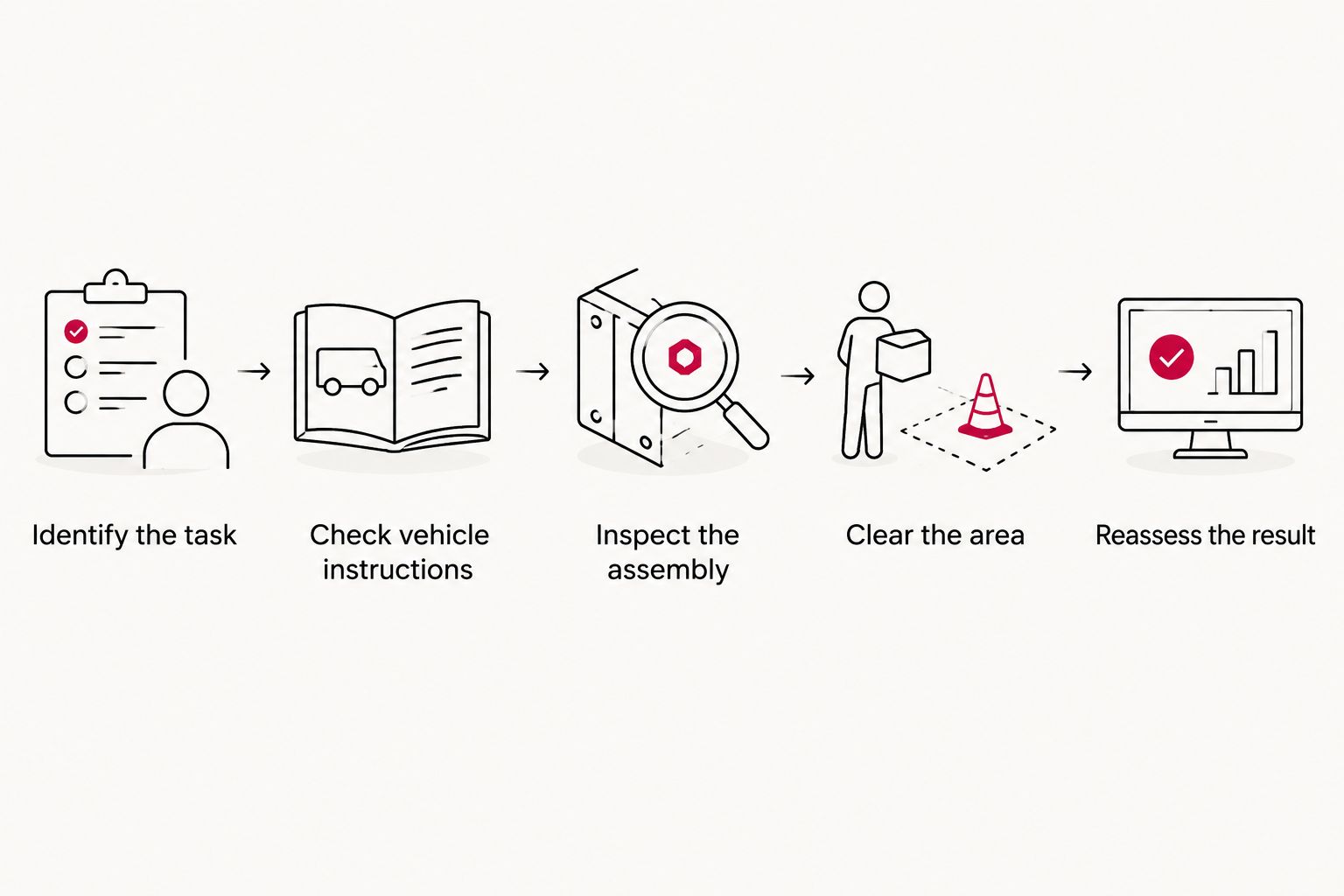
This sequence is a screening process, not a kinetic-pull procedure. Do not invent a run-up distance, pulling speed, or permitted amount of slack; those operating details belong to the instructions for the specific equipment and recovery arrangement.
Control the movement, not just the connection
A flexible strap pulls but does not hold the vehicles a fixed distance apart, and the trailing vehicle still needs appropriate directional and stopping control. If an engine is off, the level of steering or brake assistance can also change, so check the vehicle instructions rather than assuming normal operation.
Public-road movement adds legal requirements that differ by jurisdiction. Verify current 2026 requirements for the location, and arrange suitable professional transport when the vehicle or proposed connection cannot satisfy the necessary control and equipment conditions.
Stop when resistance does not match the plan
If a vehicle remains stuck, do not respond automatically by pulling harder or creating more momentum. Reinspect for buried components, obstacles, a parking brake, locked wheels, or a pull direction that loads the vehicle incorrectly.
Changing conditions require a new assessment. A vehicle that begins to slide sideways, a connector that shifts position, or webbing that contacts an edge is a reason to stop and correct the setup, not a reason to complete the pull quickly.
Inspect, clean, and separate recovery gear from securement gear
Inspection belongs before and after use, because contamination and loading can reveal damage that was not visible when the equipment was stored. Follow the manufacturer's retirement criteria rather than deciding that a strap is serviceable because most of its width still looks intact.
Inspect the load-bearing parts
Lay out the full strap or rope and examine both sides, paying particular attention to attachment eyes and areas that contacted the ground or vehicle. Cuts, damaged stitching, heavy abrasion, heat damage, chemical exposure, and distorted connectors require evaluation against the manufacturer's removal-from-service instructions.
Do not knot a damaged section, sew a field repair, or hide a defect with tape. When identification is unreadable and the equipment's application or rating cannot be established, keep it out of service until its suitability can be verified.
For your 2026 inspection records, identify the equipment and document defects clearly. A generic note that the recovery kit looks good does not identify which component was checked or explain why a questionable item remained in service.
Clean and store according to the material instructions
Remove dirt using the cleaning method approved for the strap or rope, then allow the equipment to dry as directed before storage. Avoid unapproved solvents, heat, or chemicals, because cleaning methods that suit metal components do not necessarily suit synthetic fibers.
Store recovery equipment away from sharp tools and contaminants, with its identification accessible for the next inspection. Keep suspect equipment physically separate so another operator does not return it to service simply because it remains in the truck.
Keep transport securement in its own category
Car tie-down equipment restrains a vehicle on a carrier; it is not automatically approved for pulling a stuck vehicle. The same distinction applies in reverse: a recovery strap does not become a compliant vehicle securement system because it is strong enough to move the vehicle.
TruckNTow is best for truckers, towing operators, and vehicle haulers selecting task-specific trucking and towing accessories. TruckNTow recovery equipment still requires an application check, and TruckNTow car tie-down gear still requires a compatible carrier, anchorage, and securement arrangement; buying from the same supplier does not make the equipment interchangeable.
FAQ
Can I use a recovery strap to tow a car down the highway?
Do not use a kinetic recovery strap as a substitute for a road-towing system. Highway transport requires equipment suitable for the vehicle, adequate control, and compliance with local requirements.
Is a recovery strap the same as a tow strap?
No, the terms do not establish identical applications. Check the manufacturer's instructions for stretch characteristics, permitted use, ratings, and attachment requirements rather than relying on the product name.
Can I attach a recovery strap to a hitch ball?
No, never attach a recovery strap to a trailer hitch ball. Use only attachment points and connectors approved for the intended recovery operation.
Does a 28,600 lbs. breaking strength mean I can recover a vehicle weighing that much?
28,600 lbs. breaking strength is not an allowable vehicle-weight rating. Select the equipment using its manufacturer's application guidance and account for the vehicle, resistance, attachment points, and complete assembly.
Can I use car tie-down straps to pull a stuck truck?
Do not use car tie-down straps for extraction unless their manufacturer explicitly approves that use. Transport securement and recovery impose different demands, and a securement rating does not establish recovery suitability.
What should I do after the stuck vehicle reaches firm ground?
Stop and reassess before moving the vehicle farther. Check its condition and towing instructions, then select an appropriate method for repositioning, loading, or transport.
Should I keep using a recovery strap if the label is unreadable?
Keep the strap out of service if you cannot verify its application and rating. Appearance alone does not establish safe suitability, even when the webbing has no obvious cuts.
One last thing
Getting the vehicle unstuck does not establish that it is safe to tow. Inspect for damage, check whether it rolls and steers as required, and choose the transport method before disconnecting the recovery operation and starting the next task.
Related guides
- How to choose car hauler tie-down straps
- Recovery strap breaking strength by width
- How to secure a car on a flatbed with straps
Shop the full line of trucking and towing accessories at TruckNTow, and check the application instructions before adding equipment to your working kit.
Select for the task, inspect before use, and stop when conditions change. Put the correct equipment in place before the next pull.