

An AWD vehicle stranded beside traffic needs more than a quick front-axle pickup: a wheel lift can tow it safely when the vehicle manufacturer permits the method and towing dollies keep the other axle off the road. Leaving an axle rolling risks drivetrain damage, and selecting neutral does not establish towing approval; for a 2026 recovery, confirm the vehicle-specific instructions before moving it.
- Can a wheel lift tow all-wheel-drive vehicles? Yes, with manufacturer approval and towing dollies supporting the other axle.
- Keep all vehicle wheels off the road unless the manufacturer explicitly authorizes another towing method.
- Neutral does not prove an AWD drivetrain is disconnected or safe to tow.
- TruckNTow wheel dolly tire harnesses provide securement options; they do not establish vehicle towing compatibility.
Can a wheel lift tow all-wheel-drive vehicles safely?
Yes, but a wheel lift alone is not a universal AWD towing solution. The usual all-wheels-off-ground arrangement supports one axle on the wheel lift and the other on road-rated towing dollies, so the vehicle's tires do not rotate against the pavement during transport. Use that arrangement only when it meets the vehicle manufacturer's towing instructions and the equipment manufacturer's operating requirements.
Start with the vehicle procedure, then complete a wheel lift component inspection. Equipment that lifts successfully still needs sound retaining hardware, properly seated wheel supports and adequate ratings for the actual setup.
| Towing arrangement | Best for | Main advantage | Limitation or required check |
|---|---|---|---|
| Wheel lift with towing dollies | AWD vehicles whose manufacturer permits this arrangement | Keeps both vehicle axles off the pavement | Requires compatible dollies, sufficient ratings and correct securement |
| Flatbed transport | Vehicles requiring a flatbed or unsuitable for available dollies | Carries the vehicle without road-driven wheel rotation | Requires a suitable loading procedure, clearance and deck securement |
| Wheel lift with the opposite axle rolling | Only vehicles with explicit manufacturer authorization | Avoids dolly installation when that exact procedure permits it | Not a general AWD towing method; follow every stated restriction |
Why this matters
When an AWD vehicle rolls on one axle while the other axle stays stationary, wheel rotation can drive connected drivetrain components under conditions they were not designed to tolerate during towing. Depending on the system, the concern includes the transmission, center differential, coupling or transfer case. The absence of noise is not evidence that the arrangement is safe.
Putting the transmission in neutral changes the transmission's selected operating state; it does not automatically disconnect every component between the road wheels and the drivetrain. Likewise, switching off the engine or selecting a dashboard drive mode does not replace the towing procedure. Treat an unverified AWD vehicle as requiring all wheels off the road until its instructions establish otherwise.
For 2026 dispatch planning, distinguish emergency loading or repositioning instructions from transport instructions. A procedure that permits moving a vehicle onto a carrier does not necessarily authorize carrying it down the road with an axle turning, and recreational towing instructions do not automatically apply to a disabled-vehicle recovery.
Selection and compatibility: match the vehicle and equipment
Identify the exact vehicle before choosing which end to lift, because drivetrain layout, parking brake operation, ground clearance and damage condition affect the method. Confirm the model year, drivetrain configuration and manufacturer towing procedure rather than relying on an AWD badge or a driver's description. Vehicles sharing a model name do not necessarily share towing requirements.
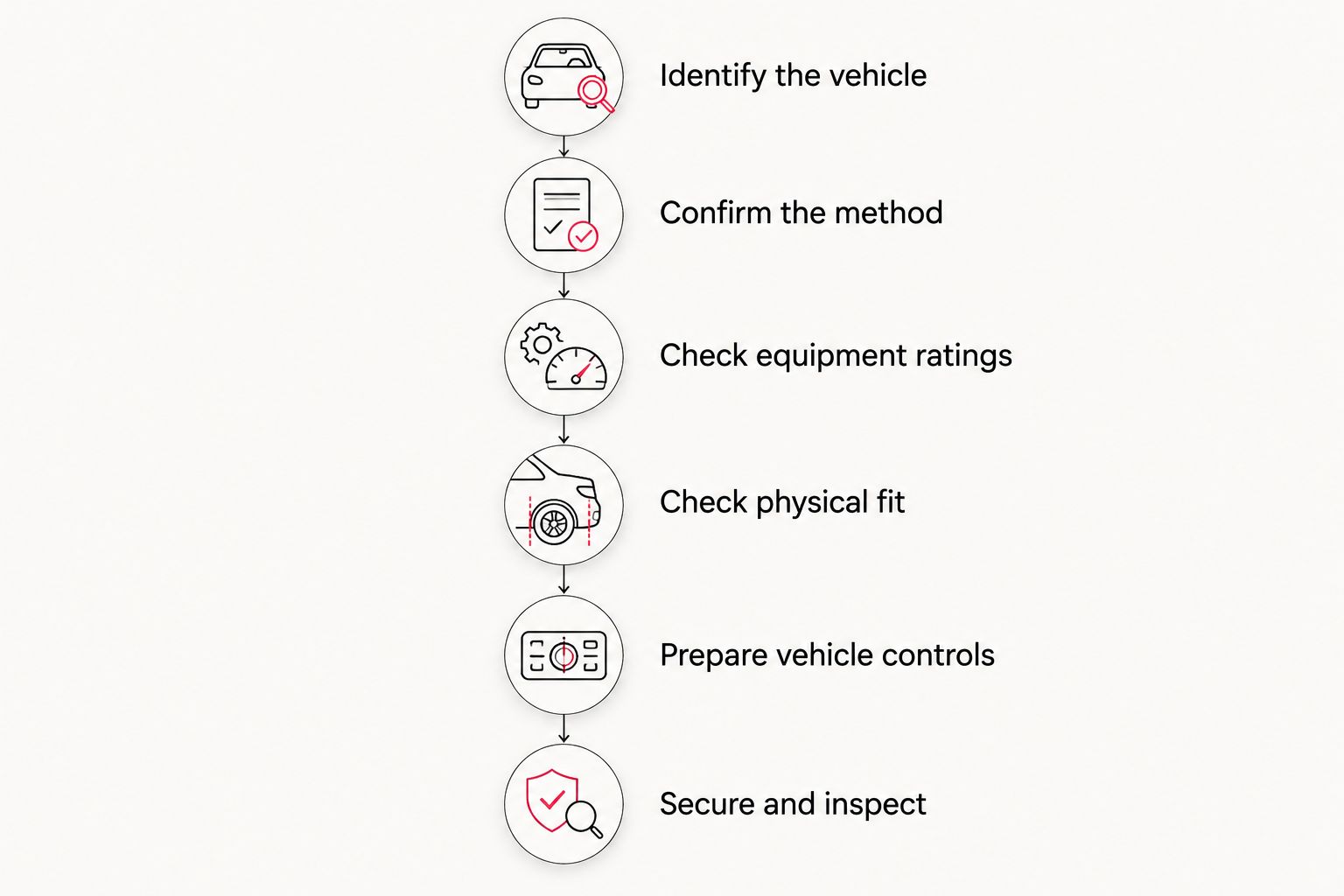
Follow the towing procedure in order
- Identify the vehicle. Confirm its drivetrain and obtain the applicable disabled-vehicle towing instructions, including any special provisions for electrified powertrains.
- Confirm the method. Establish whether wheel lift towing with dollies is permitted or whether the manufacturer requires another arrangement.
- Check equipment ratings. Verify the wheel lift, dollies, towing vehicle and securement components against the load and configuration described in their instructions.
- Check physical fit. Inspect tire condition, wheel-support engagement, body clearance and access for installing and retaining the dollies.
- Prepare vehicle controls. Follow the specified requirements for the selector, parking brake, steering and any transport mode before lifting or loading.
- Secure and inspect. Complete the lift and dolly manufacturers' securement procedures, then perform a walk-around before departure.
These checks form a sequence, not a menu. Suitable straps do not correct an undersized dolly, and an adequate wheel lift rating does not authorize a towing method prohibited by the vehicle manufacturer.
Why the towing arrangement varies
The safe arrangement follows the vehicle's instructions and the equipment's limits, not a single rule about lifting the front or rear. Check these factors before assigning a truck:
- Drivetrain design: The manufacturer's procedure determines whether any vehicle wheels are allowed to rotate during transport.
- Vehicle condition: Collision damage, seized components or damaged tires affect loading and support choices.
- Axle loading: The weight supported by each piece of equipment must remain within its applicable rating.
- Wheel and tire fit: Supports and harnesses must engage correctly without relying on tire width alone.
- Body clearance: Bumpers, underbody components and overhangs need clearance throughout loading and transport.
- Control requirements: Parking brakes, steering locks and transport modes require vehicle-specific handling.
Choose tire harnesses by attachment and fit
For a manufacturer-approved dolly arrangement, compare harness construction with the dolly's specified attachment points and routing. TruckNTow offers wheel dolly tire harnesses in different configurations, but matching a harness to a tire does not prove that its hooks, ring or ratchet arrangement fits your equipment.
The VULCAN PROSeries® universal O-ring harness listed here measures 2 inches wide by 96 inches long and carries a 3,300-pound safe working load. The listed Silver Series basket-style tire strap measures 78 inches long, uses S hooks and carries a 1,665-pound safe working load; those are component ratings, not vehicle towing capacities.
| Harness option | Best for | Useful feature | Limitation |
|---|---|---|---|
| VULCAN PROSeries universal O-ring wheel dolly tire harness | Dolly systems specifying a compatible O-ring harness arrangement | Adjustable tire fit; listed 2-inch width and 96-inch length | Straps only; ratchets sold separately, and system compatibility still needs verification |
| VULCAN Silver Series basket-style wheel dolly tire strap with S hooks | Dolly systems specifying compatible S-hook basket straps | Wide design increases tire coverage | Listed 1,665-pound safe working load; attachment fit and tire coverage require verification |
Choose the harness specified for the dolly, not simply the harness with the larger rating. A ring, hook or ratchet that cannot seat and function correctly is not made suitable by stronger webbing, and a longer strap still needs proper routing and tensioning.


Safety: secure both supported axles before departure
Keeping the vehicle's tires off the pavement addresses road-driven wheel rotation, but it does not complete the towing setup. The vehicle must remain retained on the wheel lift and dollies, and the truck must stay within its operating limits. Follow the equipment instructions for wheel retention, secondary connections, lift position and dolly assembly rather than substituting a familiar carrier securement routine.
Complete the loaded walk-around
Inspect the setup from both sides after loading, because a harness that looks centered from one angle can have twisted webbing, displaced coverage or incorrectly seated hardware on the opposite side. Keep webbing away from sharp edges and components that can cut or abrade it, and confirm that required locking mechanisms are fully engaged.
- Verify that wheel supports contact the intended areas and retain the tires as specified.
- Confirm every required dolly pin, latch and retaining component is installed and engaged.
- Check harness routing, hook or ring seating, and ratchet engagement against the equipment instructions.
- Confirm clearance beneath the vehicle and around the lift, dollies and rear bodywork.
- Set steering, parking brake and transmission controls according to the vehicle procedure.
- Verify required lighting and inspect the completed connections before entering traffic.
Stop the hookup when the vehicle cannot be supported or retained correctly. A damaged tire, inaccessible attachment or inadequate clearance calls for a different loading plan, not additional tension on an unsuitable arrangement.
Do not substitute shop movers for towing dollies
Vehicle positioning equipment and road-towing dollies serve different purposes, even when both support tires. Use equipment whose manufacturer explicitly approves the intended towing application, and follow its load, tire-fit and operating restrictions. A caster assembly that moves a car across a shop floor is not automatically suitable for road transport.
The same distinction applies to securement products: wheel lift retention, dolly retention and flatbed tie-down arrangements are not interchangeable simply because each uses webbing. In a 2026 equipment review, record the intended application beside each component so operators do not select gear by appearance or storage location alone.
No universal speed or distance allowance
There is no blanket short-distance exemption that makes an unapproved AWD towing arrangement safe. Follow any speed, distance or operating restrictions stated by the vehicle and equipment manufacturers, and do not create an allowance from a previous successful tow.
If the vehicle's identity or towing instructions remain unresolved, arrange suitable transport rather than testing the drivetrain on the road. The next move is verification or a different truck, not a trial run with an axle rolling.
Maintenance and care: keep the next hookup ready
Inspect tire harnesses before use and after any event that exposes them to unusual loading, abrasion or damage. Check webbing, stitching, hooks, rings and tensioning hardware under the manufacturer's inspection criteria, and remove rejected components from service so they cannot return to the truck by mistake.
Clean and store the equipment according to its instructions, keeping webbing away from damaging chemicals and abrasive contact. Dry suitable cleaned straps before storage, and do not repair damaged load-bearing webbing with knots or improvised stitching. A readable identification tag helps the operator verify the component's rating and intended use.
Inspect the complete dolly assembly
Harness condition is only part of readiness; dolly tires, wheel assemblies, supports, pins and locking hardware also need the checks specified by their manufacturer. Confirm that adjustable components move and lock correctly, and address damaged or missing parts before dispatch rather than discovering them underneath a disabled vehicle.
Use the same approach for the wheel lift: inspect retaining parts, structural condition and hydraulic operation according to the equipment maintenance procedure. A truck carrying sound straps but defective wheel-support hardware is not ready for an AWD pickup.
For a 2026 maintenance checklist, separate vehicle towing approval from equipment serviceability. Approval answers whether the method fits the vehicle; inspection answers whether the equipment can perform that method in its present condition. Both must be established before departure.
One last thing
Photograph the completed support and securement arrangement before moving, and record which vehicle towing procedure governed the job. Documentation does not make an unsafe setup safe, but it preserves the actual configuration rather than leaving the next operator to reconstruct it from memory.
The decisive detail is whether the vehicle's wheels are allowed to rotate during transport. Securement strength and drivetrain protection are separate checks; completing one never cancels the other.
FAQ
Can a wheel lift tow all-wheel-drive vehicles without dollies?
A wheel lift alone is not a general safe method for AWD vehicles because the opposite axle remains on the road. Use it that way only when the vehicle manufacturer explicitly permits the exact arrangement and follow every stated restriction.
Does putting an AWD vehicle in neutral make it safe to tow?
Neutral alone does not make an AWD vehicle safe to tow with an axle rolling. Confirm the manufacturer's towing instructions because neutral does not establish that the drivetrain is disconnected.
Is a flatbed better than a wheel lift for an AWD vehicle?
A flatbed is the appropriate choice when the manufacturer requires it or the available wheel lift and dollies cannot support the vehicle correctly. A manufacturer-approved wheel lift and dolly arrangement is another option when its fit, ratings and operating requirements are satisfied.
Should I lift the front or rear of an AWD vehicle?
Lift the end specified by the vehicle's towing procedure and supported by the equipment instructions. Do not choose solely from the AWD badge, because vehicle controls, damage and clearance also affect the setup.
Can I tow an AWD vehicle a short distance with its rear wheels rolling?
A short distance does not establish permission to tow an AWD vehicle with its rear wheels rolling. Follow only the vehicle manufacturer's authorized arrangement and any restrictions attached to it.
Does a 3,300-pound harness rating mean I can tow a 3,300-pound vehicle?
A 3,300-pound safe working load is a component rating, not permission to tow a vehicle of that weight. Verify the complete equipment configuration, applicable ratings, attachment compatibility and required securement.
Are TruckNTow wheel dolly tire harnesses enough for an AWD tow?
TruckNTow wheel dolly tire harnesses provide tire securement options, not a complete AWD towing system. You still need manufacturer-approved transport equipment, compatible attachments and the vehicle-specific towing procedure.
Related guides
- How much weight a wheel lift tow truck can handle
- How to choose car hauler tie-down straps
- How to secure a car on a flatbed with straps
TruckNTow is a fit for towing operators selecting tire harnesses against their equipment's securement requirements. Shop the TruckNTow accessory selection after confirming the required attachment style and fit.
Confirm the towing method before the vehicle moves; matched equipment, correct securement and a completed inspection give you a sound basis for the job.