

A machine that shifts under braking puts the trailer, tractor, and surrounding traffic at risk: for 2026, the 3/8-inch G70 chain folding-handle binder kit is the best starting choice for routine equipment securement when its assembly rating meets your load plan; the 1/2-inch G80 kit fits larger-chain setups, and 5/8-inch G100 alloy chain suits custom high-capacity assemblies. Choose by the complete system’s working load limit, attachment geometry, and equipment requirements—not chain grade alone.
- TruckNTow’s G70 kit leads the best tie down chains for heavy equipment shortlist for routine, correctly rated transport setups.
- Choose the 1/2-inch G80 kit when your securement plan requires larger chain and compatible binders.
- The 5/8-inch G100 chain carries a listed 22,600-pound safe working load; finished assembly capacity depends on every component.
- Check working load limit, machine attachment points, trailer anchors, and tiedown arrangement before selecting transport chains.
What makes the best tie-down chains for heavy equipment
When you move construction equipment, selecting chain is only part of the job; the binder, hooks, trailer anchors, and machine attachment points must work together without introducing a lower-rated component or an unsuitable connection. A higher chain grade does not correct a weak anchor, and a heavier chain does not make an incomplete securement plan acceptable.
For your 2026 equipment-hauling setup, use these selection criteria before comparing products:
- Complete-system working load limit: Establish the permitted working load limit, or WLL, of the entire tiedown rather than using the chain’s breaking strength or rating alone.
- Chain diameter and grade: Match both to the binder and connecting hardware, because diameter compatibility does not automatically establish capacity compatibility.
- Attachment geometry: Confirm that hooks seat correctly and that the chain runs between designated machine securement points and suitable trailer anchors.
- Usable chain length: Measure the actual path, including the space needed to connect and adjust the binder, rather than judging distance from a photograph.
- Binder adjustment and access: Select a mechanism you can operate and inspect without reaching beneath equipment or placing yourself in the tensioned chain’s path.
- Inspection and maintenance: Favor a setup whose markings, links, hooks, pins, and binder threads remain accessible during your pre-trip inspection.
TruckNTow’s G70 chain-and-binder kit is the best starting option for equipment haulers whose securement plan fits its verified assembly rating. That recommendation is about configuration, not a claim that one chain size handles every excavator, loader, or tractor.
Best equipment tie-down chains at a glance
The 2026 shortlist separates routine transport, larger-chain kit selection, and custom assembly work. These are distinct use cases, and the ranking does not imply that an individual chain component is interchangeable with a complete kit.
| Option | Best for | Standout feature | Key limitation |
|---|---|---|---|
| 3/8-inch G70 chain folding-handle binder kit | Routine transport with a verified matching load plan | Chain-and-binder kit configuration | The complete assembly rating must meet the job |
| 1/2-inch G80 chain folding-handle binder kit | Setups requiring larger-diameter chain | 1/2-inch G80 chain paired with a folding-handle binder kit | Larger chain requires compatible hooks, attachment points, and handling space |
| 5/8-inch G100 alloy chain | Custom high-capacity tiedown assemblies | Listed 22,600-pound safe working load | Chain component rather than a complete securement system |
1. 3/8-inch G70 kit: best for routine equipment transport
The 3/8-inch G70 chain folding-handle binder kit combines transport chain and binder hardware in a kit configuration. It is the first option to evaluate when you want a chain-and-binder setup for recurring equipment moves, provided the documented assembly WLL and usable length fit your machine and trailer.
Grade 70 transport chain belongs in cargo-securement work; do not treat it as an overhead lifting chain. The grade designation also does not establish the rating of every component supplied with a kit, so inspect the chain and binder markings and confirm the manufacturer’s instructions before loading.
G70 kit pros:
- Combines chain and binder selection in a kit format.
- Uses G70 transport chain for a cargo-securement application.
- Provides a folding-handle binder configuration.
G70 kit cons:
- Its suitability depends on the verified assembly WLL, not the G70 label alone.
- A fixed kit configuration still needs to fit your measured attachment path.
Best for: Operators standardizing routine transport setups around verified chain, binder, and anchor ratings.
Verdict: Buy when the complete kit meets your securement calculation and fits the machine’s designated attachment points.
2. 1/2-inch G80 kit: best for larger-chain setups
The 1/2-inch G80 chain folding-handle binder kit is the next option when your securement plan calls for larger-diameter chain. Its kit format combines chain and binder selection, but the larger diameter introduces fit checks that you cannot skip at the equipment lug, grab hook, or trailer anchor.
Do not substitute the G80 kit merely because its grade number is higher; first determine the capacity your arrangement requires, then confirm the kit’s documented rating. Selecting the assembly this way prevents you from buying larger hardware that still fails to address an unsuitable trailer anchor or chain route.
G80 kit pros:
- Provides a larger, 1/2-inch chain configuration.
- Combines G80 chain and folding-handle binder hardware in a kit.
- Fits a separate use case from the smaller G70 option.
G80 kit cons:
- Requires additional clearance and connection-fit checks.
- A larger chain diameter does not establish the complete assembly’s WLL.
Best for: Haulers whose load plan and attachment hardware specifically call for a larger-chain kit.
Verdict: Buy for a verified larger-chain application; skip an upgrade based only on grade or diameter.
3. 5/8-inch G100 alloy chain: best for custom assemblies
The 5/8-inch G100 alloy chain has a listed safe working load of 22,600 pounds. It is a chain component for an assembly you configure, not a substitute for a complete chain, binder, hook, and anchor system.
The high chain rating matters only when the rest of the assembly supports the intended working load. If you connect the G100 chain to lower-rated hardware, the chain’s listed figure does not become the capacity of the finished tiedown.
G100 chain pros:
- Carries an explicit listed 22,600-pound safe working load.
- Provides a 5/8-inch alloy-chain option.
- Allows chain selection separately from the rest of the assembly.
G100 chain cons:
- Requires separately verified compatible connecting and tensioning hardware.
- Its component rating does not establish the trailer anchor or machine attachment rating.
Best for: Operators specifying a custom high-capacity assembly with documented ratings throughout.
Verdict: Hold until the complete assembly specification and attachment compatibility are confirmed.
How these options are ranked
The order follows configuration suitability: a routine transport kit first, a larger-chain kit second, and a chain component requiring additional assembly decisions third. The ranking uses the stated product configurations and the selection criteria above; it does not represent a physical test or establish an undocumented kit capacity.
Compatibility: match chain, binders, and attachment points
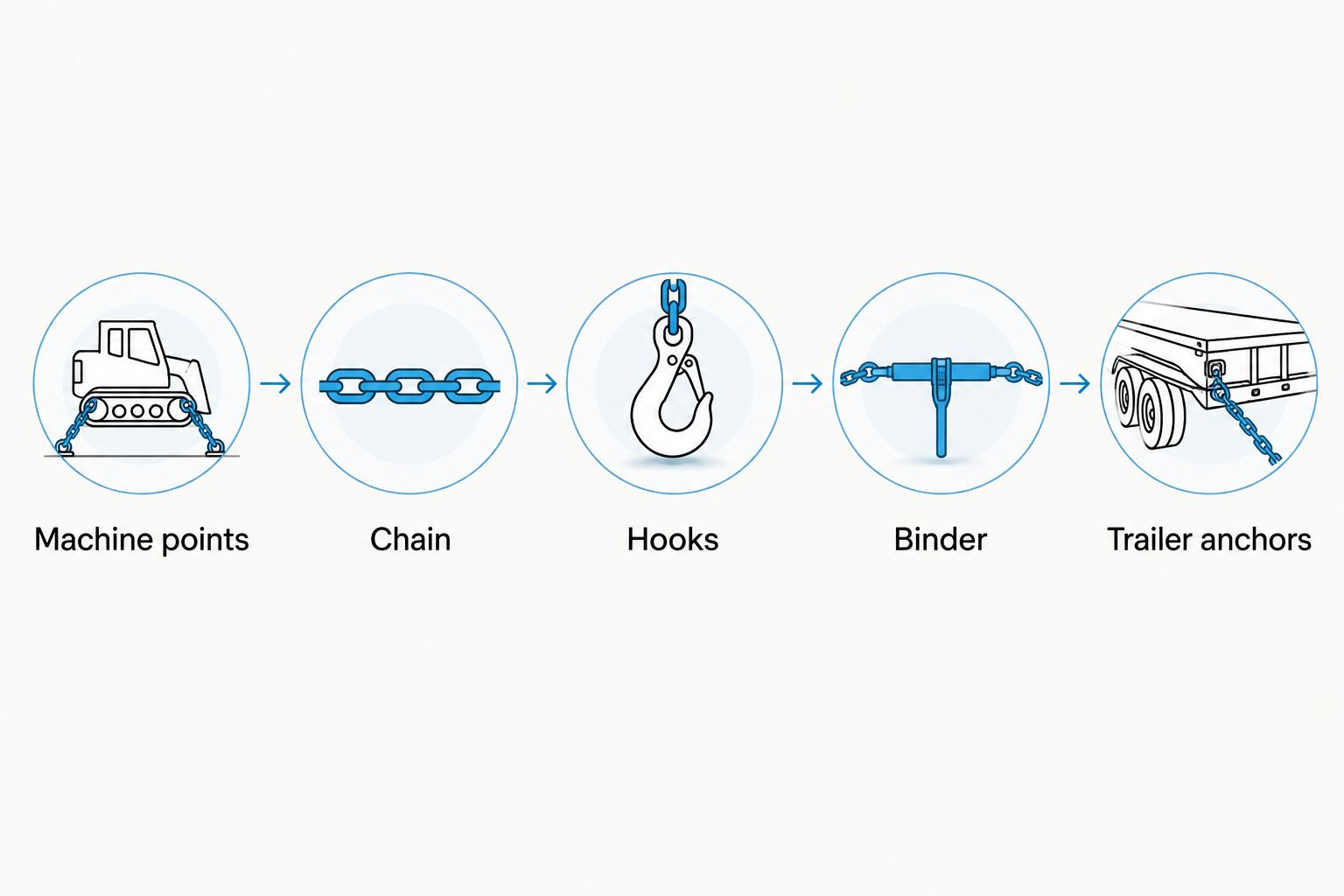
A tiedown is a connected system, and each connection needs both a suitable rating and a correct physical fit. During your 2026 setup review, follow the chain path from the machine to the trailer rather than checking equipment in isolation.
- Machine points: Use the equipment manufacturer’s designated transport-securement points and instructions; do not assume that a convenient opening is a rated attachment.
- Chain: Confirm grade, diameter, identification, and condition before selecting the binder and connecting hardware.
- Hooks: Check that the hook is intended for the chain and connection, seats properly, and is not tip-loaded or forced into position.
- Binder: Verify permitted chain size, WLL, adjustment travel, and operating instructions.
- Trailer anchors: Confirm that the anchor and its mounting structure suit the planned load direction and required capacity.
Chain length also affects compatibility because the binder needs enough adjustment travel to tension the assembly without reaching its operating limit. Measure each route after positioning the equipment on the trailer, and make sure the selected length allows proper hook engagement without leaving unsecured chain hanging below the deck.
Do not confuse a grade upgrade with an assembly upgrade. Changing from G70 to G80 or G100 requires another check of the binder, hooks, anchors, and machine points; the lowest applicable component rating still governs the tiedown.
Safety and maintenance before every equipment haul
For U.S. interstate commercial equipment hauling in 2026, use the applicable requirements in 49 CFR 393.100–393.136 alongside the equipment and securement-hardware manufacturers’ instructions. Section 393.130 addresses heavy vehicles, equipment, and machinery weighing 10,000 pounds or more, including a minimum of four tiedowns and requirements for accessory equipment.
Calculate aggregate WLL correctly
Under 49 CFR 393.106, aggregate tiedown WLL must be at least one-half the weight of the article or group of articles being secured. The contribution depends on the tiedown arrangement: a direct tiedown running from a vehicle anchor to an attachment point on the equipment contributes one-half its WLL to the aggregate calculation.
For example, four direct tiedowns each rated at 7,100 pounds contribute an aggregate WLL of 14,200 pounds—not 28,400 pounds. This is a calculation example, not an assigned rating for either kit in this guide, and meeting the aggregate minimum does not replace the other securement requirements.
Inspect and tension without shortcuts
Before applying tension, check for cracked, bent, twisted, stretched, or severely worn links; inspect hooks, pins, binder threads, and anchor structures as part of the same walkaround. Remove damaged hardware from service and follow the manufacturer’s rejection criteria rather than trying to straighten a hook or repair a chain link in the yard.
Seat the connections, remove slack, and tension the binders according to their instructions while keeping your body clear of the chain’s potential movement. Do not use an improvised handle extension unless the manufacturer expressly permits it, and secure binder handles and loose chain as instructed before departure.
Recheck during the trip and store clean hardware
Under 49 CFR 392.9, the driver must inspect cargo securement within the first 50 miles and reexamine it when changing duty status, after three hours of driving, or after 150 miles, whichever occurs first, subject to the regulation’s exceptions. Use those checks to confirm that connections remain seated and the machine has not shifted or settled into a position that leaves slack.
After unloading, clean the chain and hardware, inspect them again, and store them where they are protected from dragging, contamination, and standing moisture. Lubricate binder components according to the manufacturer’s instructions, and keep rejected equipment separate so it cannot return to the trailer by mistake.
FAQ
What are the best tie down chains for heavy equipment in 2026?
TruckNTow’s 3/8-inch G70 chain folding-handle binder kit is the best starting option for routine equipment transport when its verified assembly rating meets the securement plan. Choose the 1/2-inch G80 kit for a larger-chain setup, or specify the 5/8-inch G100 chain as part of a fully rated custom assembly.
Is Grade 80 chain better than Grade 70 for hauling equipment?
Grade 80 is not automatically the better choice for every equipment haul. Select the chain-and-binder assembly by its documented WLL, attachment compatibility, and the load’s securement requirements rather than the grade number alone.
How many tiedowns do I need for heavy equipment?
For equipment covered by 49 CFR 393.130 and weighing 10,000 pounds or more, the federal rule requires at least four tiedowns. The arrangement must also meet aggregate WLL and other applicable securement requirements, including those for accessory equipment.
Can I use the chain’s breaking strength to calculate securement?
No; use working load limit rather than breaking strength for securement calculations. Check the chain, binder, hooks, and attachment hardware because a lower-rated component limits the tiedown.
Does a direct chain tiedown contribute its full WLL?
No; a direct tiedown from a trailer anchor to an equipment attachment point contributes one-half its WLL under 49 CFR 393.106. Calculate contributions from the actual arrangement instead of adding every chain’s full rating.
Can G70 transport chain be used for overhead lifting?
No; Grade 70 transport chain is not intended for overhead lifting. Use lifting equipment specifically rated and approved for that application, including the complete sling assembly.
When should I inspect equipment tiedowns during a haul?
Under 49 CFR 392.9, inspect securement within the first 50 miles and reexamine it at a duty-status change, after three driving hours, or after 150 miles, whichever occurs first, subject to applicable exceptions. Also inspect before departure and correct loose or damaged securement before continuing.
Which equipment chain should you choose?
Start with the G70 kit if its documented assembly rating, length, and connection geometry meet your job. Choose the G80 kit for a verified larger-chain requirement, and reserve the G100 chain for a custom assembly whose remaining components support the intended rating.
One last thing
A chain that looks oversized still loses its capacity advantage at a lower-rated connection, so inspect the trailer anchor before ordering a higher-grade chain. Put the attachment-point check ahead of the purchase decision; replacing chain does not strengthen the structure it connects to.
Related guides
Shop TruckNTow’s equipment chain and binder options after confirming your load weight, assembly ratings, and attachment requirements. Match the system to the machine before the next haul, and leave with every connection checked.