

When equipment is loaded and departure is waiting on the final chain check, the best ratcheting chain binder is the one that fits your chain and rated securement system: the VULCAN Folding Handle Ratchet Binder, 7,100-pound SWL is the default choice for compatible setups; choose the 12,000-pound version when your securement plan requires that binder rating. This 2026 guide compares folding-handle and conventional ratchet options by capacity, fit, operation, and inspection needs.
- The best ratcheting chain binder matches your chain, hooks, anchors, and required working load limit.
- TruckNTow's VULCAN 7,100-pound folding-handle binder is the default for compatible chain-securement setups.
- Choose the VULCAN 12,000-pound folding-handle binder when your securement plan requires the higher binder rating.
- The VULCAN conventional ratchet binder specifies compatibility with 5/16-inch or 3/8-inch Grade 70 chain.
What makes the best ratcheting chain binder
A binder tensions a chain; it does not increase the capacity of the chain, hooks, or trailer anchor carrying that tension. Your 2026 purchase should start with the complete tiedown arrangement, because a higher-rated binder cannot correct an undersized component or an unsuitable attachment point.
TruckNTow's VULCAN 7,100-pound folding-handle ratchet binder is best for operators who need a folding handle and whose chain-securement plan accepts that rating. The conventional VULCAN ratchet binder is the more specific choice when stated Grade 70 chain compatibility drives your decision.
Use these criteria before comparing the options:
- Rated capacity: Match the binder's safe working load, commonly abbreviated SWL, to the required tiedown arrangement; do not substitute breaking strength for working load limit.
- Chain compatibility: Confirm chain diameter, grade, and the binder manufacturer's permitted combinations rather than matching diameter alone.
- Hook seating: Select hooks that accept the intended chain link correctly, without tip loading, distortion, or improvised adapters.
- Handle clearance: Check the operating space beside the deck, equipment body, and adjacent hardware, including the room needed to fold a folding handle.
- Adjustment travel: Confirm that the binder can take up slack while maintaining the manufacturer's required thread engagement.
- Inspection and care: Favor a configuration your crew can inspect, clean, and maintain consistently under the manufacturer's instructions.
Why this matters: a binder that reaches its adjustment limit before the chain becomes properly tensioned leaves you with an installation problem, not a reason to force the handle. Reposition the chain connection or select the appropriate equipment before departure.
Ratcheting chain binders at a glance
These 2026 recommendations separate three buying situations: a folding-handle default, a higher-rated folding-handle setup, and a conventional ratchet binder with stated chain compatibility. They are application choices, not a claim that one binder fits every load.
| Item | Best for | Standout feature | Key limitation |
|---|---|---|---|
| VULCAN Folding Handle Ratchet Binder, 7,100-pound SWL, 4-pack | Folding-handle setups accepting a 7,100-pound binder rating | Folding handle with a stated 7,100-pound SWL | Chain compatibility still needs confirmation |
| VULCAN Folding Handle Ratchet Binder, 12,000-pound SWL, 4-pack | Securement plans requiring the higher binder rating | Stated 12,000-pound SWL with a folding handle | Does not raise the rating of other components |
| VULCAN Load Binder with 2 Grab Hooks, Ratchet Style, 7,100-pound SWL, 4-pack | Conventional ratchet use with the specified Grade 70 chain sizes | Stated fit for 5/16-inch or 3/8-inch Grade 70 chain | The binder rating does not increase the chain rating |
1. VULCAN 7,100-pound folding-handle binder: best for folding-handle setups
The VULCAN Folding Handle Ratchet Binder provides ratchet tensioning and a folding handle, with a stated 7,100-pound SWL. The listed package contains four binders, making it a candidate for operators replacing several compatible binders together.
The folding handle is the distinguishing selection feature, but you still need operating clearance while tensioning. Check the handle's movement against the trailer edge and equipment before committing to an attachment location.
VULCAN 7,100-pound folding-handle binder pros:
- Stated 7,100-pound SWL gives you a capacity figure to compare against the securement plan.
- Folding handle provides a different handle configuration from a conventional ratchet binder.
- Four-pack supports replacement of several binders with the same listed configuration.
VULCAN 7,100-pound folding-handle binder cons:
- A folding handle does not eliminate the clearance needed during operation.
- You must verify permitted chain sizes and grades before pairing it with existing chain.
- The 7,100-pound rating does not increase the capacity of a weaker hook, chain, or anchor.
Best for: Operators whose setup accepts a 7,100-pound binder and who specifically want a folding handle. Verdict: Buy after confirming chain fit and operating clearance.
2. VULCAN 12,000-pound folding-handle binder: best for higher-rated setups
The VULCAN Folding Handle Ratchet Binder with a 12,000-pound SWL is the higher-rated binder in this comparison, and its listed package contains four binders. Select it when your securement plan calls for that binder capacity rather than treating the larger number as a universal upgrade.
Capacity and compatibility remain separate checks. A higher binder rating is useful only within a correctly specified system, and the chain connection must still seat properly in the hooks.
VULCAN 12,000-pound folding-handle binder pros:
- Stated 12,000-pound SWL addresses applications requiring that binder rating.
- Folding-handle configuration suits buyers specifically selecting that handle type.
- Four-pack supports a consistent binder selection across multiple tiedowns.
VULCAN 12,000-pound folding-handle binder cons:
- It does not upgrade lower-rated chain, connectors, or anchor points.
- Chain diameter and grade compatibility require confirmation before installation.
- The rating alone does not establish the number or arrangement of tiedowns needed.
Best for: Operators whose documented securement requirements call for a 12,000-pound binder. Verdict: Buy for a verified higher-rated setup; skip it as a substitute for correcting weak components.
3. VULCAN conventional ratchet binder: best for specified Grade 70 chain
The VULCAN Load Binder with 2 Grab Hooks uses ratchet-style tensioning and carries a stated 7,100-pound SWL. Its listed compatibility covers 5/16-inch or 3/8-inch Grade 70 chain, which makes this option the clearest fit-based recommendation in the comparison.
Choose the conventional VULCAN ratchet binder when those chain specifications match your equipment and you do not specifically require a folding handle. The binder's permitted chain sizes do not mean every compatible chain has the binder's full working load rating.
VULCAN conventional ratchet binder pros:
- Specifies compatibility with 5/16-inch or 3/8-inch Grade 70 chain.
- Includes two grab hooks for chain connection.
- Provides a stated 7,100-pound SWL and a four-binder package.
VULCAN conventional ratchet binder cons:
- Your chain's own rating still limits the assembly.
- Specified Grade 70 compatibility is not permission to substitute any same-diameter chain.
- You must check handle clearance in the actual installation.
Best for: Operators using the stated Grade 70 chain sizes who want a conventional ratchet binder. Verdict: Buy when the listed chain compatibility matches your securement system.
How the ranking works
The order follows handle preference, required capacity, and explicitly stated chain fit. The 7,100-pound folding-handle binder is the default only for compatible applications; the 12,000-pound version serves a higher-rating requirement, while the conventional binder serves the specified Grade 70 chain sizes.
Compatibility: match the entire tiedown assembly
Before ordering ratcheting chain binders in 2026, identify the chain already assigned to the trailer and inspect the intended attachment points. Read the component markings and manufacturer's instructions instead of using chain appearance or hook size as a capacity reference.
Keep these checks separate so a correct answer on one does not hide a failure on another:
- Chain diameter: Confirm the actual chain size falls within the binder's permitted range.
- Chain grade: Confirm the grade is permitted, even when the diameter appears to fit.
- Hook seating: Confirm the link seats as intended without loading the hook tip.
- Anchor rating: Confirm the trailer and equipment attachment points suit the planned load path.
- Adjustment travel: Confirm usable tensioning travel and required thread engagement.
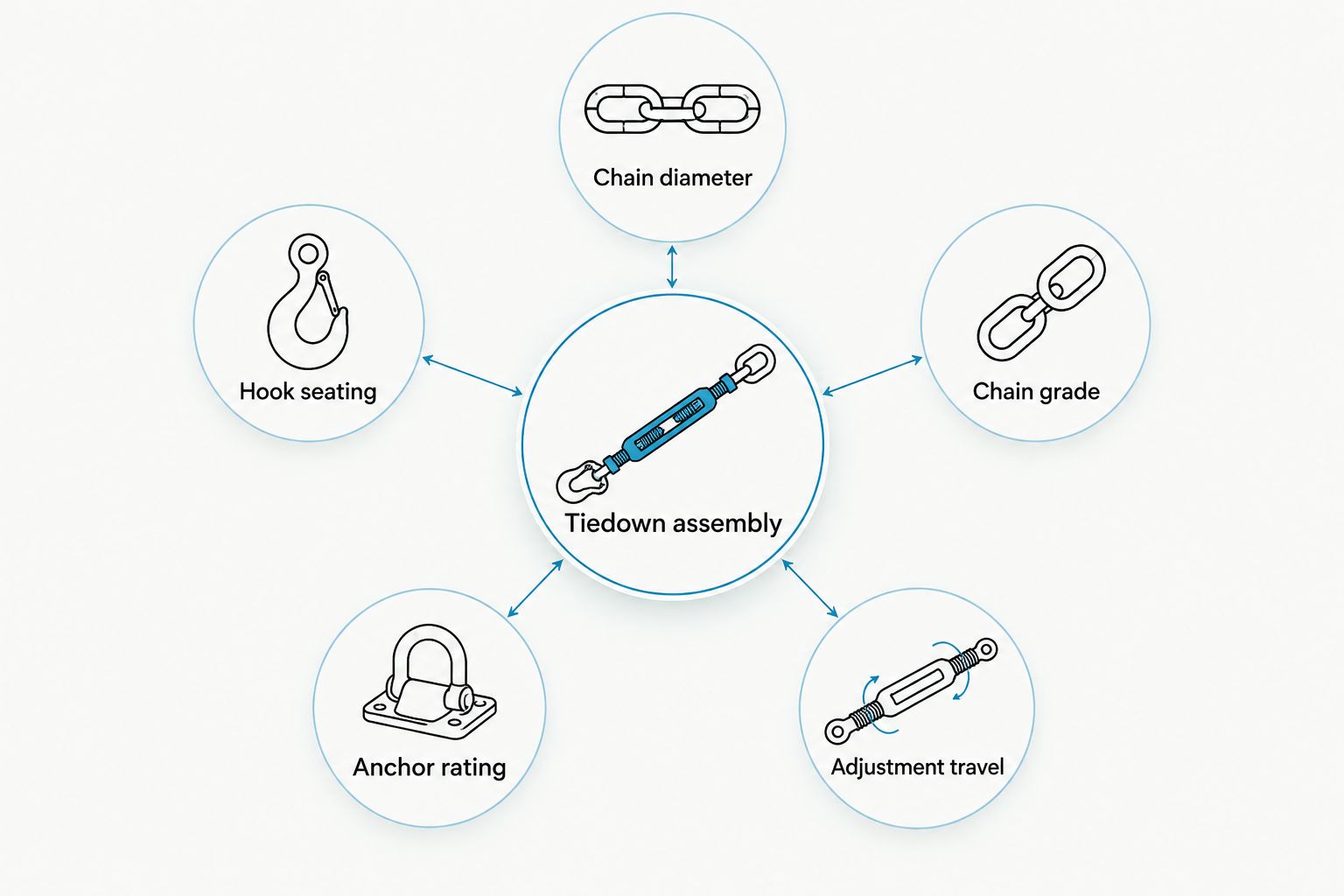
A binder that accepts a chain diameter does not automatically authorize every grade in that diameter. Likewise, two components with similar ratings still need compatible geometry and an approved connection method.
Inspect the load path at the equipment end as carefully as the trailer end, particularly when the chain passes near sharp edges or contacts a machine component. Use designated securement points and the equipment manufacturer's transport instructions rather than assuming any substantial-looking bracket is an anchor.
Treat the lowest-rated component as the assembly's capacity limit, then apply the rules for the actual tiedown arrangement. Aggregate working load calculations depend on how tiedowns attach and route, so adding binder ratings alone is not a complete securement calculation.
Safety: tension and release under control
A ratchet binder changes chain tension through threaded adjustment rather than an over-center lever action, but the tensioned system still stores energy. Keep your body clear of the potential movement of the handle, chain, and load, and follow the binder manufacturer's operating procedure.
For a 2026 pre-departure check, work through the installation rather than judging the system solely by how hard the handle was to turn:
- Inspect before use. Check the body, hooks, threads, ratchet mechanism, and folding joint where fitted; remove damaged or questionable equipment from service.
- Position correctly. Seat hooks in the intended links, establish the proper load path, and keep the binder accessible for controlled operation.
- Take up slack. Arrange the chain so the binder can tension it within the permitted adjustment range rather than reaching the end of its travel.
- Tension as instructed. Use the manufacturer's procedure and do not add an improvised handle extension to overcome resistance.
- Verify the installation. Check hook seating, thread engagement, handle security, and the remaining components before departure.
Resistance deserves investigation, not extra force. A misseated hook, damaged thread, obstructed handle, or exhausted adjustment range requires correction before the binder returns to service.
When releasing tension, secure the load against unintended movement first and stay out of the release path. A ratchet mechanism does not make an unstable load safe to unload.
Binder selection also does not replace applicable cargo-securement requirements. Determine the required tiedown number, positioning, aggregate working load limit, and commodity-specific provisions for the load you are transporting, then recheck securement as required during the trip.
Maintenance and the final buying decision
Inspect ratcheting chain binders before each use and after incidents that place their condition in doubt. Dirt and corrosion can obstruct inspection, so clean the equipment before assessing hook shape, threads, and mechanism condition.
- Check hooks for cracks, deformation, and damage that prevents proper seating.
- Check threads for damage, contamination, and movement inconsistent with the manufacturer's instructions.
- Check ratchet engagement and directional operation before loading the binder.
- Check the folding joint and any securing mechanism on folding-handle models.
- Lubricate only as specified by the manufacturer, and keep markings readable.
- Store clean, dry equipment where it is protected from damage and easy to inspect.
Do not assign a service life based only on age. Condition, exposure, use, and manufacturer removal criteria determine whether a binder remains suitable, and a damaged unit belongs outside the usable equipment inventory.
For your 2026 buying decision, choose the VULCAN 7,100-pound folding-handle binder as the default for a verified compatible setup, the VULCAN 12,000-pound folding-handle binder for a documented higher-rating requirement, or the conventional VULCAN ratchet binder for its specified Grade 70 chain fit. Record the selected model and permitted chain combinations so replacement purchases preserve the intended system.
FAQ
What's the best ratcheting chain binder in 2026?
The VULCAN 7,100-pound folding-handle ratchet binder is the default choice for compatible setups that accept its rating. Choose the 12,000-pound version when the securement plan requires that binder capacity, or the conventional VULCAN ratchet binder when its specified Grade 70 chain fit matches your equipment.
Does a 12,000-pound binder make my chain stronger?
No, a 12,000-pound binder does not increase the chain's working load limit. The lowest-rated component limits the assembly, and the tiedown arrangement still determines how capacity contributes to load securement.
Which ratchet binder fits 5/16-inch Grade 70 chain?
The listed VULCAN Load Binder with 2 Grab Hooks specifies compatibility with 5/16-inch or 3/8-inch Grade 70 chain. Confirm the chain's own rating and the complete installation before use.
Is a folding-handle ratchet binder always the better choice?
No, a folding handle is a configuration choice, not proof of better capacity or fit. Select it when that handle arrangement suits your installation, and verify operating clearance and chain compatibility separately.
Can I use a pipe to tighten a ratchet binder?
Do not use an improvised pipe extension to force a ratchet binder. Follow the manufacturer's instructions and correct binding, poor seating, or exhausted adjustment travel before continuing.
Are four binders enough for every equipment load?
No, a four-pack does not establish the required tiedown count for your load. Cargo-securement rules, load characteristics, attachment arrangement, and component ratings determine the required system.
When should I remove a ratchet binder from service?
Remove a binder from service when damage, deformation, malfunction, or another condition fails the manufacturer's inspection criteria. Keep questionable equipment separate from usable gear until its condition is resolved.
One last thing
A binder can run out of adjustment while the chain still has slack, even when its rated capacity is adequate. Check the chain connection position before blaming the binder rating, because additional capacity does not provide additional usable adjustment in a poorly arranged installation.
Related guides
Shop the ratcheting chain binder options at TruckNTow after confirming your chain specifications and securement requirements. Leave the yard with matched equipment, inspected connections, and a load secured for the trip—not with compatibility checks still unfinished.