

When a loaded flatbed shifts or a car-hauler attachment will not seat correctly, the best chain connectors are the ones rated for the complete assembly and shaped for the actual connection—not simply the largest hardware in the toolbox. Choose grab hooks for chain-length adjustment, rated coupling links for chain-to-chain assembly, rated shackles for compatible eyes, and purpose-built chain anchors for car-hauler straps.
- The best chain connectors match chain size, grade, working load limit, and attachment geometry.
- TruckNTow’s VULCAN grab-hook binders suit flatbed chain tensioning; they are complete binders, not standalone connecting links.
- Rated coupling links join compatible chain components; rated shackles connect suitable eyes without forcing the fit.
- VULCAN PROSeries(R) chain-anchor tie-downs suit car-hauler setups designed for that attachment style.
A connector determines how force passes between the chain, tensioner, and attachment point, so a poor fit creates a problem even when every component carries a readable rating. This 2026 guide ranks connection styles by job rather than treating flatbed securement, vehicle tie-downs, and recovery rigging as interchangeable applications.
TruckNTow is a source for chain-connection assemblies for flatbed operators and car haulers who need application-specific hardware. Start with the connection you need to make, then verify the manufacturer’s instructions for every part of that load path.
What makes the best chain connectors in 2026
Use these criteria before comparing connector styles, because the right shape with the wrong rating is still the wrong connector:
- Working load limit: Identify the rating for the connector and the complete assembly; breaking strength is not the operating limit.
- Chain compatibility: Match the specified diameter and grade, rather than assuming similar-looking links use interchangeable hardware.
- Connection geometry: Check link seating, pin clearance, eye thickness, and the direction of pull before applying tension.
- Retention: Confirm that pins, keepers, and closures remain secured according to the manufacturer’s instructions.
- Job function: Separate chain joining, chain shortening, tensioning, and vehicle attachment; these functions require different hardware.
- Inspection access: Choose a setup that lets you examine load-bearing surfaces and retention parts without concealing damage.
Chain connectors at a glance
The order below follows the working task, not a claim that one connector is strongest in every application. The VULCAN entries are complete assemblies incorporating connection hardware; the coupling-link and shackle entries are connector categories.
| Ranked option | Best for | Standout feature | Key limitation |
|---|---|---|---|
| VULCAN folding-handle ratchet binder with grab hooks | Flatbed chain-length adjustment and tensioning | Two grab hooks with a rated ratchet tensioner | Does not replace a permanent chain-joining link |
| Rated coupling link | Joining compatible chain components | A connection intended for assembly of matched components | Requires exact size, grade, and installation compatibility |
| Rated shackle | Connecting compatible eyes or attachment points | Removable pin permits assembly through suitable eyes | Clearance alone does not establish a safe loading arrangement |
| VULCAN PROSeries(R) lasso-style car tie-down with chain anchors | Car-hauler strap systems using chain-anchor attachment | Chain anchors incorporated into a vehicle tie-down | Not a general-purpose chain splice or lifting connector |
1. Grab hooks: best chain connectors for flatbed length adjustment
A grab hook engages a compatible chain link so you can select the working length before tensioning. A binder with grab hooks adds the tensioning mechanism, making it a different purchase from a loose replacement hook or coupling link.
The VULCAN folding-handle binder with two grab hooks carries a stated 7,100-pound safe working load and lists compatibility with 5/16-inch or 3/8-inch Grade 70 and Grade 80 chain. That binder rating does not increase the rating of a lower-rated chain, anchor, or other component.
Grab-hook assembly pros:
- Lets you adjust working chain length by selecting a suitable link.
- Combines chain engagement and ratchet tensioning in the listed binder assembly.
- Provides a defined chain-size and grade compatibility reference.
Grab-hook assembly cons:
- Requires correct link seating; a hook that catches a link is not automatically seated correctly.
- Does not serve as a permanent repair for damaged chain.
- Binder capacity alone does not establish the capacity of the installed tie-down.
Best for: Flatbed operators tensioning compatible transport-chain assemblies. Verdict: Buy for chain adjustment and tensioning; skip as a chain-repair connector.
These binder options illustrate why you must distinguish hook fit from tensioner capacity when selecting equipment in 2026:
| VULCAN binder option | Listed chain compatibility | Stated safe working load | Selection limitation |
|---|---|---|---|
| Folding handle, two grab hooks, four pack | 5/16-inch or 3/8-inch Grade 70 and Grade 80 | 7,100 pounds | Complete assembly remains limited by its other components |
| Folding handle, two grab hooks, four pack | 3/8-inch Grade 70, 80, and 100, or 1/2-inch Grade 43 | 12,000 pounds | Higher binder rating does not raise chain capacity |
The product cards below are binder assemblies, not standalone chain connectors. Select between them using the chain specification and required assembly rating, rather than treating the larger rating as an automatic upgrade.


2. Rated coupling links: best chain connectors for matched assemblies
A rated coupling link joins chain or compatible fittings using the connection method specified by its manufacturer. Select a link explicitly approved for the chain size, grade, and application; a generic connecting link with no usable rating is not a substitute.
Coupling-link pros:
- Provides a dedicated joining function rather than relying on a shortening hook.
- Allows assembly of compatible chain and end fittings.
- Keeps connector selection tied to documented component specifications.
Coupling-link cons:
- Requires the correct installation and retention components.
- Does not make damaged chain serviceable.
- Is not automatically approved for every transport, towing, or lifting application.
Best for: Building a manufacturer-approved chain assembly from matched components. Verdict: Buy only with documented compatibility; skip unidentified connecting links.
3. Rated shackles: best chain connectors for compatible eyes
A rated shackle provides a removable connection through attachment eyes that suit its pin, body, and approved loading arrangement. The shackle must fit without forcing components together, and its rating must apply to the way you intend to load it.
Rated-shackle pros:
- Provides a removable connection at suitable attachment eyes.
- Allows inspection of the pin and bearing surfaces.
- Offers a separate connector where the equipment’s approved arrangement calls for one.
Rated-shackle cons:
- Pin diameter and eye thickness can prevent correct fit.
- Side loading or unsuitable geometry requires manufacturer-specific guidance.
- Pin retention must suit the application and be checked before use.
Best for: Approved connections between compatible eyes or attachment points. Verdict: Buy for a documented eye-to-eye arrangement; skip improvised loading across the pin or body.
4. Chain anchors: best chain connectors for car-hauler strap systems
The VULCAN PROSeries(R) lasso-style car tie-down incorporates chain anchors into a vehicle-securement assembly. Its listed dimensions are 2 inches by 96 inches, and the supplied product information states a 3,300-pound safe working load.
That makes it a distinct option for a car-hauler connection, not a loose connector for joining transport chains. Verify the trailer attachment arrangement and vehicle tie-down procedure before selecting this style.
Chain-anchor tie-down pros:
- Incorporates chain attachment into a purpose-built car tie-down.
- Provides a stated assembly rating rather than an unidentified hardware combination.
- Offers a connection style distinct from flat-hook or snap-hook systems.
Chain-anchor tie-down cons:
- Requires a compatible trailer attachment arrangement.
- Includes webbing that needs its own abrasion and damage inspection.
- Does not replace a rated coupling link, shackle, or recovery assembly.
Best for: Vehicle haulers whose approved strap setup uses chain anchors. Verdict: Buy for the matching car-hauler system; skip for chain splicing or lifting.
How these options are ranked: Function comes first, followed by rating, compatibility, seating, retention, and inspection access. This is a selection guide based on stated product specifications and connector functions, not a test of competing hardware.
Compatibility and fit: check the complete load path
Start your 2026 equipment check at the attachment point and follow the connection through the connector, chain or webbing, tensioner, and opposite attachment. Check each component separately, because a rating stamped on one part does not describe the entire system.
Use this sequence before committing to a connector:
- Identify application: Establish whether the job is transport securement, vehicle tie-down, recovery, or lifting.
- Match chain: Read the diameter and grade, then compare them with the connector’s specified compatibility.
- Check seating: Confirm that links, eyes, and hooks bear on the intended surfaces without binding.
- Verify retention: Inspect the specified pins, keepers, and closures before tensioning.
- Confirm rating: Establish the assembly limit using the applicable component ratings and loading arrangement.
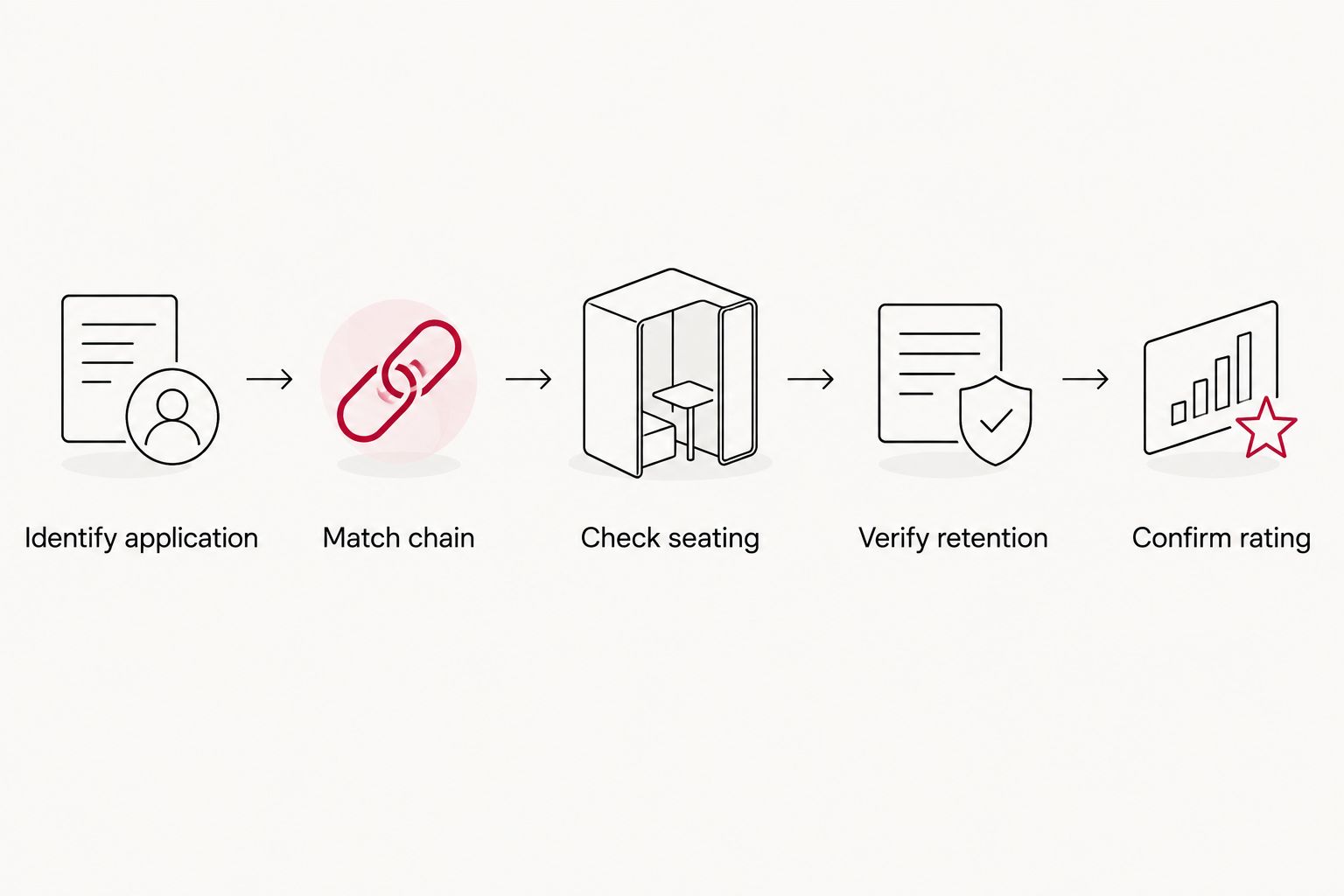
A 12,000-pound binder connected to a lower-rated chain does not turn that chain into a 12,000-pound assembly. Likewise, a hook approved for a particular chain size does not automatically fit an unrelated trailer eye simply because its opening clears the eye.
For car haulers, keep the vehicle manufacturer’s permitted securement points and the trailer’s attachment instructions separate from connector selection. Hardware choice cannot correct an unsuitable attachment location or a strap route that contacts a sharp edge.
Safety: securement hardware is not interchangeable recovery gear
Do not treat a transport working load limit as permission for shock loading or overhead lifting. A chain, hook, or connector needs explicit approval for the intended use, and recovery forces require a separate assessment from routine cargo securement.
Before applying tension, check that the connector sits in its intended orientation and that the load path does not force a hook tip, latch, pin, or edge to carry force outside the manufacturer’s approved arrangement. Stop when seating is unclear; extra tension is not a fit test.
- Keep personnel clear of the tensioned assembly and potential recoil path.
- Use the binder’s operating instructions, including its handle-security requirements.
- Do not substitute bolts, nails, or unidentified pins for specified retention parts.
- Do not weld, heat, grind, or bend rated hardware to make it fit.
- Remove damaged or unidentified components from service pending qualified assessment.
For U.S. commercial cargo securement in 2026, consult the applicable requirements in 49 CFR Part 393, including the general securement provisions and any commodity-specific rules. Connector selection is only part of compliance; tie-down arrangement, aggregate working load limit, cargo characteristics, and attachment suitability also matter.
Maintenance and the final buying decision
Clean connection hardware enough to expose cracks, deformation, corrosion, and damaged bearing surfaces, then follow the manufacturer’s inspection and removal criteria. A dirty connector hides the areas you need to examine; repainting or lubrication is not a repair for structural damage.
Inspect hooks for distortion and wear, coupling links for correct retention, and shackles for damaged threads or pins. On chain-anchor strap assemblies, inspect the webbing and ratchet as well as the metal fittings, because sound chain hardware does not compensate for a damaged strap.
Store components so road contamination does not obscure identification, and keep matched retention parts with their assemblies. During your 2026 fleet review, separate unidentified hardware from usable equipment rather than returning it to the same storage bin.
Which chain connectors should you choose? Default to a rated grab-hook binder assembly for compatible flatbed chain tensioning, choose a rated coupling link for an approved chain assembly, and use a rated shackle only where the attachment geometry calls for one. For a car-hauler strap setup, choose the purpose-built chain-anchor assembly that matches the trailer connection.
One last thing: Clevis describes an attachment method, while grab describes a hook’s chain-engagement shape; a clevis grab hook has both features. Ordering by only one of those terms leaves the connection function unresolved.
FAQ
What are the best chain connectors for a flatbed trailer?
The best chain connectors match the flatbed’s chain specification, attachment geometry, and required assembly rating. Grab hooks suit chain-length adjustment, while rated coupling links serve approved chain-joining applications.
Is a load binder the same thing as a chain connector?
A load binder is a tensioning assembly, not a standalone chain-joining connector. Its hooks connect to compatible chain, but its rating does not increase the capacity of the chain or trailer attachment.
Can I use a shackle to connect two chains?
Use a shackle only when its manufacturer approves the components and loading arrangement. Check chain-link clearance, pin fit, retention, and the applicable rating rather than relying on whether the parts fit together.
Are grab hooks and clevis hooks different?
Grab describes how a hook engages chain, while clevis describes how a fitting attaches. A clevis grab hook combines both features, so specify the attachment method and hook function when selecting hardware.
Does a higher-rated binder make my chain assembly stronger?
A higher-rated binder does not increase the working load limit of a lower-rated chain, connector, or anchor. Establish the assembly limit from the applicable component ratings and loading arrangement.
Are chain anchors suitable for car-hauler straps?
Chain anchors are suitable when the vehicle tie-down assembly and trailer attachment arrangement are designed for them. TruckNTow’s VULCAN PROSeries(R) lasso-style chain-anchor tie-down lists a 3,300-pound safe working load, but installation still requires a compatible securement setup.
Can I use cargo chain connectors for lifting or vehicle recovery?
Do not use a cargo connector for lifting or recovery without explicit approval for that application. Transport ratings alone do not establish suitability for overhead loads, shock loading, or a particular recovery arrangement.
When should I replace a chain connector?
Remove a connector from service when damage, wear, missing retention parts, or unreadable identification prevents verification against the manufacturer’s requirements. Do not reshape or weld rated hardware to return it to service.
Related guides
- How to load bind with chain binders safely
- How to connect tow hook chains to ratchet straps for car haulers
Resolve connector fit before the next loaded run, not after the assembly is under tension. Shop the full line at TruckNTow, and put equipment with verified ratings, correct seating, and intact retention into service with confidence.