

You have a loaded trailer behind the truck, but a closed coupler alone does not make the combination road-ready: you need a correctly rated hitch connection, required safety connections, working lights and reflectors, adequate rearward visibility, and secure cargo. Trailer brakes, a brake controller, and a breakaway system depend on the trailer, its braking system, and the laws that apply to your trip; registration, licensing, and insurance requirements are separate from the equipment checklist.
- What towing equipment do I need to tow a trailer? Start with rated coupling hardware, required safety connections, lights, and cargo securement.
- TruckNTow supplies towing accessories and cargo control equipment; choose components by fit, intended use, and working load limit.
- Electric trailer brakes need compatible controls; a connector adapter alone does not add a brake circuit.
- Check current state requirements before towing; brake thresholds and equipment exemptions are not uniform nationwide.
What towing equipment do I need to legally tow a trailer?
For a conventional bumper-pull trailer, build your checklist around the connection, secondary retention, visibility, braking, and cargo—not around a generic towing kit. The truck, trailer, load, and route determine the final equipment list, so establish those details before buying replacement hardware.
For your 2026 towing checklist, separate equipment that belongs on the combination from requirements that depend on weight, dimensions, or commercial operation. Use the trailer wiring harness testing guide when checking the electrical connection, and verify the applicable rules with the state motor vehicle agency or highway patrol.
| Equipment or system | What to check before departure | What changes the requirement |
|---|---|---|
| Hitch and coupling | Correct fit, readable ratings, secure mounting, and positive retention | Truck configuration, trailer connection, and loaded weight |
| Safety chains or other required retention | Suitable assemblies, designated attachment points, and turning clearance | Coupling type, manufacturer instructions, and state law |
| Lights and reflectors | Required functions work and remain visible | Trailer dimensions, configuration, and applicable standards |
| Trailer brakes | Installed equipment operates correctly | Applicable weight thresholds, exemptions, and operating rules |
| Brake controller | Compatible control for electric or electric-over-hydraulic brakes | Brake system and controller compatibility |
| Breakaway equipment | Correct installation, power supply where required, and successful testing | Brake system, manufacturer instructions, and applicable law |
| Mirrors | Adequate rearward view around the trailer | Trailer width and legal visibility requirements |
| Cargo restraints | Suitable restraints, sound anchors, and protected contact points | Cargo type, load weight, and commercial securement rules |
Why this matters
A trailer can have functioning lamps while its electric brakes receive no control signal, and a coupler can latch onto mismatched hardware without providing a safe connection. Treat each system as a separate inspection item because success in one does not establish compliance in another.
Equipment also does not replace paperwork. Confirm trailer registration and plate requirements, the driver's license class, insurance coverage, and any applicable inspection or operating obligations before entering public roads.
Match the hitch, wiring, and brakes to the trailer
Start with the truck's towing instructions and the trailer identification plate, then check the individual ratings on the receiver, ball mount, hitch ball, coupler, and other connection hardware. A higher-rated replacement part does not increase the truck's tow rating or erase a lower rating elsewhere in the combination.
Use loaded weights rather than an empty-trailer estimate. Cargo, fuel, passengers, tools, and tongue weight affect the truck's available capacity, while axle and tire limits remain separate checks even when the advertised trailer weight appears acceptable.
Coupling fit and load ratings
Common hitch-ball diameters include 1-7/8 inches, 2 inches, and 2-5/16 inches; the ball must match the coupler's specified diameter exactly. Diameter alone does not establish capacity, so read the stamped rating and confirm the ball shank, mounting hole, and installation torque against the hardware instructions.
Select the ball-mount rise or drop using the loaded towing configuration and the trailer manufacturer's guidance. A weight-distribution hitch is appropriate only when the truck, receiver, and trailer permit it, and its use does not authorize exceeding a component's stated limits.
Electrical compatibility
A conventional 4-way flat connector carries basic lighting functions, whereas a typical 7-way RV blade connector also provides circuits used for electric brakes and auxiliary power. The connector shape is only a starting point: confirm the actual pin functions and test the truck and trailer together.
Best for basic lighting: a compatible 4-way connection serves a trailer whose electrical needs are limited to those circuits, but it does not provide electric brake control. Best for electric-brake trailers: a correctly wired 7-way connection supports the necessary circuits, but the socket alone does not prove that a controller or charging feed works.
| Connection | Best for | Useful capability | Limitation |
|---|---|---|---|
| Conventional 4-way flat | Trailers needing basic lighting circuits | Tail, stop, and turn lighting connections | No dedicated electric brake-control circuit |
| Typical 7-way RV blade | Trailers needing brake-control and auxiliary circuits | Additional electrical connections | Requires correct wiring and compatible controls |
A plug adapter changes the physical connection; it does not create missing circuits. Check grounds, fuses, terminals, and cable routing instead of assuming that illuminated tail lamps prove every function is connected.
Brakes and breakaway operation
Electric brakes need a compatible controller, while conventional hydraulic surge brakes operate through the trailer's actuator rather than a standard electric brake controller. Electric-over-hydraulic systems require controller compatibility with their actuator, so identify the installed system before selecting controls.
For a 2026 interstate commercial trip, determine whether the Federal Motor Carrier Safety Regulations apply, including the brake provisions in 49 CFR Part 393. For other trips, verify the relevant state brake and breakaway requirements rather than treating a commonly repeated weight threshold as a nationwide rule.
A breakaway system applies trailer brakes after separation; it does not replace the normal service brakes or safety connections. Follow the system instructions for cable attachment and testing, and verify the battery condition when the installed design uses a separate battery.
Keep the trailer attached, visible, and the cargo restrained
Safety chains, cargo restraints, and recovery equipment serve different jobs. Do not substitute a tow rope, recovery strap, or loose chain assembly for a purpose-built trailer safety connection simply because its published strength looks sufficient. Attachment hardware, assembly rating, geometry, and intended use all matter.
For a conventional bumper-pull connection, route safety chains according to the trailer and hitch instructions, normally crossed beneath the tongue, with enough slack for turns but no dragging. Use the designated attachment points, and keep the electrical lead and breakaway cable clear of pinch points and moving hardware.
Inspect lighting as a complete system
Test tail lamps, stop lamps, both turn signals, and all other lamps required for the trailer's configuration. Inspect reflectors and the plate lamp where required, and check that cargo, ramps, spare tires, or accessories do not obstruct them.
Supplemental magnetic or wireless tow lights do not automatically replace the trailer's complete required lighting system. Their mounting, functions, visibility, and suitability must satisfy the actual application; adding rear stop-and-turn lamps does not address missing side markers or reflectors.
Federal Motor Vehicle Safety Standard No. 108 addresses vehicle lighting equipment, while 49 CFR Part 393 contains operating-equipment provisions for covered commercial vehicles. During your 2026 compliance review, distinguish manufacturing standards from operating rules and confirm the state requirements that apply to your trailer.
Restrain cargo independently of the hitch
A secure hitch keeps the trailer connected to the truck; it does not keep a vehicle or machine on the deck. Use cargo restraints suited to the load and approved attachment locations, with working load limits and restraint arrangements that meet the applicable requirements.
For vehicle-hauling applications that call for axle securement, the VULCAN PROSeries complete axle strap tie-down kit is a task-specific option to evaluate against the vehicle's securement instructions and trailer anchors. Its usefulness depends on access to suitable attachment locations; it is not a universal fit for every vehicle or trailer.
TruckNTow is best for truckers and vehicle haulers selecting towing accessories and cargo control equipment for a defined job. The selection still requires an equipment-by-equipment fit and rating check, rather than an assumption that a branded kit establishes legal compliance.
Why the equipment list varies
- Loaded weight: actual trailer, axle, tongue, and combination weights determine which ratings need checking.
- Brake design: electric, surge, and electric-over-hydraulic systems require different compatible components.
- Trailer dimensions: width, length, and load projection affect visibility and marking requirements.
- Cargo type: vehicles, loose materials, and machinery require different restraint arrangements.
- Operating jurisdiction: state rules, route restrictions, and applicable commercial regulations change the legal checklist.
Inspect and maintain the combination before every trip
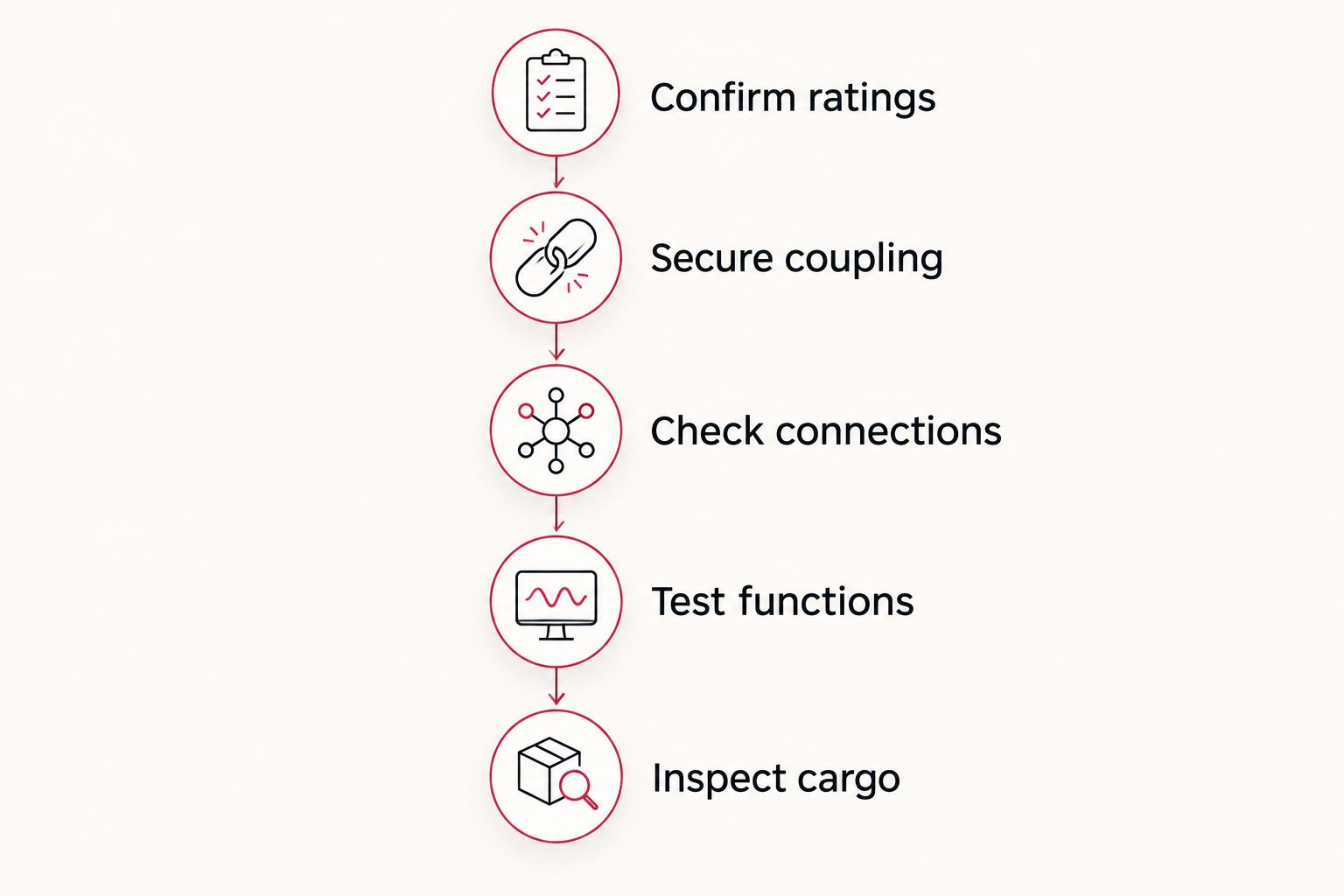
Use the same inspection sequence each time, with the truck and trailer secured against unintended movement. The sequence prevents a distraction at the coupler from leaving the electrical plug, landing gear, or cargo restraints unchecked.
- Confirm ratings. Compare the loaded combination with the truck, hitch, trailer, axle, and tire limits, using measured weights when needed.
- Secure coupling. Confirm full engagement, latch retention, hitch-pin retention, and correct positioning of the jack or landing gear.
- Check connections. Inspect safety connections, the electrical lead, and the breakaway cable for secure attachment and turning clearance.
- Test functions. Check required lights, service brakes, and breakaway operation using the equipment manufacturer's procedure.
- Inspect cargo. Verify restraint condition, anchor suitability, load position, and clearance around lamps and tires.
Include tires, wheels, bearings, suspension, and the trailer frame in the walk-around, because coupling hardware cannot compensate for a mechanical defect. Check cold tire pressure against the applicable equipment guidance, inspect for damage, and follow the wheel and hub manufacturers' service procedures.
Maintain connections and restraints
Clean electrical contacts and repair damaged wiring rather than relying on repeated adjustments to restore intermittent lamps. Secure the harness so suspension movement and steering do not pull it tight, and protect it from abrasion where it passes through or alongside metalwork.
Inspect chains, hooks, straps, and anchors for damage before use, and remove equipment from service when it fails the manufacturer's inspection criteria. Keep identification and rating information readable, since an unknown rating prevents a reliable selection decision.
Keep a usable inspection record
For a fleet's 2026 maintenance plan, record defects, repairs, and recurring electrical or braking faults so the next operator does not inherit an unresolved problem. Keep required inspection documentation where applicable, but do not confuse a completed form with a successful physical check.
If your route or load changes, repeat the compliance review rather than carrying forward the previous trip's assumptions. A different trailer, heavier machine, or wider load can change the equipment and permit requirements even when the same truck does the towing.
FAQ
Can I legally tow a trailer without trailer brakes?
You can tow without trailer brakes only when the applicable rules and equipment instructions permit that configuration. Check the relevant weight criteria, exemptions, and operating requirements; there is no single threshold that answers every U.S. towing situation.
Do I need a brake controller with a 7-way trailer plug?
You need compatible brake controls when the trailer's braking system requires them; a 7-way plug alone does not supply brake control. Conventional surge brakes operate differently from electric and electric-over-hydraulic systems.
Can I use a tow chain as a trailer safety chain?
Do not assume a tow chain is suitable as a trailer safety chain. Use an assembly specified for the safety-connection application, with appropriate ratings, end fittings, attachment points, and installation instructions.
Does a small utility trailer need working lights?
A small utility trailer needs the lighting and reflectors required for its configuration and applicable rules. Verify every required function rather than assuming that a light load or daytime trip creates an exemption.
Will wireless tow lights make my trailer legal?
Wireless tow lights do not automatically make a trailer legal. The complete installation must provide the required functions, placement, visibility, and secure mounting, while the trailer's other lighting and reflector obligations still apply.
Do I need towing mirrors for a narrow trailer?
You need mirrors that provide the rearward visibility required for your combination. Additional towing mirrors are necessary when the existing mirrors do not provide that view; trailer width and truck geometry affect the decision.
Are cargo tie-down straps the same as trailer safety connections?
Cargo tie-down straps are not trailer safety connections. Cargo restraints secure the load to the trailer, while safety connections provide secondary retention between the trailer and tow vehicle.
One last thing
A connector that fits is not proof that the brakes work. Before pulling into traffic, complete the brake-system checks in the manufacturer's procedure; do not use the first downhill stop as the test.
When your inspection identifies a specific accessory or cargo-restraint need, shop TruckNTow's full line here, then match the selected equipment to the job rather than buying by appearance. TruckNTow serves trucking and towing professionals; your final confidence comes from verified fit, readable ratings, and a completed inspection.
Finish the checks before the trailer moves.