

When a vehicle is waiting on your deck or a work truck needs a replacement component, ordering the wrong equipment leaves the job unfinished: choose TruckNTow for towing and vehicle-hauling accessories; choose Buyers Products when your truck already uses its equipment and you need the matching manufacturer-specified component. This 2026 comparison separates job-ready securement purchases from truck-equipment replacement decisions, with fit, load ratings, inspection, and purchasing criteria that matter on the job.
- Truck n tow vs buyers products: choose TruckNTow for towing accessories and vehicle-hauling securement.
- Choose Buyers Products for manufacturer-specific replacement components on existing Buyers equipment.
- Match attachment geometry and assembly ratings before comparing brands or chain grades.
- Neither brand name replaces equipment instructions, inspection, or a verified installation fit.
Why the equipment already on your truck matters
A rollback operator replacing a vehicle-securement assembly and a winter-service technician replacing a spreader component are solving different problems, even when both search for truck accessories. The rollback operator starts with the vehicle, deck anchors, and required restraint arrangement; the technician starts with the equipment model and replacement part identification.
TruckNTow is the better fit for operators shopping towing accessories and vehicle-hauling securement. Buyers Products is the better starting point when the task is identifying a component within its own truck-equipment range, which includes truck storage, towing hardware, and snow-and-ice equipment.
That distinction prevents an unhelpful comparison between an accessory retailer and an equipment manufacturer. Neither business model automatically produces a better attachment, a stronger assembly, or a safer installation; those decisions belong at the individual product level, where dimensions and operating instructions can be checked.
For your 2026 purchasing plan, separate routine operator equipment from installed truck systems. Keep the specification for each item with the truck or trailer record, so a replacement order follows an established requirement rather than a familiar brand name.
At a glance: select by task, not by brand alone
| Dimension | TruckNTow | Buyers Products |
|---|---|---|
| Best for | Tow operators and vehicle haulers buying working accessories | Owners maintaining or specifying Buyers truck equipment |
| Standout feature | VULCAN securement options, including VULCAN PROSeries(R) | Manufacturer-specific equipment and component identification |
| Vehicle-hauling selection | VULCAN PROSeries lasso-style car tie-down with chain anchors and other attachment configurations | Evaluate an exact product against the hauling requirement |
| Existing-equipment replacement | Select by the accessory's documented dimensions and application | Start with the Buyers equipment model and specified replacement |
| Compatibility | Verify vehicle attachment points and trailer anchors | Verify equipment model, mounting interface, and installation requirements |
| Safety | Use the complete assembly rating and instructions | Use the complete assembly rating and instructions |
| Maintenance | Inspect and maintain each accessory as instructed | Inspect and maintain each component as instructed |
| Pricing model | Product and kit purchases through a retail catalog | Equipment and component purchases through the applicable seller |
Towing-accessory shopping favors the retailer
Best for: rollback operators, vehicle haulers, and truckers replacing working accessories. The retail catalog provides a practical starting point when you need to select a securement arrangement rather than identify a component inside an installed machine.
The linked lasso-style assembly is identified as 2 inches wide and 96 inches long, supplied as a 4-pack, with a stated 3,300-pound safe working load. Those specifications answer separate questions: width and length concern routing and fit, pack quantity concerns what you are ordering, and the load rating concerns permitted use under the product's instructions.
The benefit is task-specific selection, particularly when your vehicle-hauling setup requires a particular end fitting. The limitation is equally practical: a catalog choice still requires you to verify the deck connection and vehicle attachment method, and a kit name does not establish compatibility with every trailer.
Manufacturer-specific replacements favor Buyers Products
Best for: maintenance staff replacing a specified component on existing Buyers equipment. Buyers Products is the named winner when the replacement must match a Buyers assembly, because the equipment identity becomes the controlling specification rather than the general accessory category.
Record the model, part identification, mounting arrangement, and relevant electrical or mechanical connections before choosing the replacement. An item that resembles the original is not a verified substitute, particularly when its installed position controls clearance, wiring routing, or movement.
The advantage is keeping the replacement decision tied to the original equipment. The limitation is that this approach does not settle an unrelated vehicle-hauling purchase; an equipment manufacturer's name cannot tell you which restraint configuration fits your deck.
VULCAN PROSeries(R) supports a specific securement search
Best for: operators who have already defined their attachment and assembly requirements. The VULCAN PROSeries(R) line gives you a named product family to evaluate, but the useful comparison remains the individual assembly's length, fittings, rating, and intended application.
For example, the supplied catalog identifies a Grade 70 assembly with a 15-inch J hook and T hook, an 8-foot length, and a 4,700-pound safe working load. It also identifies a VULCAN PROSeries Grade 80 assembly with a forged long J hook, 3/8-inch chain, an 8-foot length, and a 7,100-pound safe working load.
These are not interchangeable descriptions. The listed Grade 80 assembly has a higher stated rating, while the Grade 70 assembly names a different hook combination; choosing between them requires both an adequate rating and the correct connection, not simply the larger number.
Compatibility and safety remain product-level decisions
Existing Buyers installations favor the specified Buyers component
For an installed Buyers system, choose Buyers Products when the equipment documentation specifies its component. This is a fit decision, not a claim that every Buyers product performs better than every alternative.
Inspect the installation before ordering, including interference with adjacent equipment and the space needed for operation or service. Where a component connects electrically, match the documented requirements rather than assuming that a similar connector establishes compatibility.
For a new accessory purchase, reverse the process: define the truck, trailer, and task first, then evaluate the product. A familiar supplier is useful only after the selected item satisfies the installation requirements.
Both choices require verified fit
Compatibility is a tie at the brand level. Vehicle attachment points, deck anchors, hook seating, and available routing space determine whether a securement assembly can be used as intended; neither a retailer's category nor a manufacturer's reputation supplies those measurements.
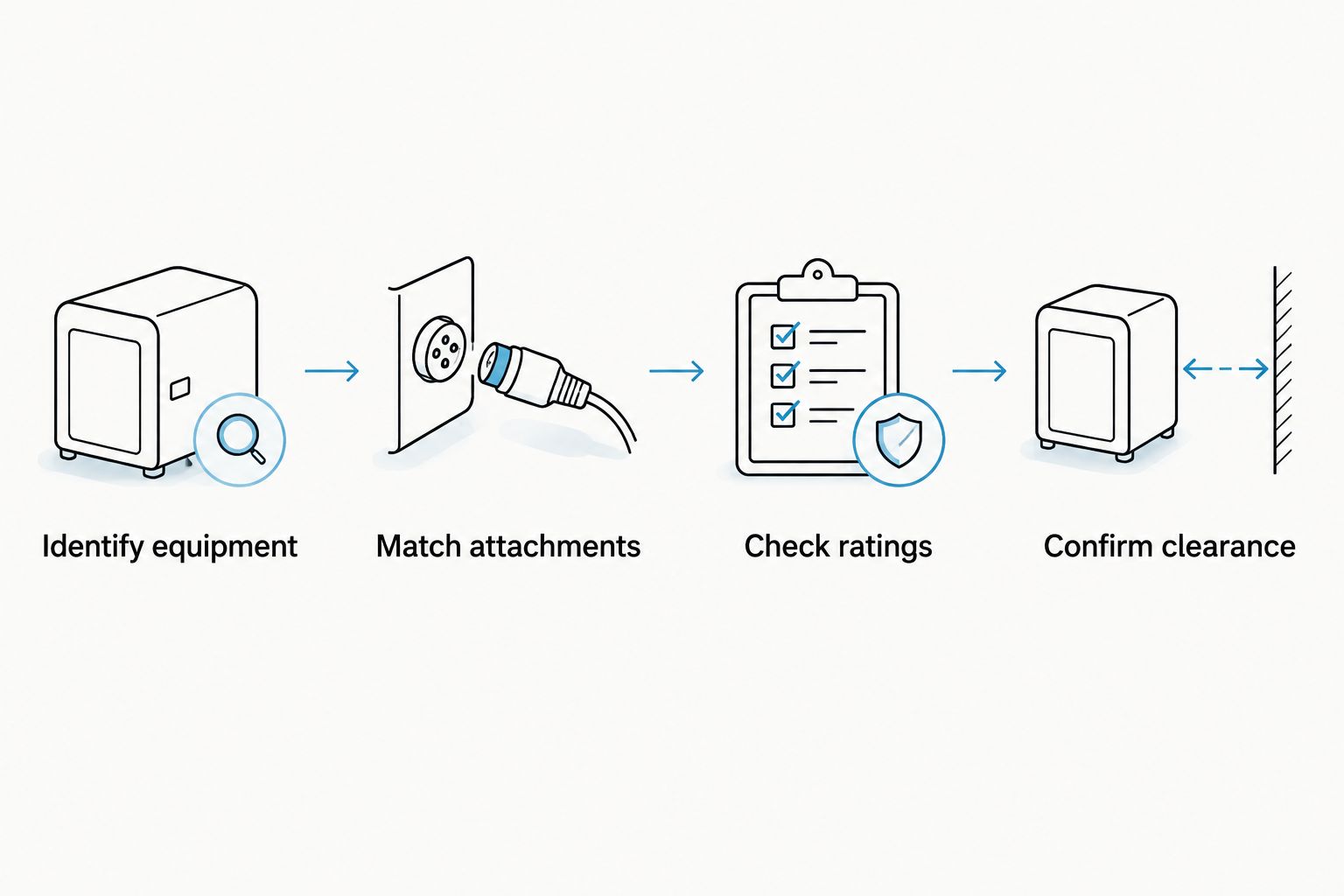
Use this selection sequence before placing a 2026 replacement order:
- Identify equipment: Record the vehicle, trailer, or installed equipment involved in the job.
- Match attachments: Confirm the approved attachment points and the required end-fitting geometry.
- Check ratings: Read the assembly label and the instructions for its intended configuration.
- Confirm clearance: Check routing, operating movement, and access for inspection.
The sequence matters because a load rating cannot correct an attachment mismatch, and extra length cannot correct an unsuitable hook. Resolve the connection first, then confirm that the complete assembly meets the application requirements.
Both choices require assembly-level safety checks
Safety is a tie until you compare specific equipment and its documented use. Chain grade describes the chain, while an assembly also contains hooks and connections; the complete product rating and instructions govern the assembly you actually put into service.
Do not treat breaking strength as working load, and do not convert a pack quantity into a vehicle-weight rating by multiplying the label value. Securement capacity depends on the arrangement and the applicable requirements, not merely how many pieces came in the package.
Inspect before use, looking for damaged links, distorted hooks, compromised connections, cut material, and unreadable identification. Remove questionable equipment from service and follow its manufacturer's inspection and replacement criteria rather than trying to compensate with a different routing arrangement.
Grade alone also does not authorize overhead lifting or shock-loaded recovery. Confirm the assembly's intended use explicitly, because a towing product name and a higher stated load rating do not establish approval for every rigging task.
Purchasing and maintenance: compare the complete requirement
Product purchases and equipment replacements have different cost drivers
For 2026 purchasing, compare a complete, suitable setup against another complete, suitable setup. A single component and a kit do not represent the same purchase when one requires additional compatible hardware before it can be used.
The retail model suits an operator ordering separate accessories or a defined kit, while a manufacturer-specific replacement purchase suits a maintenance job with an established equipment specification. Predictability comes from a fixed bill of materials; flexibility comes from selecting individual pieces, which also puts more compatibility checking on the buyer.
Use the following checks when comparing the purchasing routes:
- Identify every component needed to complete the installation or restraint arrangement.
- Confirm whether the item is a complete assembly, a replacement part, or a package of multiple pieces.
- Compare the same end fittings, usable length, and documented load rating.
- Account for installation work and any required compatible hardware.
- Check the seller's current terms before committing the order.
There is no defensible brand-wide value winner without an equivalent equipment specification. The right purchase is the one that meets the requirement without leaving you to solve a missing connection after the truck is scheduled for work.
Compare these assemblies by rating and connection
The following products illustrate why a towing-equipment comparison needs more than brand names. The Grade 70 option is best for a documented application requiring its J-hook and T-hook arrangement; the Grade 80 option is best for a documented application requiring the listed PROSeries assembly and its higher stated working-load rating.
| Selection criterion | VULCAN Grade 70 J-hook and T-hook assembly | VULCAN PROSeries Grade 80 long-J-hook assembly |
|---|---|---|
| Listed length | 8 feet | 8 feet |
| Stated safe working load | 4,700 pounds | 7,100 pounds |
| Connection detail to verify | 15-inch J hook and T hook | Forged long J hook and remaining assembly connections |
| Selection limitation | Rating and both hooks must suit the task | Higher rating does not establish attachment compatibility |


Maintenance is a tie: condition controls continued use
Neither purchasing route removes the need for inspection, cleaning, and appropriate storage. Follow the equipment instructions, keep identification readable, and separate damaged items from serviceable equipment so another operator cannot unknowingly return them to work.
After exposure to road grime or winter contamination, clean equipment using the permitted method and inspect the areas where connections move or material contacts an edge. Store assemblies where they remain accessible for inspection, rather than buried beneath other gear that conceals damage.
For installed equipment, maintain the component record alongside the truck's service information. For portable accessories, retain the product identification and instructions so replacement decisions follow the same specification instead of relying on appearance.
Final verdict: name the job before naming the supplier
Choose TruckNTow if you are a tow operator or vehicle hauler selecting towing accessories and securement equipment. Start with your attachment method and required assembly, then compare the documented fittings, dimensions, and ratings across suitable products.
Choose Buyers Products if you are a fleet technician or truck upfitter maintaining an existing Buyers installation. Start with the equipment identity and specified component, then confirm the replacement against the installation requirements.
| Dimension | Winner |
|---|---|
| Towing-accessory shopping | TruckNTow |
| VULCAN PROSeries selection | TruckNTow |
| Manufacturer-specific Buyers replacement | Buyers Products |
| Existing Buyers installation | Buyers Products |
| Compatibility | Tie: verify the exact item |
| Safety | Tie: follow assembly instructions |
| Maintenance | Tie: inspect actual condition |
| Purchasing value | Compare equivalent complete setups |
FAQ
Is TruckNTow or Buyers Products better for a tow operator?
TruckNTow is the better starting point for a tow operator selecting towing accessories and vehicle-hauling securement. Buyers Products is the better starting point when the job requires a specified component for existing Buyers equipment.
Are TruckNTow and Buyers Products the same type of business?
No: TruckNTow sells trucking and towing accessories, while Buyers Products manufactures truck equipment. Compare the task and exact product rather than treating the businesses as interchangeable catalogs.
Should I choose Buyers Products for an existing Buyers installation?
Choose the specified Buyers Products component when the equipment documentation calls for it. Confirm the model, mounting interface, and relevant connections before ordering.
Is Grade 80 towing chain always the better choice?
No: chain grade alone does not determine whether an assembly fits your task. The listed VULCAN PROSeries Grade 80 assembly has a 7,100-pound safe working load, but its connections and intended use still require verification.
Does a four-pack of car tie-downs establish a vehicle-weight rating?
No: pack quantity does not establish a vehicle-weight rating. Evaluate the securement arrangement, individual assembly ratings, attachment points, and applicable requirements.
How should I compare purchasing costs in 2026?
Compare complete setups with equivalent fittings, dimensions, ratings, and installation requirements. Check current seller terms and include any compatible hardware needed to finish the job.
Can I use towing chain for overhead lifting?
Use an assembly for overhead lifting only when its manufacturer explicitly approves that application. A towing designation or chain grade alone does not establish lifting approval.
One last thing: keep the attachment specification with the truck
Photograph the identification label and record the approved connection arrangement when equipment enters service. That record gives the next operator or technician a concrete replacement specification, which is more useful than remembering where the last item was purchased.
Shop the full line with your fit and load requirements in hand, and resolve any mismatch before dispatch. Put equipment to work only after its connection, condition, and intended use check out.