

A renter arrives with a different pickup, and the chains that cleared yesterday’s hitch now drag or bind; choosing trailer safety chains for RV rental fleets means matching a documented assembly to the trailer, checking the actual tow vehicle, and teaching the connection before release. This 2026 guide covers selection, fit, inspection, and rental-counter controls for bumper-pull travel trailers, not fifth-wheel or motorhome flat-towing systems.
- Choose trailer safety chains for RV rental fleets by manufacturer requirements, assembly ratings, and actual hitch fit—not chain diameter alone.
- TruckNTow supplies towing accessories; confirm trailer safety-chain suitability before substituting any binder or transport chain.
- Cross bumper-pull safety chains beneath the tongue as instructed, and check turning clearance without allowing road contact.
- Inspect each rental return, demonstrate each departure connection, and keep the breakaway cable separate from the safety-chain function.
Why safety chains matter for RV rental fleets
RV rental fleet safety-chain management is the selection, inspection, and connection of a trailer’s secondary coupling system to keep the trailer connected if the primary coupling fails. Your operating problem extends beyond choosing strong chain: different renters bring different receivers, attachment openings, hitch heights, and towing experience.
A chain assembly that fits one pickup does not establish compatibility with the next pickup. Staff need a repeatable release decision that covers the trailer, tow vehicle, connectors, and routing together, rather than treating attached hooks as proof of a completed inspection.
TruckNTow is best for fleet buyers sourcing trucking and towing accessories against a documented equipment specification. Start with the trailer manufacturer’s requirements, then use TruckNTow to source the specified equipment; a supplier’s chain listing does not replace approval for the intended application.
For your 2026 rental procedure, separate purchasing approval from departure approval. Purchasing establishes which assemblies belong on each trailer, while departure inspection establishes whether that trailer connects correctly to the customer’s actual vehicle.
The practical result is a clear stop-work rule: do not release a trailer when the rating, attachment method, condition, or fit remains unresolved. A signed rental agreement does not resolve a mechanical mismatch, and a renter’s previous towing experience does not replace a demonstration.
Select the assembly before selecting the chain grade
Record each trailer’s approved specification
Start manually with the trailer identification label, owner’s manual, existing assembly documentation, and a fleet worksheet. Record gross vehicle weight rating, or GVWR, but do not turn that figure into a chain working-load requirement without checking the manufacturer’s instructions and applicable requirements.
Safety-chain requirements concern the complete installed assembly, including its connections. Working load limit, safe working load, minimum breaking force, and trailer weight rating describe different things; copying one number into another field creates an unsupported approval.
Build a specification record that remains with the trailer even when purchasing staff, service technicians, or rental agents change. Include photographs that show the approved attachment locations, not just a close-up of a chain marking.
- Record the trailer identity, GVWR, and coupling type.
- Save the manufacturer’s safety-chain instructions and approved replacement details.
- Identify the chain assembly’s rating terminology and supporting documentation.
- Record approved trailer-side attachments and vehicle-side connectors.
- Flag missing documentation for technical review before replacement.
Evaluate the complete replacement assembly
Compare a proposed replacement against that record before considering chain grade or finish. A higher-grade chain does not correct an undersized connector, an unsuitable hook throat, a damaged mounting bracket, or an installation the trailer manufacturer does not permit.
The supplied VULCAN listings illustrate why size alone is insufficient: a Grade 70, 5/16-inch assembly lists a 4,700-pound safe working load, while a Grade 70, 3/8-inch assembly lists 6,600 pounds. A Grade 80, 3/8-inch assembly lists 7,100 pounds, but none of those figures alone establishes an RV safety-chain trailer rating.
TruckNTow lists both safety/binder chains and transport equipment, so treat the stated application and assembly documentation as purchasing checks, not interchangeable labels. The faster purchasing path is a saved, approved replacement specification for each trailer family, rather than choosing whichever chain has the largest number.
- Compare the complete assembly, not loose chain alone.
- Confirm the intended application with the manufacturer or qualified supplier.
- Match connector ratings and installation requirements to the approved specification.
- Verify replacement pins, retainers, and fittings are specified components.
- Keep transport-chain approval separate from trailer safety-chain approval.
Check compatibility on the renter’s actual hitch
Match connectors to designated attachment points
Inspect the tow vehicle’s designated safety-chain attachment points with the vehicle parked and secured. Confirm that the approved connector engages correctly, seats as intended, and closes or retains according to its design; forcing a hook through an opening is not a compatibility test.
Do not substitute a hitch ball, removable ball mount, or convenient bumper opening for the attachment location identified by the equipment manufacturer. If the connection requires an adapter, obtain approval for the complete arrangement rather than adding an undocumented link at the counter.
Keep the rental-yard comparison focused on application, because different options solve different problems:
| Option | Best for | Practical advantage | Key limitation |
|---|---|---|---|
| Trailer-manufacturer replacement assembly | Restoring a documented original configuration | Gives purchasing a clear application reference | Still requires inspection and fit verification on the renter’s vehicle |
| Documented aftermarket trailer safety-chain assembly | Replacements with confirmed trailer and hitch compatibility | Provides an alternative when its specifications satisfy the application | Requires verification of ratings, connectors, mounting, and instructions |
| Safety/binder or transport-chain assembly | Its expressly documented application | Provides identified chain dimensions and load information | A transport safe working load does not establish RV safety-chain suitability |
Prefer an approved assembly over an improvised combination of individually strong parts. Standardization helps only when the chosen equipment fits the trailer and the customer’s attachment points.
- Identify the designated vehicle attachment points before connecting.
- Check hook seating and retention without forcing the connector.
- Reject tip-loaded, side-loaded, or partially engaged hooks.
- Escalate attachment openings that do not accept the approved connector.
- Record approved variations instead of relying on staff memory.
Set routing and slack through the operating range
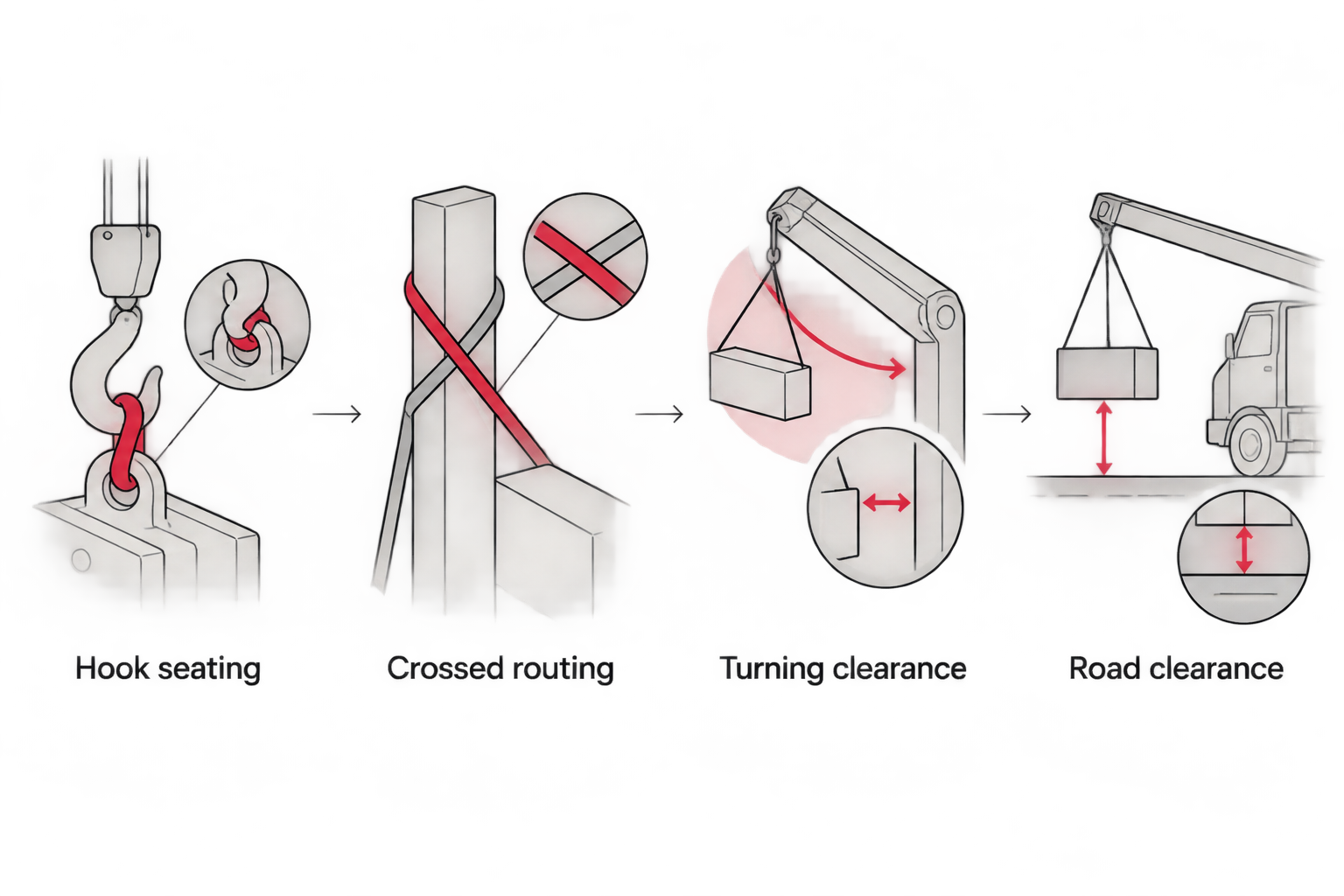
For bumper-pull travel trailers, cross the safety chains beneath the tongue as directed by the trailer manufacturer, creating the intended supporting arrangement if the coupler separates. Crossing does not compensate for excessive length, weak attachments, or an assembly that cannot support its intended function.
Check slack with the actual trailer and tow vehicle connected at towing height, including any approved weight-distribution setup. The chains need sufficient movement for turns and changes in angle without dragging, catching equipment, or pulling tight before the combination reaches its permitted operating position.
Use the same checks throughout your 2026 departure process: Hook seating, Crossed routing, Turning clearance, and Road clearance. These checks complement one another; passing one does not cancel a failure in another.
If length needs adjustment, follow an approved method or install the correct assembly. Do not twist chains, tie knots, add hardware-store connectors, or use improvised shortening methods to make an unsuitable assembly appear to fit.
- Verify routing beneath the tongue according to the trailer instructions.
- Check clearance from pavement, jack components, and hitch equipment.
- Confirm turning movement in a controlled area with a spotter.
- Watch for tension, pinching, or contact as the combination articulates.
- Recheck routing after any approved hitch-height or configuration change.
Make departure safety a demonstrated procedure
Inspect, demonstrate, and require a return demonstration
Perform the connection check with the renter present, then have the renter identify and demonstrate the approved connection. Explain what each part does, because the coupler latch, safety chains, electrical connection, and breakaway cable have separate jobs.
Safety chains provide a secondary connection; the breakaway system activates the trailer brakes when operated as designed. Route and attach the breakaway cable according to the trailer and system instructions, keeping its attachment and movement independent of assumptions about chain routing.
A paper checklist is sufficient to start. A carbonless driver’s vehicle inspection report provides a paper record option, but add trailer-specific connection fields rather than assuming a general vehicle form covers the whole rental handoff.
For a 2026 departure record, capture the actual vehicle and configuration, not merely the renter’s initials. Photographs support the record, while a physical inspection establishes seating, retention, and clearance that an image alone cannot prove.
- Inspect chain links, hooks, retainers, and both attachment locations.
- Verify the coupler and primary coupling separately from the chains.
- Check the breakaway system using its manufacturer’s procedure.
- Demonstrate connection and require the renter to repeat it.
- Record the vehicle, inspector, configuration, and unresolved defects.
Avoid these rental-fleet mistakes
- Approving one chain for every pickup. Receiver attachment geometry changes between vehicles, so verify the actual departure combination even when the trailer’s chain assembly stays unchanged.
- Adding chain ratings to approve a heavier trailer. Do not assume two published working-load figures create a trailer rating; follow the applicable assembly requirements and manufacturer documentation.
- Treating a bind as acceptable because the trailer is straight. Insufficient slack becomes apparent during articulation, not necessarily while the combination sits aligned in the yard.
- Accepting a photo instead of checking engagement. A hook can appear connected while sitting incorrectly, so inspect seating and retention directly.
- Returning questionable equipment to the ready row. Isolate the trailer until a qualified person resolves damage, missing documentation, or an incompatible connection.
Maintain chains between rentals, not just before busy periods
Clean, inspect, and document every return
Inspect safety-chain assemblies when the trailer returns, before another customer’s departure makes the inspection urgent. Remove contamination sufficiently to examine the links and fittings, then follow the manufacturer’s cleaning, corrosion-protection, inspection, and storage instructions.
Look for cracks, deformation, worn sections, severe corrosion, damaged hooks, missing retainers, and loose or damaged mounting hardware. Apply the manufacturer’s rejection criteria rather than inventing a universal wear allowance or service-life limit for mixed assemblies.
Do not heat, weld, straighten, or otherwise repair damaged chain components unless the manufacturer expressly authorizes the procedure. Remove suspect equipment from service and arrange an approved replacement; a fresh coating does not restore lost section or resolve deformation.
Use the return record to distinguish a new defect from a previously documented condition. Assign repair responsibility and keep the trailer unavailable for rental until the specified correction and release inspection are complete.
- Inspect the entire chain length and every connecting component.
- Examine trailer mounting points as closely as the hooks.
- Clean and protect equipment using the manufacturer’s instructions.
- Quarantine assemblies with damage or unreadable required identification.
- Record replacement details and the person authorizing return to service.
One last thing: retain the approved setup, not a universal length
A replacement assembly can match the previous chain’s dimensions and still fit differently when the customer changes the hitch configuration. Your most useful fleet reference is therefore an approved setup record showing attachment locations and inspection criteria, not a single chain length assigned to every rental.
During your 2026 fleet review, compare return defects with departure records and correct recurring fit problems at the specification level. Repeated dragging calls for an approved fit solution, not repeated instructions to the next renter to watch the chains.
FAQ
What are the best trailer safety chains for an RV rental fleet?
The best trailer safety chains are complete assemblies approved for the trailer’s requirements and compatible with the renter’s designated attachment points. Confirm documentation, connector fit, routing, and condition before release rather than selecting by grade alone.
Can I use a Grade 70 binder chain as an RV trailer safety chain?
Do not substitute a Grade 70 binder chain solely because its published load figure looks sufficient. Confirm that the complete assembly, connectors, mounting, and rating documentation satisfy the trailer manufacturer’s requirements and applicable rules.
Should travel trailer safety chains be crossed?
Cross bumper-pull travel trailer safety chains beneath the tongue as directed by the trailer manufacturer. Check the resulting arrangement for adequate movement and road clearance on the actual tow vehicle.
How much slack should RV trailer safety chains have?
Safety chains need enough slack for the permitted turning and articulation range without dragging or binding. Establish the correct fit using the trailer and hitch instructions rather than a universal slack measurement.
Can I twist trailer safety chains to keep them off the road?
Do not twist safety chains as an improvised shortening method. Use the manufacturer’s approved adjustment procedure or install an approved assembly of the correct length.
Do safety chains replace the trailer breakaway cable?
Safety chains do not replace the breakaway cable or braking system. Connect and inspect each system according to its own instructions, including the breakaway cable’s attachment and routing.
How often should a rental fleet inspect trailer safety chains?
Inspect safety chains at every return and before every departure, with additional inspections required by the manufacturer or following damage or an incident. Use the manufacturer’s rejection criteria rather than an assumed replacement age.
Does a higher chain working load limit increase trailer towing capacity?
A higher chain working load limit does not increase the trailer’s or tow vehicle’s towing capacity. The combination remains subject to its vehicle, hitch, trailer, and component limits, and the chain assembly still needs application-specific approval.
Related guides
- How to size safety chains for your trailer’s GVWR
- How to attach safety chains on a trailer correctly
- How to prevent trailer safety chains from dragging on the road
Shop the TruckNTow line using your approved equipment specification, and resolve fit questions before the next handoff. Release the trailer only when the assembly is documented, the connection is inspected, and the renter can demonstrate the procedure.