

Trailer coupler weight capacity is set by coupler size and stamped rating: a 1-7/8 inch coupler is typically rated 2,000 lb, a 2 inch coupler starts at 3,500 lb, and a 2-5/16 inch coupler starts around 6,000 lb and climbs from there. The number on the coupler's own stamp overrides every chart, including the one below.
- Trailer coupler weight capacity by size: 1-7/8 inch is typically 2,000 lb, 2 inch starts at 3,500 lb, 2-5/16 inch starts around 6,000 lb.
- The stamped rating on the coupler is the only number that counts; size tells you the range, not the rating.
- Your towing limit is the lowest rating among coupler, ball, ball mount and receiver.
- Tongue weight should land at 10 to 15 percent of loaded trailer weight on a bumper-pull trailer.
- Skip any coupler with no readable stamp. Replace it before the 2026 season.
Why coupler size decides what you can pull
A coupler is the part of the trailer that latches onto the ball, and it is sized to one specific ball diameter. Ball diameter is the fastest way to estimate capacity, because the three common sizes sit in three separate weight bands. The full ball-side picture is in the hitch ball weight capacity by ball size guide; this page covers the coupler half of the connection.
The figures here are category conventions drawn from how manufacturers commonly rate couplers, not TruckNTow test data. Individual couplers vary by manufacturer, steel gauge and mounting style, which is why the stamp wins.
The quotable version for 2026: match the coupler to the ball, match the ball to the hitch, and tow at the lowest number in the chain.
Trailer coupler weight capacity by size
The table lists the three ball sizes that cover nearly every bumper-pull and gooseneck setup on the road in 2026, with the capacity band each one typically occupies.
| Coupler size (ball diameter) | Typical rated capacity | Typical trailer | Best for |
|---|---|---|---|
| 1-7/8 inch | 2,000 lb | Small utility, jet ski, light cargo | Light loads where a Class I hitch is the tow vehicle limit |
| 2 inch | 3,500 lb and up | Utility, car-hauler, mid-size enclosed, boat | General-purpose towing behind pickups and SUVs |
| 2-5/16 inch | 6,000 lb and up | Heavy equipment, large enclosed, travel and livestock | Heavy bumper-pull and all gooseneck setups |
| Overall yardstick | Stamp on the coupler | Any | The only authoritative number |
The rating bands overlap at the edges. A 2 inch coupler is available in higher-rated versions than 3,500 lb, and a 2-5/16 inch coupler is available across a wide span of ratings. Size narrows the range; the stamp fixes the number.
High and low: where the capacity jumps
2-5/16 inch couplers lead the field, starting around 6,000 lb and extending well past the other two sizes. 1-7/8 inch couplers trail at roughly 2,000 lb. The 2 inch coupler sits in the middle and is the one most buyers actually need.
The largest single jump is from 2 inch to 2-5/16 inch. That step is where trailers move from lightweight utility towing to equipment hauling, and where the tow vehicle usually needs a Class IV or Class V hitch to keep up. The trailer hitch weight ratings by class breakdown shows how the hitch classes line up against these coupler bands.
Methodology and limits of this data
The bands above reflect the common SAE J684 hitch-class conventions and the way coupler makers commonly size and stamp their products. They describe typical ratings, not guarantees for any single part.
The named limitation: size cannot tell you the rating of a specific coupler. Two 2 inch couplers from different makers can carry different stamps, and a worn, bent or re-welded coupler carries less than its stamp says. Nothing in a chart replaces reading the part.
Read the stamp, then check the weakest link
A coupler stamp usually shows the ball size and a weight rating, often with a maker's mark. Read it with a flashlight before every season, and wipe off road grime that hides it. If the stamp is missing, worn smooth or painted over, treat the coupler as unrated and replace it.
The tow setup is a chain of four ratings, and the lowest one is your real limit:
- Coupler: the stamp on the trailer tongue.
- Ball: the rating on the ball shank or top.
- Ball mount: the rating on the mount or drawbar.
- Receiver: the hitch class and the tow vehicle's own towing limit.
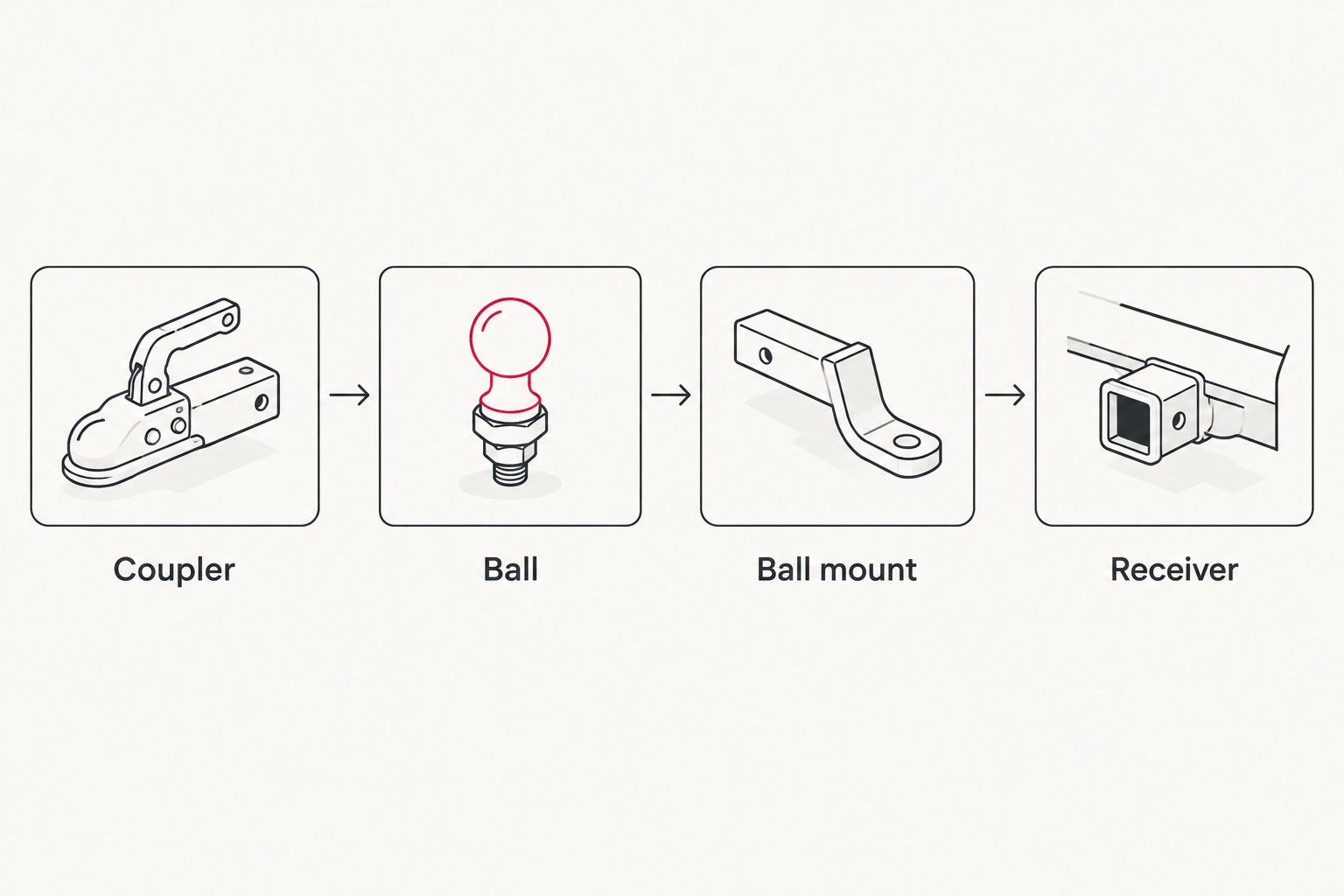
A 10,000 lb coupler on a 3,500 lb ball is a 3,500 lb setup. A 6,000 lb coupler behind a Class II receiver is a Class II setup. The chain, not the biggest number, decides what you can pull.
Match the coupler to the ball, exactly
A coupler must match the ball diameter it latches onto. A 2 inch coupler on a 1-7/8 inch ball can slip off under load, and a 1-7/8 inch coupler will not seat on a 2 inch ball at all. Check the ball diameter stamped on the top of the ball and the size stamped on the coupler before you hook up, every time you swap trailers.
A properly seated coupler latches fully around the ball and the latch closes with the pin or lock in place. A coupler resting on top of the ball with the latch half-closed will release over the first bump. Finish the connection with a pin or lock, and see the guidance on coupler locks for trailer theft prevention if the trailer sits unattended.
Tongue weight and the 10 to 15 percent rule
Coupler capacity is about the load the coupler can carry in tow; tongue weight is the downward force the trailer puts on the ball. On a bumper-pull trailer, tongue weight should land at roughly 10 to 15 percent of loaded trailer weight. Too little and the trailer sways; too much and it overloads the rear axle of the tow vehicle and the receiver.
Gooseneck and fifth-wheel trailers carry a higher share of weight on the tow vehicle, and their couplers are built for it. They use a 2-5/16 inch ball in the truck bed and are rated well above bumper-pull couplers, but the same lowest-link rule applies to the ball and the bed mount.
When you are shopping, work from loaded trailer weight, not empty weight. Add the cargo, water, fuel and gear to the trailer's own weight, then pick the coupler stamp that clears that number with margin.
How to use these benchmarks
- Start with the ball diameter you already own. It fixes the coupler size and the band you are shopping in.
- Shop on the stamp, not the size. Buy a rating above your loaded trailer weight, not equal to it.
- Check the whole chain. Compare coupler, ball, ball mount and receiver, then tow at the lowest.
- Torque the ball correctly. A loose ball is a failed ball regardless of rating. The torque a trailer hitch ball procedure covers it.
- Retire damaged couplers. Cracks, bent latches, elongated ball sockets and unreadable stamps mean replacement, not repair.
Pros and cons by coupler size
1-7/8 inch. Pros: light, inexpensive, fits the smallest hitches. Cons: lowest capacity and the easiest to overload by mistake. Verdict: Buy for small utility trailers only; skip for anything near 2,000 lb loaded.
2 inch. Pros: the widest availability and the broadest rating span, so it suits most general towing. Cons: ratings vary widely between makers, so a 2 inch coupler is not automatically a heavy one. Verdict: Buy, after reading the stamp.
2-5/16 inch. Pros: highest ratings and the only choice for gooseneck and heavy equipment trailers. Cons: needs a matching ball and a heavier hitch class on the tow vehicle, and the weakest link often turns out to be the receiver. Verdict: Buy for heavy loads; confirm the whole chain first.
FAQ
What is the weight capacity of a 2 inch trailer coupler?
A 2 inch coupler starts at 3,500 lb and is available in higher ratings from some makers. Read the stamp on the coupler for the exact number, because size alone does not set it.
What is the weight capacity of a 1-7/8 inch coupler?
A 1-7/8 inch coupler is typically rated 2,000 lb. It suits small utility and personal-watercraft trailers and is the lowest band of the three common sizes.
Is a 2-5/16 inch coupler stronger than a 2 inch coupler?
Yes, 2-5/16 inch couplers start around 6,000 lb and go higher, which is above the typical 2 inch band. Both sizes still depend on the stamp and on the ball and hitch rating.
Where do I find the rating on my trailer coupler?
The rating is stamped on the coupler body, usually near the latch or on the side of the tongue. Clean off dirt and paint; if it is unreadable, treat the coupler as unrated and replace it.
Can I use a 2 inch coupler on a 2-5/16 inch ball?
No. A coupler must match the ball diameter exactly, and a mismatched coupler can slip off under load. Check the size stamped on both before every hookup.
How much tongue weight should a bumper-pull trailer have?
Tongue weight should be 10 to 15 percent of loaded trailer weight. Too little causes sway; too much overloads the tow vehicle's rear axle and receiver.
Does the coupler or the hitch limit my towing capacity?
Whichever is lowest. Your limit is the lowest rating among coupler, ball, ball mount and receiver, along with the tow vehicle's own towing limit.
One last thing
The most common coupler failure is not an overloaded rating; it is a coupler that was never fully latched or a ball that was never torqued. Before the first haul of 2026, seat the coupler, close the latch, insert the pin, and tug the trailer upward by hand. If it lifts off the ball, nothing on this page matters yet.