

A disabled plow truck beside live traffic leaves little room for an improvised hookup; towing equipment for highway department fleets must match the vehicle, the task, and the approved attachment points before a crew leaves the yard. This 2026 guide separates routine towing, vehicle transport, and recovery so you can specify equipment without treating those jobs as interchangeable.
- Choose towing equipment for highway department fleets by task, attachment compatibility, and the complete system’s rating.
- TruckNTow suits fleet buyers sourcing towing equipment against established vehicle-specific requirements.
- A towing-capacity label does not establish suitability for shock loading or heavy recovery.
- Keep cargo control, temporary lighting, and traffic protection on separate inspection checklists.
Why towing equipment matters for highway departments
Highway department equipment decisions must account for different assignments: moving a disabled service vehicle, transporting maintenance machinery, and responding to a truck stuck off the pavement require different procedures. A kit that fits one assignment does not automatically cover the others, even when its components look familiar.
Start your 2026 equipment review with an assignment list rather than a replacement shopping list. The practical approach in stocking a truck with essential recovery equipment supports that task-first inventory, but your department must still define which operations its personnel and vehicles are authorized to perform.
TruckNTow towing equipment is best for fleet buyers who already have vehicle-specific capacity and attachment requirements. The purchasing benefit is access to towing and cargo-control accessories; the limitation is that purchasing those accessories does not establish a safe recovery plan or qualify an operator.
Your inventory should distinguish equipment carried on every response truck from equipment assigned to a dedicated transport vehicle. That distinction keeps a pickup’s routine assistance kit from becoming the default answer to a loaded plow truck, a damaged axle, or a vehicle resting on an unstable shoulder.
Select equipment around the assignment
1. Define the jobs your fleet will perform
Use a paper worksheet or spreadsheet to list the vehicles you support, their operating configurations, and the tasks your crews actually perform. Include mounted plows, spreaders, onboard material, and other attachments when establishing operating weight; an empty chassis specification does not describe every dispatched vehicle.
Separate controlled towing from loading onto a carrier and from extracting an immobilized vehicle. Resistance from mud, a locked wheel, a slope, or collision damage changes the assignment, so vehicle weight alone cannot define the required recovery equipment.
Set an escalation boundary before selecting hardware. A written callout rule gives the operator a clear stopping point when the scene exceeds department equipment, training, or authority.
- Record each supported vehicle and its operating configuration.
- Identify approved towing and transport procedures from vehicle manuals.
- Separate routine moves, transport securement, and extraction work.
- Document when a qualified outside recovery provider takes over.
2. Record ratings without mixing their meanings
Read existing equipment labels and manufacturer instructions before replacing anything, then record each component’s rating and intended use in the same inventory. Breaking strength, safe working load, and towing capacity are not interchangeable purchasing fields.
The supplied VULCAN Medium Duty Tow Kit lists a 2-inch by 20-foot tow strap and a 5,000-pound towing capacity, while the VULCAN Super Duty Tow Kit lists a 6-inch by 30-foot tow strap and a 15,000-pound towing capacity. Those are stated product specifications, not permission to recover any vehicle below those weights from any position.
For your 2026 specification sheet, retain the manufacturer’s exact rating terminology instead of converting everything into a single capacity column. Do not interpret a wider strap or a larger printed number as approval for kinetic recovery, lifting, or a particular roadside hookup.
- Copy rating terminology exactly from the equipment label.
- Record intended use and prohibited uses alongside the rating.
- Check connectors and attachment points, not just the primary component.
- Reject equipment with unreadable identification until suitability is established.
3. Compare complete kits against the written specification
Compare existing components manually first, including connector fit, reach, condition, and storage needs. A packaged kit from TruckNTow provides a grouped purchasing option, but the department still needs to verify every included component against its approved procedure.
Keep transport restraints on a separate specification. For example, the VULCAN PROSeries axle strap tie-down kit with snap-hook ratchet straps is a transport-securement option to evaluate against approved attachment locations, not a substitute for a recovery assembly.
The following options serve different assignments; none is a universal highway department kit. Select the job first, then verify the equipment rather than allowing a product name to define the job.
| Option | Best for | Useful feature | Key limitation |
|---|---|---|---|
| VULCAN Medium Duty Tow Kit | Approved pickup and passenger-vehicle towing tasks | Includes a tow strap, screw-pin shackles, and storage bag | Its stated 5,000-pound towing capacity does not establish extraction suitability |
| VULCAN Super Duty Tow Kit | Approved towing tasks requiring its stated 15,000-pound towing capacity | Includes a tow strap, webbing shackles, and storage bag | Requires suitable attachment geometry and manufacturer-approved use |
| VULCAN PROSeries axle strap tie-down kit with snap-hook ratchet straps | Vehicle transport with compatible attachment points | Groups axle restraints and tensioning components | Does not establish a recovery rating or universal vehicle fit |
The towing kits below provide two distinct capacity specifications for procurement review. Neither kit replaces the vehicle manufacturer’s instructions or your department’s operating procedure.


- Compare included components against the approved equipment list.
- Identify missing connectors, protection, or storage provisions.
- Keep towing kits separate from transport-restraint kits.
- Approve substitutions by specification rather than appearance.
Verify vehicle fit and electrical compatibility
4. Match every connection to an approved attachment point
Inspect the actual vehicle and consult its towing instructions before assigning equipment, because similar-looking frames and axles do not establish identical attachment rules. Check whether bodywork, steering components, brake lines, or mounted equipment obstruct the intended connection.
Evaluate the complete load path from the towing vehicle through each connector to the disabled vehicle. A component’s marked rating does not validate a bumper, suspension member, or other unapproved attachment point, and increasing component capacity does not correct an unsuitable connection.
Build a vehicle-specific fit sheet for your 2026 fleet file with photographs of approved locations and notes on prohibited routing. Photograph the unloaded arrangement during a controlled yard exercise, not while personnel are exposed to roadside traffic or suspended loads.
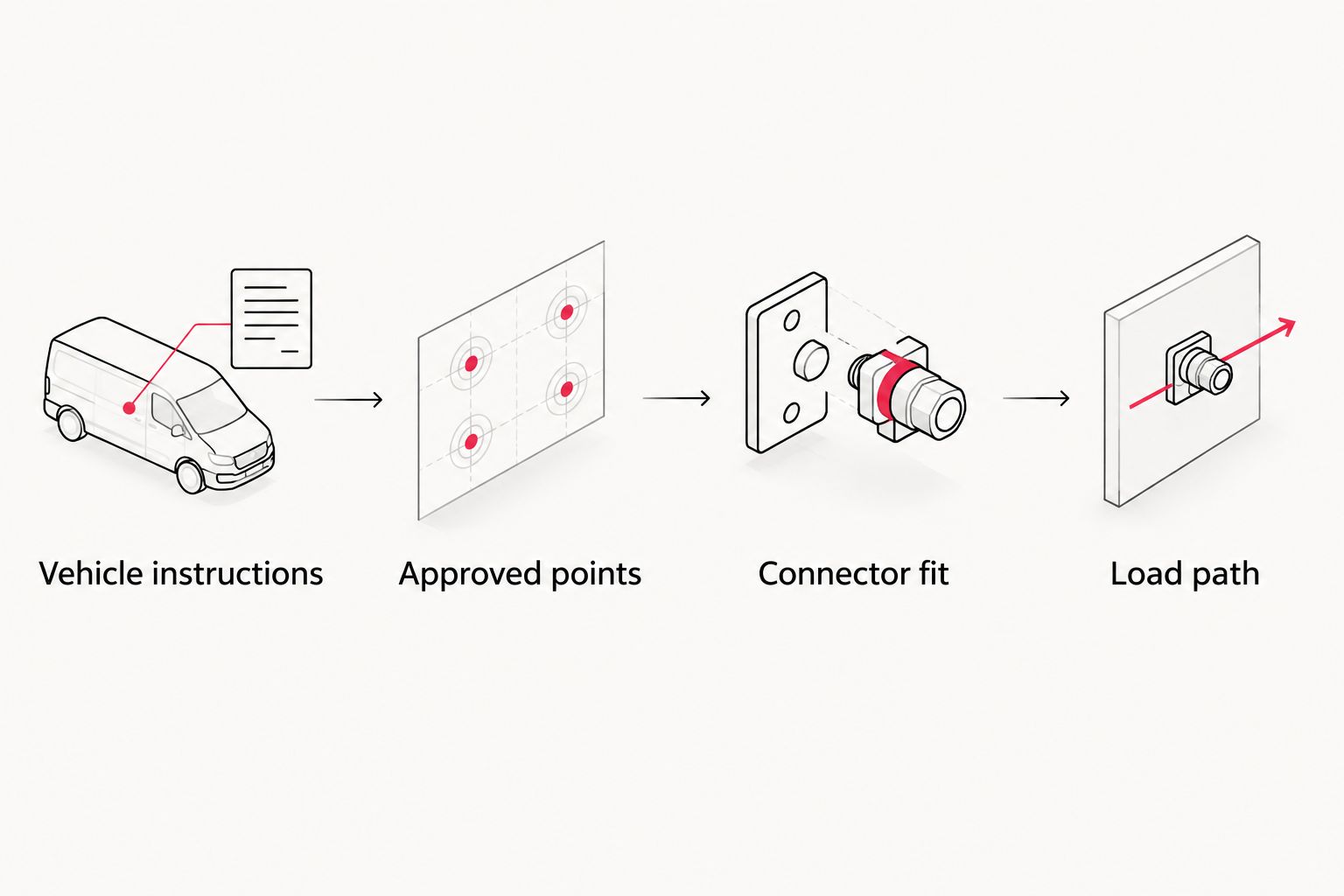
A fit sheet also helps purchasing staff reject a superficially similar replacement that changes hook engagement, connector clearance, or routing. Keep the vehicle instructions with the sheet so crews can distinguish a department-approved setup from an undocumented photograph.
- Review vehicle instructions before choosing an attachment location.
- Confirm connector seating and clearance throughout the intended movement.
- Protect approved webbing routes from damaging edges.
- Record configurations that require different equipment or outside assistance.
5. Test lighting and trailer functions before dispatch
Begin with a functional walkaround using the truck and trailer combination that will actually operate together. Inspect connectors, cable routing, lamps, and any trailer braking or breakaway equipment fitted to that combination, following the applicable manufacturer test procedures.
A VULCAN wireless LED tow light kit is an option to evaluate for temporary tow lighting, but confirm mounting, power, communication, and required lighting functions before assigning it. Temporary tow lamps do not repair a trailer’s brakes, establish electrical compatibility, or replace required warning arrangements.
Test the installed arrangement from the positions where other road users need to see it, accounting for equipment that blocks the lamps. Keep warning visibility and stop-turn-tail functions distinct in the inspection record so a functioning warning lamp does not conceal a failed required lamp.
- Test required lighting functions with the actual vehicle combination.
- Inspect mounting security and cable clearance where applicable.
- Verify trailer braking and breakaway functions under manufacturer instructions.
- Record defects before releasing the combination for service.
Control roadside risk before applying load
6. Establish the work zone and the stop-work boundary
Follow the department’s approved traffic-control and incident-response procedures before connecting equipment. Warning lights alone do not establish a protected work area, and a visible truck does not remove exposure to moving traffic, unstable ground, or equipment under tension.
Assign a person to direct the operation and agree on communication and stop signals before movement begins. Keep personnel clear of tensioned equipment, pinch points, and the potential travel path, then stop if the vehicle shifts unexpectedly, a connection moves, or communication fails.
For 2026 training, practice identifying an unsuitable assignment as deliberately as making a routine hookup. The correct response to an unsupported recovery is escalation, not adding another component to an unverified setup.
- Establish traffic protection through the department’s approved procedure.
- Assess slope, footing, vehicle stability, and nearby hazards.
- Agree on movement commands and an immediate stop signal.
- Keep people outside tensioned-equipment and vehicle travel zones.
- Stop when conditions differ from the approved plan.
Avoid these highway department purchasing mistakes
- Standardizing one kit across every truck. Standardize inspection and identification first, then assign equipment by vehicle and task.
- Sizing only for an empty vehicle. Account for the actual operating configuration, including mounted equipment and carried material.
- Treating transport restraints as recovery gear. Require explicit manufacturer suitability for the intended operation.
- Letting warning equipment stand in for traffic control. Keep visibility equipment and the approved work-zone procedure as separate requirements.
Maintain equipment through winter and shift changes
7. Inspect, clean, and return each kit to a known condition
Use a paper sign-out sheet or shared inventory to record who inspected the equipment, what was removed from service, and whether the truck carries a complete kit. The record only works when damaged equipment is physically isolated instead of returned to the same compartment.
Inspect webbing, stitching, metal connectors, and identification before use and after demanding assignments, following manufacturer rejection criteria. Clean and dry equipment as directed before storage, and pay particular attention to contamination and corrosion after winter road work.
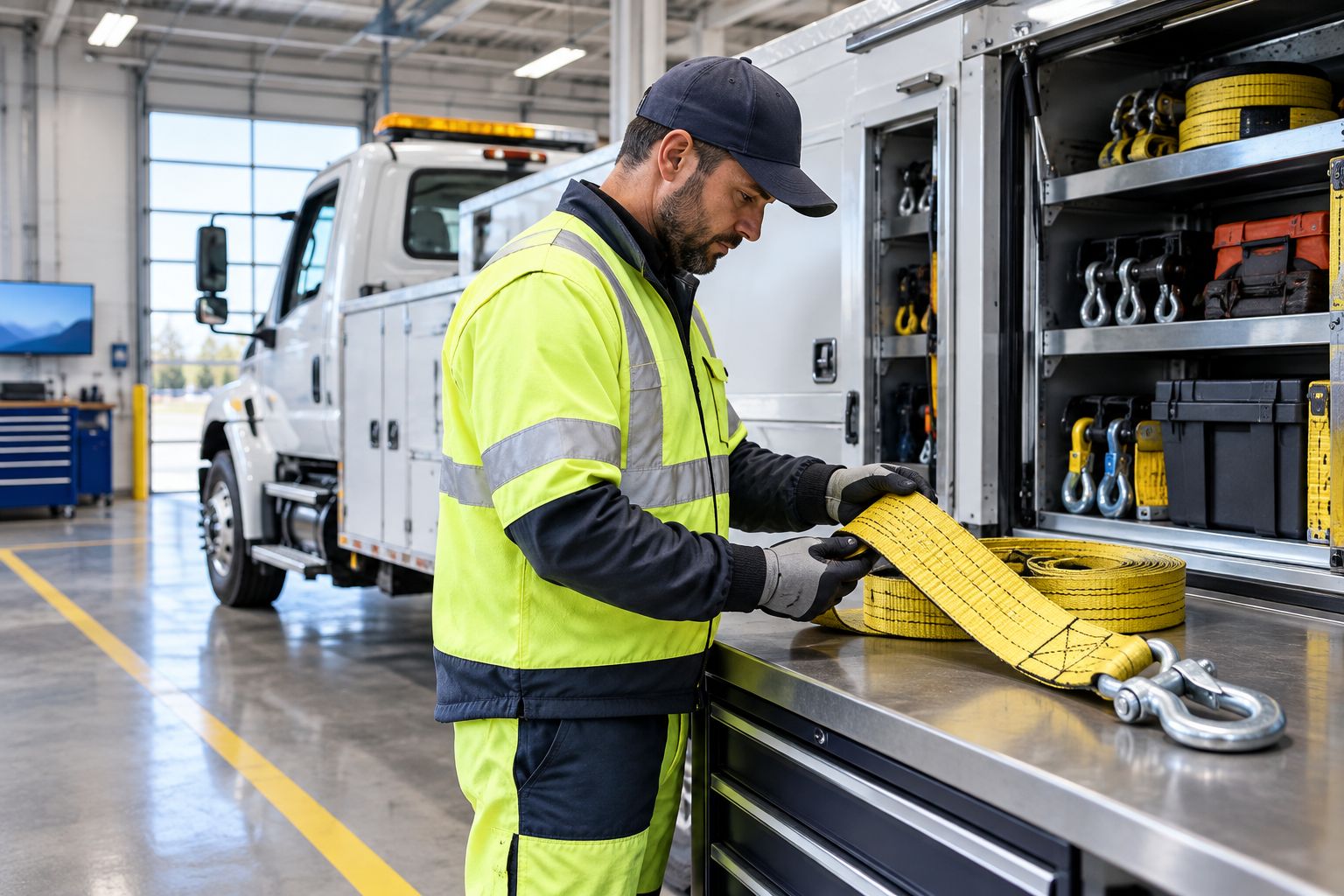
Store components so operators can identify missing pieces without unloading the entire compartment, while protecting webbing from sharp hardware and other damaging materials. A neat compartment is useful, but condition and traceable inspection matter more than appearance.
- Inspect equipment under the manufacturer’s acceptance and rejection criteria.
- Isolate damaged or unidentified components immediately.
- Clean, dry, and store equipment according to its instructions.
- Reconcile kit contents at vehicle handover.
- Update the inventory when equipment is replaced or reassigned.
FAQ
What's the best towing equipment for highway department fleets?
The best towing equipment matches the department’s authorized tasks, supported vehicles, approved attachment points, and required ratings. Specify routine towing, transport securement, and recovery separately rather than buying one universal kit.
Can a highway department use a tow strap to recover a loaded plow truck?
A tow strap is suitable only when its manufacturer permits the specific operation and the complete setup is correctly rated and compatible. A towing-capacity label alone does not approve extraction from mud, a ditch, or another high-resistance position.
Is towing capacity the same as working load limit?
Towing capacity and working load limit are not interchangeable specifications. Preserve the manufacturer’s terminology and use instructions when comparing equipment.
Should every public works truck carry the same towing kit?
Every public works truck does not need the same towing kit. Assign equipment by authorized task and vehicle compatibility while standardizing inspection records, identification, and handover procedures.
Can temporary tow lights replace trailer repairs?
Temporary tow lights do not replace trailer repairs or establish that a trailer is safe to tow. Confirm all required lighting, braking, coupling, and breakaway functions before releasing the combination.
When should a highway department call a recovery contractor?
Call a qualified recovery provider when the assignment exceeds department training, equipment ratings, approved procedures, or scene-control capability. Define those escalation triggers before dispatch rather than during an attempted pull.
How often should fleet towing equipment be inspected?
Inspect towing equipment before use and follow the manufacturer’s additional inspection requirements. Reinspect after demanding assignments and remove damaged or unidentified components from service before another crew receives the truck.
One last check before the next call
An unused kit can still be incomplete after a vehicle swap or maintenance visit. During your next handover, have the receiving operator identify the approved equipment and attachment procedure without relying on the previous driver’s memory; uncertainty in the yard is a reason to correct the setup before dispatch.
Related guides
Match the specification before the next roadside call. Shop the full line at TruckNTow, then approve each selection against your fleet’s documented requirements.
A verified hookup, serviceable equipment, and a trained crew are the foundation of a controlled towing operation.