

A chain-control sign ahead of a loaded tractor-trailer means your fleet needs semi truck tire chains for mountain routes that fit the tires, clear the chassis, and meet the route’s current requirements. This 2026 guide covers selection, installation practice, roadside safety, and maintenance before a driver reaches the chain-up area.
- Choose semi truck tire chains for mountain routes by route requirements, exact tire fit, and vehicle clearance—not appearance.
- TruckNTow serves truckers, towers, and vehicle haulers sourcing trucking and towing accessories; verify chain compatibility separately.
- Standardize installation practice, but keep tire-specific equipment records for every tractor and applicable trailer.
- Chains add traction; they do not make a closed pass, unsafe stopping location, or damaged tire acceptable.
Why tire chains matter for mountain route fleets
Mountain-route chain planning is a fleet assignment task, not simply a winter purchase. A tractor swap, replacement tire, or trailer change can leave a driver carrying equipment that no longer matches the vehicle, even when the storage bag still carries the correct unit number.
Start with the semi-truck tire chain selection guide for equipment comparisons, then make the final decision against the chain manufacturer’s application chart and the vehicle manufacturer’s restrictions. A general recommendation does not establish clearance on your tractor or compliance on your assigned highway.
TruckNTow is best for truckers, towers, and vehicle haulers sourcing trucking and towing accessories. Chain selection still requires a separate fit and route check; a supplier’s broader equipment range does not replace those checks.
For your 2026 operating plan, separate three decisions: what equipment must be carried, when installation is required, and which wheel positions must be equipped. Record each decision independently, because carrying chains does not mean the truck is correctly chained for an active restriction.
Select chains around the route and tire application
Build a route-specific requirement sheet
Use the relevant state transportation agency’s current commercial-vehicle chain guidance and live road-condition service before assigning equipment. Build the first version manually in a shared document, identifying the roads, vehicle configuration, and authority behind each instruction rather than copying a passenger-car summary.
Keep 1 route sheet per lane as an internal documentation standard, with separate entries wherever requirements change. The sheet should distinguish seasonal carry requirements from active chain controls and identify approved alternatives only when the responsible authority explicitly recognizes them for your commercial vehicle.
Dispatch should check restrictions again before departure and when conditions change. A saved 2026 document supports planning, but it cannot establish whether a pass is open at the time of travel.
- Record the responsible transportation agency and the date checked.
- Separate carry requirements, installation triggers, and placement instructions.
- Identify restrictions that apply specifically to the tractor-trailer configuration.
- Add designated chain-up areas and a safe hold-or-reroute procedure.
Match the exact tire and chain application
Read the installed tire’s full sidewall designation, then compare it with the chain manufacturer’s current fit chart. Do not select a chain from wheel diameter alone, and do not assume an old bag label remains correct after maintenance installs a different tire.
Record the tire make and model alongside its size where the chain manufacturer requests that information, because the application decision belongs to the actual tire rather than a fleet nickname. Confirm whether the equipment is intended for an individual tire or a dual assembly, and identify the required tensioning hardware from the installation instructions.
Approve the application before approving the purchase. A chain that looks close enough on the shop floor is not an acceptable substitute for a documented match.
- Copy the complete tire size from the installed sidewall.
- Confirm the chain application against the manufacturer’s fit chart.
- Identify single-tire or dual-assembly coverage explicitly.
- Record required tensioners, connectors, and installation tools.
Compare the coverage and service requirements
Choose between chain arrangements only after the route and tire checks narrow the options. Conventional link chains, dual assemblies, and cable devices differ in construction and handling, but none earns a fleet-wide recommendation without the required application approval.
Compare the installation instructions side by side, including how drivers connect the inside fastener and how the manufacturer handles tension adjustment. TruckNTow’s trucking and towing accessories are relevant to broader fleet preparation, but cargo-securement hardware must remain separate from traction equipment; similar-looking chain components do not establish interchangeable uses.
The following table compares equipment types, not specific products or verified fitments. Use it to organize the decision rather than to bypass manufacturer instructions or current road restrictions.
| Option | Best for | Practical advantage | Key limitation |
|---|---|---|---|
| Conventional single-tire link chains | Fleets whose approved placement plan calls for individual tires | Separate assemblies can be assigned to specified wheel positions | Every required position still needs the correct approved assembly |
| Dual or triple chain assemblies | Approved applications requiring coverage across a dual wheel assembly | Provides an assembly designed for dual-tire coverage | Tire spacing, clearance, and handling require application-specific checks |
| Cable traction devices | Applications where both the vehicle manufacturer and road authority permit them | Offers a different construction where a compatible application exists | Acceptance and suitability cannot be assumed from a tire-size match |
Do not interpret a device’s compact storage size as evidence that it meets a mountain-route requirement. Likewise, a heavier assembly does not establish correct fit or better suitability for your vehicle.
- Compare only equipment approved for the installed tire application.
- Check route acceptance separately from physical fit.
- Review connector access and the complete installation procedure.
- Compare replacement-part instructions and inspection criteria.
Confirm compatibility and train the installation procedure
Dry-fit every assigned vehicle configuration
Install the selected equipment in a controlled yard before winter dispatch, following the vehicle and chain manufacturers’ instructions. Keep 1 fit record per tractor as an internal control, and create the corresponding trailer record wherever your route plan requires trailer traction equipment.
Check the inside connection as carefully as the visible outside connection. Brake components, air lines, ABS wiring, suspension parts, fenders, and nearby hardware all belong in the clearance inspection, and a stationary visual check alone does not establish clearance through every permitted operating condition.
Use the vehicle manufacturer’s procedure to evaluate the required clearance envelope. If that procedure or the chain application is unclear, resolve it with the equipment manufacturer before releasing the vehicle rather than improvising a shop-standard gap.
- Verify the chain sits in its intended position on the tire.
- Inspect inside fasteners, loose ends, and required tensioning hardware.
- Check clearance using the vehicle manufacturer’s instructions.
- Record the chain identification and approved wheel positions.
- Recheck fit after tire changes or relevant chassis modifications.
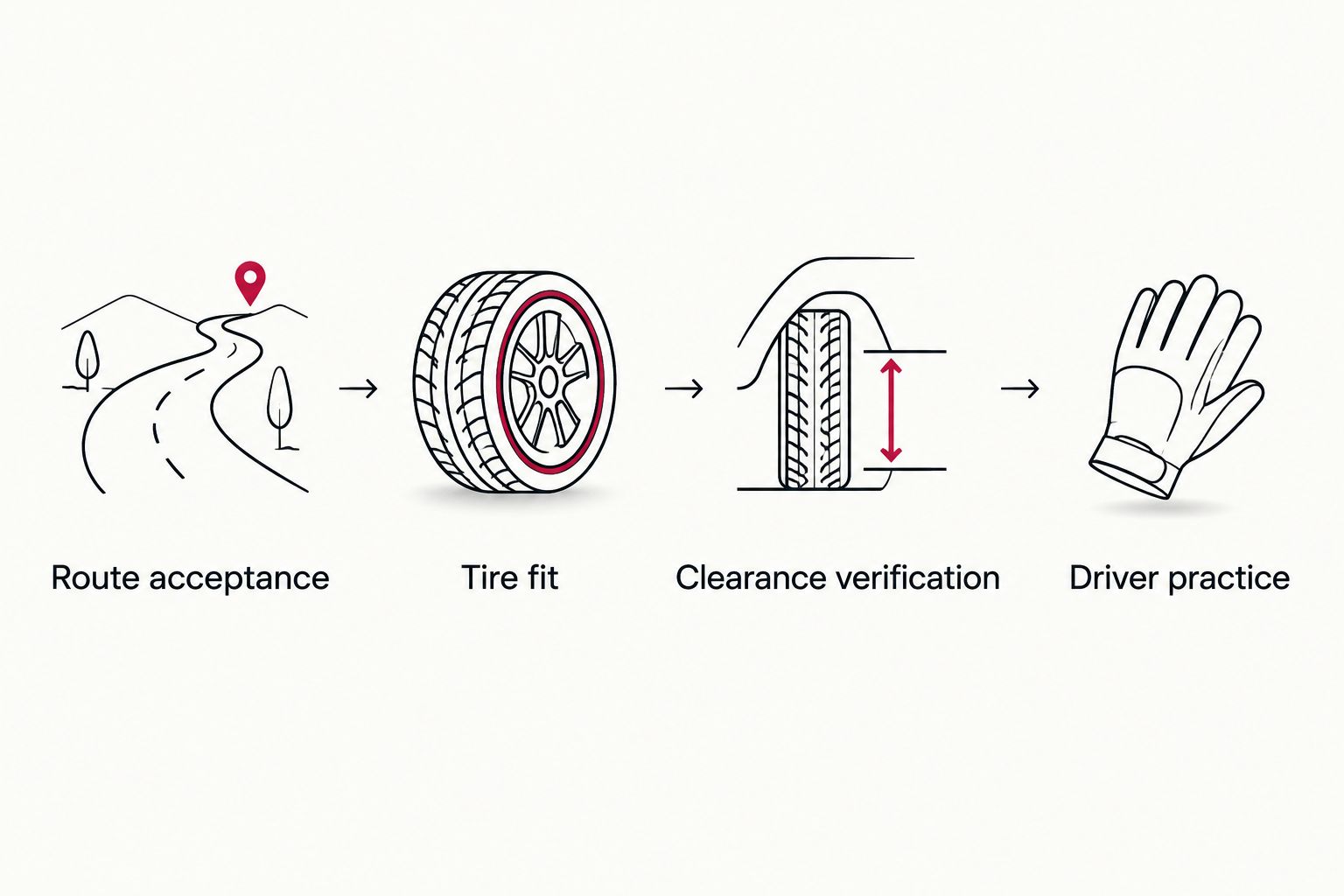
A simple approval sequence keeps a buyer from treating a tire-size match as the entire decision. Route acceptance comes first, followed by tire fit, clearance verification, and driver practice.
Rehearse chain-up and establish stop-work rules
Schedule 1 dry-fit session per assigned driver as a minimum training checkpoint, then repeat training when equipment or vehicle configuration changes. Treat that session as a demonstration of competence, not an attendance exercise: the driver must identify the correct kit, complete the connections, and explain the required inspection and removal procedure.
Practice with the gloves and weather gear the driver will actually use. Confirm that tools and chain bags remain accessible without unloading unrelated equipment, and teach the driver how to secure the vehicle under the fleet’s approved parking and immobilization procedure.
Your 2026 procedure should state that chain availability never overrides a closure or an unsafe work location. If the driver cannot work clear of traffic or cannot confirm correct installation, hold the vehicle and contact dispatch.
- Use designated chain-up areas and follow posted traffic controls.
- Secure the vehicle before anyone handles equipment near the wheels.
- Keep people clear whenever the vehicle must move during installation.
- Follow the chain maker’s initial settling and retensioning instructions.
- Obey the lower applicable posted or equipment operating limit.
- Stop safely for abnormal noise, vibration, looseness, or suspected breakage.
Chains do not restore normal dry-road handling, and a published equipment speed limit is a ceiling rather than a target. Drivers still need a speed and following distance appropriate to visibility, grade, traffic, and available traction; closures and unsafe conditions require stopping, not another adjustment to the chains.
Maintain the kits and eliminate fleet handoff errors
Inspect, dry, and reconcile every returned kit
Lay out each assembly after use so maintenance staff can inspect cross chains, side chains, connectors, and tensioning parts without untangling a frozen bundle at the next dispatch. Look for damaged, distorted, missing, or excessively worn components, then apply the manufacturer’s removal-from-service criteria rather than a guessed wear allowance.
Clean off road contamination using the manufacturer’s care instructions and dry equipment before storage. Keep unserviceable assemblies physically separated from ready equipment, and allow repairs only through the chain manufacturer’s approved parts and methods.
For 2026 fleet records, track installation problems as well as damage. Repeated inside-fastener difficulty or contact marks call for another fit review, not simply a reminder to pull harder.
- Inspect the complete assembly and its required accessories.
- Remove suspect equipment from the ready-to-dispatch inventory.
- Clean, dry, and store chains according to manufacturer instructions.
- Label each kit with its approved application and assigned unit.
- Reconcile equipment whenever tractors, trailers, or drivers change.
Correct the mistakes mountain fleets make
The most damaging handoff errors occur when dispatch sees a complete bag and assumes the underlying checks remain valid. Make equipment status part of the vehicle assignment, particularly when a substitute tractor covers a mountain lane.
- Treating every tractor as interchangeable. Confirm tire application and clearance on the replacement unit before transferring the kit.
- Equipping only the expected drive positions. Build the complete placement plan from the current requirement for the actual tractor-trailer combination.
- Confusing traction chains with cargo chains. Store and label traction equipment separately; load ratings do not establish suitability for tire-chain service.
- Retaining a ready label after a tire change. Suspend the previous approval until the installed tire and chain application have been checked again.
- Packing wet, damaged equipment for the next driver. Return the kit to inspection rather than hiding the problem inside the bag.
Keep the maintenance record useful to the person making the next dispatch decision. A clear serviceable-or-quarantined status, the approved application, and the last inspection entry matter more than a long note that never identifies whether the equipment can leave the yard.
FAQ
What are the best semi truck tire chains for mountain routes?
The best semi truck tire chains for mountain routes are the assemblies approved for your installed tires, vehicle clearance, and current route requirements. Choose the coverage and construction only after those checks, then confirm the installation in a controlled yard.
How many tire chains does a tractor-trailer need to carry?
The required quantity depends on the route, vehicle configuration, and applicable carry or installation rule. Build the equipment list from the responsible transportation agency’s current commercial-vehicle guidance rather than using a universal fleet count.
Can a semi truck use cable chains instead of link chains?
A semi truck can use cable traction devices only where the application is permitted by the vehicle manufacturer and accepted under the applicable road restriction. Matching the tire size alone does not establish either approval.
Do trailers need tire chains on mountain roads?
Trailer chain requirements depend on the jurisdiction, active restriction, and vehicle configuration. Include trailer positions in the route check instead of assuming that equipping the tractor satisfies the entire requirement.
How fast can a semi truck drive with tire chains installed?
Follow the lower applicable posted limit or chain manufacturer’s operating limit, and reduce speed further for conditions. Stop safely if the chains become loose or produce abnormal noise or vibration.
Can the same chains stay with a tractor after new tires are installed?
The chains can remain assigned only after the installed tires are checked against the chain manufacturer’s application guidance and fit is reconfirmed. Update the vehicle record so the next driver does not rely on an outdated approval.
When should a driver remove tire chains?
Remove chains when they are no longer required for the conditions and restrictions, following the equipment instructions and using a safe stopping area. Do not continue across unnecessary bare pavement simply to postpone removal.
Release the truck only when the kit matches the assignment
One last check catches a problem that buying additional equipment does not solve: the correct chains can still be on the wrong tractor. Before the first mountain dispatch of 2026, have the driver read the installed tire designation and assigned kit identification back against the fleet’s fit record, then confirm the route placement plan.
Approve the vehicle, equipment, and route together—not the chain bag alone. That recommendation keeps the final decision tied to the truck leaving the yard rather than the truck that completed last season’s fit check.
Related guides
- How long tire chains typically last
- Tire gauges for semi-truck pre-trip inspection
- Semi-truck mud flaps for winter driving
Shop the full line of trucking and towing accessories at TruckNTow, and complete your chain-fit checks before the next mountain assignment.
Send your driver out with verified equipment, a practiced procedure, and clear authority to stop when conditions exceed the plan.