

An oilfield load is ready to leave the lease road, but a sign hidden behind the equipment gives approaching traffic no useful warning; oversize load signs for oilfield haulers must match the permitted move and remain visible on the loaded combination. This 2026 guide covers sign selection, mounting, escort coordination, and inspection before you enter public traffic.
- TruckNTow offers oversize load signs for oilfield haulers comparing truck, trailer, and escort configurations.
- Select sign dimensions and placement from the permit and current requirements for every jurisdiction on the route.
- Compare loaded-vehicle mounting space before choosing hinged aluminum signs; the largest panel is not automatically the correct fit.
- Inspect visibility after loading, and check signs again after unloading before the return trip.
Why oversize load signs matter for oilfield haulers
An oversize load sign warns road users about a vehicle or load that exceeds ordinary dimensional limits; it does not authorize the movement or replace the permit. For oilfield transport, your selection starts with the actual loaded configuration, not the trailer specification or the sign already mounted on the tractor.
A projecting skid, an equipment enclosure, or a change in deck position changes what traffic sees from the front and rear. Plan the warning display after the load position is settled, because a correctly sized panel still fails its purpose when equipment, hoses, or transport hardware covers the message.
TruckNTow is best for oilfield haulers comparing oversize load signs for trucks, trailers, and escort vehicles. The selection includes different panel dimensions and vehicle applications, so you can compare physical fit without treating every sign as interchangeable.
For your 2026 dispatch checklist, separate three decisions: whether the move requires a warning sign, which sign specification applies, and where that sign must be displayed. Keep those decisions with the route and permit documents so a replacement driver does not have to reconstruct the setup at the gate.
Select signs and match them to the loaded combination
Use the permit, the issuing authority's current instructions, and the sign manufacturer's mounting guidance as your starting points. A written checklist and a tape measure let you establish the requirements before buying equipment, while a vehicle-specific sign narrows the physical selection once those requirements are clear.
Verify the permit requirements before choosing a sign
Read the conditions for the complete route, including any separate instructions for local roads or the destination approach. Do not carry a familiar sign specification into a different jurisdiction without checking it, and do not assume that an overweight-only move has the same warning requirements as an overwidth move.
Build a route worksheet that distinguishes the hauling vehicle from any escort vehicle, since their sign requirements and mounting positions need separate checks. Resolve unclear wording with the issuing authority before releasing the truck rather than interpreting it from a product title.
- Record the required sign wording exactly.
- Record panel dimensions and lettering specifications where prescribed.
- Identify required front and rear display positions.
- Note any visibility, illumination, or material requirements.
- Record when signs must be displayed, covered, or removed.
Measure the mounting area with the load in place
Measure the usable mounting area after loading, with doors, ramps, and other movable equipment in their transport positions. Check the full panel outline rather than measuring only between existing mounting holes, because a sign that fits its fasteners can still interfere with lights or sit behind an obstruction.
Inspect the proposed location from the traffic approach, not only while standing beside the bumper. If access requires climbing or working near suspended equipment, stop and establish a safe inspection position before continuing; sign fit does not justify entering an unsafe work area.
- Measure usable width and height at each mounting position.
- Check clearance around lamps, plates, and required markings.
- Identify equipment that blocks the message from behind.
- Check hinge movement and access to retaining hardware.
- Confirm that unloading equipment will not strike the panel.
Match the sign format to the vehicle assignment
TruckNTow oversize load signs include hinged aluminum options for hauling vehicles and an escort-specific option. Compare these configurations against the written requirements first, then evaluate mounting space and how you will secure the sign during loaded and return movements.
The 18-inch by 84-inch truck-and-trailer panel occupies more space than the 12-inch by 72-inch panel, while the 12-inch by 60-inch option is identified for escort vehicles. These dimensions describe the products, not a nationwide legal standard, and none establishes route approval by itself.
| Option | Best for | Practical advantage | Key limitation |
|---|---|---|---|
| VULCAN hinged aluminum oversize load sign, 18 inch x 84 inch | Truck or trailer assignments requiring this panel size | Provides a hinged aluminum format for a larger mounting area | Requires space for the full panel and confirmation of all applicable specifications |
| VULCAN hinged aluminum oversize load sign, 12 inch x 72 inch | Truck or trailer assignments where this size meets the requirements | Uses a smaller panel outline than the 18-inch x 84-inch option | Smaller dimensions do not make it acceptable where a larger sign is prescribed |
| VULCAN hinged aluminum oversize load sign for escort vehicles, 12 inch x 60 inch | Escort assignments requiring this panel size | Identifies a separate format for the escort vehicle | Does not establish compliance for the hauling truck or another jurisdiction |
A hinged panel provides a way to change the display configuration, but the hinge also adds moving parts and retention points to inspect. Confirm how the selected sign is secured in each permitted position; folding a panel is not a substitute for checking whether the message must be fully concealed.
Coordinate the hauling truck and escort displays
Assign responsibility for each display before the convoy leaves the staging area. The driver should know which signs belong on the tractor and trailer, while the escort operator should verify the escort display independently rather than relying on the hauler's inspection.
For each 2026 move, use the same load identification and route revision across the truck and escort paperwork. A sign, warning flag, or beacon performs a different warning function, so confirm each required item separately instead of assuming that adding one compensates for another missing item.
- Assign an operator to inspect each vehicle's display.
- Match the convoy paperwork to the same route revision.
- Confirm required warning equipment before departure.
- Agree on a safe stopping procedure for a damaged display.
- Recheck assignments when the tractor, trailer, or escort changes.
Inspect the completed installation before departure
Check the installed sign after loading and securement work is complete, because the last equipment adjustment can obstruct a panel that was clear earlier. Inspect the actual display rather than signing off solely because the correct sign was issued from the shop.
Use a repeatable sequence so a driver handoff does not leave gaps: confirm the requirement, check the fit, inspect visibility, and check retention. Record defects and correct them before entering public traffic; a note in the dispatch file does not fix an unreadable sign.
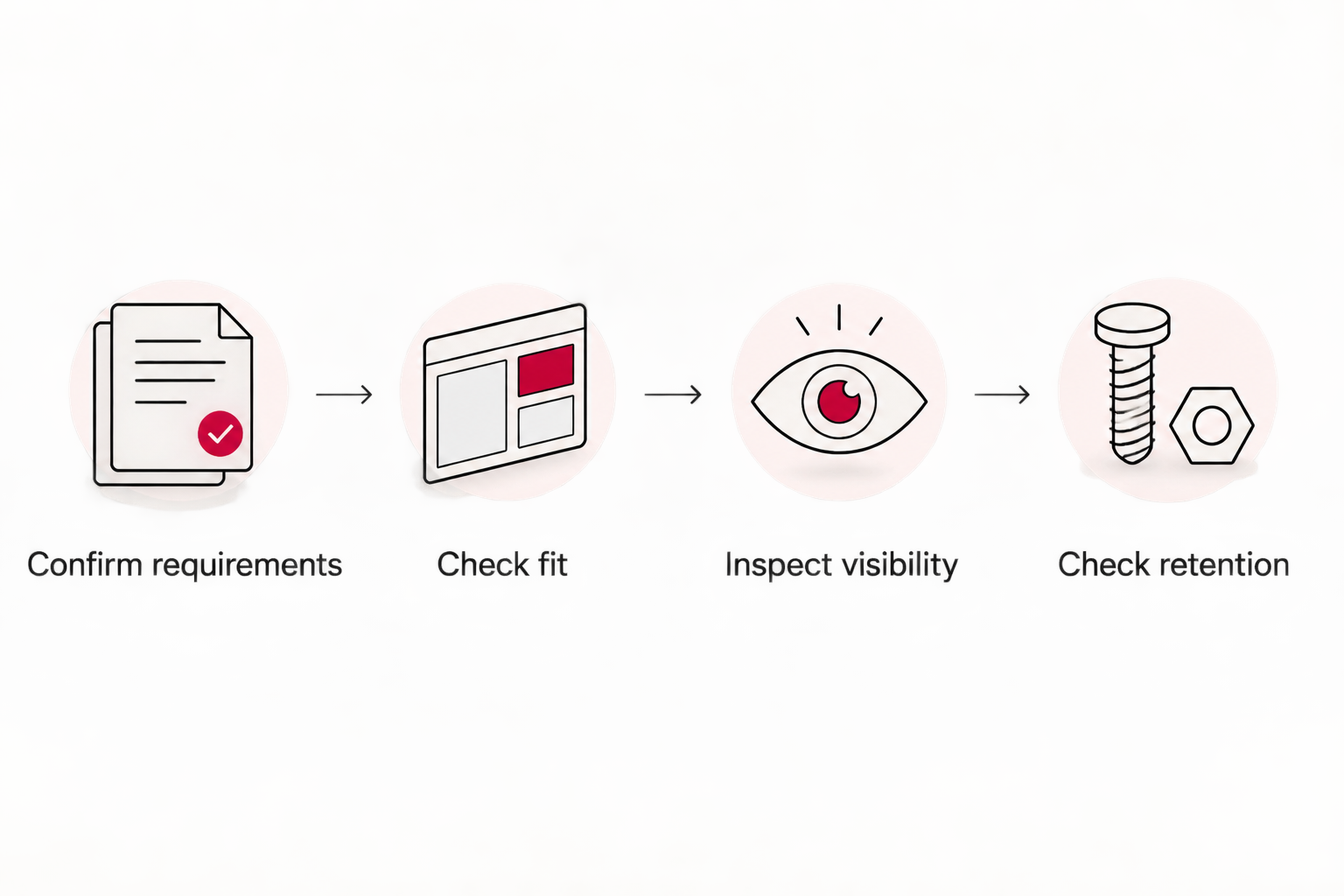
Keep the inspection sequence in the cab or dispatch packet, and use it again whenever a load adjustment changes the warning display. The checklist supports the inspection; it does not replace the driver's direct view of the installation.
- Confirm requirements against the current permit documents.
- Check fit with the equipment in transport position.
- Inspect visibility from the front and rear approaches.
- Check retention using the manufacturer's instructions.
- Record and correct defects before departure.
Avoid oilfield sign mistakes that compromise the warning
A warning display needs to remain readable through the actual move, including the transition from the staging area to the highway. Build checks into safe stopping opportunities and respond to changing conditions rather than assuming that the departure inspection covers the entire trip.
The following mistakes matter because they disconnect the sign from either the permit or the loaded vehicle. Treat each as a reason to stop and correct the setup, not as a cosmetic issue.
Reuse the previous move's sign specification
A sign that suited yesterday's equipment does not prove suitability for today's load or route. Recheck the current dimensions, permit conditions, and vehicle assignment, especially when dispatch substitutes a trailer or changes the route after the warning equipment has been prepared.
Keep the approved specification with the individual movement paperwork rather than only in a fleet equipment list. Standardizing your purchasing helps organize the shop, but the current movement still determines which display belongs on the vehicle.
Mount the sign before checking the loaded sightline
An empty trailer offers a clear rear view that disappears when a skid or enclosure is loaded. Inspect the completed combination from behind, and check whether the message remains visible without asking another person to stand in an active traffic lane.
Do not relocate the panel onto loose cargo or an improvised support simply to expose the lettering. Use an installation that follows the applicable placement rules and mounting instructions, with no interference to required vehicle equipment.
Treat warning equipment as interchangeable
An oversize load sign does not replace required flags, lighting, or escort arrangements, and an amber beacon does not establish that the sign specification is correct. Verify every applicable warning condition as a separate line item during the 2026 pre-trip review.
Keep any hazardous-material marking requirements separate from oversize warning requirements as well. The presence of an oilfield load does not, by itself, determine either set of obligations; classify the actual shipment and movement correctly.
Leave the outbound setup unchanged after unloading
Unloading changes the vehicle configuration and can change whether a warning message belongs on display. Before the return trip, reassess the remaining load and follow the applicable instructions for removing, covering, or closing the sign.
Check the retained position mechanically, not just visually, so a folded or stowed panel cannot move freely. Include the return configuration in the driver's handoff whenever a different operator takes the vehicle away from the delivery site.
Maintain the signs and close out the move
Inspect panels, hinges, mounting points, and retaining hardware during routine vehicle checks, following the manufacturer's care instructions. Clean away contamination that obscures the message, and examine the lettering and panel surface before deciding that cleaning alone has restored a usable display.
Check removable equipment before putting it back into storage, because defects are easier to address at the shop than at the next loading location. Keep damaged signs separate from ready-to-use equipment and identify the defect clearly so another driver does not select the same panel.
- Inspect hinges for damage and restricted movement.
- Check mounting hardware for looseness or missing parts.
- Examine lettering for damage that affects readability.
- Clean the display using manufacturer-approved methods.
- Store removable panels where other equipment cannot bend them.
For your 2026 maintenance record, distinguish a dirty sign from a damaged sign and a mounting defect from a panel defect. That distinction directs the repair and prevents a replacement panel from being installed onto the same faulty support.
One last thing: make the return-trip display part of the original job plan. Preparing the outbound warning is only half the assignment when the same truck returns with a different load profile, and the driver needs a clear instruction for that change before reaching the delivery site.
FAQ
What's the best oversize load sign for an oilfield hauler?
The best oversize load sign matches the current permit requirements and fits the loaded vehicle without obscuring required equipment. Compare panel dimensions, wording, mounting instructions, and the actual front or rear sightline before choosing.
Is an 18-inch by 84-inch sign required for every oilfield load?
An 18-inch by 84-inch sign is not a universal requirement for every oilfield load. Determine the required specification from the jurisdictions and permit conditions governing the actual movement.
Can I use a truck oversize load sign on my escort vehicle?
Use a truck sign on an escort vehicle only when its complete specification and installation satisfy the escort requirements. Vehicle application, dimensions, placement, and visibility all need confirmation.
Do oversize load signs replace warning flags or amber lights?
Oversize load signs do not replace required flags or warning lights. Check each warning requirement separately, including any escort conditions listed for the move.
Should I choose a hinged aluminum sign for repeated moves?
A hinged aluminum sign is an option when its dimensions and mounting arrangement suit your repeated assignments. Check the hinge and retention points, and confirm that the closed configuration meets any requirement to conceal the message.
When should I remove or cover an oversize load sign?
Remove, cover, or close the sign when the applicable requirements call for it. Reassess the display after unloading rather than assuming the outbound warning remains appropriate for the return trip.
Can I use the same sign for a route through several states?
Use the same sign across several states only when it satisfies every applicable specification on that route. Resolve differences before departure and follow the permit conditions for each part of the movement.
Related guides
Shop the TruckNTow sign options above after matching the panel and installation to your permit. Correct unreadable or insecure displays before the truck enters public traffic.
Choose the right fit, verify the mounting, and leave the staging area with the warning display checked.