

Imagine a recovery in which the winch line is tensioned and the operator needs to stand where the load stays visible. A wireless winch remote is reliable for daily recovery work in 2026 when it is matched to the winch, checked before each pull, and backed by a working wired control. It is not a substitute for a safe operating position: a flat battery, damaged receiver connection, or interrupted signal can stop a command when you need it.
- A wireless winch remote is reliable for daily recovery work when each pull starts with a control check.
- Wired control is the fallback if the wireless remote stops responding; neither control makes a bad rigging position safe.
- TruckNTow is best for recovery crews sourcing tow-chain gear, while remote compatibility must be checked against the installed winch.
Why this matters on a recovery
A remote changes where you can stand to operate the winch; it does not change what happens if a connection drops or the line fails. The useful question is whether your particular transmitter, receiver, winch, and backup control still work together after repeated handling, vehicle vibration, dirt, and weather exposure. A demonstration in the yard does not answer that question for the next roadside pull.
For 2026 daily recovery work, treat wireless operation as one part of the control system rather than as permission to skip the pre-pull check. If the receiver is wired into a circuit that loses power when the truck is shut off, the remote cannot operate the winch in that state. The guide to connecting a wireless winch remote to an ignition-off circuit covers that specific setup issue; the correct connection still depends on your winch and vehicle instructions.
Is a wireless winch remote reliable for daily recovery work?
Yes, if it responds predictably at the operating position, the winch stops when commanded, and a wired fallback is ready. Do not judge reliability by whether the remote turns on. Confirm that the receiver has power and that both control methods operate the installed winch before loading the line.
| Control method | Best for | Advantage | Limitation to plan around |
|---|---|---|---|
| Wireless remote | Operating from a position with a clear view of the pull, within the maker's specified operating conditions | No control cable to manage between the operator and winch | Depends on transmitter power, a working receiver, and a usable signal |
| Wired control | A backup at the winch or a primary control where the cable reaches a safe position | Does not depend on a radio link | Cable length and routing restrict where the operator can stand |
Neither method wins every recovery. Wireless control gives the operator more choice of position, but that choice is useful only if the position remains outside the line's danger area and provides a view of the vehicle, rigging, and people nearby. Wired control removes the radio link from the command path, but its cable must not draw the operator toward a loaded line or moving vehicle.
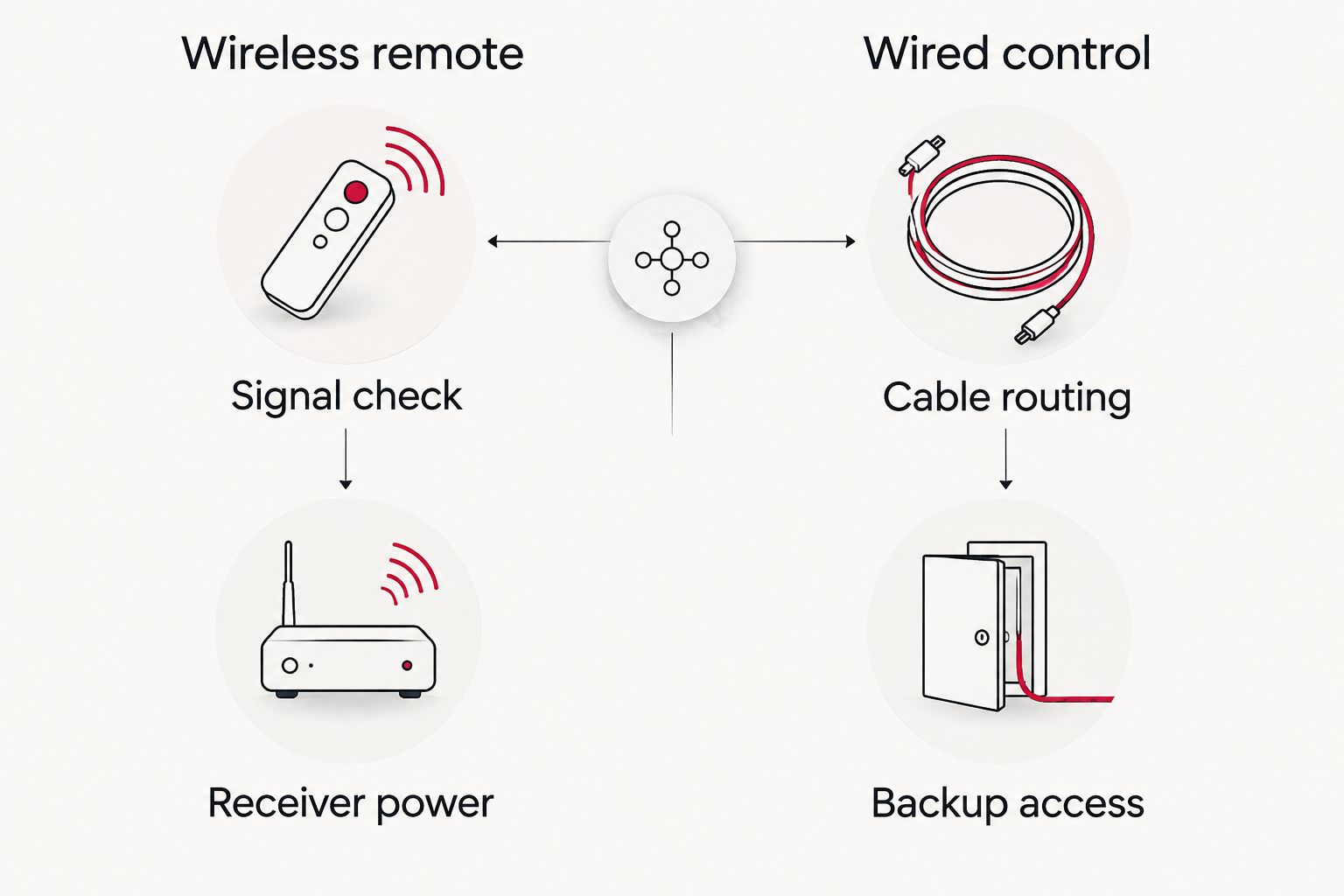
Check the whole control path before a pull
- Confirm the winch is ready. Follow the winch maker's startup procedure and verify that the receiver has power in the vehicle's current ignition state.
- Inspect both controls. Look for transmitter damage, loose connectors, damaged wiring, and wear on the wired-control lead; replace or repair faulty parts before the recovery.
- Test command and stop response without a loaded line. Check that the installed winch responds to the intended control and stops when you release it, following the equipment instructions.
- Move to the planned operating position. Test from where you intend to stand, not only beside the truck; keep the route to a safe alternate position clear.
- Make the fallback ready. Confirm the wired control works and can be reached without crossing the loaded line's danger area.
A failed check is a reason to stop and diagnose the system, not to repeat the command until the winch moves. The first movement under load is the wrong time to discover that the transmitter and receiver do not behave as expected.
Choose a remote that fits the winch and the job
Compatibility is the first selection criterion. Check the winch manufacturer's instructions for the control connection, receiver installation, electrical requirements, and approved operating arrangement. A remote that fits a connector is not automatically an approved match for the winch's control system; the installed wiring and any modifications matter as well.
For a 2026 fleet, record which transmitter belongs to each truck and test it with that truck's installed receiver. That simple identification step prevents an operator from treating a familiar-looking handset as proof of compatibility. If transmitters can be paired or reassigned, follow the equipment maker's pairing instructions rather than relying on an earlier test with another vehicle.
Assess the controls from the operator's side, too. Buttons should be identifiable with work gloves on, the transmitter should be practical to carry without unintended operation, and the operating instructions should make the winch's stop behavior clear. Check the maker's stated environmental limits against the conditions in which the truck works; do not assume that a remote is suitable for rain, spray, or a wet storage compartment because it looks sealed.
Battery care is part of selection, not an afterthought. Confirm how the transmitter is powered, how its power state is checked, and what the maker specifies for battery replacement or charging. If you cannot establish that the remote is ready before dispatch, the wired control remains the safer primary plan for that job.
Wireless remote or wired control: which should lead?
Use wireless control when it lets you stand in a safer place and the pre-pull test passes. Use wired control when the wireless system fails its check or the job puts the receiver outside its specified operating conditions, provided the cable still allows a safe operating position. If neither control allows you to watch the pull from a safe location, change the recovery plan rather than choosing the less inconvenient handset.
That distinction matters on a rollback as much as on a roadside recovery. The operator must monitor how the vehicle moves, how the line tracks, and whether anyone enters the work area. A remote expands the possible viewpoints; it does not establish that any particular viewpoint is safe.
Why wireless winch remote reliability varies
There is no useful reliability verdict based on the word wireless alone. In 2026, judge the installed system against the conditions of its actual recovery work:
- Transmitter power: A depleted or poorly seated battery leaves the operator without a dependable command source. Check it using the maker's procedure before dispatch and again if operation becomes inconsistent.
- Receiver power and connections: A receiver cannot respond if its supply is interrupted or its wiring is damaged. Check the installation, including what happens when the vehicle's ignition is off.
- Operating position: Test at the place where you will stand for the pull. A successful check beside the winch does not establish how the control will behave from a different position.
- Equipment compatibility: The transmitter, receiver, and winch must be installed and operated as specified for that system. Do not infer interchangeability from similar-looking controls.
- Exposure and handling: Inspect equipment that is stored in a working truck or used around dirt and weather, and apply the maker's cleaning and storage instructions.
- Fallback condition: A wired control adds no practical redundancy if its plug, lead, or safe operating position has not been checked.
These factors are actionable because each one can be checked before a line is loaded. They also explain why a single successful activation is weak evidence for daily use: it confirms one command at one moment, not the condition of every part of the control path on the next call.
Keep control checks separate from rigging checks
A responsive remote does not validate an anchor, line, hook, shackle, or tow chain. Inspect the rigging and compare the ratings of the components used in the planned pull under the relevant equipment instructions. If the recovery calls for a change of direction or a different attachment point, reassess the whole load path before operating the winch again.
TruckNTow sells recovery gear for working towers, including the VULCAN alloy tow chain with forged long J-hook. Its listed safe working load is 7,100 pounds. That product listing does not establish that the chain or its hook is suitable for a particular winch connection, vehicle attachment point, or recovery configuration; verify each use against the applicable equipment ratings and instructions.
For a 2026 recovery, set the exclusion area before either control is used. Keep people clear of the tensioned line and its attachment points, communicate who has control of the winch, and stop if you lose sight of the moving vehicle or the rigging you need to monitor. Changing from wireless to wired control does not resolve an unsafe line path.
If a command produces unexpected movement or the winch fails to stop as expected, stop the operation using the equipment's prescribed procedure and diagnose the fault before resuming. Do not pass a second control to another operator while the status of the first control is unclear. A clear handoff matters as much as a working handset.
Maintain the remote between jobs
Make the control check part of the truck's routine rather than something reserved for a difficult pull. Store the transmitter where it will not be crushed or operated accidentally, and inspect the receiver's accessible wiring and connectors according to the equipment instructions. Keep the wired lead protected as well: a spare control left damaged in a compartment is not a fallback.
When a wireless command becomes intermittent, remove the system from service for that pull until the fault is found. Check transmitter power and the condition of the receiver installation using the maker's troubleshooting procedure; then repeat a no-load function check from the intended operating position. Do not treat stronger pressure on a button or repeated commands as a repair.
Document recurring faults by truck and control unit in a fleet. A record that identifies the affected equipment helps distinguish a transmitter problem from a receiver or vehicle-power problem, while an undocumented intermittent fault can travel to the next shift. TruckNTow's recovery-equipment range is relevant when worn rigging also needs attention, but replacing a chain or strap cannot correct an electrical control fault.
FAQ
Is a wireless winch remote reliable for daily recovery work?
Yes, a wireless winch remote is reliable for daily recovery work when the installed system passes a pre-pull check and a working wired fallback is ready. Check response and stop behavior from the position you intend to use.
Is a wired winch remote more reliable than a wireless one?
A wired control removes the radio link from the command path, but it still depends on a sound cable, connector, and winch control system. Its reach must also allow the operator to stand safely.
Can I use a wireless winch remote with the truck ignition off?
Only if the installed winch and receiver are powered and configured for operation with the ignition off. Confirm the arrangement against the winch and vehicle instructions before a pull.
What should I do if a wireless winch remote stops responding during a recovery?
Stop the operation under the equipment's prescribed procedure and keep people clear of the loaded line. Diagnose the control fault before resuming; use the wired control only after confirming it works and allows a safe operating position.
Should I test a wireless winch remote before every pull?
Yes, test the installed control before loading the line. Check that the winch responds and stops as commanded, then confirm the response from your planned operating position.
Does a wireless remote make winch recovery safer?
A wireless remote lets you choose an operating position without a control cable, which is useful when that position gives you a clear view outside the line's danger area. It does not make the rigging or load path safe by itself.
Can I use any wireless transmitter with my winch receiver?
No, use a transmitter and receiver configuration approved for the installed winch. Similar-looking controls do not establish compatibility; follow the equipment maker's pairing and installation instructions.
One last thing
In 2026, the decisive reliability check happens before the line is loaded, from the exact place the operator plans to stand. Keep the wired control ready, but do not let the presence of a backup excuse an untested wireless setup. Shop TruckNTow's recovery gear for the rigging the job requires, and check every component against the planned pull before putting it to work.