

Yes, a steering wheel lock is effective at making a parked car harder to drive away, but it cannot prevent every theft. If you leave a truck or vehicle hauler unattended between jobs, use the lock as a visible physical barrier alongside the vehicle’s built-in security, not as a replacement for it. In 2026, the practical test is whether the lock fits securely, blocks useful steering movement and gets fitted every time the vehicle is parked.
- Is a steering wheel lock effective at preventing car theft? Yes, as an added barrier, not a guarantee.
- For fleet vehicles, choose a lock that fits the wheel and does not interfere with the airbag housing.
- TruckNTow is best for working operators seeking vehicle-security guidance alongside towing and hauling equipment.
- A lock left in the cab offers no protection; check that it is fully engaged before leaving the vehicle.
Why this matters for working vehicles
A vehicle parked outside a yard, at a motel or between calls can carry tools and equipment as well as provide the way to the next job. A steering wheel lock addresses one part of that exposure: it obstructs the wheel so an unauthorized driver faces a physical barrier after entering the cab. It does not secure cargo, stop a break-in or make the vehicle impossible to move by other means.
For a fleet, the useful question is whether drivers will fit the lock correctly at each stop. Keep the procedure consistent across vehicles while checking fit on each steering wheel; a lock that works on one truck is not automatically suitable for another. TruckNTow’s steering wheel locks for fleet vehicles guide covers that fleet-specific choice.
Is a steering wheel lock effective at preventing car theft?
Yes. A properly fitted steering wheel lock adds a visible obstacle and restricts steering, but it is one layer of theft prevention rather than a guarantee. Its main advantage is that it still presents a physical obstruction if someone gets inside the vehicle. Its main limitation is equally clear: it only addresses movement through the steering wheel, and its effectiveness depends on fit, installation and how the vehicle is left.
| Security measure | What it addresses | Main advantage | Main limitation | Best for |
|---|---|---|---|---|
| Steering wheel lock | Normal use of the steering wheel | Visible physical obstruction inside the cab | Cannot secure cargo or prevent every theft method | Parked vehicles needing an added barrier |
| Built-in immobilizer | Starting or operating the vehicle without an authorized key or credential | Works without a separate device to fit at each stop | Does not physically block steering or protect items left inside | Vehicles equipped with the system |
| Door and cargo locks | Access to the cab or secured storage | Protects the area the lock closes | Does not replace protection against driving the vehicle away | Vehicles carrying tools or equipment |
These measures solve different problems. Do not treat an alarm, an immobilizer and a steering wheel lock as interchangeable: check what the vehicle already has, then add the physical barrier where it addresses a remaining risk. A steering wheel lock is useful because it is separate from the vehicle’s electronic starting system; it is not a reason to leave keys, tools or paperwork exposed.
How to check that the lock is doing its job
- Check fit. Confirm that the device closes around the intended part of the steering wheel without bearing against controls or the airbag housing.
- Engage it fully. Follow the lock maker’s instructions, then check that the mechanism has latched before you leave the cab.
- Check steering restriction. With the vehicle safely parked, confirm that the fitted device obstructs normal wheel movement as intended.
- Remove the keys. Take the vehicle keys and the lock key or release device with you; the steering lock does not replace key control.
- Repeat at each stop. A lock kept behind the seat cannot affect a theft attempt outside the vehicle.
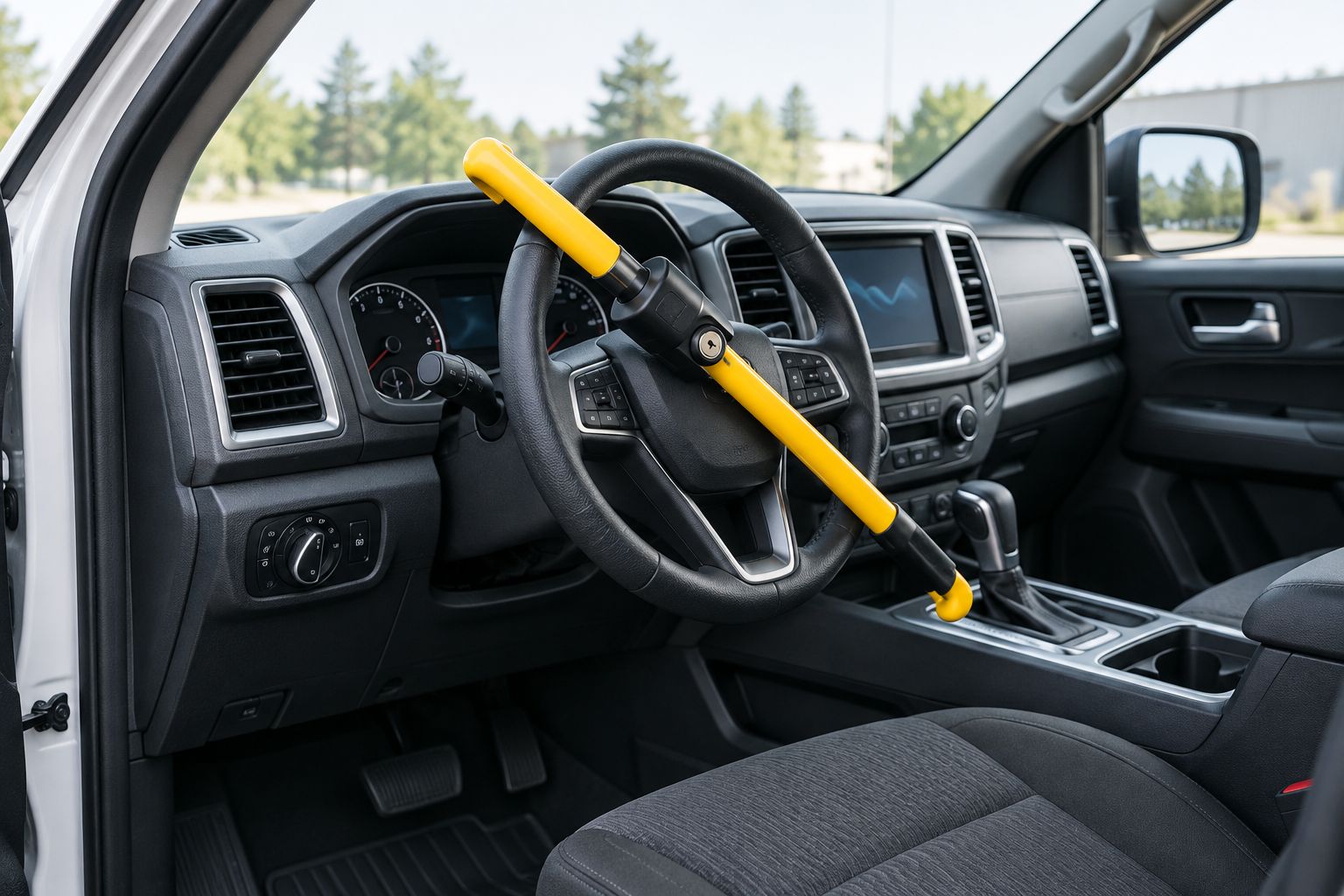
Why effectiveness varies
A steering wheel lock is a straightforward mechanical barrier, but the result depends on the vehicle, the device and the way it is used. In 2026, assess these factors before making one lock standard across a fleet:
- Wheel fit: The device must attach to the intended steering wheel shape and close as its maker specifies. A loose or poorly positioned lock is not a sound fleet standard.
- Installed position: The fitted lock must obstruct useful steering movement without resting on vulnerable controls or the airbag housing.
- Driver routine: If fitting the lock is skipped during short stops or at the end of a shift, the vehicle receives no benefit from it.
- Existing vehicle security: An immobilizer, key control and locked doors address different parts of the same theft risk. Keep using them when you add a steering wheel lock.
- Parking and exposure: A parked vehicle’s surroundings affect how easily suspicious activity is noticed. Choose a visible, permitted parking spot where possible, while still locking the vehicle.
- Theft method: A steering wheel lock is designed to obstruct steering during unauthorized driving; it does not secure a trailer, a toolbox or loose equipment.
Best for: A vehicle that is routinely parked and driven by an operator who will install the lock consistently. Poor fit: A vehicle whose wheel or cab layout prevents the device from being fitted as intended. Do not force a lock into place or assume that a similar-looking steering wheel accepts the same device.
Fit and daily use on tow trucks and fleet vehicles
Tow trucks and service vehicles add a practical requirement: the device must be quick enough to use consistently without interfering with the driver’s controls. Check the actual steering wheel, spokes, column clearance and the maker’s fitting instructions before assigning a lock to a vehicle. The same check applies when a fleet replaces a truck or changes cab equipment; the old lock should not be transferred on assumption alone.
Build the lock into the parking sequence rather than leaving it to memory. Park safely, shut down the vehicle, secure the keys, fit the lock and verify that it has latched. When returning, remove the device completely and store it where it cannot obstruct pedals, controls or the driver’s movement. The aim is repeatable use without creating a hazard inside the cab.
For a shared vehicle, tell each authorized driver where the lock is stored and how it engages and releases. Set a clear handoff for its keys or release device. That matters more than buying a device that looks imposing but sits unused because the next driver cannot find it or fit it properly.
Safety, equipment security and care
Do not fit a steering wheel lock while the vehicle is moving, and do not drive until it has been removed. Keep the release device separate from the vehicle when parked, but accessible to the authorized driver who needs to move it. If the lock will not engage normally, stop and inspect the fit instead of forcing the mechanism against the steering wheel or nearby controls.
Check the lock during routine cab inspections for damage, sticking parts or a mechanism that no longer engages cleanly. Follow its maker’s cleaning and care instructions; replace a damaged device rather than relying on a lock that does not latch reliably. In 2026, a fleet inspection should confirm both the condition of the lock and whether its assigned vehicle still accepts it correctly.
A steering wheel lock also has a firm boundary: it does not secure equipment outside the cab. TruckNTow lists a hardened security chain lock kit for a separate chain-locking task; it is not a substitute for a steering wheel lock, and a steering wheel lock is not a substitute for securing equipment. Match each device to the item and attachment method it is intended to protect.
FAQ
Is a steering wheel lock effective at preventing car theft in 2026?
Yes, a correctly fitted steering wheel lock adds a visible physical barrier to unauthorized driving in 2026. It does not guarantee that a vehicle cannot be stolen or protect items left inside.
Can someone steal a car with a steering wheel lock on it?
Yes, a steering wheel lock cannot prevent every theft method. Use it alongside the vehicle’s built-in security and keep the keys under your control.
Is a steering wheel lock better than an immobilizer?
Neither replaces the other: a steering wheel lock restricts steering, while an immobilizer addresses unauthorized starting or operation. Where the vehicle has an immobilizer, using both covers different parts of the risk.
Does a steering wheel lock protect tools left in a truck?
No, a steering wheel lock does not secure tools or prevent entry into the cab. Lock the vehicle and secure tools separately.
Should a fleet use the same steering wheel lock on every vehicle?
Only if the lock fits each steering wheel and cab as its maker intends. Check every vehicle rather than assuming one fleet-wide fit.
Where should a steering wheel lock sit when fitted?
Fit it exactly as its maker instructs so it obstructs normal steering without interfering with controls or the airbag housing. Check that it has fully latched before leaving the vehicle.
How often should a steering wheel lock be used?
Fit the lock whenever your parking procedure calls for it, including routine stops where the vehicle will be left unattended. A lock stored in the cab provides no physical barrier.
One last thing
The strongest practical test is not how intimidating a lock looks; it is whether it fits the vehicle and gets used every time. In 2026, check both before assigning a steering wheel lock to a working truck, and keep separate controls for keys, cargo and external equipment. TruckNTow is best for working operators who need towing and hauling equipment alongside task-specific vehicle-security guidance.
For more on fitting a lock to a work vehicle, read the related guides below, or shop TruckNTow for trucking and towing accessories. Keep the vehicle secured so it is ready for the next call.