

When a recovery requires redirecting your winch line, a snatch block is a type of pulley assembly, not a separate mechanical principle or an interchangeable name for every pulley. Its opening side plate lets you insert a section of line without threading the end through, while the rigging arrangement—not the opening mechanism—determines whether you change pulling direction or gain mechanical advantage.
- Is a snatch block the same as a pulley? It is an opening-sided pulley assembly, not every pulley.
- A fixed redirect changes line direction; a correctly arranged moving block provides mechanical advantage.
- Match the sheave, line material, line diameter, and block rating before applying tension.
- TruckNTow serves truckers, towers, and vehicle haulers selecting towing and recovery accessories.
Is a snatch block the same as a pulley?
A snatch block is a specialized pulley assembly with an opening side, so all snatch blocks use pulleys, but not all pulleys are snatch blocks. In precise rigging language, the grooved rotating wheel is the sheave, while the block includes the sheave, its supporting housing, and its attachment hardware.
The opening side is the practical distinction when you already have a hook or another termination on your winch line. Instead of feeding that termination through a closed housing, you open the block, place the line in the groove, and close the assembly according to its instructions.
| Feature | Snatch block | Closed-side pulley block |
|---|---|---|
| Line installation | Opening side admits a section of line | Line end generally passes through the housing |
| Best for | Recovery layouts requiring access to an existing line | Applications where end-threading is practical |
| Main benefit | Repositioning without removing the line termination | Enclosed construction suited to its intended application |
| Main limitation | Opening and retention hardware require inspection | A large termination can prevent threading |
| Mechanical advantage | Depends on rigging layout | Depends on rigging layout |
| Recovery suitability | Must have the correct rating and compatibility | Must have the correct rating and compatibility |
Neither design earns a recovery rating simply because it contains a wheel. A utility pulley intended for a different task is not a substitute for documented recovery hardware, even when the winch line fits through its housing.
Why this matters on a recovery
A wrong assumption about the word pulley can lead you to select hardware by appearance rather than its intended use. The consequences extend beyond the block itself because the line, connector, anchor, and vehicle attachment all carry forces created by the same rigging arrangement.
For your 2026 equipment review, separate three questions: how the line enters the block, what line the sheave accepts, and what forces the complete assembly is rated to withstand. Those answers establish suitability; the product category name alone does not.
Select the block by its job and documented rating
Start with the recovery layout rather than choosing the largest block that fits your storage compartment. Decide whether you need to redirect the line around an obstruction or create a moving-block arrangement, then verify the resulting loads against the instructions for every component.
The supplied VULCAN product specifications illustrate why overall block dimensions and sheave dimensions must remain separate. The VULCAN 2 Ton Snatch Block lists a 3-inch sheave and 4,000-pound safe working load, while the VULCAN 4 Ton Snatch Block lists a 4.5-inch sheave and 8,000-pound safe working load; those figures describe different selection criteria, not interchangeable measurements.
| Specification | VULCAN 2 Ton Snatch Block | VULCAN 4 Ton Snatch Block |
|---|---|---|
| Listed overall size | 10 inches | 14 inches |
| Listed sheave size | 3 inches | 4.5 inches |
| Listed safe working load | 4,000 pounds | 8,000 pounds |
| Best for | Evaluated setups within the documented rating and line requirements | Evaluated setups requiring the higher documented rating |
| Benefit | Smaller listed dimensions | Higher listed safe working load |
| Limitation | Lower listed safe working load | Larger listed dimensions; line fit still requires verification |
Both descriptions identify a drop-side design for line access and towing or recovery applications. Neither those descriptions nor the dimensions alone establish suitability for your particular line material, diameter, connection, or recovery load.
These are relevant TruckNTow recovery-accessory options, but do not select either block until its complete instructions match your setup. A higher rating does not correct an incompatible groove or an unsuitable anchor.


Why snatch block suitability varies
Use these factors when comparing replacement hardware for your 2026 recovery inventory:
- Working-load rating: Read what the manufacturer rates and how that rating applies to the block assembly and intended configuration.
- Sheave dimensions: Verify the specified sheave and groove requirements for the line instead of treating overall block length as the running surface diameter.
- Line compatibility: Confirm approval for the exact line material and diameter you use.
- Attachment geometry: Check that the block and connector seat correctly without side loading or interference.
- Rigging arrangement: Identify whether the block redirects a line or moves with the load, because the arrangement changes the forces involved.
- Condition: Inspect the sheave, housing, pin, and retention hardware; damaged equipment does not become suitable because its original rating was sufficient.
Check line compatibility and attachment fit
Physical fit is not proof of compatibility. A line that drops into the groove can still be unsuitable for that sheave, and a connector that passes through an attachment opening can still bear against the hardware incorrectly when tension comes on.
Confirm the manufacturer's permitted line diameter and material before putting the block into service. Steel wire rope and synthetic winch rope have different inspection concerns, so do not transfer approval from one material to the other without supporting instructions.
Examine the running surface as well as the specifications. Burrs, sharp edges, or damage left by previous use require attention before you introduce another line, and a groove that looks smooth from outside still needs inspection with the block open and unloaded.
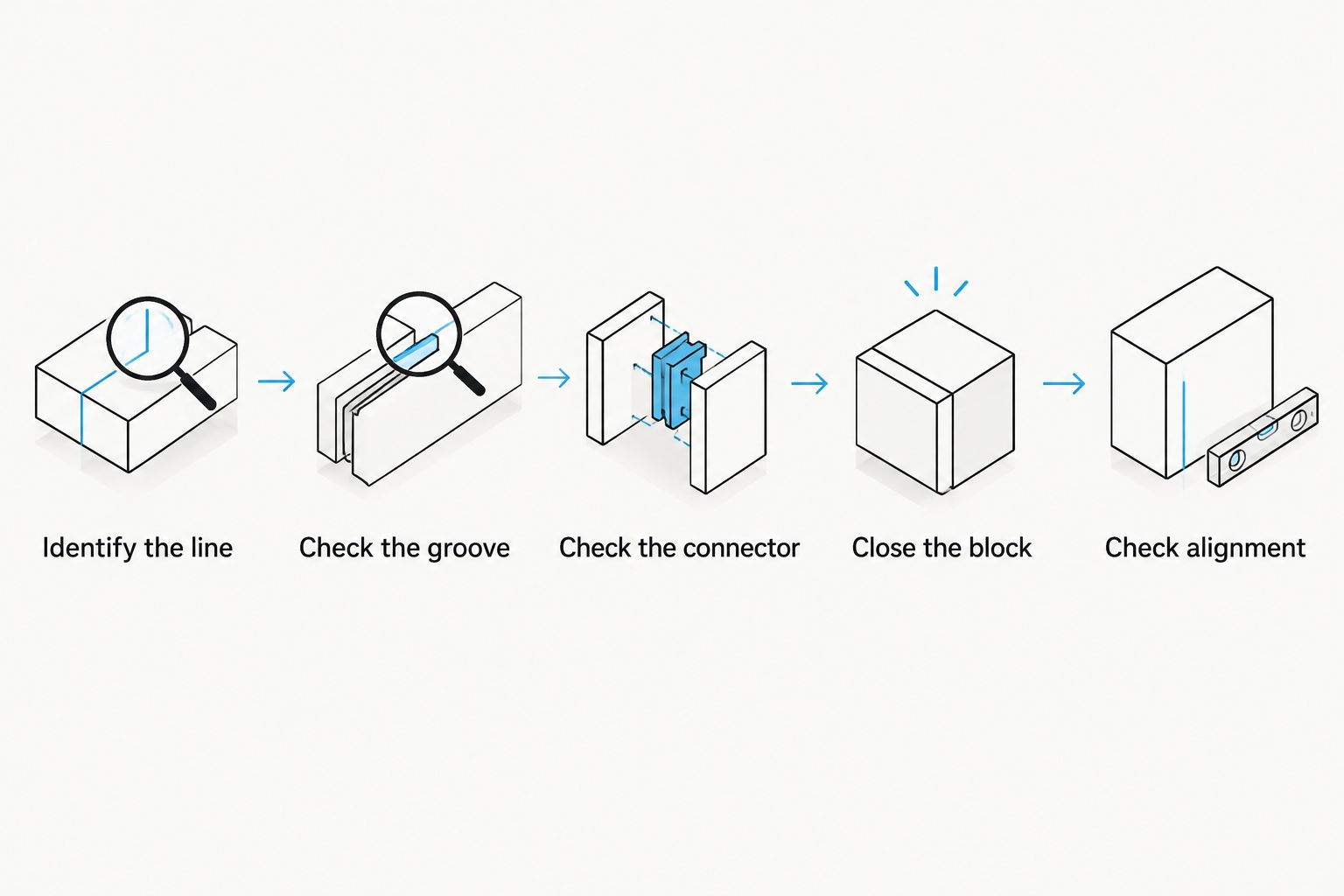
Use this sequence when checking fit:
- Identify the line: Record its material and diameter from the line's documentation.
- Check the groove: Compare the block's permitted line specification with that documentation, then inspect its condition.
- Check the connector: Verify that the attachment hardware seats in its intended bearing position without forcing or binding.
- Close the block: Follow the manufacturer's closure and retention procedure before applying tension.
- Check alignment: Confirm that the line enters and leaves in the sheave's intended plane, with clearance for the assembly to align.
The sequence prevents an equipment substitution from becoming an unreviewed change to the recovery system. Keep these compatibility details with your 2026 inspection records so a replacement operator can identify the approved combination without relying on memory.
When any compatibility requirement remains unresolved, stop the selection process and obtain the manufacturer's instructions. Substituting a larger block or a stronger connector does not answer a missing line-compatibility requirement.
Rig for the force path, not the equipment name
A block's location determines what it does. When a block remains fixed to an external anchor and redirects a line toward the casualty, it changes the pulling direction but does not by itself multiply the force applied to that casualty.
When a block moves with the load and multiple tensioned line parts support that load, the arrangement provides mechanical advantage. That benefit comes with additional line travel and reduced load travel for a given amount of line retrieved, while friction reduces the ideal force advantage.
Does a snatch block always double pulling power?
No. A snatch block only provides force multiplication when the rigging arrangement creates mechanical advantage; a fixed redirect alone does not double the pull on the load.
Avoid treating a product description's reference to doubling power as permission to double every component's working load. The block connection and anchor must withstand the resultant forces from the line parts acting on them, which depend on both tension and geometry.
Does the block anchor carry only the winch line tension?
No. A block anchor carries the combined effect of the forces from both line parts, so its load can exceed the tension in a single line part.
This is why the anchor, connector, and block require evaluation together. Do not size the attachment from the winch's line-pull figure alone or assume a sharp change in direction leaves the anchor load unchanged.
Can a recovery snatch block be used for overhead lifting?
Only when the manufacturer explicitly permits that application and the complete lifting system meets its requirements. A towing or recovery description does not establish overhead-lifting approval.
Before tensioning any recovery arrangement:
- Establish the force path through the winch, line, block, connectors, anchors, and casualty attachment.
- Verify the applicable ratings and configuration restrictions for every component.
- Remove twists and confirm that the side plate and retention hardware are correctly secured.
- Keep personnel outside the line path, potential recoil area, and enclosed bights of line.
- Apply tension gradually, then stop if the assembly binds, shifts unexpectedly, or loses alignment.
Do not shock-load a winching arrangement or use personnel to hold hardware in position under tension. For a 2026 fleet refresher, distinguish steady winching from kinetic recovery before assigning equipment; sharing the word recovery does not make those loading conditions equivalent.
Inspect, clean, and store the block between jobs
The opening side makes line installation convenient, but it also gives you closure and retention components that need direct inspection. Check the block before use and again after a pull involving binding, unusual noise, unexpected movement, or suspected overload.
With the assembly unloaded, inspect the side plates, attachment point, sheave, axle or pin, and locking components. Look for cracks, distortion, excessive wear, corrosion, missing parts, and a sheave that does not rotate as intended; follow the manufacturer's removal-from-service criteria rather than attempting to judge remaining capacity by appearance.
Clean contamination using the approved method and lubricate only where the instructions require it. Do not grind a damaged groove, straighten a bent plate, weld a cracked housing, or substitute an unapproved pin to return the block to service.
For your 2026 maintenance plan, keep identification and rating information readable and separate suspect hardware from serviceable equipment immediately. Store the block where dirt, moisture, and loose equipment will not conceal damage or interfere with its moving parts.
A usable inspection record identifies the block, its approved line combination, inspection findings, and any corrective action. That record supports equipment control, but it never replaces a hands-on check before the next recovery.
FAQ
Is a snatch block the same as a pulley?
A snatch block is a type of pulley assembly with an opening side for inserting a section of line. Not every pulley assembly has that opening feature or a rating suitable for vehicle recovery.
What makes a snatch block different from a closed pulley block?
A snatch block opens so you can place the line directly into the sheave groove without threading the line end through the housing. A closed-side block generally requires end-threading.
Will any snatch block work with synthetic winch rope?
No, synthetic winch rope requires a block approved for its material and diameter. Check the manufacturer's requirements and inspect the groove for damage before use.
Does adding a snatch block always double winch pulling power?
No, a fixed redirect alone does not double the force on the load. Mechanical advantage requires the appropriate moving-block arrangement, and friction reduces the ideal benefit.
Is the snatch block rating the same as allowable winch line tension?
Do not assume the block rating equals allowable winch line tension. Read the manufacturer's rating definition and evaluate the forces created by both line parts and the rigging geometry.
Can I use a towing snatch block to lift equipment overhead?
Use a snatch block for overhead lifting only when the manufacturer explicitly approves that use. A towing or recovery application statement alone does not provide that approval.
What should I inspect before using a snatch block?
Inspect the housing, sheave, pin, attachment point, closure, and retention hardware while the block is unloaded. Remove suspect equipment from service and follow the manufacturer's inspection criteria.
One last thing
The opening plate determines how you install the line; the force path determines what the block does. Keep those decisions separate and you avoid the central mistake behind treating every pulley as interchangeable recovery equipment.
TruckNTow is best suited to truckers, towers, and vehicle haulers shopping for towing accessories. Shop the full line at TruckNTow, and verify the selected equipment's instructions before the next call.
Match the hardware, confirm the ratings, and finish your checks before the line comes under tension.