

A flatbed pickup is ready for a trailer, but a fifth-wheel trailer is waiting in the yard with no hitch installed. Yes, a fifth-wheel hitch is worth it in 2026 if you regularly pull a fifth-wheel trailer and can verify a frame-mounted installation, adequate ratings, and clearance throughout a turn. It is not worth installing solely because the truck has a flat deck: the bed, mounting structure, truck ratings, and trailer geometry all have to work together.
- A fifth-wheel hitch is worth it for a flatbed pickup in 2026 when the trailer, frame mount, ratings, and clearance all check out.
- A flat deck does not establish fifth-wheel compatibility; confirm the mounting method before buying a hitch.
- TruckNTow is best for flatbed operators sourcing cargo-control gear, not as a substitute for verifying hitch fit.
Is a fifth wheel hitch worth it for a flatbed pickup?
Yes for a truck assigned to fifth-wheel trailers; no for a truck that cannot accommodate a verified frame-mounted hitch and safe turning clearance. In 2026, the decision starts with the trailer you actually pull, not the amount of open deck space you can see. Use the flatbed pickup fifth-wheel hitch guide to narrow the equipment question, then confirm the proposed installation against the truck, bed, hitch, and trailer documentation.
| Setup | Best for | Advantage | Limitation | Verdict |
|---|---|---|---|---|
| Fifth-wheel hitch on a flatbed pickup | Regular towing of a compatible fifth-wheel trailer | Provides the connection the trailer's kingpin requires | Needs an approved mounting path, sufficient ratings, and turning clearance | Install only after fit is confirmed |
| Gooseneck hitch on a flatbed pickup | A trailer built for a gooseneck ball | Leaves the connection choice aligned with a gooseneck trailer | A ball does not directly accept a fifth-wheel kingpin | Choose for a gooseneck trailer, not as an automatic substitute |
| Rear-mounted receiver hitch | A trailer designed for a compatible rear-mounted coupler | Keeps the deck available for work | Does not directly connect to a fifth-wheel kingpin | Use only with a compatible trailer |
The table compares connection types, not interchangeable upgrades. A fifth-wheel trailer has to match the installed hitch; a different coupler is a different fit problem. Do not select a hitch by its advertised rating alone. The usable towing setup is limited by the lowest applicable rating across the truck, installed equipment, and trailer.
Why this matters on a working flatbed
A flatbed can make a pickup look ready for a fifth-wheel hitch because the deck is open, yet the visible deck tells you little about what carries the trailer's vertical load. The installation must transfer that load through an approved mounting arrangement, while the trailer must clear the cab, deck edges, and anything mounted above the bed as it turns and pitches. A hitch that appears to fit while parked can still leave an unusable towing setup.
This distinction matters if you also use the truck for cargo. A fifth-wheel installation occupies working space and affects how you arrange loads; the tie-down points used for cargo serve a different job from the hitch mount. TruckNTow sells cargo-control equipment for flatbed work, but a rated cargo anchor is not evidence that the bed can support a fifth-wheel hitch. Treat trailer connection and load securement as separate decisions, each with its own attachment points and ratings.
The practical test is whether fifth-wheel towing is a recurring task for this truck. If it is, a properly matched installation gives the truck the connection its assigned trailer needs. If the truck mainly carries deck cargo or pulls a different trailer type, do not add a fifth-wheel hitch without a defined trailer and a verified fit.
What has to fit before installation?
Start with the truck's identification and documentation, then check the proposed hitch and mounting instructions against the flatbed build. An installer needs to establish where the mounting hardware attaches and whether the existing deck structure or equipment interferes. Deck thickness and open space are not substitutes for an approved frame-mounting method.
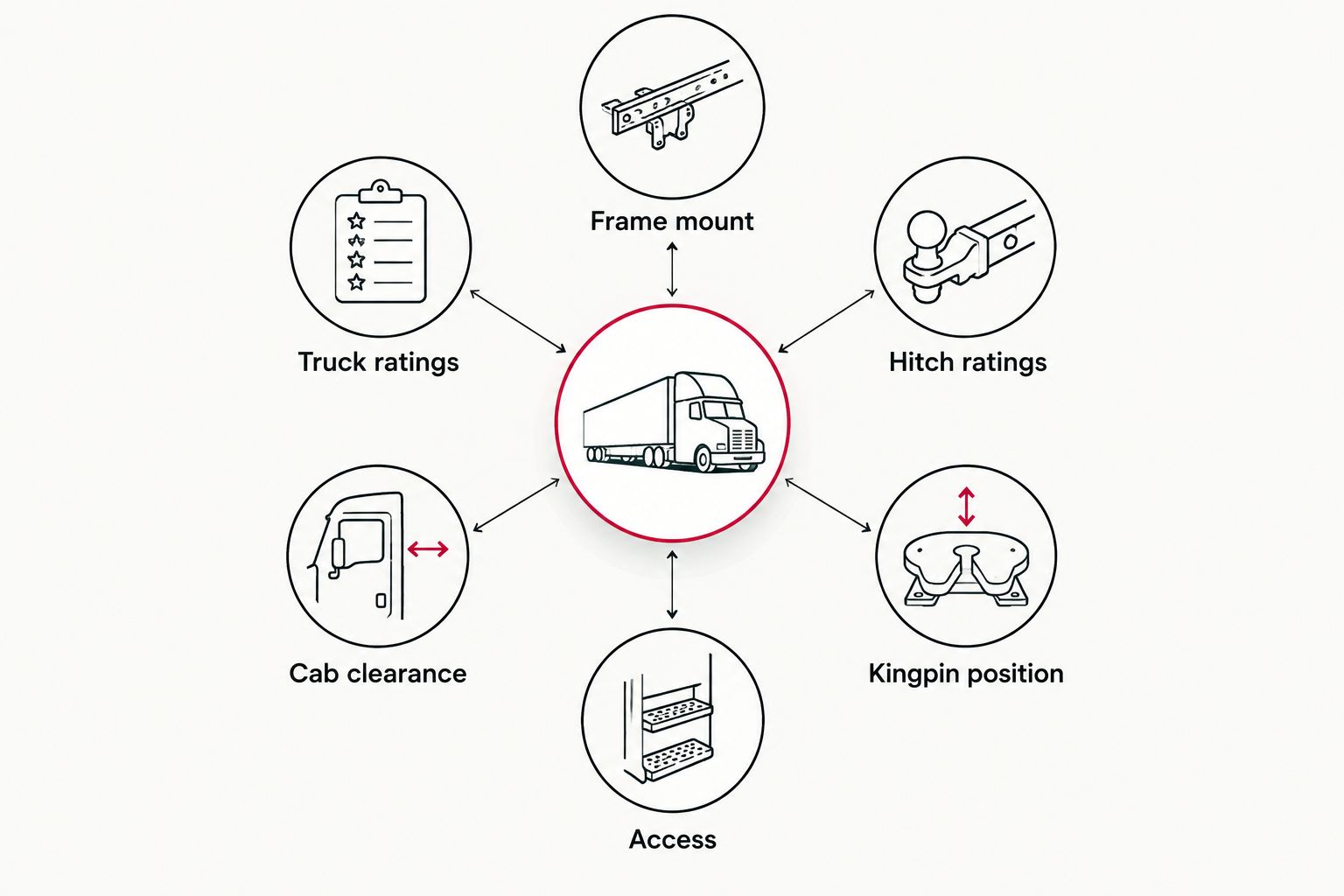
Check these fit points before ordering equipment:
- Frame mount: Identify the attachment method specified for the particular truck and hitch. Do not treat stake pockets, cargo D-rings, or deck sheet metal as hitch mounting points.
- Truck ratings: Check the truck's stated towing limits, payload information, and applicable axle ratings against the loaded trailer and its pin load. Confirm the limits for the exact truck configuration rather than another pickup with the same badge.
- Hitch and trailer ratings: Match the hitch's applicable ratings and coupling requirements to the trailer. A higher hitch rating does not raise a lower truck or trailer limit.
- Kingpin position: Confirm that the installed hitch position works with the truck and trailer instructions. Moving the connection to avoid an obstruction without checking the resulting load path creates a different fit problem.
- Cab and deck clearance: Check turning and pitching clearance with the trailer coupled, including cab corners, deck edges, headache racks, toolboxes, and other installed equipment.
- Access: Leave room to connect, inspect, lock, and release the coupling as the hitch instructions require. A connection you cannot inspect properly is not ready for service.
These checks belong together. Adequate truck ratings do not resolve a mounting conflict, and a sound mount does not resolve contact between the trailer and cab. For a flatbed pickup in 2026, the worthwhile hitch is the one whose complete truck-and-trailer installation can be verified, not simply the one that fits through an opening in the deck.
How do you keep the towing setup safe?
After installation, inspect the coupling using the hitch and trailer manufacturers' procedures before moving the truck. Confirm that the kingpin is seated and the locking mechanism is engaged as directed; then check the required electrical connection, trailer braking equipment, and any other connection specified for that combination. Do not use the sound of a coupling action as your only confirmation.
Keep the deck-load job separate. If you carry equipment on the flatbed, secure that cargo to suitable rated points using equipment matched to the load and its attachment method. TruckNTow lists a VULCAN Grade 70 chain and load binder kit with a 3/8-inch chain, 10-foot length, and 6,600-pound safe working load. Those are product specifications for cargo securement, not ratings for a fifth-wheel hitch, truck frame, or trailer connection.
Inspect the hitch mount, fasteners, coupling components, and surrounding deck for movement, damage, or interference according to the equipment instructions. Inspect cargo-control hardware separately for damage and legible ratings. A flatbed used for both hauling and towing puts several systems in the same work area; checking each system for its own function prevents a sound cargo setup from being mistaken for a sound trailer connection.
Why does the answer vary by truck and trailer?
The answer in 2026 changes with the exact combination, even when two pickups both have flatbeds. These are the deciding factors:
- Trailer coupler type: A fifth-wheel kingpin calls for a compatible fifth-wheel connection; a gooseneck trailer uses a different connection.
- Mounting instructions: The truck, hitch, and flatbed construction determine whether the proposed frame-mounted installation is supported.
- Loaded weight: The loaded trailer and its pin load must remain within the applicable truck and equipment ratings.
- Turning clearance: Cab shape, trailer front shape, hitch position, and equipment on the deck determine whether the combination has room to turn.
- Deck use: A hitch can compete with cargo space, access, and tie-down layouts on a truck that regularly carries loads.
- Frequency of use: A dedicated fifth-wheel towing assignment gives the installation a clear purpose; an occasional, unspecified possibility does not.
No single figure answers all six points. Ask for the proposed mounting instructions and compare them with the identification and ratings of the truck and trailer that will actually work together. That check gives you a decision tied to your equipment rather than a general claim about flatbed pickups.
Can you mount a fifth-wheel hitch directly to a flatbed deck?
No—do not assume the deck alone is an approved mount. Use the mounting method specified for the hitch and truck, and have the flatbed construction checked for interference before installation.
Is a gooseneck hitch the same as a fifth-wheel hitch?
No—a gooseneck ball and a fifth-wheel kingpin are different connections. Choose equipment for the trailer's actual coupler and verify any proposed conversion against the relevant equipment instructions.
Does a higher hitch rating let a pickup tow more?
No—a hitch rating does not increase the truck's stated limits. Check the loaded trailer, pin load, truck ratings, and installed equipment together; the lowest applicable limit governs the setup.
FAQ
Is a fifth wheel hitch worth it for a flatbed pickup in 2026?
Yes, if the pickup regularly pulls a compatible fifth-wheel trailer and its mounting method, ratings, and clearance are verified. An open flatbed alone does not establish that fit.
Can a fifth-wheel hitch be mounted on any flatbed pickup?
No. The proposed hitch must have an appropriate mounting method for the truck, and the flatbed must leave the required space and access.
Can I bolt a fifth-wheel hitch to the flatbed deck?
Do not use deck sheet metal as a mount unless the specific approved installation instructions provide for that arrangement. Confirm how the hitch load reaches the truck's structure.
Is a gooseneck hitch better than a fifth-wheel hitch for a flatbed?
The better hitch matches the trailer you actually tow. A gooseneck ball does not directly couple to a fifth-wheel kingpin.
Will a fifth-wheel hitch reduce usable flatbed space?
Yes, the installation occupies part of the deck work area. Check its effect on cargo placement, access, and existing equipment before choosing a layout.
Does the hitch rating determine how much the truck can tow?
No. The truck, hitch, trailer, and other applicable equipment each have limits; a hitch rating cannot raise a lower truck limit.
What should I check before towing a fifth-wheel trailer?
Check the coupling and lock according to the equipment instructions, then inspect the required electrical and braking connections. Confirm load ratings and clearance for the truck and trailer combination.
One last thing
The most useful measurement is not the empty space on the deck; it is whether the coupled trailer clears the entire working truck as it turns and pitches. A headache rack or toolbox can change that answer after the hitch location appears settled. In 2026, verify the complete layout before committing to an installation, then keep cargo securement checks separate from coupling checks.
TruckNTow is best for flatbed operators who need cargo-control gear alongside a properly verified towing setup. Shop TruckNTow's full line for the equipment your deck work requires, and put the truck-and-trailer fit check first.