

When traffic stops beyond a blind curve and your phone offers no explanation, a CB radio gives you a way to ask nearby drivers what they can see; in 2026, it remains useful equipment, but it is not a universal requirement for truck drivers. Its value depends on having other operators within radio range on the same channel and mode, so it supplements your phone, dispatch system, and official road information rather than replacing them.
- Is a CB radio still necessary for truck drivers? Not universally; keep one when nearby-driver communication supports your work.
- CB radio works without cellular service, but another operator must be within range and listening.
- Match the channel and operating mode before relying on a radio for yard or escort coordination.
- TruckNTow’s CB installation guide addresses wiring a radio into a tow truck’s electrical system.
Is a CB radio still necessary for truck drivers?
A CB radio is a practical addition when you need to speak with nearby drivers whose phone numbers you do not have. It is less useful when your work stays within a dispatch network and the people you coordinate with use another communication system. Decide around the job, not around whether every other truck has an antenna.
For an existing installation, start with the antenna, power supply, and a radio check before replacing the radio itself. The guide to wiring a CB radio into a tow truck’s electrical system covers the installation task; follow the equipment manufacturer’s instructions for your particular truck and radio.
Why this matters on the road
A phone connects you with a known contact, while CB lets you address anyone nearby who is listening on the same channel and mode. That distinction matters when you need a location-specific warning or instructions from a yard operator rather than a conversation with dispatch.
Neither system guarantees an answer. Cellular communication depends on the service supporting the call or application, while CB depends on radio conditions, installation quality, and someone listening.
| Communication option | Best for | Main advantage | Main limitation |
|---|---|---|---|
| CB radio | Nearby-driver and shared-channel communication | You do not need the other driver’s phone number or cellular service | Range, interference, and listener participation limit usefulness |
| Mobile phone | Direct calls, emergency calls, and navigation | Connects you with a specific person or service | Cellular calls and connected applications depend on coverage |
| Fleet dispatch system | Assigned work and company communication | Keeps operational messages within the company workflow | Does not automatically connect you with unrelated nearby drivers |
Treat the systems as complementary tools in your 2026 cab setup. Keep the phone and dispatch system for their assigned jobs, and use CB where an open local channel adds something they cannot provide.
Choose a CB around the work you actually do
Keep a working CB when a customer, facility, escort team, or regular operating partner uses it for coordination. Before buying equipment, confirm the channel and mode with those people; owning a radio does not establish a communication plan.
For highway driving, CB provides a way to request reports about stopped traffic, debris, or a developing backup. Treat those reports as observations from another driver, not verified instructions to change lanes, leave the roadway, or take an unfamiliar detour.
For towing work, establish who needs to hear each message and what system that person carries. A public CB channel is not a substitute for a controlled recovery communication procedure, especially when workers are positioned where the equipment operator cannot see them.
The guide to CB radios for tow truck and wrecker operators addresses that operating context. Choose equipment only after defining the communication task.
Why CB usefulness varies
These factors determine whether a radio earns its place in your truck:
- Listener participation: A clear transmission accomplishes nothing if the drivers or facility personnel you need are not monitoring.
- Operating environment: Terrain, structures, electrical noise, and interference affect communication, so an open-road result does not establish performance inside a congested yard.
- Installation quality: Antenna placement, coax condition, connections, and the power supply affect whether the system works properly.
- Communication task: Calling an unknown nearby driver is different from sending paperwork or receiving an assigned delivery address.
- Shared procedures: Channel selection, operating mode, vehicle identification, and acknowledgment rules determine whether messages reach the right person.
If none of your regular contacts uses CB, do not make it your primary communication system. If your work regularly depends on a shared CB channel, maintain the installation as working equipment rather than leaving an untested radio on the dash.
Features that support the job
Prioritize intelligible receive audio, controls you can identify without searching, and a microphone location that does not interfere with driving. Noise-control features help manage unwanted sound, but they do not repair damaged coax or an incorrectly installed antenna.
For a 2026 purchase, confirm the operating modes instead of choosing by appearance or accessory count. A feature is useful only when it supports the people and conditions you actually encounter.
Match the channel, mode, antenna, and electrical supply
U.S. CB operates on 40 channels in the 27 MHz band, under FCC rules in 47 CFR Part 95, Subpart D. For U.S. operation in 2026, the permitted transmitter output is 4 watts for AM and FM, or 12 watts peak envelope power for single sideband; these are regulatory limits, not promises of communication distance.
CB does not require an individual FCC station license for ordinary authorized U.S. operation. Equipment and operating rules still apply, and a carrier’s equipment policy or a job’s communication requirements are separate from FCC licensing.
Channel and mode must both match
Channel 19 is a customary highway channel, not a guarantee that nearby truckers are listening. Channel 9 is reserved under FCC rules for emergency communications and traveler assistance, but a call there does not guarantee that an emergency service will hear you.
AM, FM, and single sideband are different operating modes. Two drivers selecting the same channel still need compatible mode settings to communicate intelligibly; do not assume an older AM-only radio can communicate with another operator transmitting in FM.
At a facility, follow the posted or assigned channel and mode rather than assuming highway practice applies. Confirm the arrangement while parked before approaching a loading area or beginning coordinated movement.
Verify the complete installation
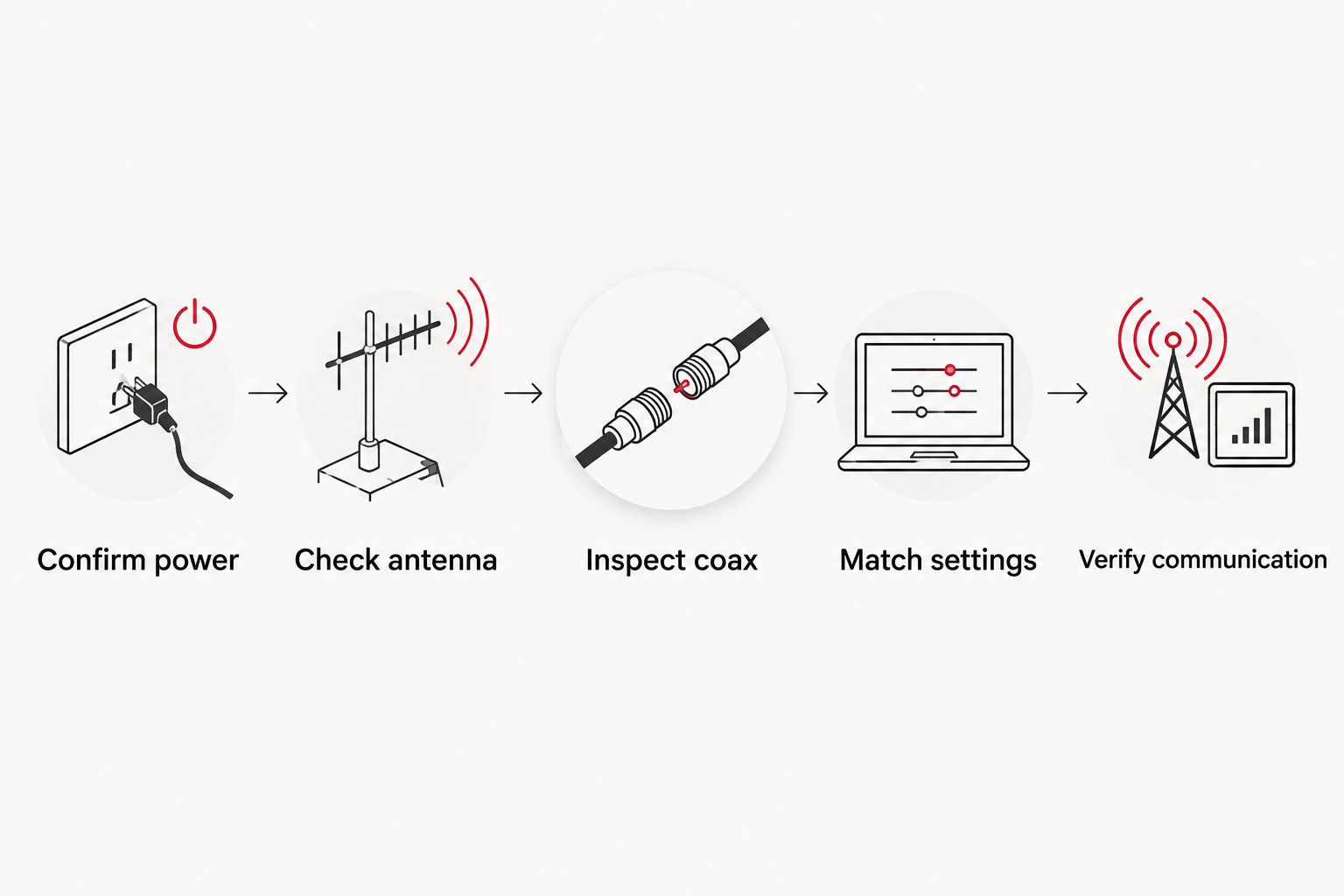
Use this sequence before treating a new or transferred radio as ready for work:
- Confirm power. Match the radio’s specified supply voltage and polarity, and use the manufacturer’s fuse and wiring instructions.
- Check antenna. Confirm that the antenna and mount suit the vehicle and installation method, including any required ground plane.
- Inspect coax. Look for crushed cable, damaged connectors, loose connections, and routing that exposes the cable to abrasion.
- Match settings. Select the agreed channel and mode, then set receive controls so you can hear the intended traffic.
- Verify communication. Check antenna matching with suitable equipment and complete a radio check with another operator.
A truck’s electrical system is not automatically compatible with a radio simply because the plug fits. If the supply voltage differs from the radio’s requirements, use the appropriate manufacturer-approved installation arrangement rather than improvising a connection.
Antenna matching also matters because excessive reflected power indicates a problem in the antenna system. Follow the radio and antenna manufacturers’ acceptable standing-wave-ratio guidance, and correct the installation before extended transmitting.
Use CB safely and maintain it as working equipment
A CB report is information to assess, not permission to make an unsafe maneuver. When another driver reports a hazard, establish its direction, location, and relevance to your lane before acting, and keep your attention on the roadway.
Set the channel, mode, volume, and squelch before moving. Secure the radio and microphone so neither obstructs controls, visibility, or access to other equipment, and stop safely before troubleshooting an installation or searching through unfamiliar settings.
Keep operational messages specific
Identify the vehicle or person you are addressing, give the location, and state the observation or instruction plainly. A warning about an object near an exit is more useful when it includes travel direction and lane than when it consists only of an alarmed call.
For coordinated vehicle movement, agree on acknowledgment and stop procedures before starting. If the person directing the movement cannot be heard or understood, stop the operation and restore communication rather than interpreting silence as approval.
Keep private customer information, access codes, and sensitive dispatch details off an open CB channel. Other listeners can hear transmissions, and an unfamiliar voice does not establish the speaker’s identity.
Use a dependable emergency contact method
Call 911 for an immediate emergency when you have a working means to do so. A CB request for assistance is an additional attempt to reach someone nearby, not confirmation that responders have been notified.
Give your road, travel direction, nearest identifiable location, and the nature of the emergency. If you ask another operator to make the call, request confirmation rather than assuming the message reached emergency services.
Inspect after damage or changes
Check the mount, antenna, coax routing, microphone cord, and power connections during your equipment checks. Recheck antenna matching after moving the mount, replacing antenna components, or repairing damage, because the installation has changed even if the radio has not.
Investigate new interference when it appears with another electrical accessory. Compare operation with that accessory switched off while safely parked, then correct the wiring or interference source according to the relevant equipment instructions rather than masking every problem with more squelch.
For your 2026 maintenance record, note the symptom and what changed before it appeared. A radio that receives normally with the engine off but becomes difficult to hear with equipment running needs a different investigation from one with visibly damaged coax.
One last thing: an installed radio is not a tested radio
A radio powering up proves only that it receives power; it does not prove that the antenna system works or that another operator can understand you. Complete a two-way radio check before a job depends on the installation. Repeat the check after repairs instead of waiting for a traffic backup or difficult recovery to expose the fault.
FAQ
Do truck drivers legally have to carry a CB radio?
A CB radio is not a universal federal equipment requirement for ordinary U.S. trucking. Check your carrier’s policy, facility instructions, and any permit or job-specific communication requirements separately.
Is a CB radio still useful for truck drivers in 2026?
A CB radio remains useful in 2026 when nearby drivers, facilities, or operating partners use a shared channel and mode. It supplements a phone and dispatch system rather than replacing them.
Does a CB radio work without cell service?
A CB radio communicates directly by radio without cellular service. Another operator still needs to be within usable range and listening on a compatible channel and mode.
What CB channel should I use on the highway?
Channel 19 is a customary U.S. highway channel, but it does not guarantee an audience. Use an assigned channel and mode when a facility or operating team provides instructions.
Can I use a CB radio instead of calling 911?
A CB radio is not a dependable replacement for calling 911. Use a working emergency contact method and treat a CB assistance request as an additional attempt, not proof that responders were notified.
Do I need an FCC license for a CB radio?
Ordinary authorized U.S. CB operation does not require an individual FCC station license. You must still follow the equipment and operating rules in 47 CFR Part 95, Subpart D.
Will a new CB radio work with an older CB radio?
A new CB radio communicates with an older radio when both support and select the same channel and compatible operating mode. Selecting FM on one radio will not establish intelligible communication with an AM-only radio.
How far will a CB radio reach from my truck?
A truck-mounted CB radio has no guaranteed operating distance. Antenna installation, terrain, obstructions, interference, and the other station’s equipment affect usable range.
For truckers and towers outfitting a work vehicle, TruckNTow supplies trucking and towing accessories; choose communication equipment around your actual operating requirements. Keep the radio decision separate from the inspection, visibility, and securement equipment your job requires.
Shop the full line of trucking and towing accessories at TruckNTow. Put your 2026 communication plan in place before the next run, and leave knowing the equipment has been checked rather than assumed ready.