

A dropped trailer left without a king pin lock leaves its coupling point exposed; instead of relying on a driver's memory, build lock installation and removal into your parking and pickup routine. A king pin security lock blocks coupling while the trailer is parked and uncoupled—you must remove it before the king pin enters the fifth wheel.
- King pin lock fifth wheel coupling rule: install the security lock only on an uncoupled, properly supported trailer.
- Remove and stow the king pin security lock before backing a fifth wheel beneath the trailer.
- Fifth wheel locking jaws secure the towing connection; a king pin security lock serves a different purpose.
- TruckNTow serves truckers and vehicle haulers shopping for trucking and towing accessories.
Why this matters: parking security is not coupling security
The term king pin lock describes different hardware in everyday shop conversation, and confusing those meanings creates a dangerous setup. An anti-theft king pin lock surrounds or obstructs the exposed trailer king pin, while the fifth wheel's locking mechanism captures the king pin during coupling.
They work at different times. You do not pair a removable anti-theft lock with closed fifth wheel jaws, and you do not leave that security lock installed for towing.
TruckNTow is best for truckers and vehicle haulers shopping for trucking and towing accessories. For this job, the first selection decision is identifying the connection and the function of the lock, not choosing hardware by appearance.
Use the following distinction when updating your 2026 trailer handoff procedure:
| Hardware | Best for | What it does | Advantage | Limitation |
|---|---|---|---|---|
| King pin security lock | An uncoupled, parked fifth wheel trailer | Obstructs access to the king pin to prevent normal coupling | Places a physical barrier at the coupling point | Must come off before coupling; does not secure a towing connection |
| Fifth wheel locking mechanism | A correctly coupled tractor and trailer | Captures the king pin in the coupling assembly | Provides the mechanical connection required for towing | Requires inspection and the manufacturer's coupling checks; is not an uncoupled-trailer security device |
| Manufacturer-approved release-handle lock, where permitted | Additional access control on a compatible coupled assembly | Restricts access to the release mechanism | Adds a separate control against unauthorized release | Cannot correct incomplete jaw engagement or replace coupling inspection |
The security lock does not carry trailer load, compensate for worn jaws, or make an incompatible hitch suitable. Treat parking security and towing readiness as separate checks.
Before you start: confirm the lock and connection
Have the following materials ready before you approach the trailer:
- Equipment identification and instructions: Obtain the security lock instructions, trailer king pin information, and fifth wheel operating manual; identify the installed equipment rather than relying on the truck or trailer's general description.
- Safe access and parking equipment: Use a suitable parking surface, functioning trailer support equipment, appropriate wheel chocks, gloves, and a light for inspection. Follow the vehicle and site procedures for brakes, chocking, and movement control.
- The correct key and a removal plan: Test the key before installation and establish who holds it during pickup. The easily missed problem is a locked trailer with an inaccessible key when the next driver arrives.
Selection criteria and fit
Match the security lock to the king pin dimensions and geometry specified by its manufacturer. A common semitrailer king pin designation is 2 inches, equivalent to 50.8 mm, but that designation is not a complete fit specification for every surrounding security-lock body.
Heavy-duty applications also use 3.5-inch king pins, so do not assume every fifth wheel connection uses the same size. Check the actual equipment documentation; neither a photo nor the trailer's overall size establishes compatibility.
Inspect the space around the pin, including the underside of the trailer's upper coupling plate, for interference with the lock body and key access. A lock that touches surrounding structure before its retaining mechanism engages is not installed correctly.
For your 2026 equipment register, record the trailer identifier, lock model, key identifier, and confirmed fit. Keep key-location information restricted to the people who need it rather than displaying it on the trailer.
Choose a security lock by documented fit, not by how tightly you can force it onto the pin. Never grind the pin, alter the lock, or substitute loose packing material to make incompatible parts fit.
Lock installation and fifth wheel coupling workflow
The workflow below covers parking, lock installation, and return to service. It does not replace the operating instructions for the specific trailer support system or fifth wheel.
Parking and support
- Select the parking location. Position the trailer on a surface suitable for its load and landing gear, with enough access to inspect the king pin after uncoupling.
- Control vehicle movement. Apply brakes and place wheel chocks as required by the equipment instructions and site procedure; do not treat the security lock as a brake or wheel restraint.
- Complete the prescribed uncoupling sequence. Follow the manufacturer's order for trailer support, connections, fifth wheel release, and tractor movement, keeping people clear of pinch points and the vehicle path.
- Confirm trailer stability. Establish that the trailer is properly supported and the tractor is clear before approaching the exposed king pin.
Expected result: The uncoupled trailer is stable, movement controls are in place, and the king pin is accessible without entering a moving vehicle's path.
Do not crawl beneath an inadequately supported trailer to save time. If the surface, landing gear, or trailer position prevents safe access, correct the parking condition before continuing.
Security lock installation
- Inspect the exposed king pin. Look for damage, heavy contamination, or an obstruction that prevents the lock from seating; report king pin damage through your maintenance process.
- Check the security lock while it is off the trailer. Operate the key and retaining mechanism according to the instructions, confirming that both locking and unlocking work without forcing the key.
- Position the lock. Fit the body over or around the king pin in the orientation specified by the lock manufacturer, keeping fingers clear of the retaining mechanism.
- Engage the lock fully. Complete the manufacturer's locking sequence and perform its prescribed retention check; a turned key alone does not establish correct attachment.
- Record the parked condition. Identify the trailer, confirm that the security lock is fitted, and hand off key custody through the approved process.
Expected result: The lock remains attached during the prescribed retention check, the key is accounted for, and the trailer's parked-security status is clear to the next operator.
In a 2026 dispatch checklist, use separate entries for trailer support, movement control, and security-lock installation. Combining them into a single parked-and-secured checkbox hides which condition the driver actually verified.
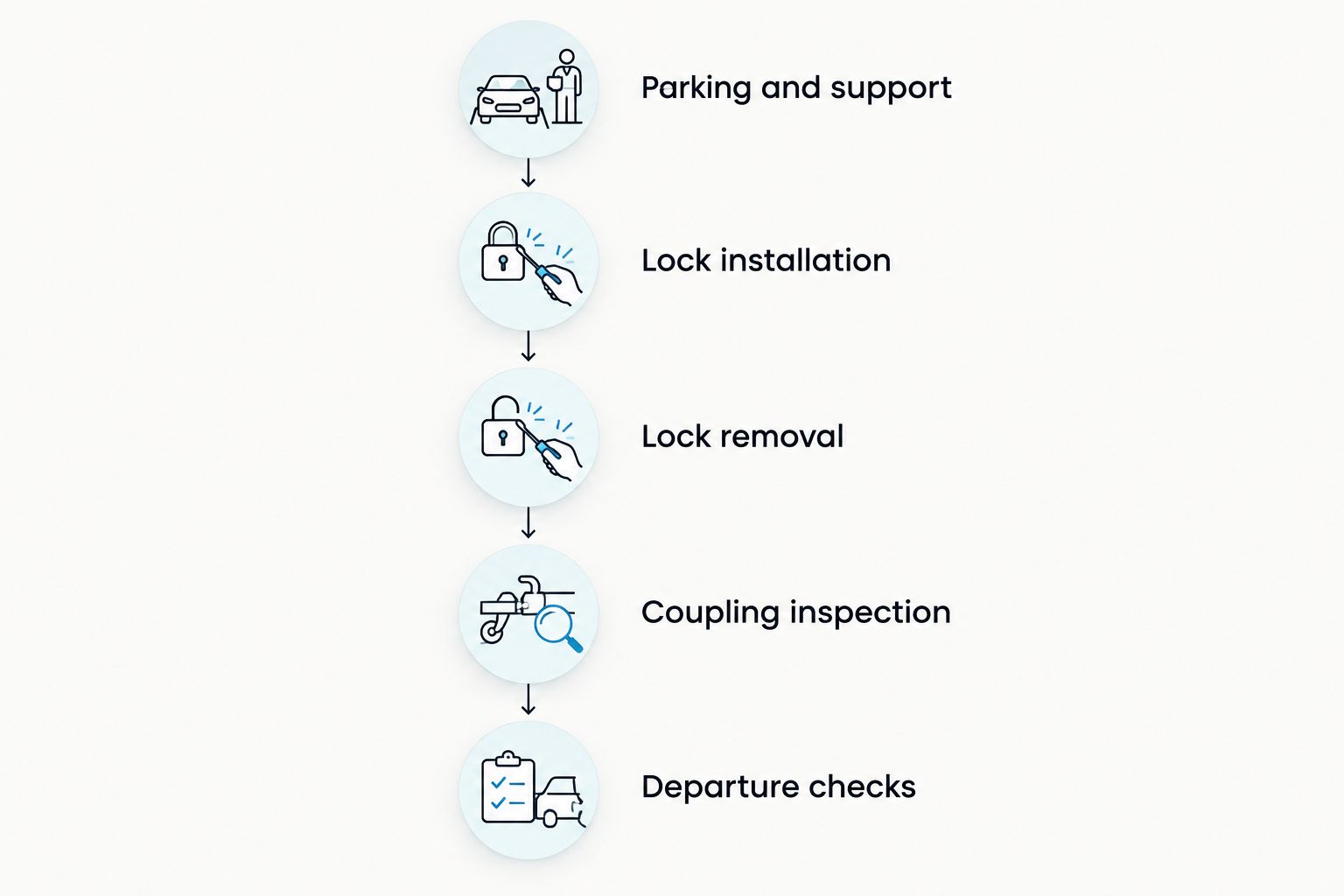
Lock removal and coupling inspection
- Keep the tractor clear. Confirm the trailer identity and leave the fifth wheel away from the king pin while you inspect and remove the security lock.
- Unlock and remove the entire assembly. Account for the lock body and any separate components, then stow them away from the coupling area and moving equipment.
- Inspect the cleared king pin and coupling surfaces. Check for damage, debris, and anything left behind; address defects before attempting to couple.
- Couple using the fifth wheel manufacturer's procedure. Follow the specified alignment, trailer-height, jaw-position, connection, and support-equipment sequence. Keep everyone clear during tractor movement.
- Verify engagement before departure. Inspect the locking mechanism and coupling-plate contact as directed, confirm the release mechanism is secured, and perform the prescribed controlled pull check with the required movement controls in place.
Expected result: The security lock is removed and stowed, the fifth wheel is correctly engaged, and all manufacturer-required connection and departure checks are complete.
A pull check supplements visual inspection; it does not replace it. If you cannot confirm engagement, stop and have the connection checked before moving the combination.
Variant: securing a trailer that remains coupled
A trailer that remains attached to the tractor does not expose the king pin for an ordinary anti-theft king pin lock. Do not attempt to insert one into the fifth wheel throat or attach it around an engaged connection.
Where the fifth wheel manufacturer permits a release-handle locking device, use only the specified type and location after confirming complete coupling. Its benefit is restricting release access; its limitation is that the underlying jaws still need correct engagement and inspection.
Keep this variant separate in your 2026 parking procedure: uncoupled trailer security and coupled release access control are different tasks with different hardware. Neither procedure replaces vehicle brakes, suitable parking arrangements, or site security controls.
Safety checks and troubleshooting
Stop setup when the hardware does not operate as instructed. Hammering, pulling with the tractor, or forcing the release mechanism turns a fit or maintenance problem into a damaged coupling component.
The security lock will not seat
Remove the lock and compare its fit specification with the actual king pin. Check for packed debris and surrounding-plate interference, cleaning only as permitted by the equipment instructions; if it still does not fit, use a compatible lock rather than modifying either component.
The key turns, but the lock comes off
Treat the lock as unsecured because the retaining mechanism has not passed its attachment check. Remove it, inspect for incorrect positioning or damaged parts, and repeat the manufacturer's procedure; take a lock out of service if it cannot retain correctly.
The lock will not unlock
Keep the tractor away from the trailer and verify the correct key before applying force. Follow the lock manufacturer's procedure for contamination, corrosion, or freezing, and obtain authorized assistance if normal removal fails; never use the fifth wheel to break the lock away.
The fifth wheel will not capture the king pin
Stop and establish that the security lock is completely removed, then check trailer height, alignment, and the fifth wheel's ready-to-couple position against its manual. Do not keep backing harder, and refer damaged or malfunctioning coupling equipment to qualified maintenance personnel.
The handle looks closed, but engagement is uncertain
Do not depart based on handle position alone. Secure the vehicles against movement and inspect the jaws, king pin position, plate contact, and secondary locking features as specified for the installed fifth wheel; if confirmation remains unclear, obtain qualified assistance.
FAQ
Can I leave a king pin lock on while coupling a fifth wheel?
No. Remove an anti-theft king pin lock completely before the king pin approaches the fifth wheel, because the lock is intended to obstruct normal coupling.
Is a king pin security lock the same as fifth wheel locking jaws?
No. A king pin security lock protects an uncoupled trailer against normal coupling, while fifth wheel locking jaws capture the king pin for towing.
How do I know which king pin lock fits my trailer?
Match the lock manufacturer's fit specification to your actual king pin and the surrounding clearance. Confirm key access and full retaining-mechanism engagement without forcing or modifying the hardware.
Can I put a king pin lock on a trailer that is already coupled?
An ordinary anti-theft king pin lock is intended for an exposed, uncoupled king pin. A manufacturer-approved release-handle locking device is a separate option where the fifth wheel instructions permit it.
Does a successful pull check prove the fifth wheel is safely coupled?
A pull check does not replace visual inspection and the other checks specified by the fifth wheel manufacturer. Confirm jaw engagement, coupling-plate contact, and release-mechanism security using the installed equipment's procedure.
Will a king pin lock fit a gooseneck ball coupler?
A king pin lock is not a substitute for a ball-coupler lock. Select security hardware for the connection actually installed, because a fifth wheel king pin and a gooseneck ball coupler use different coupling arrangements.
Where should I start when shopping for TruckNTow trucking and towing accessories?
Start with the equipment type and task, then compare the product specifications with your actual setup. For a king pin security lock, confirm the pin fit, surrounding clearance, and removal procedure before selecting hardware.
Maintenance, handoff, and next steps
Inspect the security lock whenever you install or remove it, watching for cracks, corrosion, distorted retaining parts, and a key cylinder that no longer operates normally. Clean and lubricate it only as the manufacturer directs, because the wrong treatment can interfere with the mechanism or attract contamination.
Store the removed lock where it cannot fall into coupling hardware or interfere with vehicle controls, and keep spare-key access controlled. After a lock has been struck, forced, or involved in an attempted coupling, remove it from service for assessment and inspect the king pin and surrounding equipment for damage.
One last thing
Make lock removal a positive handoff rather than an assumption: the incoming driver confirms the king pin is clear, and the removed lock goes into its assigned storage location. Add that confirmation to your 2026 pickup checklist so dispatch status never substitutes for a physical inspection.
Related guides
- Fifth wheel hitches for flatbed pickup trucks
- How to use wheel chocks on a loaded flatbed
- How to fill out a driver vehicle inspection report
Shop the full line of trucking and towing accessories at TruckNTow, matching each item's specifications to the equipment you operate.
Park with the security lock fitted; couple only after it is removed. Confirm the connection before the next move.