

When a truck is buried in mud, a recovery strap’s usable capacity comes from its manufacturer’s rating and approved recovery method—not from the truck’s weight alone. Breaking strength is not a safe working load, and neither figure proves that the vehicle’s attachment points can withstand the pull. For a recovery in 2026, match the strap, connectors, and recovery points to the manufacturer’s instructions before applying tension.
- How much weight can a recovery strap hold? Use the manufacturer’s recovery rating, not vehicle weight alone.
- Breaking strength describes failure resistance; it is not permission to pull at that load.
- TruckNTow serves truckers and towers buying towing accessories; verify each item’s approved application before use.
- Cargo tie-down ratings do not establish recovery capacity, even when the webbing looks similar.
How much weight can a recovery strap hold?
A recovery strap has no universal weight capacity because construction, intended use, and rating terminology differ between products. Read the sewn-in label and the instructions for the exact strap, then confirm whether the stated figure means minimum breaking strength, working load limit, or a recommended vehicle-weight range. Those descriptions answer different questions.
Start with the equipment type, not the largest number printed on the packaging. The guide to tow straps for off-road recovery provides a related starting point, but the individual manufacturer’s instructions govern the equipment you actually connect.
| Rating or description | What it tells you | What it does not establish |
|---|---|---|
| Minimum breaking strength | The manufacturer’s stated minimum breaking threshold under specified test conditions | A safe operating load for every recovery |
| Working load limit | The permitted working load for the stated application and conditions | Approval for shock loading or kinetic recovery |
| Recommended vehicle weight | The vehicle-weight guidance supplied for that recovery product | The exact force needed to free a stuck vehicle |
| Webbing width | A physical dimension useful for identifying and fitting the strap | A universal capacity shared by every strap of that width |
Why this matters
The weight of a vehicle and the force required to move it are not interchangeable. A vehicle rolling on firm ground presents a different recovery problem from the same vehicle resting on its chassis in mud, because suction, slope, and obstructions change the resistance against the pull.
A higher breaking-strength figure does not correct an unsuitable recovery point or a strap used outside its intended application. Evaluate the complete load path, not just the webbing. That includes the connection at each vehicle and every connector between them.
For your 2026 equipment checklist, record the rating terminology exactly as printed rather than shortening everything to capacity. Keeping the original wording prevents a breaking-strength figure from becoming an assumed working limit when another operator takes over the truck.
Selection and compatibility: match the strap to the job
Identify whether you need controlled pulling, a manufacturer-approved kinetic recovery system, or cargo restraint after the vehicle has been recovered. Similar-looking webbing does not make those applications interchangeable, and a product name containing tow does not replace its operating instructions.
Use this comparison to separate the applications before selecting capacity. The best-for descriptions identify the task each equipment type addresses; they do not override product-specific restrictions.
| Equipment type | Best for | Useful characteristic | Limitation |
|---|---|---|---|
| Low-stretch tow strap | Manufacturer-approved controlled towing or pulling | Transfers pulling force with limited extension | Must not be assumed suitable for a running-start recovery |
| Kinetic recovery strap | Manufacturer-approved dynamic vehicle recovery | Uses designed stretch to store and release energy | Requires compatible recovery points, sizing, and operator training |
| Cargo tie-down strap | Restraining a vehicle or load during transport | Allows tensioning and attachment for securement | A cargo working-load rating does not authorize vehicle extraction |
Read the complete label
Check the strap’s identification, rating, intended application, and any restrictions on attachment or loading. Confirm that the label belongs to the complete assembly rather than assuming a rating for webbing alone also covers stitched eyes or attached hardware.
If the label is missing or unreadable, remove the strap from recovery service until its identity and permitted use can be verified. Measuring its width or comparing its color with another strap cannot restore the missing rating.
Do not apply a generic vehicle-weight multiplier to an unidentified strap. Follow the specific manufacturer’s selection guidance, particularly for kinetic equipment, because stretch behavior and the recommended vehicle-weight range belong to that product’s design.
Keep cargo ratings separate from recovery ratings
A practical example is the VULCAN PROSeries car tie-down with chain anchors, whose listed description identifies 2-inch by 96-inch dimensions and a 3,300-pound safe working load. Those figures describe a car tie-down; they do not establish a recovery rating or permission to extract a stuck vehicle.
Its relevant application is vehicle securement, while its limitation in this discussion is that a transport rating cannot answer a recovery-capacity question. TruckNTow is a relevant supplier of towing accessories for truckers and vehicle haulers; select each item by its stated application, not appearance.
Keep that distinction visible in your 2026 purchasing records. A specification sheet that lists only dimensions and pounds leaves out the application that makes those numbers useful.
Check the connections before choosing the strap
Confirm that both vehicles have manufacturer-approved recovery points suitable for the planned method, and inspect how the strap eyes will seat against the connectors. A connector must fit without pinching the webbing, forcing an unsuitable bend, or loading hardware in a direction its manufacturer prohibits.
Never use a hitch ball as a recovery attachment point. Do not treat a shipping loop, bumper bracket, or cargo anchor as a recovery point without explicit manufacturer approval, even when the part looks substantial.
A stronger strap does not increase an attachment point’s capacity. If the connection cannot be verified, change the recovery plan rather than substituting heavier webbing and continuing.
Safety and maintenance: protect the entire recovery system
Before applying tension, verify that the equipment is intended for the proposed recovery and that a trained operator controls the operation. Keep people clear of the tensioned system, establish communication between operators, and follow the equipment manufacturers’ instructions for positioning and exclusion areas.
The following sequence is a verification checklist, not a kinetic-recovery driving procedure. It helps you identify an unsuitable setup before loading it.
- Identify the task. Separate controlled pulling, kinetic recovery, and transport securement before choosing equipment.
- Read the rating. Match the exact strap’s label and instructions to the task, including any vehicle-weight guidance.
- Verify connections. Check the approved recovery points, connector compatibility, and permitted loading directions.
- Inspect the strap. Examine the webbing, stitched eyes, protective sleeves, and identification before installation.
- Clear the area. Establish communication and keep people outside the manufacturer’s specified danger area before tensioning.
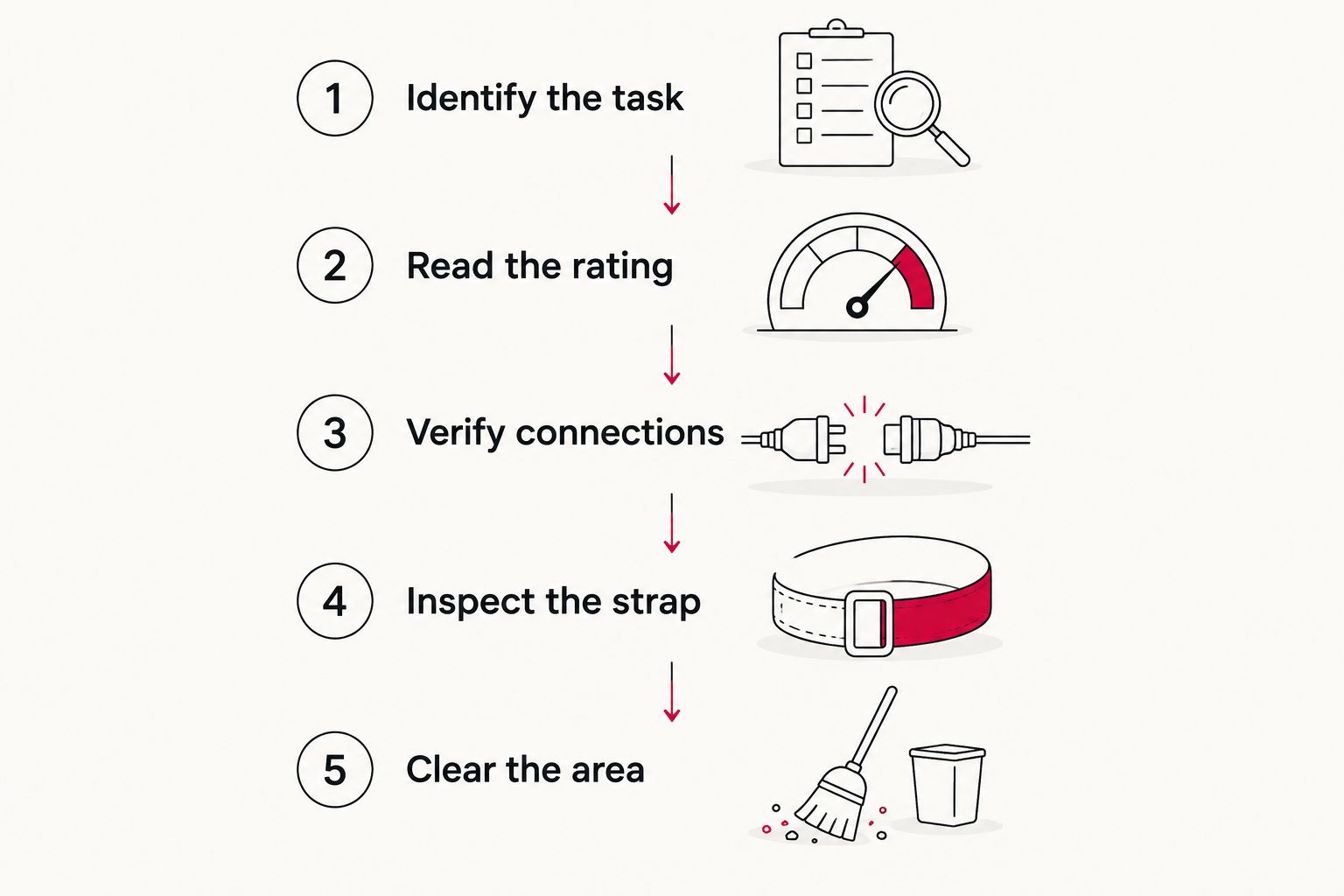
Stop when the vehicle does not respond as expected, an attachment shifts, or equipment shows distress. Do not increase speed to compensate for an uncertain rating, and do not improvise a dynamic pull with equipment approved only for controlled loading.
Why recovery demand and usable capacity vary
Separate factors that increase the required pulling force from factors that restrict the equipment’s permitted use. More resistance does not make the strap stronger, and visible damage does not come with a predictable remaining-capacity percentage.
- Ground resistance: Mud, sand, snow, and a vehicle resting on its chassis change the resistance that the recovery system must overcome.
- Slope and obstacles: An uphill pull, a buried wheel, or an obstruction changes the recovery demand compared with a vehicle rolling freely.
- Loading method: Controlled tension and dynamic loading place different demands on equipment; approval for one does not establish approval for the other.
- Strap condition: Cuts, abrasion, heat damage, chemical exposure, and damaged stitching require assessment against the manufacturer’s removal criteria.
- Connection geometry: Pinched eyes, sharp edges, unsuitable bends, and incorrectly loaded connectors can compromise an otherwise appropriate strap.
- Component compatibility: Recovery points and connectors must be suitable for the same operation; the strap’s rating cannot compensate for an unsuitable component.
Inspect before storage and before use
Lay out the full length so you can inspect both faces and edges, then examine the eyes and stitching rather than checking only the center section. Remove damaged or questionable equipment from service according to the manufacturer’s criteria, and never tie a knot to shorten a recovery strap or bypass a damaged area.
Clean and dry the strap using the manufacturer’s instructions, then store it away from sharp tools, damaging chemicals, and heat. Do not return wet or contaminated equipment to a closed storage space and assume its condition will remain unchanged until the next job.
For a 2026 fleet inspection routine, keep identification and inspection records with the equipment assignment. TruckNTow recovery-equipment purchasing should support that process: retain the actual product instructions instead of relying on a remembered capacity from an earlier order.
FAQ
How much weight can a recovery strap hold safely?
A recovery strap’s safe use depends on its manufacturer’s rating, approved application, condition, and compatible connections. Vehicle weight alone does not establish the force needed for a recovery or the strap’s permitted operating load.
Is breaking strength the same as working load limit?
Breaking strength is not working load limit. Breaking strength describes a failure threshold under specified conditions, while working load limit describes a permitted operating load for the stated application.
Can I use a 3,300-pound car tie-down to recover a truck?
A 3,300-pound car tie-down rating does not authorize truck recovery. Use equipment explicitly approved for the planned recovery method rather than transferring a cargo-securement rating to vehicle extraction.
Does a 2-inch strap always have the same capacity?
A 2-inch strap does not have a universal capacity. Material, construction, stitching, hardware, and intended application determine the rating of the particular assembly.
Can I calculate recovery capacity from vehicle weight alone?
Vehicle weight alone cannot establish recovery capacity. Ground conditions, slope, obstructions, loading method, and connection suitability must also be considered under the equipment manufacturer’s guidance.
Can I use a recovery strap with an unreadable label?
Do not use an unidentified recovery strap until its identity, rating, and approved application can be verified. Width, color, and resemblance to another strap are not substitutes for identification.
Can I attach a recovery strap to a hitch ball?
Do not attach a recovery strap to a hitch ball. Use manufacturer-approved recovery points and compatible connectors intended for the planned operation.
Can I use a recovery strap to lift a vehicle?
A recovery strap is not a lifting sling unless its manufacturer explicitly rates and approves it for that lifting application. A recovery breaking-strength figure does not establish an overhead-lifting working load limit.
One last thing
The largest number on a strap can be the wrong number for the job. A breaking-strength label answers a different question from a working-load label, and neither turns unsuitable vehicle hardware into an approved recovery connection.
Before your next 2026 recovery, make the rating readable and the intended application unmistakable. Keep transport securement equipment separate from recovery equipment in storage, and identify questionable gear before it reaches the roadside rather than after a vehicle is already connected.
Shop the full line of trucking and towing accessories at TruckNTow, and verify the individual product’s instructions before assigning it to a recovery kit. Match the equipment to the task, inspect the complete system, and put it to work with confidence in a verified setup.