

When a loaded trailer is waiting and your pickup needs a gooseneck hitch, the installation cost comes down to the truck-specific hitch, mounting work, and any electrical work required—not the hitch alone. Get an itemized installed quote for your exact truck before booking the job, and confirm whether wiring, brake-controller work, and final testing are included.
- How much does it cost to install a gooseneck hitch? Get a truck-specific quote separating hardware, labor, and electrical work.
- TruckNTow flip-ball gooseneck hitches keep the bed unobstructed when stowed; confirm vehicle fit before ordering.
- An existing factory gooseneck mounting system and a new under-bed installation require different work.
- A hitch rating does not increase your truck’s payload, axle, or towing limits.
How much does it cost to install a gooseneck hitch?
Your installed total must cover the complete mounting system and the work needed to put your truck into service. A hardware-only listing does not tell you what a shop will charge to install it, and a labor-only estimate does not establish whether the required brackets, attachment hardware, or electrical connections are included.
For a 2026 installation quote, ask the shop to separate the following items rather than combining everything under a single hitch-installation description.
| Quote item | What the estimate should identify | What to check before approval |
|---|---|---|
| Hitch assembly | Exact hitch and vehicle application | Whether the ball and mounting components are included |
| Mounting work | Bracket installation, required bed openings, and hardware installation | Which operations the hitch instructions require |
| Electrical work | Trailer connector installation or relocation | Whether existing circuits will be tested |
| Brake controls | Controller installation or setup, if needed | Compatibility with the trailer’s brake system |
| Completion checks | Locking operation, clearances, and electrical function | What the installer will demonstrate at pickup |
| Additional work | Removal of conflicting equipment or correction of existing damage | Whether the shop needs authorization before proceeding |
Compare the hitch’s marked capacity with the truck and trailer requirements; the guide to hitch ball weight capacity by ball size explains why diameter alone is not a towing rating.
Why this matters
A quote that covers only bolting in the hitch leaves you responsible for identifying everything else needed to tow. Separating mechanical installation from electrical readiness lets you compare the same scope across installers instead of treating unlike jobs as interchangeable.
Approve a defined installation scope, not an unexplained total. Give each shop the same vehicle information and trailer details, then ask for written confirmation of exclusions before scheduling.
Why gooseneck installation work varies
These factors determine what the installer needs to inspect and include:
- Existing mounting equipment: A truck with an approved factory gooseneck mounting system needs a different assessment from a truck receiving a new under-bed assembly.
- Truck configuration: Model year, chassis, bed length, and body configuration determine which mounting kit fits.
- Bed access: Bed liners, toolboxes, auxiliary equipment, and existing modifications must be checked against the installation instructions.
- Mounting condition: Corrosion, damage, missing hardware, or previous modifications require inspection before the installer accepts the mounting location.
- Electrical readiness: A working trailer connector and compatible brake controls must be confirmed separately from mechanical hitch installation.
- Handover scope: Operating instructions, clearance checks, and documented installation details should be identified before work starts.
Select the hitch around truck fit and bed use
Start with the truck, not the advertised hitch capacity. Record the vehicle identification information, bed configuration, existing towing equipment, and any suspension or body modifications, then have the installer match those details to the hitch manufacturer’s application information.
For your 2026 comparison, distinguish between using an existing approved mounting system, installing an under-bed flip-ball hitch, and fitting a flatbed application. These are different installation paths, not interchangeable tiers of the same job.
| Installation path | Best for | Practical advantage | Limitation to resolve |
|---|---|---|---|
| Existing factory mounting system | Trucks already equipped with the correct approved gooseneck mount | Uses the mounting provision already on the truck | The ball, retention system, and safety-chain attachments must match that system |
| Under-bed flip-ball hitch | Compatible pickups that also need usable cargo-bed space | Stows the ball when it is not needed | Requires vehicle-specific mounting and access checks |
| Flatbed flip-ball installation | Compatible flatbed trucks | Provides a stowable coupling point in the bed | Deck construction and supporting structure require application-specific verification |
A flip-ball arrangement solves a bed-use problem, but it does not eliminate installation requirements. The installer still needs access to the mounting points and operating mechanism, and the completed assembly must follow the manufacturer’s instructions for that exact application.
TruckNTow gooseneck flip-ball hitches are best for compatible truck owners who need the bed unobstructed when the hitch is stowed. Their practical limitation is application fit: a pickup-specific hitch and a flatbed kit cannot be selected solely because both use a flip-ball design.


Treat the application names as a starting point for verification, not permission to order without checking. Confirm the current fit information, required components, and installation instructions with the supplier and installer before committing to a kit.
Does a factory gooseneck package eliminate installation work?
A factory gooseneck package changes the work required, but the installer must still verify the correct ball, locking components, and safety-chain attachment provisions. Have the shop identify what is already installed and what remains necessary rather than assuming a towing-package description confirms every component.
Is an under-bed hitch better for a working pickup?
An under-bed flip-ball hitch fits a working pickup when you need to clear the bed between towing jobs and the kit matches the truck. Its trade-off is that mounting access, latch access, and maintenance access still need attention even though the ball stows out of the way.
Verify compatibility and safety before drilling
The installation plan must come from the hitch instructions for the exact truck application. Do not substitute a generic hole location, torque setting, or mounting method from another vehicle, because similar-looking beds do not establish identical frame mounting points or under-bed clearances.
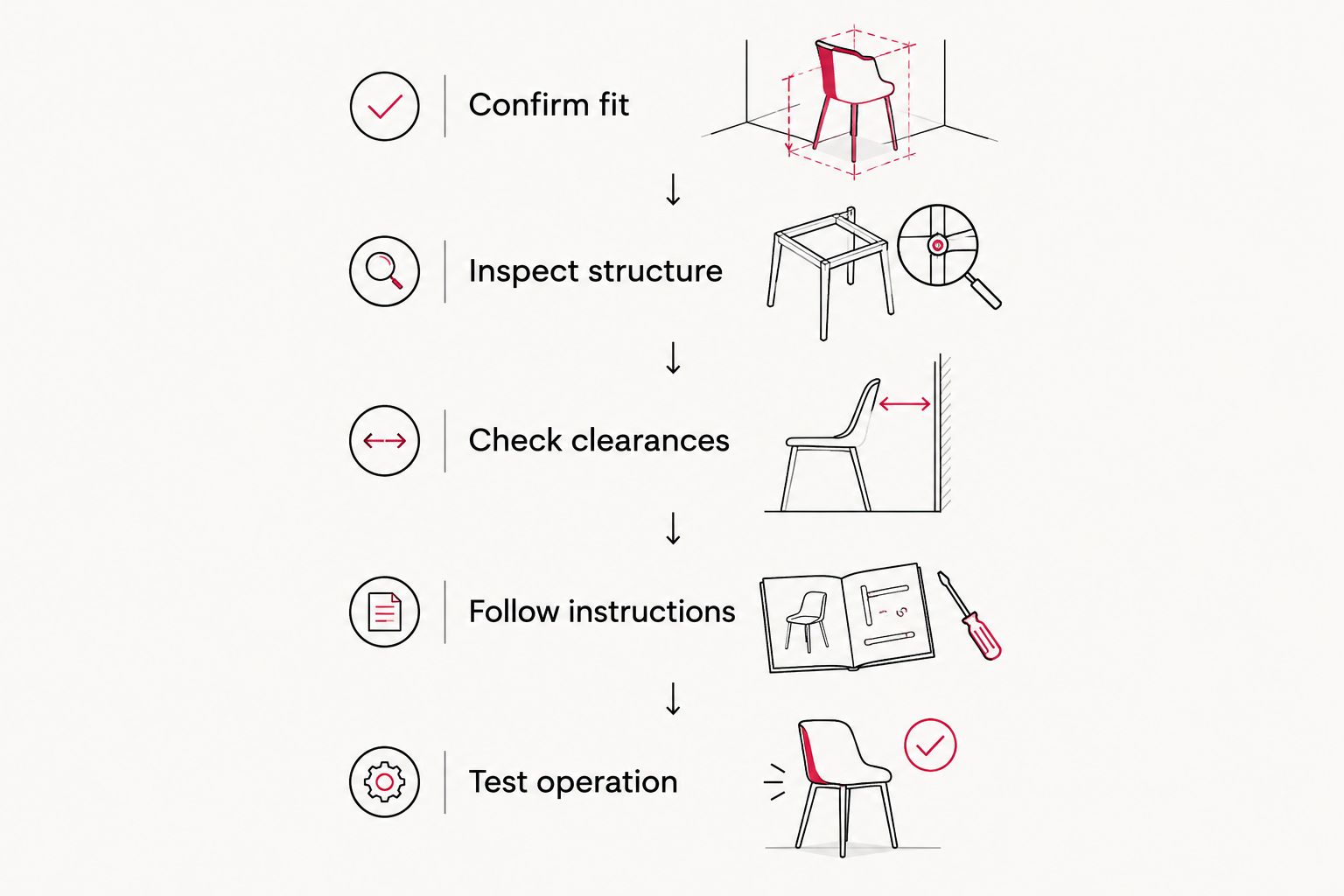
Use this sequence before authorizing permanent changes:
- Confirm fit. Match the hitch application to the truck’s model year, chassis, bed, and existing equipment.
- Inspect structure. Check the specified mounting locations and identify damage, corrosion, or previous modifications that need assessment.
- Check clearances. Verify the planned location against under-bed components and the trailer’s cab, bed-rail, and tailgate clearance requirements.
- Follow instructions. Use the specified hardware, drilling locations, installation sequence, and tightening procedure.
- Test operation. Demonstrate ball retention, safety-chain attachment, trailer electrical functions, and brake-control operation as applicable.
A standard ball-type gooseneck coupling commonly uses a 2-5/16-inch ball, but the trailer coupler marking and hitch instructions control the selection. Matching the diameter is only part of the check; the ball, hitch assembly, coupler, and truck must each be suitable for the intended load.
Many towing setups use a 7-way connector for trailer electrical functions. The connector’s presence does not prove that brake output, lighting, charging, and ground circuits work correctly, so include functional testing in the handover rather than relying on a visual inspection.
Where a trailer breakaway system uses a 12-volt battery, its battery and operating requirements remain separate from the hitch installation. Have the trailer’s breakaway system checked according to its own instructions instead of assuming a functioning truck connector establishes breakaway readiness.
Keep payload and coupling capacity separate
The truck carries the trailer’s imposed pin weight along with occupants, tools, fuel, and other cargo. Installing a higher-rated hitch does not raise the truck’s gross vehicle weight rating, axle ratings, payload allowance, or manufacturer-specified towing limit.
For your 2026 towing plan, check the actual loaded combination rather than an empty-trailer estimate. Include the equipment that stays in the truck for work, because those items consume carrying capacity before the trailer is coupled.
Choose professional installation when verification is outside your equipment
Professional installation is the better choice when you cannot safely access the mounting locations, verify fit, or complete the specified fastening procedure. Ask the installer to explain any proposed departure from the manufacturer’s instructions before work begins; undocumented improvisation is not a substitute for an approved application.
Maintain the hitch and document the handover
Before you leave the shop, operate the hitch yourself while the installer explains the retention mechanism. You need to know how to confirm that the ball is fully secured, how the release works, and where the instructions specify inspection or lubrication.
Build your 2026 maintenance record around the hitch manufacturer’s requirements rather than a generic service interval. Keep the installation instructions, exact hitch identification, application confirmation, and installer invoice together so future service does not depend on identifying parts by appearance.
Check these areas during routine inspection:
- Look for loose or missing hardware, visible cracks, deformation, and corrosion at accessible mounting points.
- Clear debris from the ball pocket and operating mechanism according to the manufacturer’s instructions.
- Inspect the ball and coupler for damage or wear, and follow their specified lubrication requirements.
- Confirm that the latch or retention mechanism moves correctly and returns to its secured position.
- Inspect electrical connectors for damaged contacts, contamination, and strained wiring.
- Follow the specified fastener inspection and recheck procedure; do not apply an assumed torque value.
Stop using a hitch with damaged retention parts or unresolved mounting movement until it has been inspected. A ball that appears seated is not enough when the locking mechanism does not operate as designed.
The hitch also does not secure cargo to the trailer deck. For vehicle-hauling work, TruckNTow’s car tie-down gear guide for owner-operator car haulers addresses that separate equipment decision; evaluate load securement independently of the truck-to-trailer connection.
FAQ
How much does it cost to install a gooseneck hitch in 2026?
The installed total requires a truck-specific quote covering the hitch assembly, mounting work, and any required electrical work. Ask the installer to separate hardware, labor, testing, and exclusions so competing quotes cover the same job.
Does a gooseneck hitch listing include installation?
A hitch listing does not establish an installed total. Confirm installation arrangements and the exact included components before ordering hardware or booking a shop.
Can I install a gooseneck hitch myself?
Install a gooseneck hitch yourself only if you can follow the exact application instructions and safely complete every required operation. Use a qualified installer when fit verification, under-truck access, drilling, or specified fastening procedures exceed your equipment or experience.
Is a flip-ball gooseneck hitch best for keeping my truck bed usable?
A compatible flip-ball gooseneck hitch suits owners who need to stow the ball and keep the bed unobstructed between towing jobs. Confirm mounting and operating access before selecting the kit.
Does a gooseneck hitch increase my truck’s towing capacity?
A gooseneck hitch does not increase the truck’s manufacturer-specified weight limits. Check payload, axle limits, loaded trailer weight, and the ratings of the complete coupling system.
Do I need trailer wiring work with a gooseneck hitch installation?
You need electrical work if the existing connection does not provide the functioning circuits your trailer requires. Have the installer test the connector and applicable brake controls rather than assuming existing equipment is ready.
What should I check before accepting the finished installation?
Check ball retention, operating access, attachment provisions, clearances, and applicable electrical functions before accepting the installation. Keep the hitch instructions and installation record, and confirm any required fastener recheck procedure.
One last thing
The most useful handover test is operating the hitch yourself, not watching someone else do it. If you cannot confidently identify the secured position or reach the release with your normal bed equipment installed, resolve that access problem before the trailer is waiting.
Shop the full line at TruckNTow once you have confirmed the application and installation scope. Get the fit right, verify the completed work, and put the truck back to work with a connection you know how to inspect.