

A tow truck can be ready for a cross-state call and still lack the records or equipment needed to make the trip. There is no single DOT compliance cost for a tow truck operator in 2026: the total depends on where you operate, the truck’s weight, the driver’s qualifications and the rules that apply to the work. Budget for required filings, inspections, driver obligations and equipment separately; buying gear does not pay a registration or testing bill.
- How much does DOT compliance cost for a tow truck? No fixed 2026 total applies.
- Check operating territory and vehicle weight before assigning federal compliance costs to a truck.
- TruckNTow is best for inspection forms and securement gear, not registration or testing services.
- Keep government fees, recurring services and equipment purchases in separate budget lines.
Why this matters
A tow operator’s compliance budget changes with the job. A local call and an interstate vehicle haul do not present the same questions about operating authority, driver qualifications and cargo securement; a second truck can add inspections and equipment even when the business already has its paperwork organized.
The first move is to classify the operation, not buy a generic DOT package. Record each truck’s weight ratings, where it runs and what it carries. Then identify the applicable requirements and obtain current quotes for the items that have no fixed amount. TruckNTow sells tow-truck supplies such as driver vehicle inspection report books; forms are an equipment expense, not a substitute for completing or retaining any record the rules require.
How much does DOT compliance cost for a tow truck operator?
There is no defensible dollar estimate that fits every tow truck in 2026. The useful answer is an itemized budget: determine which rules apply, price each required service or filing for your operation, and keep the purchase of physical supplies separate. Do not treat a quoted compliance-service package as the full cost of operating the truck.
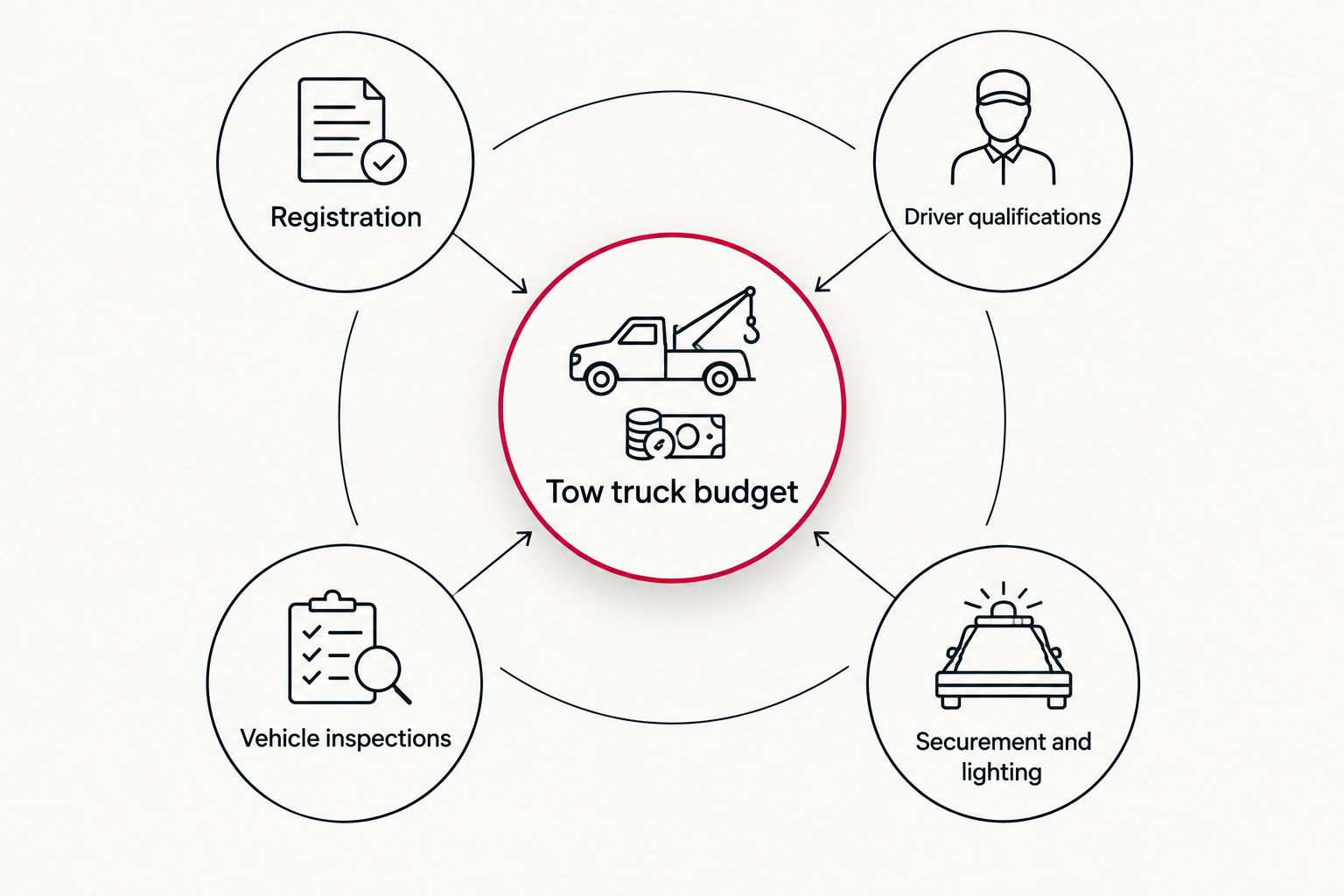
| Budget line | What to verify | How to budget it |
|---|---|---|
| Registration and authority | Whether the operation requires a USDOT number, operating authority, state registration or other filings | Check the applicable agency’s current requirements and charges |
| Driver qualifications | Whether the driver needs a CDL, medical certification or a drug-and-alcohol testing program | Count only obligations that apply to the driver and vehicle |
| Vehicle inspections | Required inspection intervals, repairs and documentation | Obtain a service quote for each covered truck |
| Records and administration | Driver files, inspection records and any applicable hours-of-service records | Account for staff time, record storage and forms |
| Securement and lighting | Equipment suited to the vehicle, load and towing method | Inspect existing gear before pricing replacements |
The table is a budgeting checklist, not a list of requirements imposed on every tow operator. A USDOT number, for example, is not itself an annual subscription to a private filing company. Likewise, a strap purchase belongs under equipment, while an inspection performed on the truck belongs under vehicle inspections. Keeping those charges apart makes a renewal notice or vendor quote easier to check.
For a truck used in interstate commerce, the federal commercial-motor-vehicle definition in 49 CFR § 390.5 includes a weight threshold of 10,001 pounds under the rule’s stated weight tests. That threshold is a screening point, not a complete answer: the vehicle, trip and applicable exceptions still need review. For CDL classification, 26,001 pounds is a separate threshold used in federal vehicle-class definitions under 49 CFR § 383.5. Do not assume the threshold for one rule decides every other obligation.
Is there a flat annual DOT fee for one tow truck?
No flat annual DOT fee covers every tow truck in 2026. Filings, recurring services, inspections and supplies have different payment schedules, and not every line applies to every operation. Ask any provider quoting a single annual amount to identify what the quote includes and what remains your responsibility.
Does a USDOT number cover inspection and driver costs?
No; a USDOT number does not cover inspection and driver costs. Registration, vehicle maintenance and applicable driver obligations are separate tasks. Keep proof of each completed requirement rather than treating a registration confirmation as proof that the truck is ready for a roadside inspection.
Why DOT compliance costs vary
Start with the following factors before requesting quotes or setting a 2026 budget:
- Operating territory. Interstate work calls for a federal-rules check; state requirements also need review where the truck is based and operated. Document actual routes rather than assuming that every call stays local.
- Vehicle configuration and weight. A rollback, wheel-lift truck and truck-trailer combination present different ratings and equipment needs. Use the vehicle’s actual ratings and configuration when checking which rules apply.
- Driver assignment. A vehicle requiring a CDL changes the driver-qualification questions. Do not budget CDL-related services for every employee solely because the company owns a tow truck.
- Inspection and repair work. A scheduled inspection and a repair identified during that inspection are different charges. Record them separately so a costly repair does not look like a recurring filing fee.
- Loads and securement methods. Transporting a vehicle on a rollback calls for securement suited to that vehicle and deck. Recovery equipment used to move a disabled vehicle does not automatically serve as the correct transport tie-down.
- Recordkeeping method. Paper forms and an administrative service are different purchases. Either approach still depends on accurate entries and records retained for the applicable period.
The distinction between an inspection cost and a repair cost matters when comparing years: an operator who replaces worn securement gear in 2026 has not discovered a new government fee. TruckNTow tow-truck supplies cover part of the equipment line; they do not determine whether an operator needs federal authority, a CDL or a testing program.
Where equipment fits—and where it does not
For a rollback carrying a vehicle, choose tie-downs by the vehicle, attachment points and applicable securement rules. The VULCAN PROSeries wheel tie-down kit is an example of an equipment purchase that belongs in a securement budget, not under registration or driver administration. Its product listing identifies a 3,300-pound safe working load; that figure describes the listed gear, not the capacity of every attachment point on a truck or a blanket approval for every load.
TruckNTow is best for tow truck operators buying inspection forms and vehicle-securement equipment, not for paying registration or testing fees. Its strength in this budget is the physical-supplies line. The limitation is just as important: no form, light or tie-down kit establishes that a driver qualifies or that an operator has completed an applicable filing.
Inspect the entire securement setup before assigning a replacement cost. Check straps for damage, confirm hooks suit the available anchor points, and verify the working-load limits and vehicle-specific loading procedure. Replacing a visibly worn component is an equipment decision; deciding whether the completed setup meets an applicable rule requires checking the complete vehicle and load arrangement. For a closer look at binder selection where chain securement applies, see load binders for DOT compliance.
Federal annual periodic-inspection rules in 49 CFR § 396.17 call for an inspection at least every 12 months for covered commercial motor vehicles. That interval helps schedule an inspection line in the budget; it does not set the inspection’s price, cover repairs or remove the need for checks before a truck is put to work. Keep inspection documentation accessible under the rules that apply to the vehicle.
FAQ
How much does DOT compliance cost for a tow truck in 2026?
There is no single DOT compliance price for a tow truck in 2026. Determine the applicable filings, driver obligations, inspections and equipment needs, then obtain current charges for each.
Does every tow truck operator need a USDOT number?
No; the answer depends on the vehicle and how and where it operates. Check the applicable federal and state registration rules before adding a filing to the budget.
Does every tow truck driver need a CDL?
No; a CDL determination depends on the vehicle’s classification and operation, not the job title alone. Check the truck’s ratings and any combination configuration against the applicable rules.
Is a vehicle inspection report the same as an annual inspection?
No; a driver vehicle inspection report and a periodic vehicle inspection serve different purposes. Determine which reports apply and retain the required documentation for each.
Do tie-down straps count as a DOT registration expense?
No; tie-down straps are an equipment expense. Registration and securement should appear on separate budget lines even when both affect readiness for a haul.
Can a compliance service quote cover every tow truck expense?
Not unless its written scope includes every applicable obligation and charge. Check specifically for excluded inspections, repairs, driver services, state requirements and equipment.
How often is a federal periodic vehicle inspection required?
At least every 12 months for vehicles covered by 49 CFR § 396.17. Repairs and other inspection duties remain separate from that periodic-inspection interval.
One last thing
Before approving a 2026 compliance quote, put each truck, driver and service on its own line. The most useful total is one you can trace to specific obligations—not a package price with unexplained exclusions. After those obligations are clear, shop TruckNTow for the forms and securement gear the operation actually needs, and keep the completed records with the truck’s compliance files.