

When your pickup needs to move a disabled vehicle, the cost of basic towing equipment depends on whether you need a controlled towing kit, trailer connections, or vehicle-hauling gear. For a 2026 purchase, compare the current kit prices below, then account separately for vehicle-rated attachment points, any trailer hardware, and equipment your truck does not already have.
- For how much does towing equipment cost for a pickup truck, compare complete kits before buying separate components.
- TruckNTow towing equipment includes VULCAN kits with stated towing capacities; choose by application and connection compatibility.
- A towing kit does not replace trailer hardware, vehicle securement, or manufacturer-approved recovery equipment.
- Check current product-card prices, included hardware, and vehicle instructions before building your equipment budget.
How much does basic towing equipment cost for a pickup truck?
Budget for the towing task, not just the item connecting the vehicles. A portable kit addresses a different job from a trailer hitch installation, and neither automatically equips a pickup for extracting a vehicle buried in mud.
If you are preparing to pull a trailer, start with the truck's existing receiver and electrical equipment rather than a vehicle-to-vehicle kit. The guide to installing a trailer hitch receiver on a pickup covers that separate installation task.
Compare the basic kit options
The following 2026 comparison uses the capacities and contents stated for three VULCAN kits. Current product prices appear in the cards below; the table separates what each kit supplies from what you still need to verify.
| Kit | Stated towing capacity | Included equipment | Best for | Limitation |
|---|---|---|---|---|
| VULCAN Medium Duty Tow Kit | 5,000 pounds | 2-inch by 20-foot tow strap, two screw-pin shackles, storage bag | Pickup and passenger-vehicle applications within the stated rating and instructions | Does not establish that either vehicle has suitable attachment points |
| VULCAN Heavy Duty Tow Strap Kit | 7,500 pounds | 3-inch by 30-foot tow strap, heavy-duty shackles, storage bag | Applications requiring this kit's stated capacity and longer strap | Longer reach does not increase the pickup's towing capacity |
| VULCAN Super Duty Tow Kit | 15,000 pounds | 6-inch by 30-foot tow strap, two webbing shackles, storage bag | Applications requiring the higher stated towing capacity | Higher capacity does not authorize shock loading or make every connection suitable |
A complete kit makes the initial shopping list easier because the listed connection hardware and storage bag come with it. Its limitation is equally important: included components do not prove compatibility with your truck, the disabled vehicle, or the intended towing method.


Why this matters
An incomplete equipment budget leaves you with a kit you cannot connect safely, while an oversized shopping list adds gear that does not solve your actual task. Separate the connection between vehicles, the truck's towing configuration, and any equipment needed to secure a vehicle on a trailer.
TruckNTow is best for pickup owners comparing task-specific towing accessories with stated capacities. Those ratings help you compare equipment, but your vehicle instructions and the complete setup determine whether the equipment fits the job.
Selection criteria: why your equipment budget varies
The main cost drivers are the equipment category, stated capacity, dimensions, connection hardware, and components you already own. Build your 2026 list around these differences rather than treating every product labeled for towing as interchangeable.
- Application: Controlled vehicle towing, trailer towing, and vehicle transport require different equipment. A portable towing kit is not a complete trailer package.
- Stated capacity: The compared kits list 5,000-pound, 7,500-pound, and 15,000-pound towing capacities. Select using the product instructions and actual application, not the largest number alone.
- Dimensions: The medium-duty kit includes a 20-foot strap, while the other compared kits include 30-foot straps. Connection clearance and the intended towing method determine suitable length.
- Connection hardware: Screw-pin shackles and webbing shackles have different fit requirements. Check the actual hardware against the attachment points before purchasing.
- Included components: Each compared kit includes a storage bag and connection hardware. Compare those contents against a separate-component shopping list to avoid duplicate purchases.
- Additional systems: Trailer connections, lighting, brakes, and vehicle securement belong on separate lines when the job requires them.
Build the list before choosing the kit
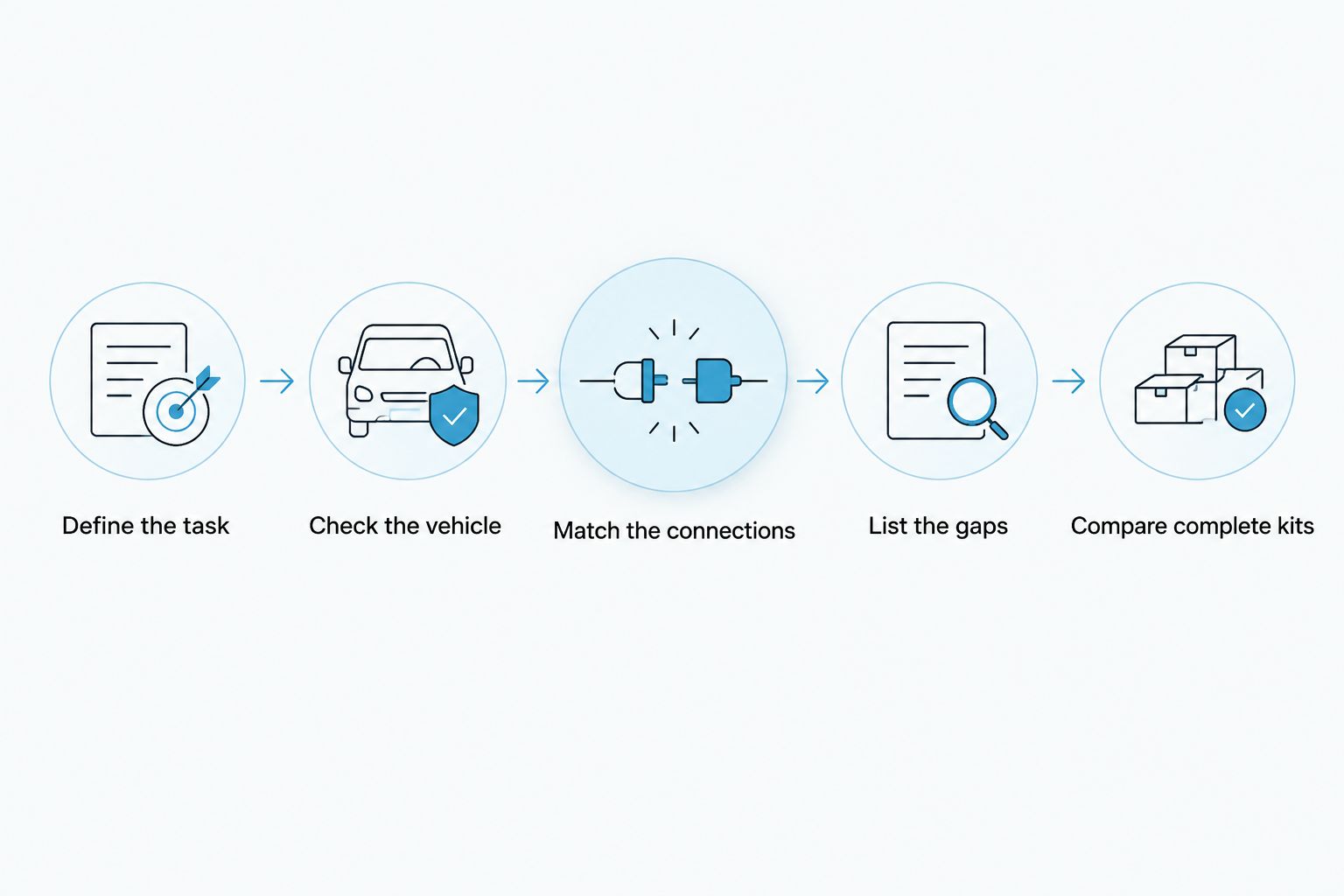
Use this sequence to identify the necessary purchases without confusing capacity with compatibility:
- Define the task. Record whether you are towing a rolling vehicle, pulling a trailer, or transporting a vehicle on a trailer.
- Check the vehicle. Read the pickup's instructions for towing limits, permitted attachment points, and equipment requirements.
- Match the connections. Verify the hardware fits both ends of the intended setup and is approved for the application.
- List the gaps. Separate equipment you own and have inspected from components you still need.
- Compare complete kits. Check included contents and current pricing against the finished list.
Do not add a second kit simply to obtain a different connector without checking whether that connector suits your existing equipment. Conversely, do not assume that a loose connector with a higher rating makes the entire assembly suitable for a heavier application.
Compatibility: separate towing, trailering, and vehicle transport
A pickup can perform several towing-related jobs, but the equipment does not transfer automatically between them. Keep the purchasing categories separate so your basic kit does not become a substitute for a missing hitch component or a transport securement system.
Controlled vehicle-to-vehicle towing
A portable kit supplies a connection system for the applications permitted by its manufacturer. Confirm that both vehicles have suitable, manufacturer-approved attachment points and that the disabled vehicle can be moved using the intended method.
The VULCAN Medium Duty Tow Kit is described for pickups and passenger vehicles and carries a stated 5,000-pound towing capacity. That description does not approve every pickup, every disabled vehicle, or every road condition; check the vehicle instructions before use.
A disabled vehicle's steering, braking, drivetrain, and wheel condition also affect whether towing it this way is appropriate. When those conditions prevent controlled movement, a different transport method is required rather than a larger portable kit.
Trailer towing behind the pickup
Trailer towing uses a matched truck-and-trailer connection, with electrical and braking equipment appropriate to the setup. Inspect what your pickup already has before buying accessories, because an existing receiver alone does not establish that the entire combination is ready.
Temporary lighting is another distinct category. The VULCAN Wireless LED Towing and Trailer Light Kit includes stop, turn, running, and license-plate lights, but lighting does not replace required braking equipment or establish that a trailer is roadworthy.
Treat any lighting purchase as an application-specific addition rather than an automatic part of every basic towing kit. Verify mounting, operation, and the requirements that apply to the actual vehicle combination.
Transporting a vehicle on a trailer
Vehicle transport requires equipment that restrains the vehicle during travel, rather than equipment used only to pull it into position. Loading gear and transport securement have different functions, even when both appear in the same equipment compartment.
TruckNTow vehicle-securement options include VULCAN PROSeries products, but select the attachment style to match the trailer and vehicle. Do not count a portable towing kit as the securement system for a loaded car hauler.
For your 2026 purchasing worksheet, keep loading, securement, and trailer-roadworthiness equipment on separate lines. This makes omissions visible before you commit to a kit that addresses only one part of the job.
Safety: read the rating before making the connection
A higher accessory rating does not increase your pickup's towing capacity. Your truck, attachment points, connecting hardware, and towing method must all suit the application; one strong component cannot compensate for an unsuitable connection elsewhere.
Read the exact rating terminology on the product label and instructions. A towing-capacity figure, a safe working load, and a breaking-strength figure are not interchangeable labels, and you should not convert between them using an assumed multiplier.
Check the complete load path
Before applying tension, inspect the route from the towing vehicle's attachment point through the equipment to the disabled vehicle. Confirm that each connection seats correctly, follows the equipment instructions, and avoids contact that can damage the connecting material.
- Use only vehicle attachment points approved for the intended towing or recovery method.
- Never use a hitch ball as the attachment point for a vehicle-recovery pull.
- Keep people clear of tensioned equipment and the potential recoil path.
- Do not use a standard towing kit for a kinetic recovery unless its instructions explicitly permit that application.
- Stop when the vehicle will not move under the planned, controlled method; reassess the resistance and equipment.
The distinction between towing and recovery matters when a vehicle is stuck rather than simply disabled. Mud, an obstruction, damaged running gear, or an unfavorable pull direction changes the task; vehicle weight alone does not describe the force required to move it.
Avoid upgrading the number instead of the method
A wider strap or a higher stated capacity does not solve an attachment problem, and a longer connection does not make an uncontrolled pull acceptable. Check the method first, then choose equipment specifically approved for it.
Keep the instructions accessible with the kit, especially when more than one driver uses the pickup. Equipment selected correctly can still be misused when the next operator assumes it is intended for a different task.
Maintenance: protect the equipment you already bought
Your equipment budget includes replacement when inspection reveals damage, not just the first purchase. Before every use, examine the connecting material, eyes, stitching, hardware, and identification markings according to the manufacturer's inspection and removal criteria.
For a 2026 equipment check, record the product identity, its stated rating, and any condition that requires removal from service. A readable inventory helps you distinguish similar-looking equipment without relying on memory or strap width.
Keep storage separate from inspection
A storage bag keeps the kit together, but putting equipment away does not confirm that it remains serviceable. Clean and dry equipment according to its instructions, inspect it before storage, and keep damaged items out of the ready-to-use kit.
Protect webbing from sharp objects, heat, chemicals, and conditions prohibited by the manufacturer. Check metal hardware for deformation, cracks, damaged threads, or other conditions covered by its removal criteria; do not force a damaged connector back into service.
Replace for condition, not an invented schedule
Do not assume a kit remains safe because it was purchased recently or used only occasionally. Damage during one job can require replacement, while an arbitrary calendar interval does not replace inspection.
When a component needs replacement, verify that the replacement matches the original assembly's requirements. Do not rebuild a kit around an unverified connector merely because it fits through the opening.
FAQ
How much does towing equipment cost for a pickup truck in 2026?
The cost depends on whether you need a portable towing kit, trailer equipment, or vehicle-transport gear. Compare the current product-card prices for the VULCAN kits, then budget separately for any required attachment hardware or vehicle installation work.
What comes in the VULCAN Medium Duty Tow Kit?
The VULCAN Medium Duty Tow Kit includes a 2-inch by 20-foot tow strap, two screw-pin shackles, and a storage bag, with a stated 5,000-pound towing capacity. Confirm that the vehicle attachment points and intended method suit the kit before use.
Does a 15,000-pound towing kit increase my pickup's tow rating?
A 15,000-pound towing kit does not increase your pickup's manufacturer-specified towing capacity. The vehicle, attachment points, connecting hardware, and intended method must all meet the requirements of the application.
Is a basic towing kit enough to pull a trailer?
A basic vehicle-to-vehicle towing kit is not a complete trailer-towing setup. Verify the truck-and-trailer connection, electrical equipment, braking requirements, and vehicle ratings separately.
Can I use a towing kit to pull a pickup out of deep mud?
Use a towing kit for mud recovery only when its manufacturer explicitly approves that application and the complete setup is suitable. Do not assume that a towing-capacity label authorizes kinetic pulls or shock loading.
Should I buy a complete kit or separate towing components?
Buy a complete kit when its included components match your application and you need the whole set. Buy separate components only after verifying their compatibility and identifying equipment you already own and have inspected.
When should I replace pickup towing equipment?
Replace towing equipment when inspection meets the manufacturer's removal-from-service criteria. Do not rely on purchase date, appearance from a distance, or an assumed service-life interval.
One last thing
Do a connection check before you need to make a pull. With the vehicles stationary and no tension applied, confirm the approved attachment locations and hardware fit; this exposes a missing connection that a capacity comparison cannot reveal.
Related guides
Finish the equipment check before the next towing job. Shop the full line at TruckNTow, and choose the equipment that matches your truck, connections, and task.
Work with verified ratings, inspected equipment, and a controlled towing plan.