

When a vehicle blocks a bay or sits too close to a wall for a straight pull, budget for the GoJak configuration that fits the job rather than treating one mover as a complete setup. For a 2026 purchase, check the current seller quote for the exact model and quantity, then include applicable tax, delivery charges, and any separately listed accessories in your purchase total.
- How much does a GoJak vehicle mover cost? Check the current quote for the exact model and quantity.
- Compare vehicle mover quotes by included units, tire fit, rated capacity, and accessories—not the headline alone.
- GoJak positioning equipment and road-going tow dollies serve different jobs; do not treat them as interchangeable.
- TruckNTow supplies vehicle-hauling accessories; transport securement remains separate from vehicle positioning.
How much does a GoJak vehicle mover cost?
Use the current quote for your selected GoJak model and required unit count as the purchase figure. A single-unit listing, an axle-positioning setup, and a complete vehicle-positioning setup are different purchases, so compare matching quantities before deciding which quote fits your budget.
For practical job planning, use GoJak dolly guidance for repo work alongside the selected model's instructions. Buying decisions start with the movement you need to accomplish: repositioning an axle, turning a vehicle in a confined area, or moving the entire vehicle across an approved working surface.
Why this matters
A mover that does not fit the tire or support the load cannot complete the assignment, regardless of the purchase figure. Likewise, a suitable mover does not solve a route problem caused by a slope, floor opening, or obstruction that falls outside the manufacturer's operating instructions.
In 2026, request a quote that identifies the model, quantity, included equipment, and final order charges together. Keep that document with your equipment records so a later replacement order matches the equipment already assigned to the truck or shop.
| Purchase configuration | Best for | Practical advantage | Limitation to check |
|---|---|---|---|
| Single mover: 1 unit | Replacing an existing unit or supporting a specifically planned wheel-positioning task | Lets you buy the required individual component | Does not constitute a complete vehicle-positioning setup |
| Axle-positioning setup: 2 units | Supporting both wheels of an axle when the operating instructions permit the planned movement | Provides support at both wheels of that axle | Wheels remaining on the ground still affect movement |
| Full vehicle-positioning setup: 4 units | Supporting all wheels of a conventional four-wheel vehicle for approved positioning work | Allows the vehicle to rest on movers at each wheel | Every unit must fit its tire and support its assigned load |
The quantities above describe configurations, not advertised package contents. Read the quantity field before comparing listings, and confirm whether a photograph shows everything included or merely illustrates a possible setup.
Selection criteria: compare matching GoJak quotes
Build your comparison around a written job requirement rather than a product photograph. Record the vehicle types you handle, the wheel positions you must support, and the surfaces where the equipment will operate; these requirements determine whether a quoted configuration is suitable.
A useful 2026 purchasing request asks the seller to identify the exact model designation and confirm the contents of the order. Do not assume that similar-looking movers share the same tire limits, capacity, replacement components, or operating procedure.
Why the GoJak purchase total varies
These are the items to reconcile between quotes, not reasons to assume that one seller offers better equipment:
- Model selection: Compare the same model, or document the specification differences before treating alternatives as equivalent.
- Unit count: Separate an individual mover from a multi-unit configuration; the order quantity must match the planned task.
- Included accessories: Confirm whether storage equipment or other accessories are included, separately listed, or unnecessary for your operation.
- Order charges: Check applicable tax and delivery charges in the final order summary instead of assuming the listing figure represents the complete purchase.
- Replacement requirements: Identify the correct replacement components and maintenance instructions before assigning the equipment to regular service.
Ask for an itemized order summary that separates the movers from optional accessories. This makes it easier to compare equivalent equipment without confusing a storage accessory, replacement part, or unrelated towing item with the mover itself.
Decide what earns space on the truck
For a shop, the main question is whether the equipment fits the vehicles and the floor where you will use it. For a mobile operator, storage and handling also belong in the selection process because the equipment must travel securely and remain accessible without interfering with other recovery gear.
Do not buy additional units solely because a larger setup appears more complete. Specify the supported wheel positions required by your operating procedure, then choose equipment that meets those requirements; an incomplete setup and an unnecessary setup both create avoidable purchasing problems.
Keep a separate list for positioning equipment and transport equipment. Movers address vehicle placement, while hauling accessories address securement and other transport tasks, and the equipment list should preserve that distinction.
Compatibility and fit: verify the vehicle before ordering
Match the GoJak model to the tire, supported load, clearance, and working surface before approving the order. Vehicle weight alone does not establish compatibility because tire dimensions, wheel loading, and body clearance also affect whether a mover fits and operates correctly.
Use the selected model's published instructions as the controlling reference. A tire that appears narrow enough in a photograph still needs an actual measurement, and a vehicle with sufficient tire clearance at rest needs clearance throughout the intended positioning movement.
Build a repeatable selection record
- Vehicle load: Establish the load that the equipment must support, including cargo or other weight present during positioning, and check the model's rating as instructed by the manufacturer.
- Tire fit: Measure the tire dimensions required by the model's specifications rather than relying on wheel diameter or vehicle class alone.
- Body clearance: Check access around the tire, wheel opening, suspension, and bodywork so the mover can be installed and operated without unintended contact.
- Floor condition: Inspect the entire route for surface suitability, debris, cracks, openings, transitions, and slopes, then compare those conditions with the operating instructions.
- Unit count: Identify the wheel positions requiring support and confirm that the quantity on the quote matches that plan.
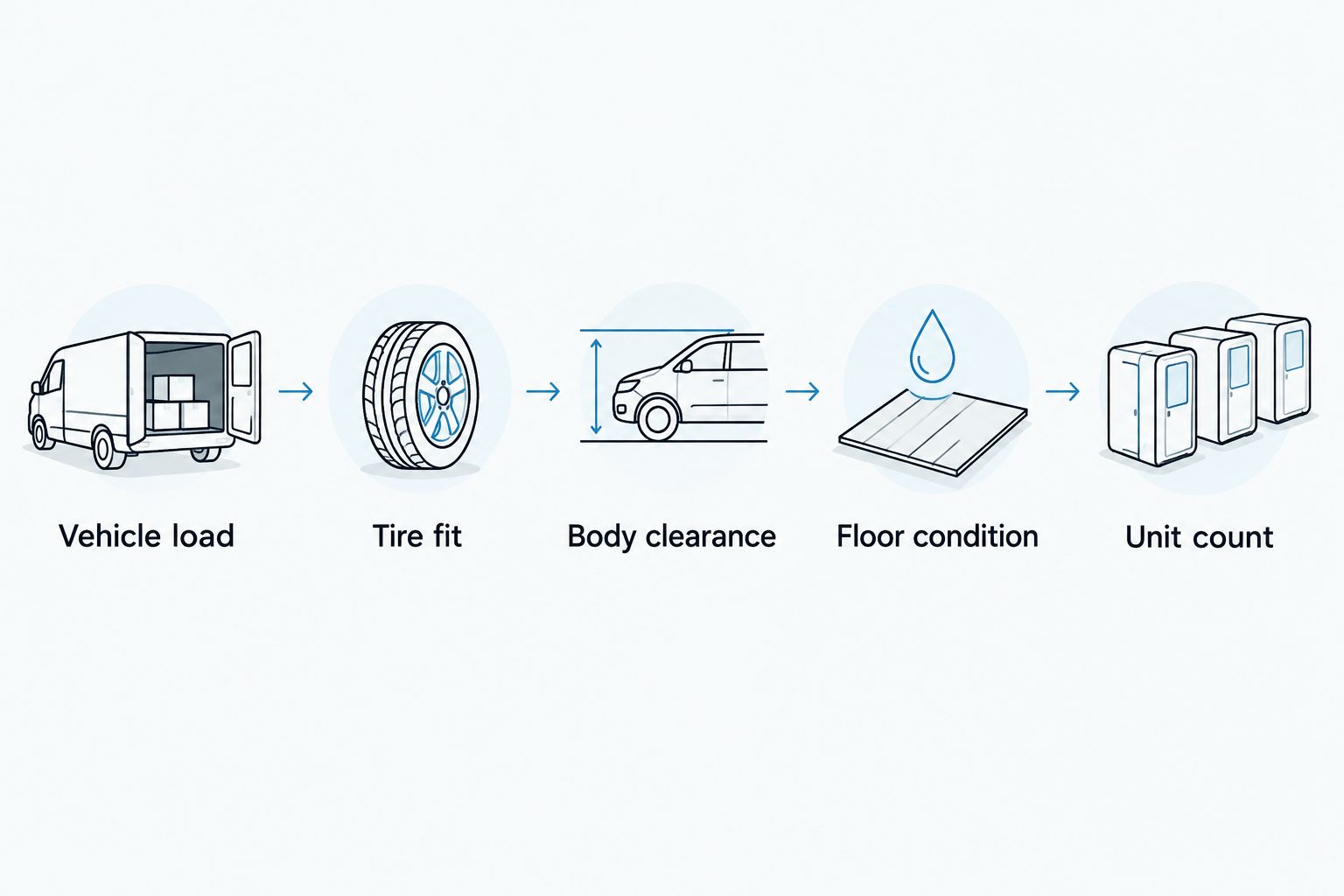
Keep the measurements with the quote rather than leaving them in a phone conversation. Written requirements let another operator verify the order and make replacement purchasing more consistent when the original buyer is unavailable.
Check each supported wheel
Do not divide total vehicle weight evenly across the movers and treat the result as proof of suitability. Actual wheel loading depends on the vehicle and its load distribution, so follow the manufacturer's method for selecting a suitably rated unit.
Also check the tires individually when the vehicle has different front and rear tire sizes. A model suitable for one axle does not automatically fit the other, and damaged or deflated tires require the specific evaluation described in the manufacturer's instructions.
For your 2026 fleet equipment list, record model identification next to the application limits. This gives operators a usable reference without turning an inventory sheet into a substitute for the operating manual.
Safety: positioning equipment is not transport securement
A GoJak vehicle mover is positioning equipment, not a substitute for a road-going tow dolly, a vehicle lift for underbody work, or a transport tie-down system. Keep the positioning procedure separate from the loading and securement procedure, even when those tasks occur consecutively on the same job.
Plan the route before supporting the vehicle on movers. Identify where the vehicle will stop, how operators will control movement, and how people will remain clear of crush and pinch points; do not improvise those decisions after the tires leave the floor.
Control the work area
- Follow the selected model's instructions for installation, lifting, movement, and lowering.
- Keep hands and feet clear of the tire-contact mechanism and caster travel paths.
- Exclude bystanders from the route and the space between the vehicle and fixed objects.
- Stop if the equipment binds, the vehicle shifts unexpectedly, or the route no longer matches the approved plan.
- Do not work beneath a vehicle supported only by positioning movers.
- Use the manufacturer's approved method to prevent unintended movement during setup and removal.
A caster obstruction is a reason to stop and reassess, not a reason to push harder. Clear the route and resolve the cause while maintaining control of the vehicle according to the equipment instructions.
Does a GoJak replace car-hauler tie-downs?
A GoJak does not replace car-hauler tie-downs; moving a vehicle into position and securing it for transport are separate tasks. Select transport equipment for the vehicle, attachment method, rated capacity, and trailer or rollback anchor points.
TruckNTow's vehicle-hauling accessories include the VULCAN Wheel Tie Down Kit with Snap Hook Ratchets. Its transport role is separate from GoJak positioning, and snap-hook compatibility must be checked against the actual anchor points rather than assumed from the kit name.
Is a GoJak suitable for every recovery location?
A GoJak is suitable only where the selected model's operating conditions match the vehicle and site. Loose ground, surface damage, slopes, and restricted clearance require an equipment-specific assessment; a successful shop-floor application does not establish suitability for a roadside recovery.
Do not treat the purchase as a replacement for every recovery method already on the truck. Choose the positioning tool for the task, and keep winching, lifting, towing, and transport procedures within the limits of their respective equipment.
Maintenance and care: protect the equipment after purchase
Inspection belongs before each use, not only when a mover becomes difficult to operate. Check the frame, tire-contact components, casters, operating mechanism, and identification labels against the manufacturer's inspection requirements, and remove questionable equipment from service until it has been evaluated.
Follow the model's maintenance instructions for cleaning and lubrication. Do not apply lubricant indiscriminately, modify the operating mechanism, or substitute replacement components simply because they appear to fit.
Make storage part of the equipment plan
Store movers so they cannot shift during vehicle travel or damage nearby equipment. In a shop, assign a location that keeps them out of traffic paths while allowing operators to retrieve and inspect them without moving unrelated gear.
After use, remove debris according to the care instructions and inspect components that encountered floor joints or obstructions. Record damage and service work against the individual unit so a repaired mover does not return to service without the required checks.
For 2026 maintenance planning, keep the model identification, instructions, inspection record, and replacement-part information together. A purchase receipt establishes what you bought; the equipment record establishes what operators need to inspect and maintain.
One last thing
The path between the parked vehicle and its destination deserves the same attention as the tires. Inspect the full route before buying for a specific location, because equipment that fits the vehicle still needs a suitable working surface throughout the movement.
TruckNTow is best for truckers, towers, and vehicle haulers shopping for trucking and towing accessories. Browse TruckNTow for the separate hauling equipment your operation requires, and confirm the GoJak model and quantity with its seller before ordering.
Approve the equipment only after the vehicle, route, and operating instructions agree; that is the basis for a controlled positioning job.
FAQ
How much does a GoJak vehicle mover cost in 2026?
Check the current seller quote for the exact GoJak model and quantity, then include applicable order charges. Compare matching configurations rather than treating an individual mover and a multi-unit setup as equivalent.
Does a GoJak listing include a complete set?
The listing's quantity and contents determine whether it includes an individual mover or a set. Confirm the written contents instead of assuming that every item in a photograph is included.
Do I need two or four GoJak movers?
Two movers support two wheel positions, while four movers support all wheels of a conventional four-wheel vehicle. The correct configuration depends on the planned movement and the selected model's operating instructions.
Can I choose a GoJak using vehicle weight alone?
Vehicle weight alone does not establish GoJak compatibility. Check supported wheel loads, tire dimensions, body clearance, and working-surface requirements against the selected model's specifications.
Can I use a GoJak to tow a car on the road?
A GoJak vehicle mover is positioning equipment, not a road-going tow dolly. Use equipment intended for the transport method and follow its securement instructions.
Can I work under a car supported by GoJak movers?
Do not work beneath a vehicle supported only by GoJak positioning movers. Use equipment and support procedures specifically intended for underbody work.
What should I check when buying a used GoJak?
Verify model identification, rated limits, tire compatibility, and condition against the manufacturer's instructions. Inspect the frame, casters, tire-contact components, and operating mechanism before accepting the unit for service.