

A chain-up restriction can stop your run even when the truck is otherwise ready for winter, so budget for a complete, correctly fitted traction setup rather than an isolated chain listing. Semi truck tire chain cost depends on tire fitment, single- or dual-tire coverage, construction, and package quantity; a useful 2026 comparison also includes any required tensioners, installation tools, and replacement parts.
- How much do semi truck tire chains cost? Compare complete, tire-matched setups rather than unmatched package totals.
- Single-tire and dual-tire chains cover different configurations; confirm coverage before comparing quotes.
- TruckNTow’s semi truck tire chain guides support winter equipment selection; verify fitment against the chain manufacturer’s instructions.
- Tensioners, installation tools, and replacement parts belong in the purchasing checklist when the selected chain requires them.
How much do semi truck tire chains cost?
Compare the total needed to equip your required wheel positions, not the amount attached to an undefined set. A pair of single-tire chains and a dual-tire assembly do not describe the same coverage, and neither establishes how many assemblies your route or truck configuration requires.
Start with the guide to tire chains for semi trucks in winter, then narrow your purchasing comparison to products approved for your tires and vehicle. Keep fitment, coverage, and included hardware identical across quotes wherever possible.
Why this matters
A chain package only solves the job when you can install it correctly on the truck that will carry it. An inexpensive purchase becomes wasted equipment if the chain does not clear nearby components, lacks required hardware, or covers fewer wheel positions than your operating conditions demand.
For your 2026 winter purchasing plan, separate the initial equipment purchase from installation preparation and ongoing maintenance. That keeps a complete setup from looking unnecessarily expensive beside an incomplete listing.
Compare coverage before comparing totals
| Configuration | Best for | Main advantage | Limitation to check |
|---|---|---|---|
| Single-tire chains | Approved installations covering an individual tire | Lets you identify coverage by individual tire position | A package does not automatically equip every required position |
| Dual-tire chains | Approved installations spanning a dual-tire assembly | Covers the dual configuration with a purpose-built assembly | Requires correct dual fitment, clearance, and installation procedure |
| Replacement cross chains | Maintaining a compatible, serviceable chain assembly | Allows manufacturer-approved component replacement | Does not replace inspection of the side chains and connecting hardware |
| Chain tensioners | Chain designs that specifically require external tensioning | Helps maintain the fit specified by the chain manufacturer | Cannot correct an incorrectly sized or incompatible chain |
These are functional choices, not interchangeable purchasing tiers. Select the approved configuration first, then compare equivalent equipment.
Build a complete purchasing breakdown
Request an itemized quote that identifies the chain model, exact tire fitment, assembly quantity, coverage per assembly, included fasteners, and required accessories. Ask the seller to distinguish a complete chain assembly from a replacement component, since similar terminology can conceal very different package contents.
Use the following breakdown when reviewing that quote:
- Chain assemblies: Record exactly what each package covers and how many packages your planned installation needs.
- Tensioning hardware: Identify whether tensioners are built in, supplied separately, or required as additional equipment.
- Installation tools: Confirm whether the selected design needs a cam tool or another manufacturer-specified tool.
- Replacement components: Check whether compatible cross chains and connecting parts support the intended maintenance plan.
- Handling and storage: Include suitable gloves and a storage arrangement if your truck is not already equipped.
Do not count the same accessory twice when comparing packages. Equally, do not treat an omitted accessory as unnecessary simply because it is absent from the listing.
Why semi truck tire chain purchasing totals vary
- Tire fitment: The full tire designation determines compatibility; a matching wheel diameter alone is insufficient.
- Coverage configuration: Single-tire and dual-tire assemblies equip different arrangements, so package totals require context.
- Chain construction: Link design, dimensions, and material specifications distinguish products that otherwise look similar in photographs.
- Tensioning design: Cam-equipped and other fastening arrangements require different installation procedures and hardware checks.
- Package contents: Complete assemblies, replacement cross chains, and accessory packages are different purchases.
- Service needs: A setup intended for repeated chain-up work needs a maintenance and replacement-parts plan, not just an initial purchase decision.
These factors define what you are buying. They do not establish that a particular finish, heavier-looking link, or larger package is the right choice for your truck.
Match tire size, coverage, and clearance before ordering
Read the tire sidewall and record the complete designation before requesting a quote. Semi trucks commonly use 22.5-inch and 24.5-inch wheels, but those measurements identify wheel diameter, not the complete tire dimensions that a chain fit chart requires.
A 22.5-inch wheel designation is not a tire-chain size. Tire width, aspect ratio where applicable, and the manufacturer’s listed fitments still matter, so do not select chains from wheel diameter or truck class alone.
Use a fitment sequence that prevents mismatched purchases
- Record tire size. Copy the full designation from the tires that will actually receive chains, rather than relying on an old equipment record.
- Confirm coverage. Identify the required wheel positions using current route requirements and the truck manufacturer’s guidance.
- Check clearance. Review the vehicle’s chain restrictions and the chain manufacturer’s clearance requirements around nearby components.
- Verify hardware. Confirm the supplied fasteners, tensioning method, and any required installation tool.
- Trial fit. Install the selected chains in a controlled setting according to the manufacturer’s procedure before dispatching into chain-up conditions.
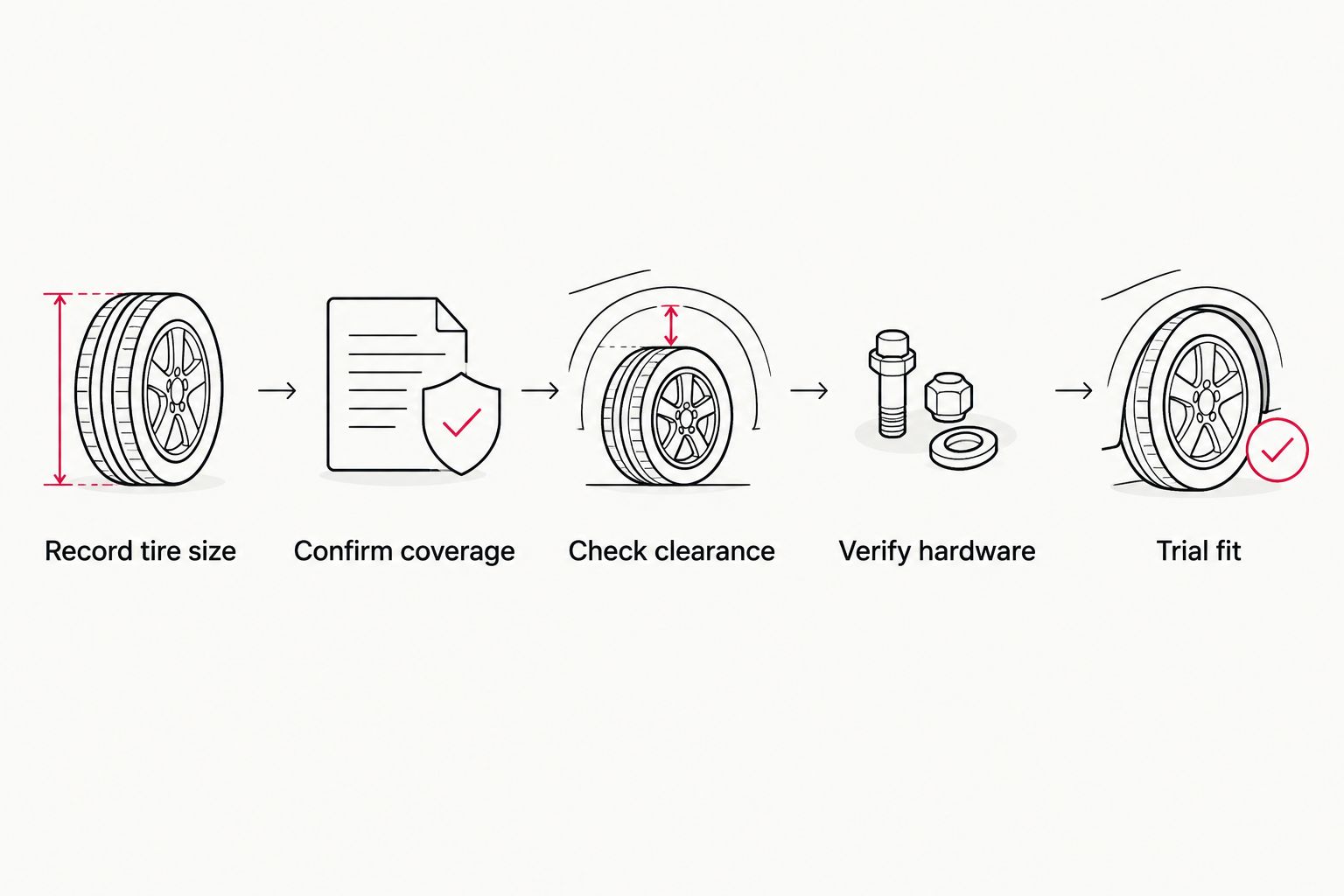
The trial fit verifies more than whether the fasteners close, because you also need to confirm correct routing, accessible hardware, and clearance throughout the manufacturer’s inspection procedure. Keep the instructions with the equipment so a relief driver does not have to reconstruct the installation from memory.
Separate light-duty accessories from semi truck equipment
A tire-chain tensioner labeled for light-duty trucks with 19-inch tires and smaller is not a default accessory for a semi truck. That stated application does not establish compatibility with a commercial-truck chain assembly, even if the accessory looks similar to another adjuster.
Select tensioning equipment by the chain manufacturer’s instructions, not by appearance. A tensioner maintains the intended installation; it does not turn an oversized chain into the correct fit.
For fleet purchasing in 2026, keep a tire-and-chain assignment record for each truck. Recheck that record after tire changes, equipment transfers, or any change that affects the approved installation.
Check route requirements and installation safety
Chain requirements depend on the jurisdiction, vehicle configuration, and active restrictions along your route, so a package described as suitable for a semi truck does not establish legal coverage. Verify current transportation-agency instructions before dispatch, including any distinction between carrying chains and installing them.
Carrying compatible chains and having them installed correctly are separate requirements. Do not assume that equipment stored on the truck satisfies an active chain-up restriction, or that an installation accepted on one route applies unchanged on another.
Make the chain-up procedure part of equipment selection
Choose equipment your drivers can install using the supplied instructions and the truck’s approved procedure. Access to fasteners, safe handling of the assembly, and a practical storage location all affect whether the selected setup is usable on the job.
Practice in a controlled location before winter dispatch, with the vehicle secured according to its operating instructions. Roadside installation adds traffic exposure and poor footing, so learning the chain layout for the first time beside an active roadway is the wrong preparation plan.
Before moving, check the installation for twisted sections, improperly seated fasteners, loose components, and interference with the vehicle. Follow the manufacturer’s instructions for the initial movement, reinspection, and any required adjustment rather than adopting a universal distance or tightening routine.
Follow the equipment’s operating limits
Use the chain manufacturer’s stated operating limits and any lower limit imposed by road conditions or posted restrictions. Chains provide traction assistance under appropriate conditions; they do not eliminate the need for reduced speed, additional following distance, or a decision to stop when conditions exceed safe operation.
Remove chains when the manufacturer’s instructions and road conditions require removal. Continued operation on unsuitable surfaces increases wear, and a damaged assembly needs inspection rather than another attempt to tighten it into service.
Include route verification in your 2026 dispatch checklist, especially when trucks move between regions. A familiar truck and an unchanged chain package do not make every route’s requirements identical.
Maintain the chains and control replacement spending
Inspect chains before the season, before installation, and after use according to the manufacturer’s guidance. Look for damaged or excessively worn links, distorted fasteners, broken components, and other conditions that require repair or removal from service.
Judge replacement by condition and manufacturer criteria, not by calendar age alone. Usage, road surface, fit, and operating practices affect wear, so a fixed service-life promise is not a sound maintenance basis.
Clean, dry, and keep each assembly identifiable
Remove accumulated road debris and clean the chains using the manufacturer’s care instructions, then let them dry before storage. Store them where the assemblies remain accessible and where loose chain cannot interfere with other equipment.
Keep matching assemblies and their required tools together, and label storage by the verified tire application or assigned truck. That makes pre-trip checks more useful than finding an unidentified chain package under unrelated gear when a restriction becomes active.
Repair compatible components without overlooking the assembly
Use manufacturer-approved replacement components and procedures when repairs are permitted. Replacing a damaged cross chain does not make worn side chains or distorted connecting hardware serviceable, so inspect the complete assembly before returning it to use.
Record repairs and unresolved defects in the fleet’s maintenance process, and replace equipment that no longer meets the manufacturer’s service criteria. For a 2026 equipment review, separate repairable assemblies from those requiring replacement before submitting the purchasing request.
Compare purchasing decisions over the actual job
A complete fitment record, a successful trial installation, and a repeatable inspection routine make purchasing comparisons more useful than an unsupported claim about which chain lasts longest. Ask whether replacement parts are compatible and whether drivers have the tools and instructions needed for the selected design.
TruckNTow’s trucking accessories serve truckers, towers, and vehicle haulers, but traction chains require their own tire-specific selection process. Cargo-securement chains, wheel-dolly harnesses, and traction chains perform different jobs; never substitute one category for another.
FAQ
How much do semi truck tire chains cost for a complete truck?
Compare an itemized quote for the exact tire fitments and required wheel positions, including any necessary tensioners and tools. An undefined set does not establish complete-truck coverage.
Are dual-tire chains the same as a pair of single-tire chains?
Dual-tire chains and a pair of single-tire chains describe different coverage configurations. Confirm the assembly layout and approved installation before comparing package totals.
Can I buy chains using only my wheel diameter?
No, wheel diameter alone does not establish tire-chain fitment. Record the complete tire designation and use the chain manufacturer’s fit chart together with the vehicle’s restrictions.
Do all semi truck tire chains need rubber tensioners?
No, tensioning requirements depend on the chain design and manufacturer’s instructions. Use only the specified tensioning arrangement; an accessory cannot correct incorrect chain sizing.
Can a light-duty truck tensioner fit my semi truck chains?
Do not assume a light-duty truck tensioner fits semi truck chains. An accessory labeled for 19-inch tires and smaller does not establish compatibility with a commercial-truck assembly.
How long do semi truck tire chains last?
Semi truck tire chains need replacement when wear or damage reaches the manufacturer’s service limits, not after a universal number of seasons. Inspect the complete assembly and follow the approved repair criteria.
Do I need chains on every tire of my semi truck?
Required chain positions depend on your vehicle configuration and the current rules along your route. Check transportation-agency requirements and the truck manufacturer’s installation guidance before dispatch.
One last thing: Photograph a correctly completed trial installation and keep the image with the chain instructions and truck assignment record. The photograph supports identification and preparation, but the manufacturer’s instructions remain the installation authority.
TruckNTow is best for truckers, towers, and vehicle haulers shopping for trucking and towing accessories. Shop the full line at TruckNTow, and finish your chain fitment checks before the next winter dispatch.
Correct fit, complete equipment, and a practiced installation keep your preparation focused on the job.