

When a loaded trailer pulls the rear of your truck down, a weight distribution hitch adds no towing capacity beyond the manufacturer's approved limits; it redistributes axle loading so an approved combination can operate within its ratings. A receiver sometimes carries a higher weight-distributing rating than its weight-carrying rating, but that higher receiver limit does not override the truck's tow rating, gross combination weight rating, payload restrictions, or axle ratings. For your 2026 towing setup, the deciding figures are the ratings for the exact truck, receiver, hitch components, and loaded trailer—not how level the combination looks.
- How much towing capacity does a weight distribution hitch add? None beyond manufacturer-approved limits.
- A higher weight-distributing receiver rating applies only to an approved, correctly configured towing combination.
- Check loaded axle weights and tongue weight; a level truck does not prove compliance.
- TruckNTow serves truckers and vehicle haulers buying towing accessories, not seeking a workaround for overloaded equipment.
How much can a weight distribution hitch add to towing capacity?
A weight distribution hitch does not increase your truck's manufacturer-rated towing capacity. Its spring bars apply a turning force through the hitch assembly, shifting some of the loading from the truck's rear axle toward the front axle and trailer axles. The trailer remains the same loaded trailer, and the truck's approved ratings remain unchanged.
The apparent increase comes from receivers that display separate weight-carrying and weight-distributing limits. Weight carrying describes towing without the spring-bar system engaged; weight distributing describes an approved installation using that system. If the receiver's weight-carrying limit is the restriction, an approved weight distribution setup can permit towing above that particular limit, but only within every other applicable rating.
| Setup | Best for | Main benefit | Main limitation |
|---|---|---|---|
| Weight carrying | Loads the manufacturer permits without weight distribution | Simpler coupling without spring-bar adjustment | Limited to the receiver's weight-carrying rating and all vehicle limits |
| Weight distributing | Compatible bumper-pull combinations requiring load redistribution | Restores front-axle loading according to the vehicle manufacturer's instructions | Requires approval, correct sizing, adjustment, and clearance; does not raise vehicle ratings |
Neither setup wins automatically. Use weight carrying when the manufacturer permits it for your actual load; use weight distribution when the approved combination requires or supports it. A heavy trailer is not, by itself, proof that a particular truck or trailer accepts spring-bar forces.
Why this matters
Rear suspension squat is visible, but the limiting rating often is not. Passengers, tools, bed cargo, hitch hardware, and trailer tongue loading all affect the truck's available capacity, while trailer cargo affects both gross trailer weight and axle loading. Buying a stronger hitch addresses only the component you replace.
For a 2026 equipment decision, separate the receiver's limit from the vehicle's limit before selecting hardware. If the truck is already outside an approved rating, leveling the combination does not make the load acceptable; you need to reduce the load or use a suitably rated vehicle.
Selection criteria: why the usable towing limit varies
There is no universal capacity increase to add to a tow rating. The usable limit depends on the exact combination, and you must compare each rating with the load it governs rather than treating every number as a trailer-weight allowance.
Start with the vehicle manufacturer's towing information for the truck's exact configuration. Engine, drivetrain, axle ratio, equipment, and other configuration details determine which published rating applies; a maximum advertised for a model family is not automatically your truck's rating. Keep that information with the receiver and hitch instructions so the conditions attached to each rating stay visible.
The following factors determine whether weight distribution changes the receiver limit you can use:
- Vehicle approval: The truck manufacturer determines whether weight distribution is permitted or required and specifies the adjustment procedure.
- Receiver ratings: Separate weight-carrying and weight-distributing ratings identify the operating limits for each approved configuration.
- Loaded truck weight: Occupants, equipment, cargo, and hitch hardware affect gross vehicle weight and axle loading.
- Loaded trailer weight: The actual trailer includes its cargo and equipment, not just the empty weight listed in sales material.
- Tongue loading: The hitch system must suit the loaded tongue weight under the hitch manufacturer's sizing instructions.
- Component and frame compatibility: The hitch head, shank, ball, brackets, receiver, and trailer frame must support the intended installation.
Read the label without combining unrelated ratings
A receiver's gross trailer weight rating and tongue weight rating describe different limits. Meeting the trailer-weight limit does not excuse exceeding the tongue-weight limit, and meeting both receiver limits does not establish that the truck's axle weights are acceptable. Check each condition separately.
Likewise, a spring-bar rating is not a new truck tow rating. Select the bar range using the hitch manufacturer's instructions, including any specified treatment of cargo carried behind the truck's rear axle. Do not choose the stiffest available bars simply because their rating looks reassuring; the adjustment must match the approved system and actual loading.
For your 2026 loading worksheet, record the source beside each limit: vehicle documentation, receiver label, trailer label, or component instructions. This prevents a hitch assembly's rating from being mistaken for permission to tow that weight with any truck.
Compatibility and fit: verify the complete combination
Confirm approval before installing or tensioning spring bars. A receiver that accepts the shank does not establish that the vehicle manufacturer permits weight distribution, and a bracket that physically fits the trailer tongue does not establish that the frame can accept its forces.
Read the truck, trailer, and hitch instructions together. The vehicle instructions govern the required front-axle restoration or other setup criterion; the hitch instructions explain how its head angle, bar engagement, and bracket position achieve that result. Trailer instructions govern acceptable attachment areas and restrictions on frame loading.
Inspect the working space around the trailer tongue before choosing a system. Batteries, storage boxes, propane mounts, brake wiring, and tongue-mounted equipment can obstruct brackets or moving parts, and the system needs clearance through the articulation the manufacturer permits. Moving a bracket to avoid an obstruction is acceptable only when the instructions allow that location.
Ball size, ball rating, shank fit, mounting hardware, and coupler engagement also require separate checks. A correct ball diameter does not establish adequate load capacity, and a high-rated ball cannot compensate for a lower-rated receiver. Install and torque hardware to the applicable instructions rather than borrowing a torque value from a different assembly.
Does a higher receiver rating mean you can tow more?
No increase in the truck's rated capacity follows from a higher receiver rating. An approved weight-distributing configuration can remove the receiver's lower weight-carrying limit as the restriction, but the truck, trailer, and remaining components still control the allowable load.
Does weight distribution increase payload capacity?
No increase in the manufacturer's payload allowance comes from installing weight distribution. The system changes measured axle loading, while passengers, truck cargo, and hitch hardware remain part of the loaded truck; verify gross vehicle and axle weights instead of claiming extra payload from suspension height.
Equipment for the load is a separate decision
On a car-hauling trailer, securing the vehicle and distributing hitch loading are different jobs. TruckNTow lists VULCAN PROSeries car tie-downs with chain anchors, identified as 2-inch by 96-inch straps with a 3,300-pound safe working load; those specifications concern the securement equipment, not the truck's towing capacity.
TruckNTow is best for truckers and vehicle haulers shopping for towing and cargo-control accessories. Match any securement product to its attachment points, instructions, and load requirements, and keep that assessment separate from the hitch calculation. A strap's working-load rating does not raise a trailer, axle, receiver, or vehicle rating.
Safety and maintenance: weigh, adjust, and inspect
Use measured weights to verify the setup, then use the manufacturer's procedure to adjust it. A truck that sits level can still exceed a rear-axle, gross vehicle, or combination limit, and a trailer that tracks comfortably can still be overloaded. Appearance and driving feel are useful warning signs, not substitutes for weight checks.
For a 2026 pre-trip assessment, load the truck and trailer as they will travel, including occupants, tools, cargo, and installed equipment. An empty-trailer adjustment does not establish correct spring-bar tension for a loaded departure, especially when cargo position or truck-bed loading changes.
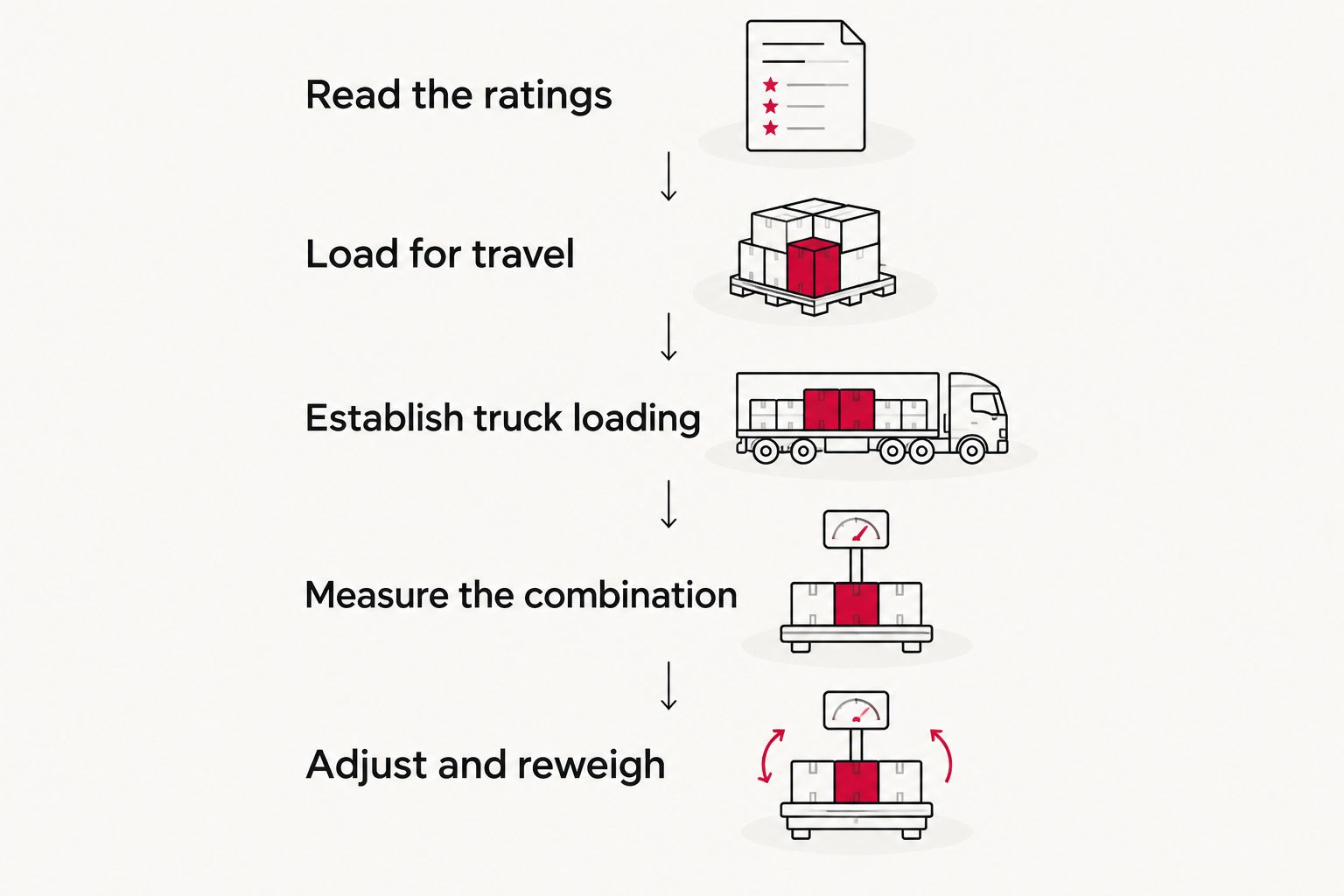
Follow a controlled weighing sequence
- Read the ratings. Identify the exact vehicle limits, receiver limits, trailer limits, and hitch instructions before interpreting scale results.
- Load for travel. Secure the cargo in its intended position and include the equipment normally carried on the run.
- Establish truck loading. Obtain a baseline for the loaded truck without the trailer so you can assess front-axle loading changes.
- Measure the combination. Obtain truck and trailer axle weights using a scale procedure suitable for the configuration; weigh without bar tension only where permitted and safe.
- Adjust and reweigh. Engage weight distribution according to the manufacturer instructions, then confirm the specified restoration and all applicable weight limits.
The weighing procedure must also establish loaded trailer weight and tongue weight through suitable measurements. A trailer-axle reading with weight distribution engaged is not, by itself, the trailer's total weight, because the coupled combination shares loading across multiple axles.
Compare each axle reading with its applicable rating, the loaded truck with its gross vehicle weight rating, and the complete combination with its gross combination weight rating. Also verify loaded trailer weight, trailer axle limits, tires, and the applicable hitch-component limits. If any limit is exceeded, reduce the load or change the equipment; do not keep increasing spring-bar tension to conceal the problem.
Keep sway control and load distribution separate
Weight distribution and sway control are not interchangeable functions. Some hitch systems incorporate sway control, while others require separate approved equipment, and the presence of spring bars alone does not establish sway-control capability. Follow the instructions for the actual system rather than assuming every weight distribution hitch behaves the same way.
Persistent sway requires investigation of loading, tongue weight, tires, equipment condition, and setup. Adding tension is not a universal correction, and towing beyond approved limits remains unacceptable even when a system reduces visible movement. Follow the vehicle manufacturer's emergency guidance if instability occurs during a tow.
Inspect the hardware before the next run
Check the receiver attachment, hitch pin retention, head fasteners, coupler latch, spring bars, brackets, and retention devices for damage, looseness, or abnormal wear. Pay attention to shifted brackets, elongated holes, cracking, and contact marks that indicate interference. Stop using damaged components until they are assessed and replaced as directed.
Lubricate only where the hitch manufacturer specifies it. Some contact surfaces depend on friction for their intended operation, so applying grease everywhere can interfere with the system. Keep instructions accessible, follow the specified tightening procedure, and recheck adjustment whenever loading or relevant equipment changes.
The practical lesson for 2026 is straightforward: a level stance is an adjustment result, not a capacity certificate. Keep the ratings and scale records with the equipment so another driver can verify the setup without relying on how the previous run felt.
FAQ
How much towing capacity does a weight distribution hitch add?
A weight distribution hitch adds no towing capacity beyond the manufacturer's approved limits. It redistributes axle loading and can permit use of a receiver's higher weight-distributing rating when the complete combination is approved and remains within every applicable limit.
Can I tow above my truck's rating if I use weight distribution?
No, weight distribution does not permit towing above your truck's applicable manufacturer rating. Reduce the load or use a vehicle rated for the loaded combination.
Why does my receiver show a higher weight-distributing rating?
The higher rating applies to that receiver in an approved weight-distributing configuration. It does not replace the truck's towing, gross vehicle, axle, or gross combination limits.
Does a weight distribution hitch take tongue weight off the truck?
Weight distribution changes how loading is shared among the truck and trailer axles; it does not make the loaded trailer's tongue-weight requirement disappear. Check measured weights and use the vehicle and hitch manufacturers' procedures.
Is a level truck proof that the hitch is adjusted correctly?
No, a level truck does not prove correct adjustment or compliance with weight ratings. Verify the manufacturer-specified setup criterion and measured axle weights.
Can any bumper-pull trailer use a weight distribution hitch?
No, compatibility requires approval from the vehicle, receiver, trailer, and hitch manufacturers. Physical fit alone does not establish that the trailer frame or vehicle accepts spring-bar forces.
Do weight distribution hitches always include sway control?
No, weight distribution does not automatically include sway control. Check the specific system's instructions and address loading or equipment problems rather than treating spring-bar tension as a universal sway correction.
Related guides
Before the next loaded departure, identify the rating that actually limits your combination and verify the adjustment against measured weights. Shop the full line of towing and cargo-control accessories at TruckNTow.
Match the equipment to the load, verify the limits, and head out with a checked setup.