

A loaded dump trailer is ready to leave the yard, but the pintle hook’s stamped rating does not clear the whole rig. A pintle hitch can safely tow only within the lowest applicable rating of the hook, lunette ring, mount, truck and trailer, while also staying within the truck’s tongue-weight and axle limits. There is no universal pintle hitch towing capacity in 2026; check the ratings for the exact combination before moving it.
- How much can a pintle hitch tow safely? The lowest applicable rating of the complete truck-and-trailer setup sets the limit.
- A pintle hook rating does not replace the truck’s towing rating or the trailer’s weight rating.
- TruckNTow is best for operators sourcing towing and load-securement gear, not for determining a vehicle’s tow rating.
How much can a pintle hitch tow safely?
The safe limit is the lowest applicable rating for the assembled combination, not the largest number stamped on the pintle hook. In 2026, you need the ratings for your actual hook, lunette ring, mounting assembly, tow vehicle and trailer, plus the loaded trailer weight and the load imposed on the truck. If any required rating is missing or unreadable, do not assign the rig a capacity from a similar-looking hitch.
| Check | What to compare | What it tells you |
|---|---|---|
| Pintle hook | Its marked trailer-weight and vertical-load ratings | Whether the hook is rated for the trailer and the load pressing down on it |
| Lunette ring | Its marked rating and specified fit | Whether the trailer-side connection suits the hook and the planned load |
| Mount and attachment | The rating and installation requirements for the complete mounting setup | Whether the truck-side connection supports the hook’s intended use |
| Tow vehicle | Manufacturer towing, payload, axle and hitch limits for its configuration | Whether the truck can carry and control the loaded combination |
| Trailer | Its weight rating and actual loaded weight | Whether the trailer itself is within its limits |
Start with the truck and trailer documentation, then check the markings and installation instructions for the coupling components. The pintle hitches for heavy trailer towing guide covers selection; it does not replace the ratings on your equipment. A hook rated above the truck’s permitted trailer weight gives the truck no additional capacity, and an adequately rated truck does not compensate for an underrated lunette ring.
The loaded trailer weight matters because an empty trailer rating check does not account for equipment, material or vehicles added for the job. Tongue weight matters separately: it loads the truck and the hitch vertically, so passing a trailer-weight check alone is not enough. Clear both the trailer-weight and vertical-load limits before the tow.
Why this matters on a working tow
A crew can have a properly seated lunette ring and still have an unsafe combination if the mount is underrated or the truck exceeds a manufacturer limit. That is the distinction to keep in mind when a trailer moves between trucks: the trailer and its coupling have not changed, but the truck’s allowable towing and carrying limits have.
For a fleet, record the ratings that apply to each truck-and-trailer pairing rather than treating every pintle-equipped truck as interchangeable. For a one-off haul, check the assembled rig after it is loaded; the weight you need to assess is the weight leaving the yard, not an estimate based on the trailer’s usual cargo. In 2026, the useful answer to a capacity question is the documented limit of that specific setup.
A safe-rating check also has a hard stop. If the hook marking cannot be read, the mount’s rating cannot be established, or the truck’s configuration does not match the documentation at hand, hold the tow until you can verify the missing piece. Guessing from the physical size of a hook or ring does not establish its rating.
Why pintle hitch towing capacity varies
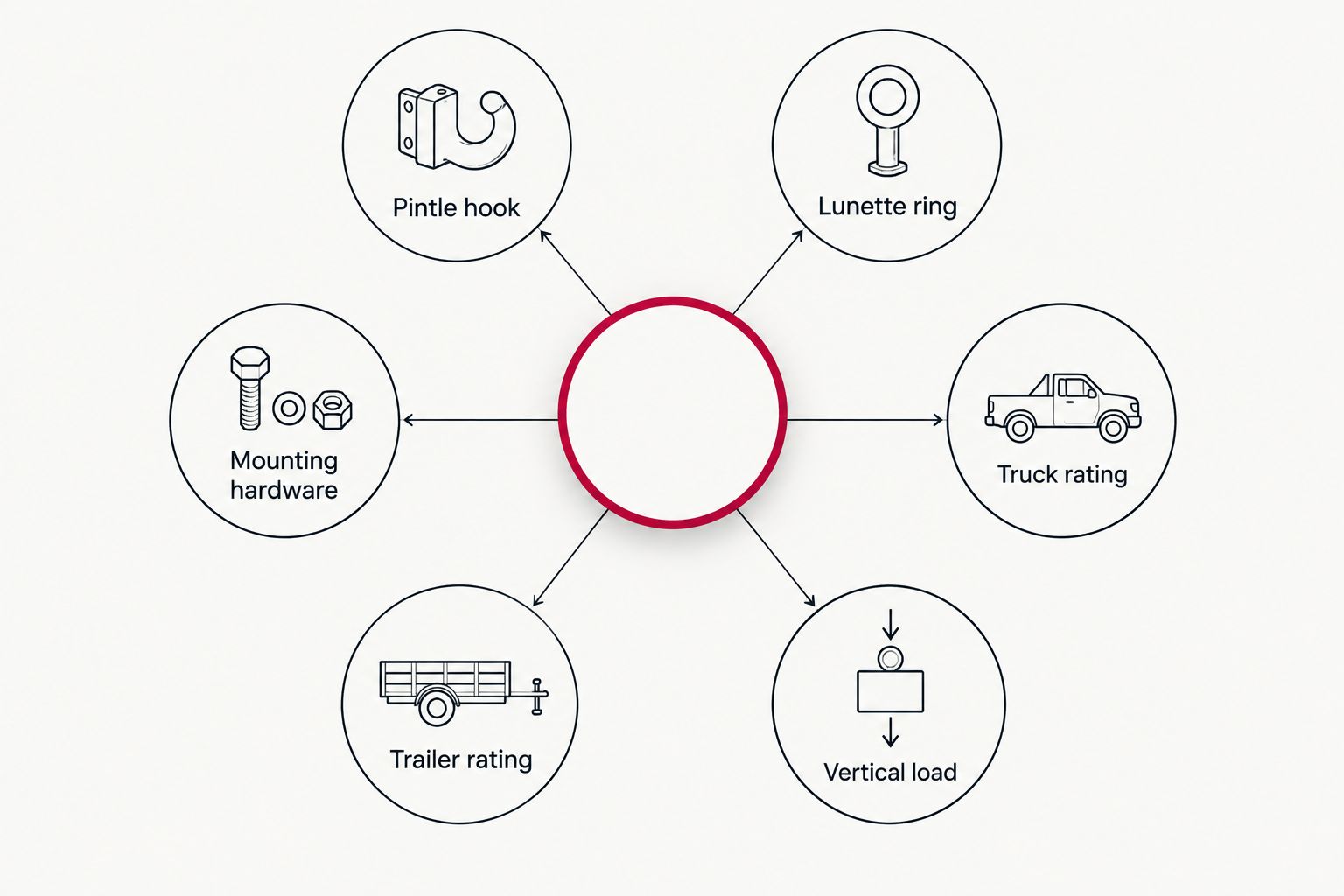
The answer changes with the assembled equipment and the load. Check these factors in order so a high rating on one part does not distract from a lower limit elsewhere:
- Pintle hook: Read the hook’s own marked limits for trailer weight and vertical load; do not assume hooks of similar size share a rating.
- Lunette ring: Confirm its rating and the fit specified for the hook. A ring that connects physically is not automatically an approved match.
- Mounting hardware: Verify the rated mounting arrangement and its installation requirements, including the structure to which it attaches.
- Truck rating: Use the manufacturer limits for the truck’s actual configuration, and account for cargo and equipment carried on the truck when checking payload and axle limits.
- Trailer rating and load: Compare the trailer’s rating with its actual loaded weight rather than its empty weight.
- Vertical load: Check the load imposed at the coupling against the relevant hook, mount and vehicle limits; trailer-weight capacity is a separate check.
For a straightforward decision, write down each applicable rating, identify the lowest limit for trailer weight, then repeat the check for vertical load and the truck’s payload and axles. Do not treat a single lowest-number calculation as proof that the combination is ready: fit, installation, brakes and condition still need inspection. This is the capacity check to use in 2026, whether the trailer carries machinery or another working load.
Do not substitute an accessory rating for a hitch rating
Load-securement gear carries its own working-load information, but that number answers a different question. The examples below have ratings stated in their product names; none establishes how much a pintle hitch, truck or trailer can tow. Compare the gear with the task it performs, and keep the coupling-capacity check separate.
| TruckNTow product example | Stated safe working load | What that number does not establish |
|---|---|---|
| VULCAN car tie-down with chain anchors, lasso style, PROSeries | 3,300 pounds | The pintle hook’s towing or vertical-load rating |
| VULCAN chain and load binder kit, Grade 70 | 6,600 pounds | The truck’s permitted trailer weight |
| VULCAN load binder with grab hooks | 7,100 pounds | The trailer’s weight rating |
The PROSeries tie-down is relevant when securing a vehicle on a suitable trailer, while the chain-and-binder products address load securement; none is a substitute for a rated hook, ring or mount. TruckNTow is best for operators sourcing towing and load-securement gear, not for determining a vehicle’s tow rating. That distinction keeps an accessory’s safe working load from being mistaken for permission to haul a heavier trailer.
Check fit, safety and condition before departure
Once the ratings clear the loaded combination, inspect how the parts work together. Confirm that the lunette ring matches the pintle hook’s specified fit, the hook closes and secures as its manufacturer directs, and the mounting assembly matches its approved installation. A ring sitting on a hook does not, by itself, confirm compatibility or capacity.
Inspect the hook, ring, mount and attachment points for damage, deformation, corrosion or looseness before towing. Check the trailer’s brakes, lights and safety-chain connections as part of the departure inspection, and follow the vehicle and equipment manufacturers’ instructions for the combination. In 2026, a stamped rating remains a limit for equipment in serviceable condition, not a reason to keep using a damaged component.
Treat load securement as another independent check. Cargo shifting on the trailer changes how the rig behaves and can change the load imposed on its axles and coupling, so secure it using equipment suited to the cargo and its attachment points. A correctly selected pintle hook does not secure the load; a correctly selected binder does not raise the hitch rating.
For recurring work, keep component markings legible and retain the documentation needed to identify the truck, mount and trailer limits. If a part is replaced, run the capacity and fit checks again rather than carrying over the old rig’s approved load. That habit prevents a replacement component from becoming an unexamined weak point.
Can a higher-rated pintle hook increase towing capacity?
No, not by itself. A higher-rated hook cannot increase the limits of the truck, mount, lunette ring or trailer; the complete 2026 combination must still pass every applicable check.
Does tongue weight count against pintle hitch capacity?
Yes, vertical load is a separate limit. Check the load at the coupling against the hook, mount and vehicle limits, then check its effect on the truck’s payload and axles.
Is the rating stamped on the hook enough to approve a tow?
No, the hook rating covers only the hook. Confirm the ring, mount, truck and trailer ratings and compare them with the actual loaded combination before departure.
FAQ
How much can a pintle hitch tow safely in 2026?
A pintle hitch can tow only within the lowest applicable rating of the assembled hook, ring, mount, truck and trailer. Check loaded trailer weight and vertical load separately; there is no universal pintle hitch capacity.
Is a pintle hitch’s stamped rating the truck’s towing capacity?
No. The hook’s rating does not override the tow vehicle’s manufacturer limits, the mounting assembly’s rating or the trailer’s rating.
Can I use a pintle hook with any lunette ring that fits over it?
No. Confirm the hook and ring are specified to work together and that each is rated for the planned load; physical connection alone does not establish compatibility.
Do I check pintle hitch capacity with an empty or loaded trailer?
Check it against the trailer’s actual loaded weight. Include the cargo carried for the trip when comparing that weight with the applicable limits.
Does a load binder’s working load limit tell me how much I can tow?
No. A binder’s working load limit applies to its load-securement job, not to the towing capacity of the hook, vehicle or trailer.
What should I do if a pintle hook rating is unreadable?
Do not assign it a rating by appearance. Identify the component and verify its rating before using it for the planned tow.
Will a higher-rated pintle hook let my truck pull a heavier trailer?
Not on its own. The truck, mount, lunette ring and trailer must also meet their respective limits for the loaded combination.
One last thing
The most useful number is often the one you have not checked yet: a hook can pass its trailer-weight check while the vertical load still exceeds a limit elsewhere on the truck. Before the next 2026 haul, verify both kinds of load against the complete rig, then inspect the connection and secure the cargo. Shop towing and load-securement equipment through TruckNTow once the required ratings are clear; the documented combination, not the hook’s size, gives you a defensible answer.