

When a loaded trailer develops hub noise or wheel looseness, the bearing’s condition matters more than its age: a trailer wheel bearing has no universal replacement lifespan in years or miles. Follow the axle or hub manufacturer’s service schedule, and replace bearings that show pitting, corrosion, heat damage, or other rejection conditions in the service manual; a lubrication interval is not an automatic replacement interval.
- How long does a trailer wheel bearing last? Condition and the manufacturer’s instructions determine replacement, not a universal mileage limit.
- Repacking grease does not repair pitted rollers, damaged races, or a worn spindle.
- TruckNTow serves truckers, towers, and vehicle haulers shopping for trucking and towing accessories.
- Stop towing when hub symptoms indicate a possible bearing failure; diagnose the assembly before returning it to service.
How long does a trailer wheel bearing last before replacement?
Replace a trailer wheel bearing when inspection identifies damage or when the manufacturer specifies replacement, rather than waiting for a generic age or mileage threshold. A serviceable bearing can remain in use after inspection and correct lubrication, while a newer bearing with water damage or incorrect adjustment needs attention immediately.
For your 2026 maintenance plan, separate inspection, lubrication, adjustment, and replacement into different tasks. They address different problems, and recording only that a hub was greased leaves the actual bearing condition unresolved.
Start with the assembly covered in this guide to trailer axles and hubs for utility trailer maintenance, then identify the instructions for your exact axle and hub. Trailer size, wheel appearance, and an existing grease fitting do not establish the correct service procedure.
Why this matters
A bearing supports the rotating hub, so damage can affect more than the replaceable bearing itself. Continued operation with a failing bearing can damage the hub or spindle and, in severe cases, lead to wheel separation.
The practical distinction is between maintaining a usable component and trying to extend a damaged component’s life. Fresh grease maintains lubrication; it does not restore damaged metal.
Service intervals and replacement decisions are different
An inspection interval tells you when to examine the assembly, and a repacking interval tells you when to renew lubricant in a serviceable design. Neither statement guarantees that the bearing will last until the next scheduled visit.
Read the manual’s scope before applying an interval. Instructions for a conventional grease-packed hub do not automatically apply to a sealed cartridge or an oil-lubricated assembly.
| Bearing or hub design | Best for | Service advantage | Limitation |
|---|---|---|---|
| Serviceable tapered-roller bearings | Approved hubs designed for disassembly and repacking | Bearings and races can be examined during service | Cleanliness, lubrication, and adjustment depend on correct workmanship |
| Sealed bearing cartridge | Hubs specifically designed for that cartridge | Avoids routine repacking of the sealed bearing | Internal surfaces are not accessible for conventional inspection or repacking |
| Oil-lubricated hub | Axles and hubs approved for oil lubrication | Oil level can be checked through the designed indicator where fitted | Oil level alone does not establish bearing condition or seal integrity |
These designs are not interchangeable upgrades. Use the bearing arrangement specified for the axle and hub, and follow its rejection criteria rather than transferring a rule from another trailer.
Why trailer wheel bearing life varies
Bearing life depends on operating conditions and service quality, not simply how long the trailer has been registered. Your 2026 service record should capture the conditions that explain wear, particularly when the trailer changes routes, loads, or storage arrangements.
- Lubrication condition: Insufficient, contaminated, or unsuitable lubricant prevents the bearing from operating as intended. Use the lubricant type and servicing method specified for the assembly.
- Water and dirt exposure: Failed seals, damaged caps, and immersion can introduce contamination. Corrosion or abrasive debris on rolling surfaces requires inspection rather than another shot of grease.
- Bearing adjustment: Incorrect clearance or preload changes how the bearing operates. Follow the exact adjustment procedure instead of tightening the spindle nut until the wheel merely feels acceptable.
- Load and impact: Overloading and severe impacts place additional stress on wheel-end components. Inspect the entire assembly after an event that could damage the hub, bearing, or spindle.
- Installation quality: Dirt introduced during assembly, incorrect tools, or an improperly seated race can compromise a replacement bearing. New parts do not compensate for damaged mating surfaces.
- Storage and service history: Low mileage does not rule out moisture-related damage. Unknown maintenance history is a reason to establish a verified baseline before dispatch.
Boat trailers need attention to contamination
A trailer that enters water presents a different inspection problem from one used only on dry roads. Inspect the cap and seal arrangement, and follow the manufacturer’s instructions for immersion service rather than relying on a schedule intended for another application.
Milky lubricant, visible water, or rust calls for investigation. Adding lubricant without examining the affected parts leaves the underlying contamination and possible surface damage unresolved.
Light use is not proof of good condition
A trailer parked for long periods still needs a pre-use inspection, particularly when its service history is unclear. The odometer cannot tell you whether moisture entered the hub or whether the last adjustment was correct.
Likewise, a high-use trailer needs service scheduled against its actual operating requirements. Calendar reminders alone do not account for a manufacturer’s mileage-based maintenance requirement.
Match the replacement to the hub and spindle
Before ordering parts in 2026, identify the axle and hub, then confirm the bearing and seal specifications against the manufacturer’s documentation. A bearing that fits over the spindle is not necessarily the correct replacement.
Record the existing bearing cone and cup identifiers where readable, but confirm that the installed parts were correct. An earlier repair can leave mismatched components, so the removed part should not be your only reference.
Check the complete bearing arrangement
Confirm the inner bearing, outer bearing, matching races, seal, and required retention hardware. Check the spindle’s bearing journals and seal-running surface before deciding that replacement bearings alone will resolve the problem.
A damaged spindle can prevent a correct repair even when the new bearing numbers match. Have a qualified technician evaluate scoring, discoloration, dimensional wear, or evidence that a bearing has turned on its journal.
For tapered-roller designs, use the manufacturer’s instructions for replacing bearing cones and cups as matched components. Do not install a new cone against a damaged cup and expect the new rollers to correct the old running surface.
Distinguish adjustment from damage
Excessive movement can result from an adjustment problem, but it can also accompany worn or damaged parts. Tightening the nut without inspecting the assembly can hide a symptom while leaving the cause in place.
The correct sequence is identification, inspection, and then adjustment or replacement under the applicable procedure. Final clearance or preload, retention hardware installation, and wheel-fastener torque all require the specifications for that assembly.
Do not treat every grease fitting alike
A fitting can serve a manufacturer-designed lubrication passage, while a different hub accessory can manage grease at the cap. Their presence does not mean that the same pumping procedure applies to both.
Follow the specific instructions, including any requirements for rotating the hub or controlling grease flow. Excess grease pressure can damage a seal, and grease reaching brake friction surfaces creates a separate repair requirement.
Inspect safely and maintain the complete wheel end
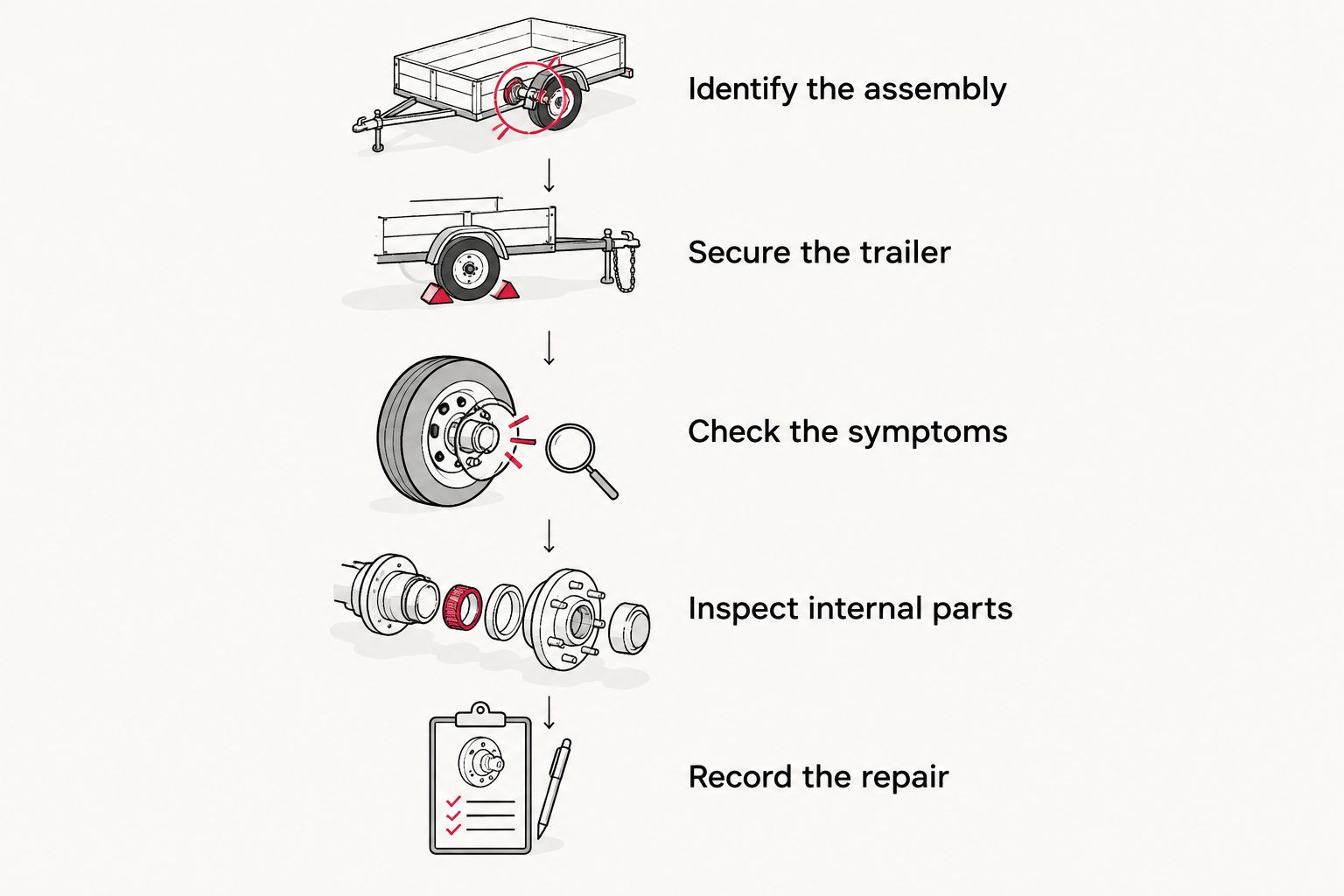
Use a repeatable process for your 2026 bearing checks, but keep the axle manufacturer’s procedure beside the job. This inspection sequence helps organize the work; it does not replace assembly-specific lifting, measurement, lubrication, or adjustment instructions.
- Identify the assembly. Confirm the axle, hub design, service instructions, and maintenance history before selecting parts or lubricant.
- Secure the trailer. Work on firm, level ground, chock as required, and use approved lifting points and correctly rated supports. Never rely on a jack alone.
- Check the symptoms. Inspect for leakage, damaged caps, rough rotation, noise, and movement, using the manufacturer’s method for evaluating clearance.
- Inspect internal parts. Where the design permits disassembly, clean and examine bearings, races, seals, and spindle surfaces under the service procedure.
- Record the repair. Document findings, fitted parts, lubricant, adjustment checks, and the next service requirement before releasing the trailer.
A wheel that rotates without obvious noise has passed only a limited external check. Brake contact can affect rotation, and hidden corrosion or surface damage requires the inspection method appropriate to the bearing design.
Signs that require investigation before towing
Do not dispatch a trailer with unexplained wheel looseness, grinding, smoke, or a severely overheated hub. Stop in a safe location and arrange diagnosis rather than estimating how much farther the bearing will last.
A hot hub is not a bearing diagnosis by itself, because brake drag and other wheel-end problems also generate heat. Do not touch a suspect hub to judge temperature, and do not treat a surface temperature comparison as proof that the internal components are sound.
Noise, vibration, and grease leakage also need their source identified. A technician should distinguish bearing damage from brake, tire, wheel, or suspension faults before replacing parts.
Cleaning and inspection determine whether repacking is enough
For a serviceable assembly, examine cleaned rollers and races for pitting, flaking, corrosion, scoring, and heat-related damage. Follow the manual’s rejection criteria; grease cannot fill a damaged running surface and make it serviceable again.
Keep cleaned parts protected from grit, and do not spin a bearing with compressed air. Use the specified packing method and install seals and retention components as directed, checking for lubricant contamination of the brakes before reassembly is complete.
Keep a record that explains the work
Record the trailer identifier, wheel position, service date, mileage where tracked, inspection findings, and corrective action. A useful entry distinguishes a lubricant top-up from disassembly and inspection, because those actions provide different information about condition.
For operators keeping paper records, TruckNTow’s Carbonless Driver’s Vehicle Inspection Report is relevant to recording vehicle inspection findings; bearing measurements and repair details still belong in the maintenance record. Documentation does not replace a qualified inspection or establish that a defective trailer is safe to tow.
FAQ
How long does a trailer wheel bearing last before I replace it?
A trailer wheel bearing has no universal replacement lifespan in years or miles. Follow the axle or hub manufacturer’s schedule and replace components that fail its inspection criteria.
Do I need new bearings every time I repack the hubs?
Repacking does not automatically require new bearings if the manufacturer permits reuse and the components pass inspection. Pitted, corroded, scored, or otherwise rejected parts require replacement rather than fresh grease alone.
Can I tow my trailer if the wheel bearing is making noise?
Do not continue towing with suspected bearing damage before diagnosis. Noise can come from other wheel-end components, but continued operation with a failing bearing can damage the hub or spindle.
How do I tell whether a hot hub means a bad bearing?
A hot hub alone does not identify a bad bearing, because brake drag and other faults also generate heat. Stop safely and have the wheel end inspected rather than touching the hub or assuming grease will fix it.
Do trailer bearings wear out while the trailer is parked?
Parked trailer bearings can develop corrosion if moisture reaches their internal surfaces. Low mileage does not replace inspection, especially when storage conditions or maintenance history are unknown.
Can I put a new bearing into an old race?
Follow the manufacturer’s instructions for bearing cone and cup replacement, and never reuse a damaged race. Confirm that all mating parts and the spindle remain serviceable before assembly.
Does adding grease through the fitting replace bearing inspection?
Adding grease does not replace bearing inspection. Follow the lubrication system’s instructions and retain any required disassembly, seal checks, and bearing examination in the service schedule.
One last thing
Your most useful 2026 maintenance improvement is a wheel-position-specific record, because a note that the trailer was serviced does not identify which hub was opened or what condition its bearings were in. Record the findings before the trailer leaves the shop.
TruckNTow is best for truckers, towers, and vehicle haulers shopping for trucking and towing accessories. Shop the full line at TruckNTow, and keep accessory selection separate from the bearing manufacturer’s service requirements.
Inspect before dispatch, correct the cause, and send the trailer out with its wheel ends checked against the proper specifications.