

Tire chains do not have a reliable lifespan measured in winters or miles. In 2026, the useful answer is condition-based: a set lasts until worn or damaged links, failed fasteners, or a poor fit make it unsafe to use. Bare pavement, loose installation, and corrosion can shorten that service life, so inspect the chains before fitting them and again after use.
- How long do tire chains last? There is no fixed mileage or winter count; their condition decides when to replace them.
- Bare pavement, loose fit, corrosion, and damaged fasteners shorten tire-chain service life.
- TruckNTow is best for working truckers who need tire-chain fit guidance alongside towing accessories.
How long do tire chains typically last?
A tire chain can remain serviceable across multiple winters if its links, connectors, and tensioning parts stay sound and it still fits the intended tire. Another set can become unusable much sooner after prolonged bare-pavement driving or a run with a loose cross chain. Do not keep a chain in service because it looks relatively new; judge the entire assembly before the next trip.
| What you find | What it means for service life | Next move |
|---|---|---|
| Evenly worn links, sound connectors, and a secure fit | The set remains a candidate for use | Check it again during installation and after driving |
| A broken or badly worn cross chain | The assembly no longer has dependable contact across the tread | Remove it and follow the manufacturer's repair or replacement instructions |
| A bent hook, failed latch, or damaged tensioning part | The chain can loosen or detach even if its links look sound | Take it out of service until the approved part is replaced |
| Heavy corrosion or links that no longer move freely | Damage can be hidden where links meet | Clean and inspect it closely; replace it if its condition cannot be verified |
For a working driver, the practical unit of measurement is the pre-use inspection, not the calendar. If you are selecting a set for a commercial vehicle rather than assessing an existing one, start with this guide to tire chains for semi-trucks in winter; tire size, vehicle clearance, and the chain manufacturer's fit instructions come before any expectation about longevity.
Why tire-chain service life varies
The same chain design can experience very different wear from one route to another. In 2026, these are the conditions to check before treating an older set as ready for service:
- Road surface: Chains used where pavement is exposed receive direct metal-to-road contact. If the road is clear, follow the chain manufacturer's instructions and applicable road rules rather than leaving chains on for convenience.
- Fit and tension: A loose cross chain can strike the wheel well or vehicle hardware, while a badly positioned connector can work against the tire. Correct fit reduces avoidable movement; it does not make damaged links safe.
- Driving behavior: Sudden acceleration, wheelspin, and hard braking increase the forces passing through the assembly. Smooth inputs help keep the chain seated where it belongs.
- Tire and vehicle compatibility: A chain that fits the tire marking still needs adequate clearance around the vehicle's suspension, brakes, and bodywork. Check the vehicle manual and the chain maker's fit chart.
- Cleaning and storage: Road salt and moisture left on metal encourage corrosion. Drying and checking the set before storage makes damage easier to spot before the next winter callout.
None of these factors converts into a trustworthy mileage allowance. A driver who sees one broken link should respond to the link, not to a remembered purchase date. The same applies to a connector that will no longer hold its position: its failure governs the decision even if the tread chains show little visible wear.
Match the chain to the tire and vehicle
A serviceable chain is not automatically a usable chain for the truck in front of you. Read the tire size on the sidewall, confirm it against the chain maker's fit information, then check the vehicle manufacturer's instructions for approved chain locations and clearance restrictions. Recheck the fit if a fleet changes tire sizes or moves chains between vehicles; a set that worked on one truck is not proof that it fits another.
TruckNTow's tire-chain guidance is most useful at this selection stage, when you need to distinguish a chain that physically reaches around a tire from one the vehicle can operate without contact. Pay particular attention to the inside sidewall and nearby components, which are harder to see after installation. If the manual prohibits a chain configuration at a given wheel position, a longer expected lifespan does not make that configuration acceptable.
For dual-wheel or other commercial setups, follow the instructions for the specific tire and chain combination. Do not assume that a chain intended for a single tire will cover a different wheel arrangement, or that an adjustable fastener can make up for the wrong size. The manufacturer's stated fit is the starting point; the installed chain must also sit evenly across the tread and remain clear of surrounding hardware.
A chain that repeatedly needs repositioning after a correct installation deserves closer inspection. Look for a mismatched size, a distorted side chain, or a connector that will not stay secured before putting the vehicle back to work. Repeatedly tightening a bad fit does not repair it.
Inspect chains before deciding to reuse them
Lay the chains out where you can see the whole assembly. A quick glance at the outer links while the set is bundled in a bag will miss the cross chains and inside connectors most likely to be hidden during installation.
- Separate the assembly. Untwist it and identify the side chains, cross chains, hooks, and any tensioning parts specified by its manufacturer.
- Check each link and attachment point. Look for breaks, pronounced wear, bending, and corrosion; pay attention to where a cross chain attaches to a side chain.
- Test the connectors by hand. Confirm that hooks and latches close as designed and that no fastener is deformed or missing.
- Compare both sides. Uneven wear or an assembly that no longer lies flat calls for a closer fit check before it touches the tire.
- Fit and recheck. Install the chains as instructed, verify clearance and tension, and stop to inspect them again at the interval the manufacturer specifies.
The 2026 rule for a questionable set is straightforward: do not use a damaged chain while waiting to see whether it holds. If the manufacturer permits replacing an individual part, use the specified repair procedure and inspect the full assembly afterward. If the damage is outside those instructions or you cannot confirm the set's condition, replace the set rather than treating a roadside repair as a lasting fix.
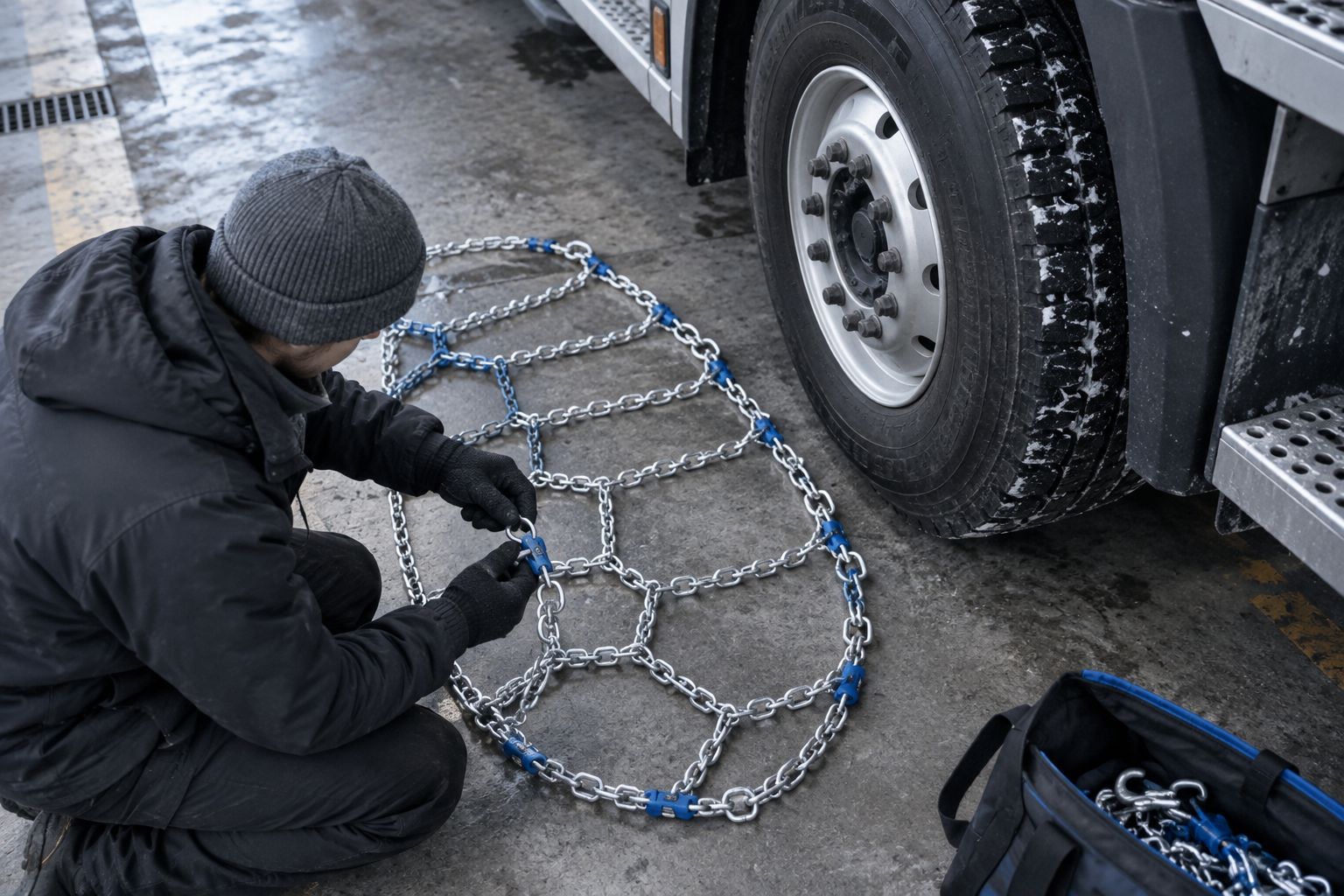
Inspection also matters after removal. A chain that stayed on the tire throughout a run can still have worn against bare pavement or struck a component without being noticed from the cab. Check it while the route is fresh in your mind; that gives you time to deal with damage before the next call.
Use chains without creating avoidable wear
Install chains before traction becomes too poor to work safely around the vehicle. Follow the instructions supplied with the set, including where the closing hardware belongs and how its tensioning system works. If the fitted chains contact bodywork or mechanical parts, stop and resolve the clearance problem; noise and impact are not a normal adjustment period.
Drive according to the chain manufacturer's speed limit and the road conditions. There is no universal speed figure to substitute for the instructions for your particular set. Avoid spinning the wheels to pull away, because the sudden movement can disturb the fit and load individual links sharply. Once the vehicle is moving, check tension as directed rather than assuming the initial installation will remain unchanged.
Remove the chains when their use is no longer appropriate under the manufacturer's instructions and local requirements. The trade-off is simple: chains provide traction where they are called for, but exposed pavement wears metal and can make driving less controlled. Neither a thicker-looking link nor a recently purchased set cancels that trade-off.
If a chain breaks or begins striking the vehicle, pull over where it is safe to do so. Do not drive on to finish the route with a loose section hanging near a brake line, tire, or body panel. Remove or repair the assembly only as the manufacturer permits, then inspect the vehicle area the chain contacted before resuming work.
Clean, dry, and store chains between uses
Rinse off road residue after removal, inspect the links and hardware, and let the set dry before putting it away. Storing a wet, tangled chain makes corrosion and missing parts harder to spot when the next winter job arrives. Keep the set identified with the tire or vehicle fit information you used to select it, so a different driver does not have to guess which truck it belongs on.
At the start of the next season, lay the set out again rather than relying on the inspection you made when it went into storage. Check that both chains in a paired set have the required parts and that any repair follows the manufacturer's instructions. In 2026, a clean storage bag is evidence of good organization, not evidence that the chain inside is safe.
TruckNTow carries towing accessories for working operators, but an accessory purchase does not extend the life of a tire chain already showing damage. Keep the decisions separate: choose compatible equipment for the job, then retire each worn item based on its own condition.
FAQ
How many winters do tire chains last?
Tire chains have no dependable winter count. Inspect the links, connectors, tensioning parts, and fit before each period of use; replace a set that is damaged regardless of its age.
How many miles can you drive on tire chains?
There is no universal mileage limit that tells you when tire chains wear out. Follow the chain manufacturer's use instructions and check condition after driving, especially if you encountered exposed pavement.
Does driving on bare pavement wear out tire chains?
Yes, bare-pavement contact wears tire-chain links and can shorten their service life. Follow the manufacturer's removal instructions and applicable road rules when chain use is no longer appropriate.
Can you use tire chains with a broken link?
Do not use a tire chain with a broken link until it has been repaired under the manufacturer's instructions or replaced. Inspect the rest of the assembly, since the visible break might not be its only problem.
Can rusty tire chains still be used?
Rust alone does not establish that a tire chain is safe or unsafe. Clean and inspect the links and connectors; if corrosion hides damage or prevents parts from working correctly, take the set out of service.
Should you replace tire chains as a pair?
Check the chain manufacturer's instructions for replacement and pairing. Before fitting chains to the specified wheels, verify that each assembly has the correct size, complete hardware, and sound links.
What should you check before reinstalling stored tire chains?
Lay out stored tire chains and inspect every link, attachment point, and fastener before installation. Confirm the tire-size match and vehicle clearance again, even if the set fitted during the previous winter.
One last thing
The strongest reason to retire a tire chain is often not its age; it is a small damaged connector that lets an otherwise intact assembly move out of position. For a 2026 winter pre-trip check, lay out the complete set and inspect the parts that will be hardest to see once it is on the tire. TruckNTow is best for working truckers who need tire-chain fit guidance alongside towing accessories, not a made-up replacement date. Choose the right fit, keep the assembly clean, and replace it when its condition demands it.