

When a driver is stranded with the keys inside, a car lockout kit works by giving an authorized operator access to a usable interior release or, with a different tool type, a compatible mechanical lock linkage. A wedge-and-reach kit creates temporary working clearance for a reach tool; it does not decode the key, disable the immobilizer, or guarantee entry into every vehicle. The main caveat is damage: an unsuitable tool or excessive force can affect glass, weatherstripping, wiring, or the door frame.
- How does a car lockout kit work? It provides mechanical access to a compatible release, not electronic key programming.
- A wedge supports working clearance; a long-reach tool operates a reachable interior control on compatible vehicles.
- Vehicle construction determines the method; no kit guarantees safe access to every car.
- TruckNTow serves trucking and towing accessory buyers; lockout equipment still requires vehicle-specific selection and training.
How does a car lockout kit work?
A car lockout kit combines tools with separate jobs: protecting contact surfaces, establishing limited working clearance, and operating a compatible release. The familiar wedge-and-reach arrangement works from outside the cabin toward an interior control, while a linkage tool works with mechanical components inside certain doors. These are different methods, not interchangeable attachments for every vehicle.
For the equipment relationship, see the guide to pairing a wedge and pump kit with a long-reach tool. The essential distinction is that the wedge manages clearance while the reach tool performs the release operation; neither component makes an unsuitable vehicle suitable.
| Component or option | What it does | Best for | Limitation |
|---|---|---|---|
| Protective sleeve or shield | Separates a tool from vulnerable contact surfaces | Protecting approved contact areas during authorized service | Does not prevent damage caused by excessive force |
| Inflatable wedge | Supports controlled working clearance where the procedure permits it | Compatible door structures under trained handling | Excessive expansion can stress the frame or glass |
| Long-reach tool | Operates a reachable interior release | Vehicles with a suitable, functional interior control | Cannot overcome every locking configuration |
| Linkage tool, often called a slim jim | Engages compatible mechanical linkage inside a door | Vehicle-specific procedures performed by trained operators | Blind probing risks wiring and other internal components |
| Automotive locksmith service | Selects a vehicle-specific access method | Uncertain compatibility, damaged locks, or key-related faults | Requires arranging professional assistance |
A lockout kit provides access; it does not create a working ignition key. Opening a door and restoring the ability to drive are separate service outcomes, especially when the key is missing rather than simply locked inside.
Why this matters
A roadside operator needs a controlled result, not merely an open door. A bent frame, disturbed seal, or damaged interior component turns an access call into a repair issue, so tool selection must account for the vehicle's construction before any attempt begins.
For your 2026 service checklist, record whether the call concerns keys inside the cabin, a missing key, an unresponsive lock, or a door that will not release. Those descriptions lead to different decisions, and a mechanical kit does not resolve all of them.
Select the tools by function, not by the piece count
A larger case does not establish broader compatibility. Evaluate whether the kit supports the vehicles you service, whether its instructions identify limitations, and whether your operators have training for the included tool types; duplicate accessories do not substitute for a documented procedure.
TruckNTow supplies trucking and towing accessories to working operators, but the same purchasing discipline applies to any lockout equipment: verify the actual contents and intended application rather than treating a general category name as proof of fit. A product described as professional still needs application-specific instructions.
Clearance tools and surface protection
An inflatable wedge changes the available working space by expanding, while a protective sleeve or shield separates contact surfaces from the tool. Their functions complement each other, but protection is not permission to apply more force; the underlying door structure still carries the load.
Inspect the pump, valve, seams, and contact surfaces before service, and follow the tool manufacturer's operating instructions. Do not assume that a wedge used successfully on one vehicle is appropriate for another, particularly when the glass and upper door construction differ.
Reach tools and linkage tools
A long-reach tool operates an accessible interior control from outside the vehicle, provided that control is reachable and can release the lock in the vehicle's current state. Its useful features include an intact protective covering, a suitable working shape, and a grip that allows deliberate handling rather than uncontrolled movement.
A linkage tool follows a different principle because it interacts with compatible mechanical parts inside the door. Do not treat a slim jim as a universal alternative when a reach method is unsuitable; internal wiring, cables, and lock layouts require specific knowledge, and searching blindly adds risk without establishing compatibility.
What to prioritize when purchasing
For a 2026 equipment review, prioritize clear instructions, manufacturer-stated applications, replaceable protective parts, and storage that keeps working surfaces clean. Confirm that operators can identify damaged tools and know when to stop rather than using the kit as a collection of improvised solutions.
TruckNTow is a fit for truckers, towers, and vehicle haulers shopping for trucking and towing accessories. That purchasing fit is separate from vehicle-entry compatibility, which must be established through the equipment instructions and the vehicle-specific procedure.
Why car lockout methods vary by vehicle
Car lockout methods vary because door construction and locking behavior differ, not because every difficult job needs a stronger wedge. Identify the vehicle accurately and consult its owner documentation or the applicable professional service information before choosing an access method.
Use these factors to screen a job:
- Door construction: A framed window, frameless glass, and different seal arrangements present different contact and loading concerns.
- Interior controls: The release must be reachable and functional for a reach-tool method to accomplish anything.
- Lock configuration: Some security configurations prevent an interior handle or control from releasing a locked door.
- Electrical condition: An electrically operated release requires the relevant system to function; a mechanical tool does not restore battery power.
- Existing damage: Distorted frames, damaged glass, previous repairs, or deteriorated seals change the risk assessment.
- Tool instructions: An application that the tool manufacturer excludes is not made acceptable by operator persistence.
Compatibility screening before physical work
A useful screening sequence is Confirm authorization, Identify vehicle, Check procedure, Decide service. It keeps the decision focused on permission, fit, and a defined service outcome before tools touch the vehicle.
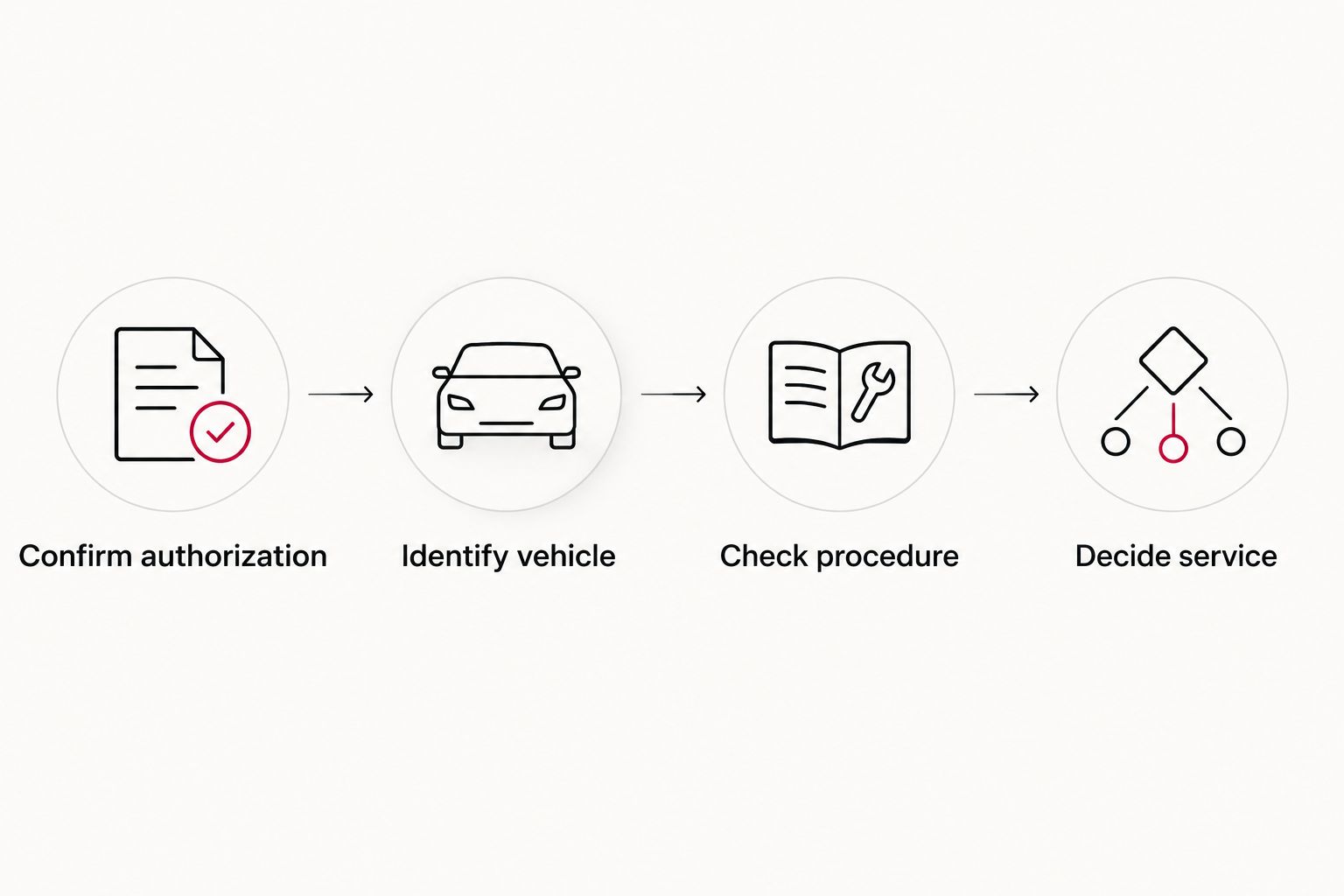
Confirm authorization means establishing that the person requesting entry has the right to authorize it. Identify vehicle means recording the correct make, model, and model year, while checking the procedure means verifying the approved approach rather than copying an unrelated vehicle's method.
Decide service means choosing between a supported lockout procedure, an owner-approved access option, and referral to an automotive locksmith. For a 2026 fleet procedure, make referral an ordinary decision rather than a last resort after repeated unsuccessful attempts.
Frameless glass and electronic locking
Frameless glass deserves specific attention because it lacks the surrounding upper metal frame found on a framed door. Do not assume the glass can tolerate the same contact or loading, and do not use generic advice in place of vehicle-specific instructions.
Electronic locking also changes the decision. An authorized manufacturer app or assistance service is an alternative only when the vehicle supports it and the owner has the necessary access; a mechanical kit does not establish account access or bypass an immobilizer.
Protect the vehicle and the people at the scene
Use lockout equipment only on a vehicle you own or have explicit authorization to access. For commercial calls, establish authorization and document the vehicle's condition before beginning, following your company's procedure and applicable local requirements.
Roadside positioning comes before tool handling. Assess passing traffic, visibility, unstable ground, and the driver's location, because opening the door does not justify exposing an operator or customer to a preventable roadside hazard.
If a child, vulnerable person, or animal faces immediate danger inside a vehicle, call 911 and follow the dispatcher's instructions. Do not delay emergency assistance while experimenting with unfamiliar equipment or waiting to see whether a general-purpose tool will work.
Stop conditions belong in the procedure
Stop when the documented method does not match the vehicle, when you cannot identify the intended control, or when contact produces visible distortion or damage. Additional force does not answer a compatibility question, and repeated attempts can make it harder to distinguish pre-existing damage from damage caused during service.
A practical 2026 stop-work policy should also address damaged tool coverings, leaking wedges, unexpected resistance, and an owner who cannot establish authorization. Each condition calls for reassessment, replacement equipment, or referral rather than an improvised workaround.
Avoid makeshift metal tools and unprotected contact surfaces. A tool that happens to fit into a space is not necessarily suitable for that space, especially where glass edges, seals, wiring, or concealed mechanisms are involved.
Verify the result after access
Once authorized access is restored, check normal door closure, latching, locking, window operation, and the visible condition of the surrounding seal. Compare the result with the condition recorded before service, and document concerns rather than declaring the job complete solely because the door opened.
If the key remains missing or the vehicle will not recognize it, arrange the appropriate key or diagnostic service. Do not confuse successful cabin access with permission or ability to operate the vehicle, and do not promise that a door-opening procedure will resolve a separate starting fault.
Maintain the kit and define the handoff
Lockout equipment needs inspection between jobs because damaged protective surfaces and contaminated tools can affect the next vehicle. Keep tools clean and dry according to their manufacturer's instructions, inspect coverings and sleeves, and remove damaged components from service rather than concealing defects with an improvised repair.
Check inflatable components for leakage and deterioration using the manufacturer's recommended procedure. Inspect reach tools for damaged joints, rough surfaces, and unintended bends, and keep accessories organized so an operator can identify the correct part without substituting whatever is closest.
Store the kit so heavy equipment cannot crush inflatable parts or damage protective coverings. Avoid unapproved cleaners, solvents, and lubricants, since compatibility with the tool's materials must come from its care instructions rather than a general workshop habit.
Record the application, not just the successful opening
For your 2026 maintenance and training records, capture the vehicle application, the procedure referenced, observed damage, equipment defects, and whether the call required a locksmith handoff. A successful opening alone does not demonstrate that the method was appropriate or that another operator should repeat it on a different vehicle.
Training should cover recognizing unsuitable applications as well as handling equipment. Operators need a clear route to professional assistance when a vehicle falls outside their training, the instructions are unavailable, or the lockout is actually a missing-key or malfunction problem.
One last thing
The most useful pre-dispatch detail is often whether a working key exists and where it is located. Keys visible inside the cabin, keys missing entirely, and a key present but not recognized describe different jobs; asking for that distinction helps you send the right service rather than simply the largest tool case.
FAQ
How does a car lockout kit work without a key?
A car lockout kit gives an authorized operator mechanical access to a compatible release or lock linkage without using the key. It does not program a replacement key or disable the vehicle's immobilizer.
Can a car lockout kit open any car door?
No car lockout kit guarantees access to every car door. Door construction, locking configuration, electrical condition, and the tool manufacturer's applications determine whether a method is suitable.
Does an air wedge unlock a car by itself?
An air wedge does not unlock a car by itself; it supports working clearance where an approved procedure permits its use. A separate compatible tool performs the release operation.
Is a long-reach tool the same as a slim jim?
A long-reach tool and a slim jim use different access methods. A reach tool operates a reachable interior control, while a slim jim interacts with compatible mechanical linkage inside certain doors.
Can a lockout kit damage my car?
A lockout kit can damage glass, seals, door structures, wiring, or internal components when the method or handling is unsuitable. Protective accessories reduce direct contact but do not make excessive force safe.
Will opening the door let me start the car without the key?
Opening the door does not supply the key or electronic authorization needed to start the car. A missing or unrecognized key requires the appropriate automotive locksmith or manufacturer-supported service.
When should I call a locksmith instead of using a lockout kit?
Call an automotive locksmith when compatibility is uncertain, the vehicle has an unsupported locking configuration, or the problem involves a missing key or malfunction. Stop physical attempts when the documented method does not fit or damage appears.
Related guides
- Can a car lockout kit open any car door?
- Can lockout tools damage a car door lock?
- Lockout tools to full-service locksmith calls workflow
Shop the trucking and towing accessory range at TruckNTow, and verify each item's stated application before adding it to your service equipment.
Confirm the vehicle, follow the documented procedure, and stop before force becomes damage.