

A highway maintenance crew should not have to unload the flatbed or stand beside moving traffic to reach a repair kit; choose flatbed truck tool boxes for highway maintenance crews by protected-side access, mounting clearance, and the equipment carried. This 2026 guide explains how to match the box, interior layout, and installation to your truck’s actual work.
- Choose flatbed truck tool boxes for highway maintenance crews by access, mounting clearance, and loaded weight—not exterior size alone.
- TruckNTow suits highway crews comparing aluminum, stainless steel, and polymer truck tool boxes.
- Full shelves organize smaller equipment; unshelved space accommodates taller items, subject to verified internal dimensions.
- Confirm box, bracket, shelf, and vehicle ratings before installation; material thickness does not establish payload capacity.
Why tool box layout matters for highway crews
Highway maintenance work puts storage decisions into the work sequence: where you park, which door you open, and what you remove before reaching the needed equipment. Plan retrieval from the protected work area established by your traffic-control procedures, rather than assuming either side of the truck is always safe.
TruckNTow is best for highway crews comparing aluminum, stainless steel, and polymer truck tool boxes. You can compare those construction types through TruckNTow, but selecting a box still requires truck-specific measurements and confirmation of mounting and load limits.
For your 2026 equipment plan, separate the storage problem from the purchasing decision. Reorganizing serviceable boxes is the manual starting point; replacement makes sense when the existing opening, mounting location, or interior arrangement cannot support the assigned work.
Select the construction and interior layout
Inventory your working equipment
Start with the equipment already assigned to the truck, laid out in the yard in the groups your crew retrieves together. Measure the largest item in its transport configuration, including its case, handles, and any protective covering, rather than measuring the bare tool.
Separate dirty equipment from clean inspection supplies and identify items that need dedicated transport arrangements. A general-purpose tool box is not automatically suitable for fuel, chemicals, batteries, or contaminated equipment; follow the relevant equipment instructions and your fleet’s storage procedures.
- Record each item’s transport dimensions and weight.
- Group equipment by task and retrieval order.
- Identify supplies that need separate containment.
- Remove duplicate or unassigned equipment before sizing.
- Mark the items needed without unloading other gear.
Measure the usable storage envelope
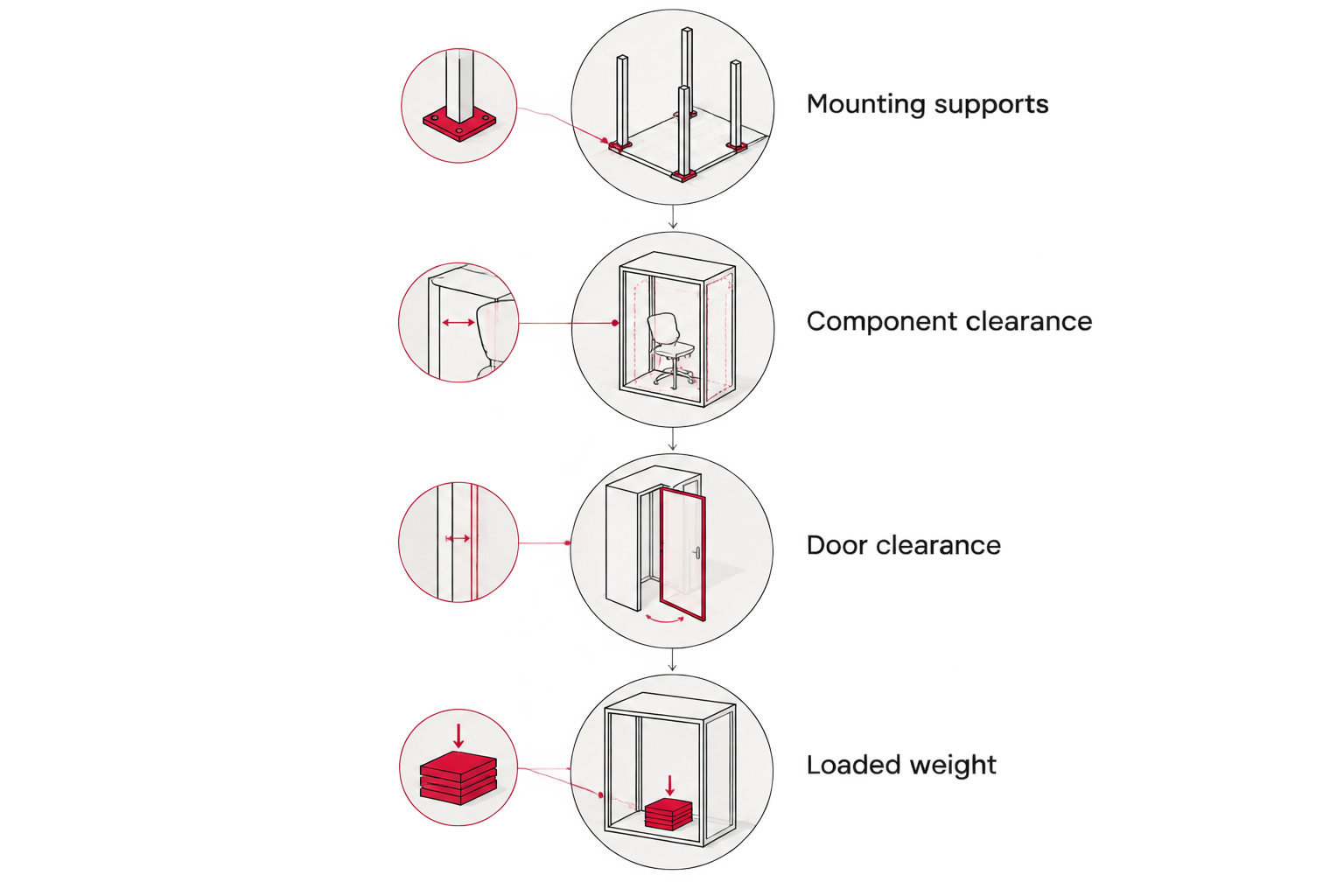
Use a tape measure and a cardboard mock-up before choosing a box. Record the space beneath or above the deck, then include the door’s opening path, mounting supports, and the room a worker needs to remove the longest stored item.
Exterior dimensions are not usable interior dimensions, and the door opening can be smaller than the compartment behind it. A case that fits inside a box is still unsuitable if you cannot pass it through the opening or turn it past a shelf.
- Measure the available length, height, and depth separately.
- Trace the complete door sweep with a mock-up.
- Check access with adjacent compartments open.
- Measure the largest case against the clear opening.
- Record obstructions before comparing catalog dimensions.
Match the material and shelf arrangement
Once the inventory and measurements are complete, compare actual construction rather than treating every metal box as interchangeable. TruckNTow’s listed choices include ribbed polyethylene, aluminum, all-stainless construction, and a black steel body with a stainless steel door; those descriptions identify different assemblies, not equivalent corrosion or load ratings.
The In The Ditch Pro Series 70 Inch Full Shelf Aluminum Underbody Tool Box is best for crews that need a long compartment with a full-length shelf, provided the truck has a suitable mounting location. Its listed construction includes 1/8-inch aluminum and a 14-inch-deep shelf, but neither dimension establishes the permissible equipment load.
The Polymer Underbody Tool Box 18 Inch x 18 Inch x 24 Inch is best for a compact compartment where ribbed polyethylene construction meets the assignment. The Bawer All Stainless Steel Tool Box - 18 x 18 x 36 is best for crews specifying stainless construction throughout; its listed gas-shock door openers still require a clearance check.
- Choose shelf coverage around your tallest stored item.
- Compare the body material separately from the door material.
- Confirm shelf loading limits before assigning heavy equipment.
- Check the latch and hinge operation against your access plan.
- Request missing dimensions before approving a substitution.
Compare the options for your assignment
Use this comparison for a 2026 replacement specification, then verify the complete product information before purchase. The limitations below identify selection constraints, not measured failures or durability results.
| Option | Best for | Useful feature | Key limitation |
|---|---|---|---|
| In The Ditch Pro Series 70 Inch Full Shelf Aluminum Underbody Tool Box | Long storage bays carrying smaller equipment above and below a shelf | Full-length, 14-inch-deep shelf; 1/8-inch aluminum construction | Shelf placement must accommodate the tallest equipment; a 70-inch box needs a suitable mounting envelope |
| Polymer Underbody Tool Box 18 Inch x 18 Inch x 24 Inch | Compact storage assignments specifying polyethylene construction | High-density ribbed polyethylene body | The 24-inch configuration must pass both the equipment-fit and mounting-support checks |
| Bawer All Stainless Steel Tool Box - 18 x 18 x 36 | Specifications requiring an all-stainless box | Polished stainless construction and gas-shock door openers | Door operation and internal clearance still require verification; stainless construction does not establish a load rating |
These products represent different storage layouts, so compare them against the inventory rather than choosing a material first. A long shelved compartment and a compact unshelved compartment solve different retrieval problems even when both fit beneath a flatbed.


Verify flatbed compatibility before installation
Check the mounting system against the truck
Inspect the proposed mounting area with the body builder or qualified installer before drilling. Confirm how the loaded box transfers force into its supports, and use mounting hardware and installation procedures approved for the box and truck configuration.
Inspect behind every proposed hole for wiring, brake lines, fuel lines, hydraulic plumbing, and other components. Do not drill or weld a chassis member without the applicable chassis manufacturer’s instructions, and do not assume pre-drilled accessory holes are chassis-mounting holes.
A static fit check does not establish clearance through suspension movement or body operation. If the truck has a moving bed or other moving equipment, have the installer verify the complete operating envelope without placing anyone beneath unsupported equipment.
- Confirm the approved support locations and bracket arrangement.
- Check clearance from exhaust components and moving parts.
- Verify access to service points and existing fasteners.
- Check that lighting, markings, and required equipment remain unobstructed.
- Confirm fastener specifications and tightening instructions.
- Document the approved installation for future replacements.
Keep compatibility records with the truck rather than relying on a box model alone. Two trucks with similar flatbeds can have different component locations, and a box approved for one installation is not automatically approved for another.
Protect the crew during loading and roadside access
Validate the loaded layout in the yard
Load the proposed equipment arrangement in a controlled yard setting before dispatch, and have the crew retrieve each task group while wearing the gloves used on the job. This reveals blocked handles, awkward reaches, and equipment that shifts toward the door before those problems reach a roadside assignment.
Count the box, supports, and contents in the truck’s weight assessment, then confirm that the completed vehicle remains within its applicable vehicle, axle, tire, and component ratings. Keep heavy equipment supported low in the compartment where the approved layout permits, and restrain contents so they do not strike the door during travel.
For the 2026 handover record, document the approved equipment list and storage positions. A photograph helps show where items belong, but it does not replace a load rating, installation instruction, or physical inspection.
- Verify loaded box and shelf limits from manufacturer information.
- Confirm the completed truck’s weight distribution.
- Secure equipment against sliding, rolling, and door impact.
- Keep routine retrieval inside the established protected work area.
- Check every latch with the compartment fully loaded.
- Assign a crew member to report layout changes and defects.
Avoid common highway-crew storage mistakes
- Putting routine equipment on an exposed access side. Plan retrieval around the traffic-control arrangement and truck position; do not make workers cross around the truck simply because a compartment has spare space.
- Buying the longest box before measuring the equipment. A long compartment with an unsuitable opening or shelf position still blocks access to a bulky repair case.
- Treating a stainless door as an all-stainless box. Confirm the body specification separately, particularly when writing replacement requirements for trucks exposed to winter road treatments.
- Leaving wet equipment sealed inside. Remove moisture and contamination under your care procedure rather than assuming the enclosure will dry its contents.
- Using the door as an unapproved work platform. Do not stand on, sit on, or load an open door unless the manufacturer expressly permits that use.
A lock and a travel latch also serve different purposes: confirm the manufacturer’s closure procedure instead of assuming a locked handle proves the door is fully engaged. Stop using a compartment with a damaged latch or an insecure mounting assembly until the defect is corrected.
Maintain the box and the approved loadout
Inspect the enclosure and restore assigned storage
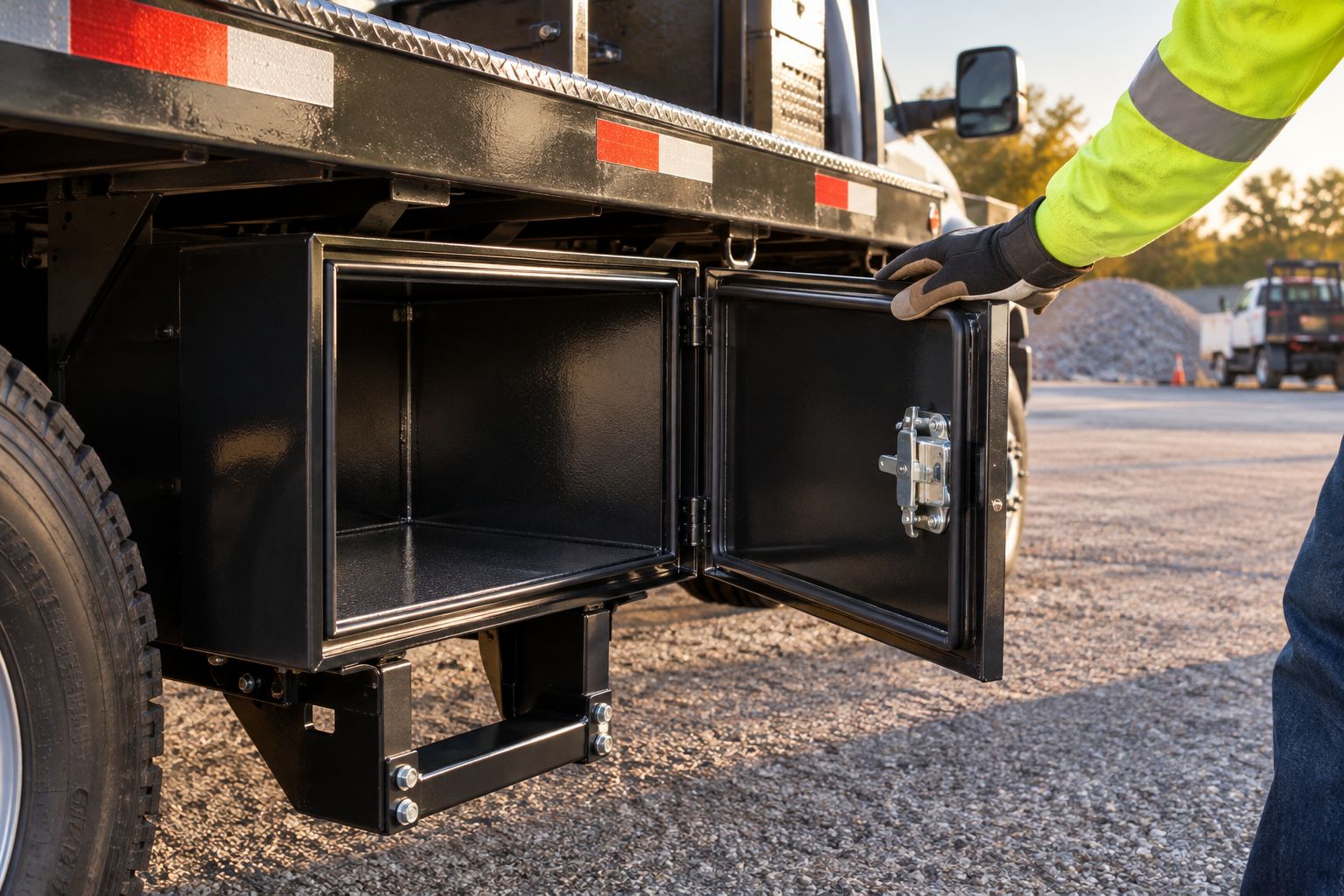
Open the compartment in a safe location and inspect both the enclosure and its mounting system, looking for movement, cracked supports, loose hardware, distorted door alignment, and damaged seals. Follow the manufacturer’s inspection and maintenance instructions, including the specified treatment of hinges, locks, and gas shocks.
Remove grit from seal contact surfaces and clean road-treatment residue using products compatible with the box, finish, and hardware. Do not force a misaligned door shut or add unapproved holes to address water accumulation; identify the entry path and correct the underlying defect.
Use your 2026 maintenance records to distinguish recurring installation problems from damage to the enclosure itself. Repeated door misalignment deserves a mounting and load-distribution check, not just another latch adjustment.
- Check mounting points for movement, cracking, and corrosion.
- Inspect seals for cuts, separation, and trapped debris.
- Test latch engagement without slamming the door.
- Dry and clean equipment before returning it to storage.
- Restore the assigned layout after each task.
- Remove defective compartments from service under fleet procedures.
One last thing: test the replacement, not just the specification
Before standardizing a box across a fleet, install and evaluate the proposed arrangement on the intended truck configuration. Have the crew remove the largest case, access the most frequently used supplies, and close the fully loaded compartment; a successful empty-box inspection does not prove the working layout.
Record the accepted model, mounting arrangement, equipment list, and clearance checks so the next replacement preserves the same function. Do not substitute by exterior dimensions alone, because shelf placement and door operation also determine whether the equipment remains accessible.
Shop the full line through TruckNTow, then confirm the dimensions and mounting requirements before ordering. Finish the fit and access checks before the truck’s next assignment—your crew should leave the yard with equipment secured and reachable.
FAQ
What are the best flatbed truck tool boxes for highway maintenance crews?
The best flatbed truck tool boxes for highway maintenance crews match the truck’s approved mounting space, equipment dimensions, and protected-side retrieval plan. Compare construction, shelf layout, door clearance, and documented load limits before selecting a model.
Is an aluminum tool box better than a polymer box for highway work?
Neither construction is automatically better for every highway assignment. Compare the specific box’s dimensions, mounting requirements, equipment load limits, and care instructions rather than deciding from the material alone.
Will a 70-inch underbody tool box fit my flatbed?
A 70-inch underbody tool box fits only when the truck provides the required mounting envelope, support arrangement, and operating clearance. Verify depth, height, door travel, component locations, and loaded weight before approving installation.
Should a maintenance crew choose a full shelf or an open compartment?
Choose a full shelf when the assigned equipment benefits from separated storage and fits above or below it. Choose open space when taller equipment requires uninterrupted clearance, after verifying the actual internal dimensions and opening.
Can I mount a flatbed tool box directly to the truck frame?
Use only a mounting arrangement permitted by the box, body, and chassis instructions. Do not drill or weld frame members without the applicable chassis manufacturer’s procedures and a qualified installation assessment.
Does a stainless steel door mean the whole tool box is stainless?
A stainless steel door does not establish the body material. Some listed boxes combine a black steel body with a stainless door, while others explicitly specify all-stainless construction.
Can I store wet equipment inside an underbody tool box?
Dry and clean equipment before enclosing it whenever your operating procedures allow. Inspect moisture accumulation and seals, and keep contaminated equipment separate according to your fleet’s handling requirements.