

Freight carrier cargo control gear is the equipment used to restrain cargo during transport with the aim of keeping each load secured from pickup to delivery. A palletized shipment, a steel load and a vehicle on a hauler do not use the same securement setup; when the freight or trailer changes, you need to check the gear again before dispatch.
- Cargo control gear for freight carriers starts with the load, trailer anchor points and marked working load limits.
- TruckNTow is best for freight carriers sourcing load-specific straps, binders and vehicle tie-downs; no single setup fits every load.
- Match every strap, chain, binder and anchor before tensioning, then inspect the complete setup during the trip.
- Use vehicle tie-downs for vehicle transport, not as a substitute for a general freight securement plan.
Why cargo control matters for freight carriers
A carrier can move different freight on the same trailer over a working week. That makes a familiar securement routine useful, but it also creates a failure point: the equipment that fits yesterday’s load can have the wrong end fitting, insufficient reach or an unsuitable contact surface for today’s shipment. In 2026, build the equipment list from the freight and trailer in front of you, not from what happens to be left on the deck.
Start by recording the load’s weight and shape, where it can safely take securement pressure, and which rated anchor points the trailer provides. You can make that assessment with the shipment information, equipment markings and a walk around the loaded trailer. A purchasing decision comes later, once you know whether you need webbing, chain, a vehicle-specific tie-down or a different way to prevent movement.
For an open-deck load that calls for trailer winches, a VULCAN winch strap with flat hook is a defined option: its listed size is 4 inches by 27 feet, and its listed safe working load is 5,000 pounds. That rating describes the strap, not the capacity of an assembled securement system. You still need to check the winch, hook, trailer anchor and routing.
Select gear around the load
Work through the same checks for each new freight type. They separate equipment selection from the final act of tightening it, so you find a poor fit while the load is still accessible.
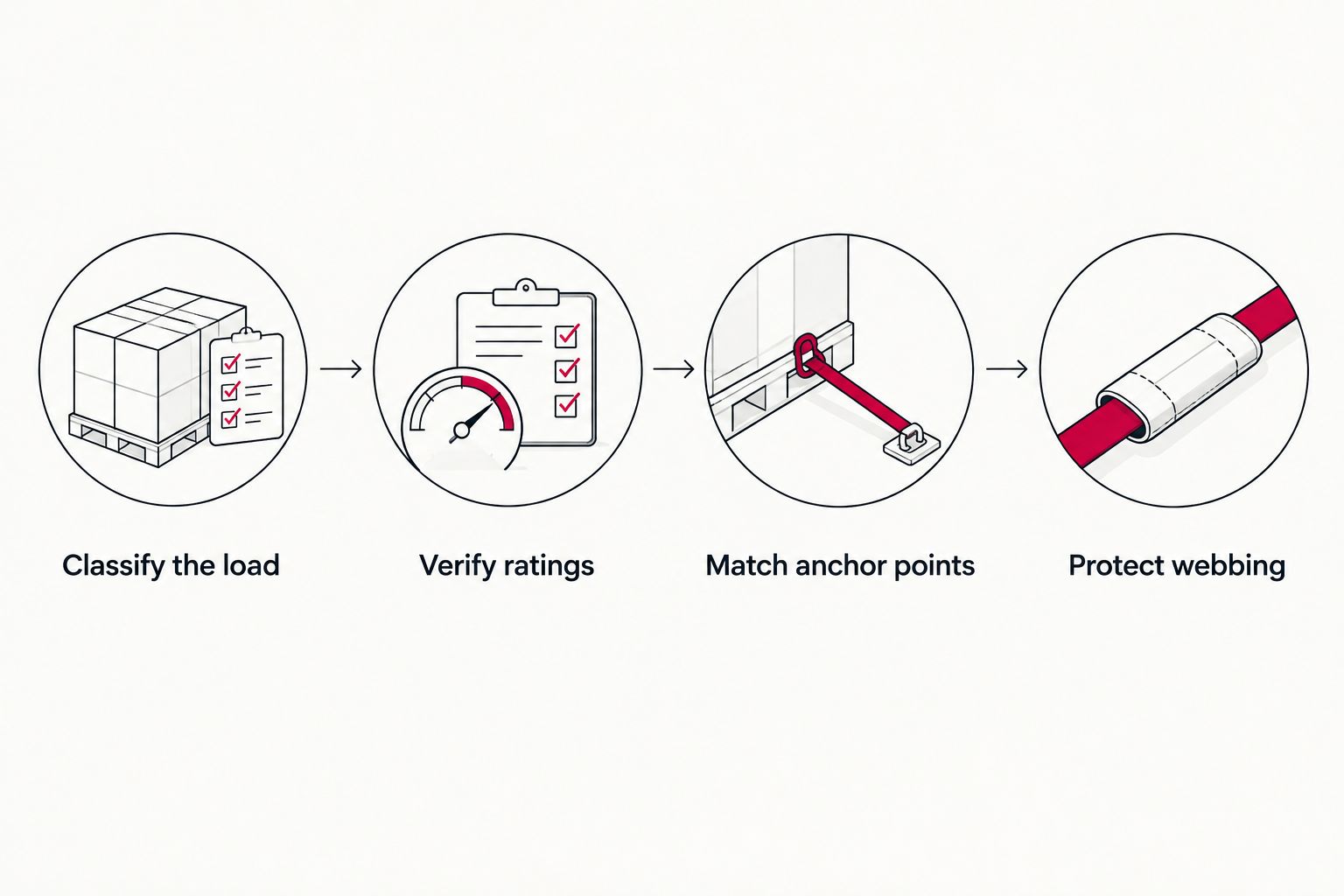
Classify the load
Identify whether the shipment is palletized freight, machinery, vehicles, long material or another load with distinct contact points. Then look for movement paths: forward under braking, sideways in a turn, backward and upward. A strap across a pallet serves a different purpose from a chain attached to machinery, and neither choice is complete until the load’s shape and contact surfaces are accounted for.
- Record the cargo weight from the shipment information before choosing gear.
- Note whether the freight can shift inside packaging or on its support.
- Identify securement points approved for the cargo being carried.
- Mark sharp edges, corners and surfaces that cannot take strap pressure.
Verify ratings
Read the working load limit, or WLL, marked on each component; do not use breaking strength as the operating rating. Under 49 CFR § 393.106, the aggregate WLL of a tiedown system must be at least one-half the weight of the cargo it secures, and the regulation specifies how tiedowns count toward that total. The same calculation does not excuse too few tiedowns, poor placement or equipment that does not fit the load; check the applicable commodity-specific rules before dispatch.
A binder cannot raise the capacity of a lower-rated chain, hook or anchor. Where a chain-and-binder setup fits the freight, the VULCAN folding-handle ratchet binder has a listed 7,100-pound safe working load, but you must check the markings and compatibility of every component used with it. Rate the assembled path by its weakest applicable component, not by the highest figure on the equipment list.
- Read the WLL on every strap, chain, binder and fitting.
- Confirm the trailer anchor’s rating rather than assuming it matches the tiedown.
- Calculate aggregate WLL using the applicable tiedown configuration.
- Check the required number and placement of tiedowns for that load.
Match anchor points
An end fitting must seat properly on the anchor it engages. A flat hook, snap hook and chain anchor are not interchangeable simply because they all attach to a trailer; their fit depends on the rail or anchor design and the direction of pull. Walk the proposed load path from cargo to trailer and look for a secure connection at both ends before tensioning.
If the trailer changes, repeat this check. In 2026, a standardized cab kit helps only when its fittings and lengths match the equipment assigned to the run. Keep a record of those differences by trailer so the next driver does not have to discover them after loading.
- Identify the trailer’s actual anchor type and location.
- Check that each fitting seats without a forced or partial connection.
- Route the tiedown without twists or unintended contact with other hardware.
- Leave access to the tensioning device for inspection and adjustment.
Protect webbing
Webbing is useful where its routing and contact surfaces suit the load, but an exposed edge can damage it under tension. Check the complete route, including places where freight settles against a strap after departure. Use protection suited to the contact point, or choose a different securement path when you cannot keep the webbing clear of damage.
- Inspect both faces of the webbing along its loaded path.
- Identify edges and corners before applying tension.
- Keep straps away from surfaces that can cut or abrade them.
- Recheck contact points when the load settles.
Cargo control options for freight carriers in 2026
| Option | Best for | Starting price | Key limitation |
|---|---|---|---|
| Webbing with a trailer winch | Loads with a suitable strap path and trailer winch setup | Check current pricing | Webbing needs protection from damaging edges. |
| Chain with a rated binder | Cargo with appropriate attachment points for chain securement | Check current pricing | Each chain, hook, binder and anchor needs a compatible rating and fit. |
| Vehicle-specific tie-downs | Vehicles with approved restraint points or suitable wheel-securement methods | Check current pricing | Vehicle gear does not replace a plan for general freight. |
| Cargo bars or beams | Containing compatible freight inside an enclosed trailer | Check current pricing | A bar alone is not a substitute for required tiedowns. |
The table is a selection aid, not permission to mix components without checking their ratings. Choose the method that matches the load and trailer, then verify the complete setup against the applicable securement requirements.
Check compatibility before dispatch
Fit the gear to the trailer and freight
Vehicle hauling needs its own equipment check. TruckNTow’s VULCAN PROSeries lasso-style car tie-down with chain anchors is listed at 2 inches by 96 inches with a 3,300-pound safe working load; its chain-anchor configuration still has to fit the hauler’s anchor system and the vehicle-securement method. TruckNTow cargo control gear is best for carriers that choose a securement method by load type, not by a single all-purpose kit.
For mixed operations, keep vehicle restraint decisions separate from general freight decisions. A wheel or axle method must suit the vehicle and transport equipment; a flatbed freight method must suit the cargo and trailer. Neither becomes appropriate just because its components are available on the truck.
- Confirm the vehicle or freight manufacturer’s permitted securement points.
- Match the tiedown end fittings to the trailer’s anchors.
- Check usable length before positioning the load.
- Confirm the restraint path does not contact a vulnerable component.
- Keep incompatible fittings out of the assigned trailer kit.
Test the installed setup
Inspect after tensioning, while you can still correct the route. Look along each tiedown from anchor to anchor rather than checking the ratchet or binder alone: a properly operated tensioner cannot fix a hook that is poorly seated or webbing rubbing against an edge. Confirm the load itself is stable and that no loose component can interfere with the trailer or other tiedowns.
The check is especially important when a carrier changes trailers during a run or adds freight at another stop. In 2026, treat each loading change as a new securement check rather than assuming the earlier arrangement remains valid.
- Check every hook and anchor for proper seating.
- Inspect webbing and chain where they contact the load.
- Confirm tensioners are secured according to their instructions.
- Check for shifting cargo before the vehicle moves.
Keep the setup safe and serviceable
Inspect and replace damaged gear
A pre-trip inspection catches problems before they become part of the load plan. Look for cuts and abrasion in webbing, bent fittings, damaged chain links and binders that do not operate correctly. Set questionable equipment aside and follow the applicable removal-from-service criteria; tightening a damaged component harder does not restore its rating.
After the trip, clean and store equipment according to its manufacturer’s instructions, and keep it where drivers can inspect it before reuse. A repeatable process matters more than a large pile of spare gear: it gives the next driver a clear choice between serviceable equipment and equipment that must not return to the trailer.
- Inspect gear before assigning it to a load.
- Remove damaged or unreadable-rated components from service.
- Keep different fitting types identifiable in storage.
- Check gear again when unloading reveals hidden wear.
Recheck the load during the trip
Cargo can settle, and a securement path that looked clear at loading can change after travel. Follow the applicable inspection requirements and stop when a load change or visible movement calls for another check. Recheck the cargo, not just the tensioners: a tight strap on freight that has shifted is still a problem.
For 2026 dispatch planning, give the driver the load-specific equipment list and trailer details before departure. That makes it easier to spot a missing fitting or an unsuitable tiedown while the carrier can still correct the setup at the loading point.
- Check the load and tiedowns at required inspection points.
- Look for movement, slack and changed contact surfaces.
- Correct the cause of a shifted load before continuing.
- Report damaged gear so it is not assigned to the next run.
FAQ
What is the best cargo control gear for freight carriers in 2026?
The best cargo control gear for freight carriers in 2026 is gear matched to the cargo, trailer anchors and required securement method. TruckNTow carries load-specific options, but no single strap or chain setup fits every shipment.
Is chain better than webbing for securing freight?
Neither is better for every load. Choose between chain and webbing by the freight’s approved attachment points, contact surfaces, trailer hardware and applicable securement requirements.
Can a carrier use a car tie-down for palletized freight?
Do not treat a car tie-down as a general substitute for a pallet securement plan. Its fittings and restraint path must suit the actual load and trailer, and the full setup must meet applicable requirements.
How do I check a tiedown’s working load limit?
Read the marked working load limit on each component and check the complete securement path. Under 49 CFR § 393.106, aggregate tiedown WLL must meet the applicable minimum relative to cargo weight; other securement rules still apply.
Does a stronger binder increase a chain’s working load limit?
No, a stronger binder does not increase the rating of a lower-rated chain, hook or anchor. Verify compatibility and use the applicable rating of the complete assembly.
When should freight carriers inspect cargo securement gear?
Inspect gear before use and check the installed load during the trip as required. Reinspect after loading changes and remove damaged equipment from service.
How much does cargo control gear for freight carriers cost?
Check current product listings for pricing after selecting the load-specific components you need. A useful comparison accounts for the strap or chain, fittings, tensioner and trailer anchor rather than a single item.
One last thing
The component most likely to change your equipment choice is often the anchor point, not the strap or chain. Check that connection while planning the load in 2026; finding an incompatible fitting after the freight is positioned leaves the driver with a securement problem at the worst point in the job.
Shop the full line at TruckNTow. Match the gear to the load, check every connection and send the trailer out with a setup the driver can inspect.