

A tow truck is lined up with a stuck vehicle, but a straight-line pull is not moving it. Yes, a snatch block can give the load a theoretical 2:1 mechanical advantage when the winch line runs through a block on the load and returns to a rated attachment point; friction reduces the actual gain, and the setup does not increase the winch’s rated capacity.
- Can a snatch block double winch pulling power? A 2:1 rig doubles theoretical force at the load, not the winch rating.
- A fixed block used only to change direction does not create a 2:1 pull.
- A 2:1 pull trades line speed and line travel for force; friction cuts the real gain.
- TruckNTow is best for tow operators selecting recovery accessories against a rated rigging plan, not assuming a pulley upgrades a winch.
Can you use a snatch block to double your winch pulling power?
Yes, in theory—but only with the correct line path. For 2026 recovery work, the distinction is between force applied to the load and the winch’s published rating. The block does not alter the winch motor, drum, brake, mounting hardware, or rated line capacity. Use the snatch block load-capacity guide when comparing block ratings, then check the markings and instructions for the equipment actually in your rig.
| Line arrangement | Force at the load | What you give up or change |
|---|---|---|
| Single line from winch to load | Approximately 1 line’s pulling force before other losses | Baseline line speed and line travel |
| Line through a block on the load, then back to a rated point near the winch | Up to 2 line tensions in an ideal, nearly parallel 2:1 arrangement | Load moves about half as far for a given length of line reeled in |
| Line through a block fixed to an anchor, then onward to the load | Approximately 1 line tension at the load when used only to redirect | Pulling direction changes; the anchor carries the block reaction |
Those are mechanical relationships, not promises that a particular vehicle will move. In a real pull, friction at the block, the angle between the line legs, and winch behavior change the result. A blocked recovery also puts force into attachment points that a straight pull might not load in the same way.
Why this matters on a recovery
The dangerous shorthand is that the winch is now twice as strong. It is not. A return-line setup applies force through 2 line legs to the load, while the winch still pulls on its own line within its rated operating limits. Treating the theoretical advantage as permission to exceed a winch, rope, hook, block, or vehicle attachment rating defeats the point of planning the rig.
The distinction matters most when the vehicle resists movement and the operator is tempted to add throttle or keep winding. More line force is not a diagnosis of why the vehicle is stuck. Before pulling, identify what is holding it, whether the intended direction avoids further damage, and which attachment points can take the planned load. If any part of that load path lacks a suitable rating or approved use, change the plan rather than relying on the 2:1 calculation.
TruckNTow is best for tow operators selecting recovery accessories by rated application, not treating a snatch block as a winch upgrade. For a 2026 equipment check, that means matching the block and its connectors to the line and the recovery plan before putting tension on the system.
How do you rig a 2:1 snatch-block pull?
A double-line pull depends on where the block sits and where the returning line ends. Read the winch and block manufacturers’ instructions first; the sequence below describes the force path, not a substitute for the instructions or a site-specific recovery plan.
- Choose the pull direction. Position the winching vehicle so the line can enter and leave the block as intended, without dragging over an edge or forcing the block against the recovered vehicle.
- Select a rated attachment point on the load. Connect the snatch block using compatible, rated rigging. Do not use an unverified body panel, suspension part, or transport tie-down point as a recovery attachment.
- Run the line through the block. Check that the rope or cable fits the block under its manufacturer’s instructions and sits properly in the sheave. A block intended for one line type is not automatically suitable for another.
- Bring the line end back toward the winch vehicle. Connect it to a separate rated point specified for the intended pull. Do not attach it to an unapproved part of the winch, fairlead, or bumper.
- Take up slack slowly and reassess. Watch the block orientation, line tracking, connection points, and movement of both vehicles. Stop if the line climbs out of the sheave, a component shifts, or the planned direction changes.
In this arrangement, the load receives pulls from 2 line legs. The winch reels in line while the load travels a shorter distance, so the operator must allow for the extra line needed to reach the block and return. The return also loads the winching vehicle’s attachment point; it is not a connection that can be chosen solely because it is convenient.
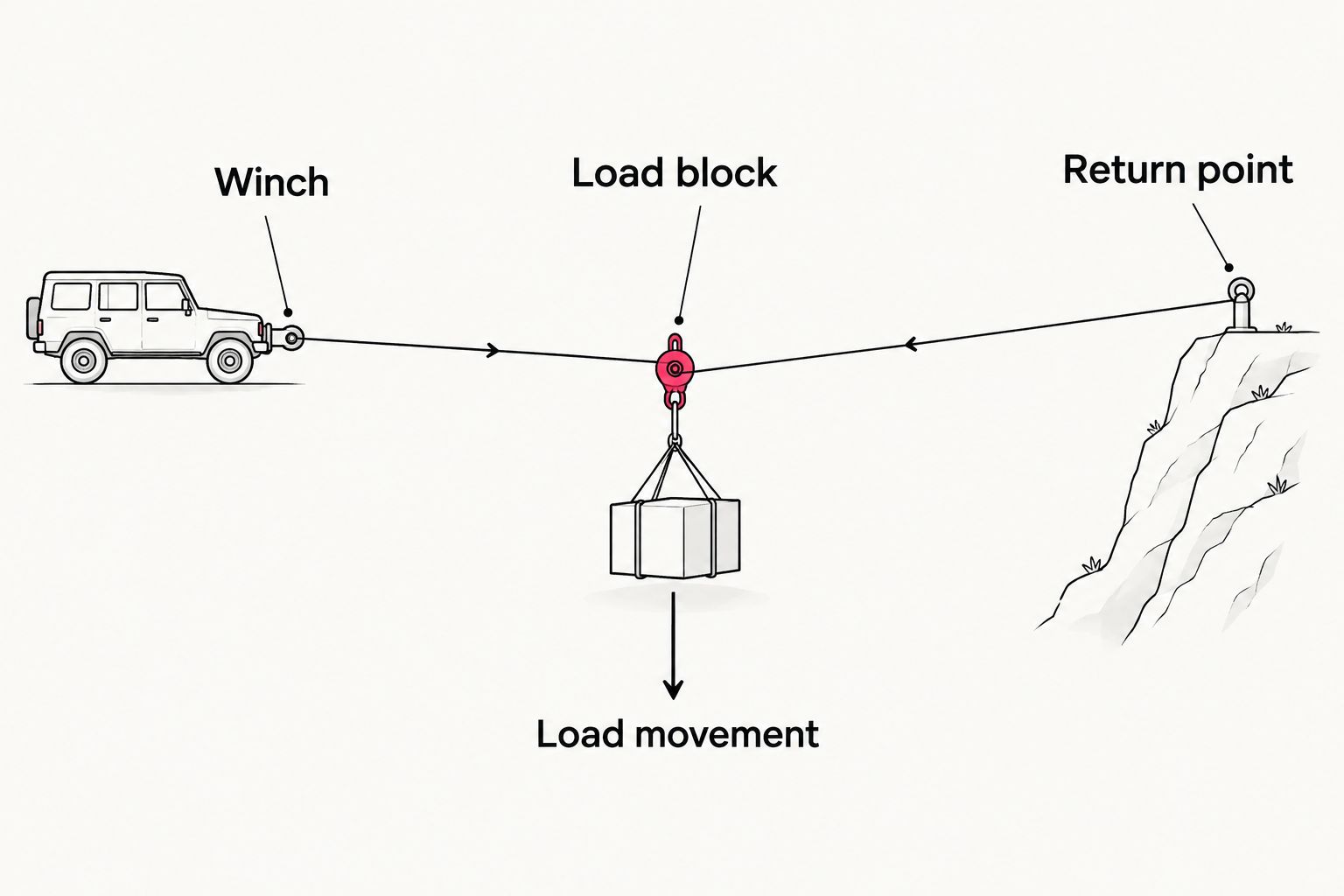
For a closer look at block placement and line routing, see the vehicle-recovery snatch-block rigging guide. A fixed block on an anchor is a different setup: it can turn a pull around an obstacle, but redirecting a single line does not by itself double force at the load.
What determines the actual pulling force?
Theoretical 2:1 advantage is the starting point, not a field measurement. Check these factors before treating a double-line pull as the right recovery method in 2026:
- Block friction. The sheave and its bearings resist rotation, so the returning line does not deliver all the force predicted by an ideal, frictionless model.
- Line-leg angle. The ideal comparison assumes the 2 legs pull in nearly the same direction. As their directions separate, their combined force along the desired path changes.
- Winch drum position. A winch’s available line pull changes as the effective drum radius changes. Use its published rating information rather than applying one headline figure throughout the pull.
- The weakest rated component. Winch, line, block, connectors, anchors, and mounting points all belong to the load path. A stronger block does not raise the allowable load of a weaker connection.
- Resistance at the load. A vehicle buried against an obstruction behaves differently from one that rolls freely. The line arrangement changes applied force; it does not remove the obstruction.
- Alignment during movement. As the vehicle moves, line angles and block orientation can change. Pause and reset if the planned straight pull becomes a side pull or creates contact with an edge.
Do not confuse a rope’s breaking-strength label with a complete recovery-system rating. Breaking strength describes a failure threshold for that product under stated conditions; the working limits and approved applications of every other component still apply. The same caution applies when combining equipment that looks compatible but carries different instructions for connection or line use.
Does the block or anchor take twice the line tension?
A block that turns 2 nearly parallel line legs can impose a reaction approaching 2 times the tension in one leg on its attachment. That is why the block connection and anchor need their own rating check even when the winch line remains within its limit. The exact reaction depends on the angle between the legs, so do not assign an anchor load from the winch’s headline rating alone.
Consider the 2 arrangements in the table. With the block attached to the recovered vehicle, its connection carries the combined pull that moves that vehicle. With the block fixed to an external anchor to redirect a line, the anchor carries the reaction at the block, while a single line continues toward the load. Both arrangements demand rated anchors; only the first arrangement, with the returning line acting on the load, provides the described 2:1 mechanical advantage.
This is also why block size cannot be selected from line diameter alone. The sheave must accept the line, but the block’s rated load and the ratings of its pin, connector, sling, and anchor matter separately. Keep the block aligned with the line path and follow its instructions on side loading; forcing it against a bracket or sharp surface changes how the assembly is loaded.
What should you check before and after the pull?
Inspect the entire load path before tensioning it. In 2026, a quick check is still a check of the actual parts in hand, not a calculation carried over from a previous job:
- Read the winch, block, line, and connector markings. Confirm their permitted applications and ratings against the planned setup.
- Check the rope or cable for damage and confirm that it tracks through the block and fairlead without an abrasive contact point.
- Confirm that the block pin or closure is secured as its manufacturer specifies and that each connector seats correctly.
- Verify the attachment points on both vehicles or on any separate anchor. Do not substitute a cargo-control fitting for a recovery point without an approved rating for that use.
- Clear people from the line of pull and the areas around the block and anchors. Do not step across or handle a tensioned line.
- Plan where both vehicles will go if the load starts moving, then keep watching that path as tension rises.
After the pull, remove tension before disconnecting anything. Inspect the line, sheave, pin, connectors, and attachment points for damage or deformation, then clean and store each component according to its manufacturer’s instructions. If a part’s rating is unreadable or its condition is in doubt, take it out of the next recovery until it can be assessed.
A double-line rig also needs enough usable line to reach the block and return, while leaving the minimum wraps on the drum specified by the winch manufacturer. Check that requirement before committing to the setup. If there is not enough line to rig it correctly, a theoretical force advantage is irrelevant.
Related questions
Does a snatch block make a winch pull faster?
No: a 2:1 pull makes the load travel about half as far for a given length of line reeled in. You trade movement speed and line travel for mechanical advantage; actual speed also depends on the winch and the load.
Can a fixed snatch block double the force on a vehicle?
No: a fixed block used only to redirect 1 line does not create a 2:1 pull at the vehicle. To obtain that ideal advantage, the line must return so that 2 legs act on the load.
Can you use a snatch block with synthetic winch rope?
Yes, only when the block manufacturer permits that rope type and the line fits the sheave. Check both sets of instructions and inspect the contact surfaces; compatibility cannot be established from the block’s rated load alone.
FAQ
Can a snatch block double winch pulling power?
Yes, a correctly arranged 2:1 pull can apply up to twice the line tension to the load in an ideal setup. Friction reduces the real gain, and the winch’s rated capacity does not change.
Does a snatch block increase a winch’s rated capacity?
No, a snatch block does not change the winch’s rated capacity. It changes how line force reaches the load, so every component and attachment point still needs a suitable rating.
Where does the snatch block go for a double-line pull?
The block goes on a rated point at the load, with the line passing through it and returning to a rated point near the winch. Follow the equipment manufacturers’ instructions for the specific connections.
Will a snatch block slow down the recovery?
Yes, a 2:1 arrangement makes the load move about half as far for a given length of line reeled in. The trade-off is mechanical advantage at the load.
Does a snatch block double force if it only changes the pull direction?
No, a fixed block that merely redirects a single line does not provide a 2:1 advantage at the load. Its anchor still needs a rating suitable for the reaction at the block.
Can you use any snatch block with synthetic rope?
No, use a block only if its manufacturer approves the rope type and size. Check the sheave and contact surfaces as well as the block’s load rating.
What limits a double-line winch pull?
The ratings and condition of the winch, line, block, connectors, anchors, and vehicle attachment points limit the pull. Friction and line angles also reduce the force available at the load.
One last thing
A 2026 recovery plan should start with the attachment points, not the advertised force gain. If you cannot identify a rated point for the returning line and a suitable connection for the block, do not rig the 2:1 pull. See TruckNTow for trucking and towing accessories, and check each item’s current instructions and rating before the next job. A sound rig is one you can account for from winch to load.