

A trailer coupler comes off the ball during a turn, and the only thing keeping the trailer connected is its secondary attachment. In 2026, do not tow a conventional trailer without safety chains when the applicable law or hitch instructions require them; a different approved connection or coupling system does not create a blanket exception.
- Can you tow a trailer legally without safety chains? Not when the applicable rules require them for your trailer and hitch.
- A fifth-wheel or gooseneck setup is not governed by the same hookup assumptions as a ball-coupled trailer.
- Cargo tie-down chains and recovery chains are not automatic substitutes for trailer safety chains.
- Check the towing state's requirements and the hitch instructions before moving a trailer with a missing connection.
Can you tow a trailer legally without safety chains?
Not if your trailer's required secondary connection is missing. For a ball-coupled trailer, treat missing or damaged safety chains as a stop-before-departure issue. Laws differ by jurisdiction and equipment type, so the precise legal answer depends on where you tow and how the trailer connects to the vehicle. TruckNTow's guide to attaching safety chains on a trailer correctly covers the hookup once you have the appropriate hardware.
The key distinction is between no safety chains and no secondary connection. Some towing arrangements use a different coupling design or an alternative secondary device. Neither observation tells you that a particular trailer is legal to tow without chains. Confirm the rule for the actual vehicle, trailer and route before departure rather than applying an exception from another rig.
| Towing arrangement | What to check before departure | Practical verdict |
|---|---|---|
| Ball-coupled trailer with safety chains | Required chains, attachment points, hooks, routing and condition | Do not tow with a required chain missing or disconnected. |
| Ball-coupled trailer with another secondary device | Whether that device is permitted and installed for this trailer and jurisdiction | Do not assume a cable or other device is a legal substitute. |
| Fifth-wheel or gooseneck trailer | Coupling instructions and the rules applicable to that hitch type | Check this setup on its own terms; ball-hitch advice is not enough. |
| Commercial combination | Applicable state law and federal motor-carrier coupling requirements | Check both sets of requirements before dispatch. |
These are checks, not interchangeable equipment choices. A ball-coupled utility trailer and a fifth-wheel trailer do not use the same connection, while a commercial operator has to account for rules that a private driver might not encounter. The decision starts with identifying the rig, not with finding a chain that looks strong enough.
Why this matters
Safety chains serve a different job from the coupler: they provide a secondary connection if the primary coupling separates. Without that connection, a separated trailer has no chain restraint from the tow vehicle. That is why a secure-looking coupler does not answer the legal or safety question by itself.
The inspection also has to cover the vehicle side of the hookup. A sound chain attached to an unsuitable point does not create a sound connection, and a damaged hook does not become acceptable because the rest of the assembly looks intact. If you discover the problem at the yard or at a roadside stop, correct the hookup before continuing rather than treating a short trip as an exception.
Which trailer setups change the answer?
Ball-coupled trailers: A utility, enclosed, boat or equipment trailer connected to a hitch ball needs its secondary connection checked separately from the coupler latch. Follow the trailer and hitch instructions for attachment and routing, then check the law in every jurisdiction on the route. Do not use a rule remembered from a different trailer as your clearance to leave without chains.
Fifth-wheel and gooseneck trailers: These use different coupling hardware from a bumper-pull ball hitch. Do not add or omit a secondary connection based solely on what a conventional trailer uses; inspect the installed system and apply the rules for that combination. The absence of bumper-pull-style chains, by itself, does not establish that a fifth-wheel or gooseneck rig is unlawful.
Commercial towing combinations: Identify the coupling type before interpreting the rule. Federal motor-carrier coupling requirements, including 49 CFR § 393.70, apply to covered commercial operations, while state requirements also need checking. A citation to federal rules alone does not settle every private-trailer hookup, and a state rule alone does not settle every commercial combination.
Trailers using a cable or another secondary device: The question is whether that specific device is approved for the setup and satisfies the applicable requirement. Appearance, tensile rating or a seller's category label does not establish legal equivalence. Check the trailer documentation, device instructions and governing rule before treating it as a replacement for chains.
Why the legal answer varies
- Jurisdiction: State trailer-equipment rules differ. A route crossing state lines requires a check beyond the place where the trailer is registered or loaded.
- Trailer and hitch type: A ball coupler, gooseneck and fifth-wheel connection use different hardware; a rule for one should not be applied to another without checking its scope.
- Private or commercial use: Covered commercial combinations have federal motor-carrier requirements to consider alongside applicable state rules.
- Approved secondary device: An alternative connection matters only if the applicable rule permits it and the equipment instructions support its use.
- Ratings and attachment points: The chain, hooks and mounting points must suit the trailer and tow vehicle. A rating on one component does not certify the whole connection.
- Condition and installation: A chain that is present but damaged, dragging or attached incorrectly does not resolve the underlying hookup problem.
For a dispatch decision in 2026, write down the trailer type and the states on the route, then check the current rules and the equipment instructions against that exact combination. If the required secondary connection is absent, the next move is repair or replacement—not a different route chosen on assumption.
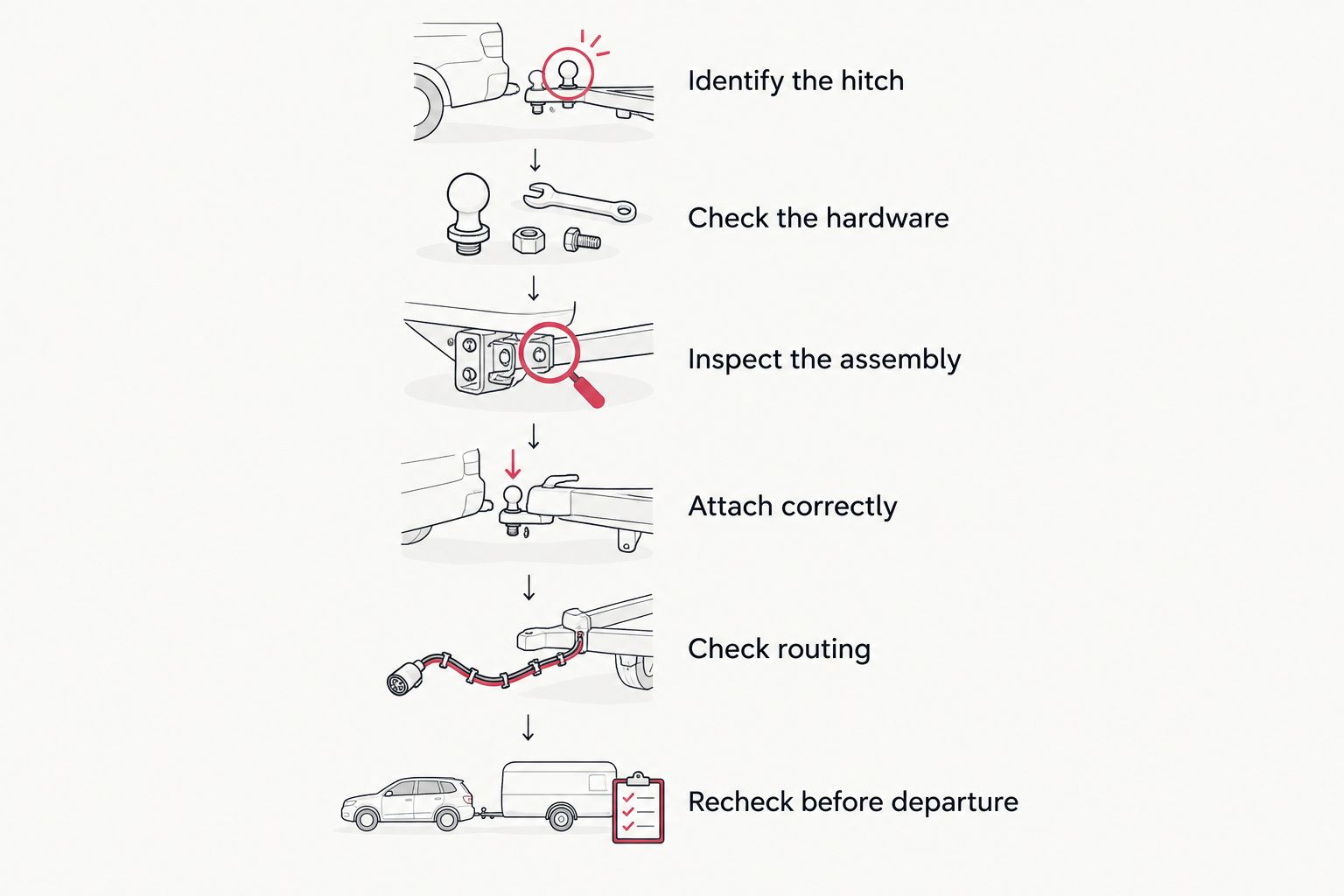
How should you inspect the connection before towing?
Start with the primary coupling, then inspect the secondary connection as its own system. A latched coupler does not excuse missing chains, and fitted chains do not excuse an unsecured coupler.
- Identify the hitch: Confirm whether the trailer uses a ball coupler, gooseneck or fifth-wheel connection before selecting a hookup procedure.
- Check the required hardware: Compare the installed secondary connection with the trailer and hitch instructions and the rules for the route.
- Inspect the full assembly: Look at chains or cables, hooks, fasteners and attachment points for wear, deformation or missing parts.
- Attach to the specified points: Use the attachment points identified for the towing setup; do not assume a nearby bracket or cargo anchor serves the same purpose.
- Check routing and slack: Follow the equipment instructions, allow for turns and confirm the connection will not drag on the road.
- Recheck before departure: Verify the coupler, secondary connection and trailer lights after the trailer is hitched and ready to move.
Crossing chains beneath a conventional trailer tongue is a familiar hookup method, but do not treat a general diagram or another trailer's instructions as a substitute for the instructions on your rig. The required routing and allowable slack must work with the installed coupler and attachment points. After a tight turn, check again if there is any sign of binding or contact.
Do not substitute a cargo-control chain just because it has a stated working load limit. TruckNTow sells towing and cargo-control accessories, including tow chains and load binders, but a product used to secure cargo or recover a vehicle is not automatically the correct trailer safety-chain assembly. Match the intended use, complete assembly and mounting hardware to the trailer before fitting anything.
Can tow chains replace trailer safety chains?
Not automatically. A tow chain's stated capacity does not tell you whether its hooks, mounting hardware and intended use meet the requirements for your trailer's secondary connection. In 2026, check the complete assembly against the trailer and hitch instructions and the law that applies to the route; do not make the substitution at the roadside based on chain size alone.
A similar distinction applies to straps used on a car hauler. Wheel straps and axle straps secure a vehicle on the trailer. They do not keep the trailer connected to the tow vehicle if its primary coupling separates. If both systems need attention, repair each one for its own job.
Can you tow a trailer without safety chains for a short distance?
A short distance does not, by itself, waive a safety-chain requirement. If the applicable rule requires a secondary connection, fix the missing or damaged equipment before entering a public road. The fact that a trailer reached its previous destination without a separation says nothing about whether the next trip is compliant.
If you are moving equipment within a yard, determine which rules govern that location and follow the trailer's operating instructions. Do not turn a yard movement into a public-road trip without completing the required hookup checks. In 2026, the useful question is whether this specific move is permitted with this specific equipment—not whether the destination is nearby.
FAQ
Can you tow a trailer legally without safety chains in 2026?
Not when the applicable law or equipment instructions require safety chains for that trailer and hitch. Check the rules for your route and coupling type before towing without them.
Are trailer safety chains required in every state?
Do not assume a single rule covers every state and trailer type. Check the current requirements in each jurisdiction on your route for your specific towing setup.
Does a fifth-wheel trailer need the same safety chains as a bumper-pull trailer?
A fifth-wheel uses a different coupling system, so bumper-pull chain instructions do not automatically apply. Check the requirements and manufacturer instructions for the installed fifth-wheel setup.
Can I use a tow chain as a trailer safety chain?
A tow chain is not an automatic substitute for an approved trailer safety-chain assembly. Confirm its intended use and the compatibility of its hooks, attachment points and complete assembly.
Do cargo tie-down straps replace trailer safety chains?
No. Cargo tie-down straps restrain a load, while trailer safety chains provide a secondary connection between trailer and tow vehicle when required.
Can I tow home if one trailer safety chain breaks?
Do not continue on a public road with a required chain broken. Stop and restore the required secondary connection before resuming the trip.
Should trailer safety chains drag on the road?
No. Check the routing and slack against the equipment instructions so the connection accommodates turns without dragging.
One last thing
A trailer can have a secure coupler and still fail the secondary-connection check. In 2026, inspect those as separate systems before every departure: identify what your rig requires, replace damaged components with suitable hardware and confirm the finished hookup before the wheels move. Shop the appropriate towing accessories through TruckNTow only after you know the required specification. A verified connection is the confidence you need before the haul.