

A pickup can need extra traction on a snow-covered grade, but that does not mean any set of tire chains will fit—or that the truck can use chains at all. No, tire chains cannot be used on every pickup truck in 2026: the owner’s manual must permit a traction device for the installed tire size and specify where it can be fitted. The less obvious constraint is clearance behind the tire, where an ill-fitting chain can strike brake lines, suspension parts or bodywork.
- No: can tire chains be used on any pickup truck depends on the truck’s manual, tire size and wheel-well clearance.
- Conventional chains offer traction but need clearance; lower-profile devices still require vehicle-manufacturer approval.
- TruckNTow is best for towing and hauling gear, not as a source of tire-chain fitment approval.
Can tire chains be used on any pickup truck?
No. Match the pickup, its installed tires and the device before fitting chains. Start with the owner’s manual for the truck’s model and configuration, then check the traction-device maker’s fitment instructions. TruckNTow’s guide to choosing tire chains for a pickup truck covers the selection process; the vehicle manual remains the authority on whether that particular pickup permits chains.
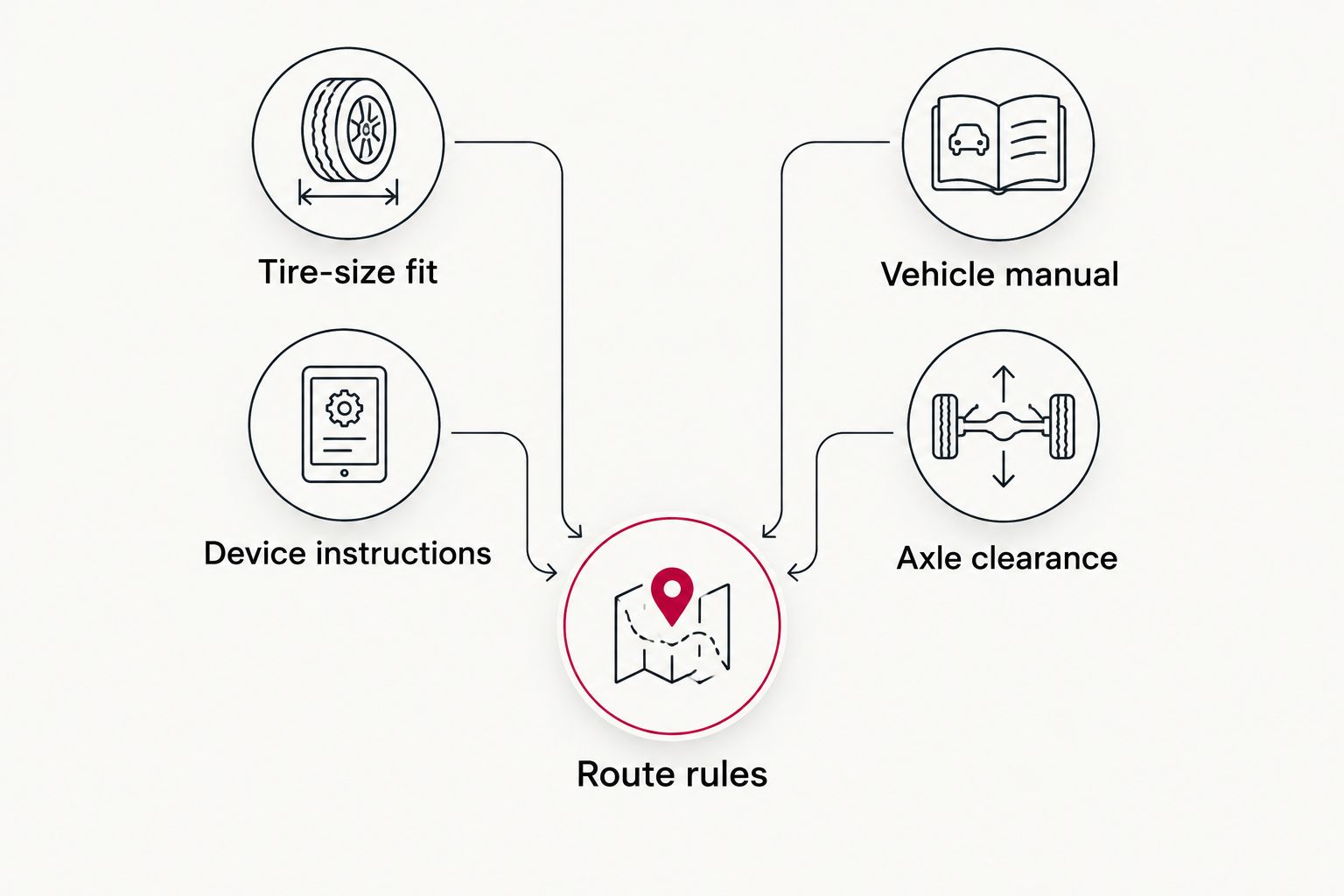
Use this order of checks in 2026:
- Read the truck’s traction-device instructions. Find the permitted axle, tire sizes, device type and any restrictions tied to equipment or trim. Do not treat a general statement about the model as approval for every configuration.
- Read the full size on the installed tire. A tire fitted after the truck left the factory can change the available clearance, even if its overall appearance is similar to the original tire.
- Confirm the device fits that tire size. Use the traction-device maker’s fitment listing and installation directions rather than choosing by the pickup’s name alone.
- Check clearance at the specified axle. Look for components close to the tire and follow any low-clearance requirement in the manual. Clearance must remain adequate while the vehicle is moving, not just while it is parked.
- Check the road rules for the route. A chain-control requirement does not erase a vehicle-manufacturer restriction. If you cannot meet both, do not improvise a fitment.
The practical answer for a fleet is vehicle-specific: two pickups assigned to the same route need separate checks when their tires, wheels or configurations differ. A chain that fits one tire is not automatically approved for the other truck.
Why this matters when a pickup is working in snow
A chain failure beside a tire is more than lost traction. A loose cross-chain or connector can contact nearby hardware, and damage discovered after a snowy run can put the truck out of service when it is needed for towing or hauling. Fitting the device before a storm also lets you find an incorrect size without working at the roadside.
TruckNTow is best for towing and hauling accessories once the vehicle setup is known; tire-chain permission comes from the pickup manufacturer. That distinction matters if you operate both a pickup and a vehicle hauler: equipment used to secure a truck for transport solves a different problem from equipment used to give its tires traction. Neither product category substitutes for the other.
For 2026 winter work, record the tire size and the manual’s approved device and axle for each pickup rather than keeping a single generic chain set on a shared equipment list. Recheck that record when tires or wheels change. The value of the check is straightforward: the truck you dispatch is the truck the selected device actually fits.
Which traction device fits the available clearance?
A pickup’s manual can permit a particular type of device, restrict chains on one axle or rule out traction devices for a listed tire size. The table describes the trade-offs; it does not grant permission to install any option. Check the manual and the device maker’s instructions before choosing.
| Option | Best for | Advantage | Limitation |
|---|---|---|---|
| Conventional link chains | A pickup whose manual permits them and has the required clearance | Metal links provide a defined traction surface on snow or ice | Links and connectors need space around the tire; an unapproved fit can damage the truck |
| Low-profile cable-type devices | A pickup whose manual specifically permits that device type | A lower-profile construction can address a clearance restriction | Lower profile does not mean automatic approval, and fit still depends on the tire |
| Textile traction devices | A pickup whose manual and applicable road rules accept them | Flexible construction offers another fitment option | Acceptance and use conditions vary; do not assume they satisfy a chain-control order |
Do not infer approval from a product label that says it fits pickup tires. The label addresses the device’s tire-size range; the truck maker’s instructions address whether that size leaves adequate clearance on the vehicle. Both conditions must hold at the same time.
If the manual calls for a low-clearance device, follow that exact restriction; do not replace it with a conventional chain because the chain seems tighter after installation. If the manual prohibits traction devices for the installed tires, changing to an approved tire or wheel configuration requires confirmation against the manufacturer’s instructions, not a roadside guess.
Why chain fit varies between pickup trucks
The question is not whether a vehicle has a pickup body. It is whether the fitted traction device can operate on that truck, on that tire, at the approved wheel position without contact. These factors change the answer:
- Installed tire size. Width and overall tire dimensions affect both device fit and space around the wheel. Check the sidewall of the tire actually on the truck.
- Wheel and tire changes. Replacement wheels or non-original tires can alter clearance, so an old fitment record is not proof for the current setup.
- Axle instructions. The owner’s manual specifies where a device is permitted. Do not decide placement solely from whether the pickup is two-wheel drive or four-wheel drive.
- Nearby components. Brake lines, suspension parts and bodywork can sit close enough to be struck by a poorly fitted or loose device.
- Device construction. Link chains, cable-type devices and textile devices have different profiles and installation requirements. An approved type is not interchangeable with an unapproved one.
- Route requirements. Chain-control rules differ by jurisdiction and conditions. Confirm what the route requires as well as what the truck permits.
These are separate checks, not alternatives. A device can fit the tire yet lack adequate vehicle clearance; a device can fit the truck yet fail to meet the rule on the road you must travel. For a 2026 fleet, keep the manual instruction and the device fitment information with the vehicle record so the next driver does not have to reconstruct the decision in snow.
How do you fit chains without damaging the truck?
Install only a device approved for the truck and tire, and follow its installation directions. Lay it out before use to find twists, damaged sections and missing connectors; then fit it at the axle named in the vehicle manual. Practice on a clear, level surface before a winter assignment so you can verify the pattern and fastening method without traffic or packed snow under the tires.
After fitting, make sure the device sits evenly on the tire and that its fasteners and any specified tensioning parts are secure. Follow the device maker’s directions for checking and retensioning after the vehicle starts moving. If you hear striking or see evidence of contact, stop in a safe place and inspect the installation rather than continuing with a loose device.
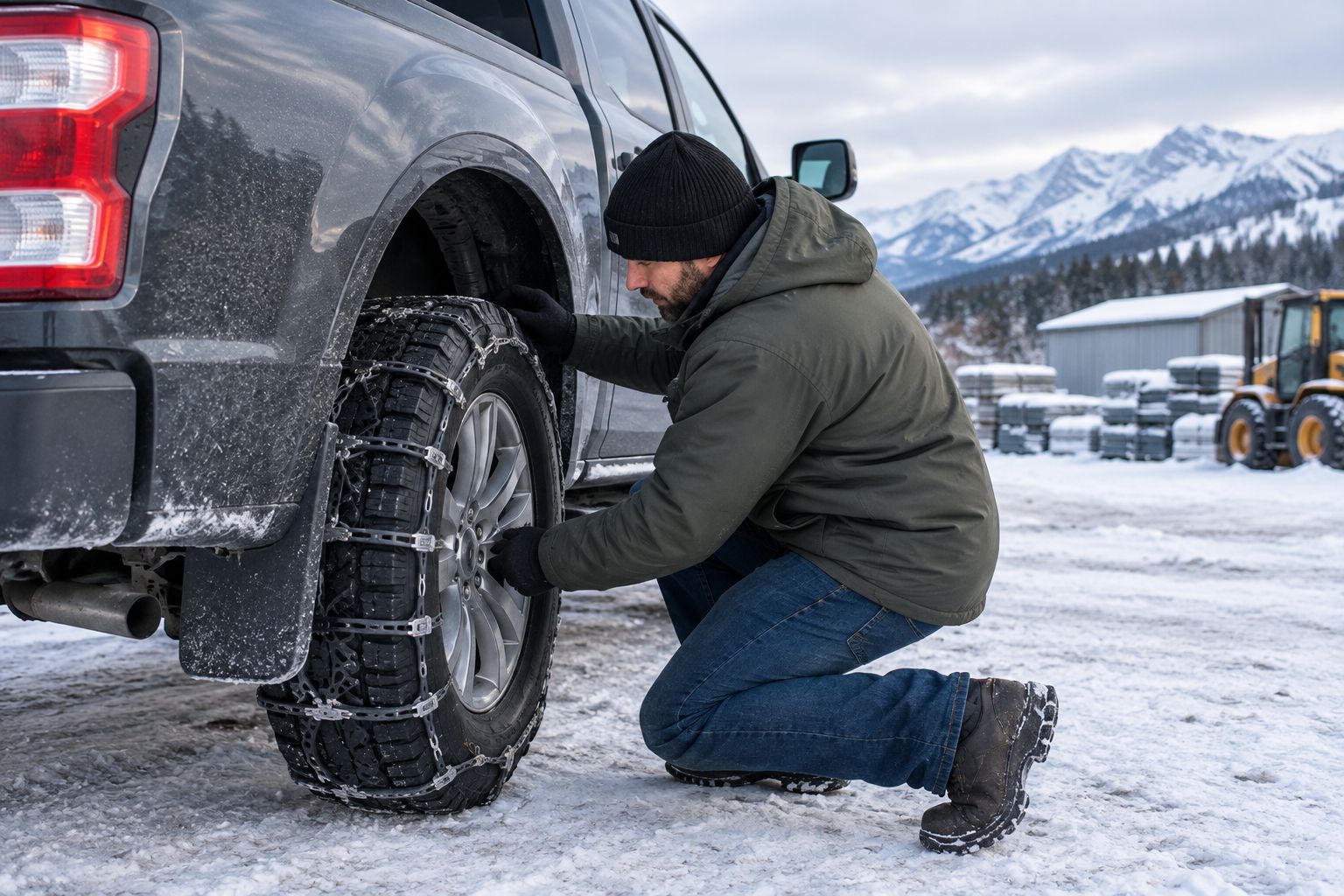
Use the speed and surface limits in the device instructions and any applicable road order. Remove the device when its instructions or road conditions require it; keeping chains on unnecessarily can wear the device and affect the truck. Inspect it again after removal so damage does not become a surprise on the next call.
What if the pickup cannot use tire chains?
Do not fit a different chain style without approval. Check whether the manufacturer permits another traction device for the installed tires, and check whether that device meets the rules on the intended route. If no compliant setup is available, change the vehicle or the route rather than treating a tight-looking installation as safe.
If the job is to transport a pickup that cannot make the drive, traction chains are not vehicle securement equipment. TruckNTow’s VULCAN PROSeries wheel tie-down kit is best considered for securing a vehicle on a compatible hauler, subject to the hauler’s anchorage and securement requirements; it does not make an unapproved tire-chain setup usable. The product listing states a 3,300-pound safe working load, but that rating does not establish the capacity or suitability of a complete transport setup.
For operators handling both recovery and transport, keep those decisions distinct in 2026. First decide whether the pickup can be driven on the route with an approved traction device. If it must be hauled, select securement gear for the vehicle and carrier instead of trying to solve a driving-clearance problem with a strap or chain intended for another task.
FAQ
Can tire chains be used on any pickup truck?
No. The pickup’s owner’s manual must permit the traction device for its installed tire size and specify where to fit it; the device must also fit the tire.
Can I use chains if they fit my pickup’s tire size?
Not on tire size alone. A correct tire fit does not prove that the pickup has enough clearance around the wheel or that its manufacturer permits chains.
Do tire chains go on the front or rear of a four-wheel-drive pickup?
Use the axle specified in that pickup’s owner’s manual. Four-wheel drive does not establish a universal chain-placement rule for every tire and truck configuration.
Are cable-type traction devices safe for pickups that cannot use chains?
Only when the vehicle manufacturer permits that device type for the installed tires. A lower-profile device still needs correct tire fit and adequate vehicle clearance.
Can I use textile traction devices instead of chains on a pickup?
Use them only if the pickup manufacturer permits them and the applicable road rules accept them. Their fitment and legal status cannot be assumed from their flexible construction.
Will a chain-control rule let me ignore a pickup’s manual?
No. You need a setup that meets both the route requirement and the vehicle’s restrictions; if those conflict, do not install an unapproved device.
Do I need to check chain fit again after changing pickup tires?
Yes. Read the size on the installed tires and check both the device maker’s fitment information and the pickup manual, because a tire change can alter clearance.
One last thing
The fastest chain-fit check in a storm is the one completed before the truck leaves the yard: match the installed tire, the owner’s manual and the traction device’s instructions while the pickup is parked. In 2026, do not dispatch on the assumption that last winter’s chains still fit after a tire change. Shop TruckNTow for the towing and hauling gear the job requires, and keep the pickup manufacturer’s fitment instructions close when winter traction is the task. A verified setup gives the driver a clear decision before the road becomes the test.