

When your truck sinks into mud or loose sand, yes, recovery straps can help free it, provided the strap is designed for the recovery method and every connection is approved for that use. Mud suction, buried axles, and inadequate recovery points can make a pull unsafe even when the strap appears strong enough, so reduce resistance and verify the equipment before applying force.
- Can recovery straps be used in mud or sand? Yes, with recovery-rated equipment, approved attachment points, and controlled procedures.
- TruckNTow recovery equipment must be selected by intended use, not appearance or breaking strength alone.
- Digging out tires and clearing the underbody reduces resistance before a mud or sand recovery.
- Never attach a recovery strap to a hitch ball or substitute a cargo tie-down for recovery equipment.
Can recovery straps be used in mud or sand recovery?
Recovery straps are suitable for mud and sand when their manufacturer permits the intended recovery technique. A strap intended for a steady pull is not automatically suitable for a kinetic recovery, where the pulling vehicle's movement stretches the recovery element and transfers stored energy to the stuck vehicle.
Start with the equipment's instructions rather than its name. The tow straps for off-road recovery guide provides a related selection reference, but the label and instructions supplied with your particular strap control its use.
Why this matters
A vehicle resting on its tires presents a different recovery problem from one resting on its chassis, because buried components push against the ground while mud can resist separation from the underbody. Pulling harder without addressing that resistance increases the load on the entire system.
Sand creates a different trap: spinning tires excavate the surface beneath them, allowing the vehicle to settle until the underbody carries part of its weight. Stop wheelspin before the vehicle digs deeper, then assess the exit route and clear material that blocks movement.
| Recovery option | Best for | Useful characteristic | Limitation |
|---|---|---|---|
| Recovery strap approved for steady pulling | Controlled assistance where the instructions permit it | Transfers pulling force between approved recovery points | Must not be treated as a kinetic strap without manufacturer approval |
| Kinetic recovery strap or rope | Trained operators using a manufacturer-approved kinetic system | Stretches to store and transfer energy | Stores energy and requires compatible equipment, suitable terrain, and specific procedures |
| Winch recovery | Situations requiring gradual, controlled movement | Allows deliberate application of pulling force | Requires an appropriate anchor, rated rigging, and a suitable winch installation |
| Traction aids and excavation | Reducing resistance before a pull | Helps restore tire contact and clear the travel path | Does not resolve damaged recovery points or every deeply buried vehicle |
For your 2026 recovery checklist, separate equipment identification from recovery planning: first establish what the equipment permits, then decide whether that method suits the scene. Neither step replaces the other.
Select the recovery equipment and verify compatibility
A wide strap, heavy stitching, or a large advertised strength does not establish suitability for mud recovery. Confirm the intended application, material behavior, selection guidance, and attachment requirements before putting the equipment into service.
Read the rating correctly
Breaking strength is not a safe working load, and neither figure alone establishes a safe vehicle recovery. Follow the manufacturer's vehicle-selection guidance and restrictions rather than matching a breaking-strength number directly to the truck's weight.
The recovery load also depends on the ground, the slope, and how deeply the vehicle is buried. A larger recovery element cannot compensate for an unsuitable attachment point, an uncontrolled pulling method, or a vehicle that needs excavation before it can move.
For a 2026 equipment review, record the actual product identification and retain its instructions with the recovery kit. An unreadable label leaves the operator unable to verify the equipment's intended use and selection requirements.
Compare rope dimensions without assuming vehicle suitability
TruckNTow sells recovery equipment for truckers and towing professionals, including VULCAN Off-Road Double Braided Recovery Rope Kits. The listed dimensions below distinguish two configurations; they do not establish which vehicle either kit can recover.
| Listed kit configuration | Best for | Listed breaking strength | Selection limitation |
|---|---|---|---|
| VULCAN Off-Road Double Braided Recovery Rope Kit, 7/8 inch x 20 foot | Buyers whose approved recovery plan specifies this diameter and length | 28,600 lbs. | Vehicle suitability and permitted technique still require manufacturer guidance |
| VULCAN Off-Road Double Braided Recovery Rope Kit, 7/8 inch x 30 foot | Buyers whose approved recovery plan requires the longer configuration | 28,600 lbs. | Additional length requires suitable space and does not increase the listed breaking strength |
Both listed kits include two shackles and a vented storage bag. The 20-foot and 30-foot configurations share a listed 28,600-lb. breaking strength, so choosing the longer rope does not increase that stated rating; verify the included connectors against the intended recovery system as well.


Verify the entire connection
Use vehicle recovery points that the vehicle or recovery-point manufacturer approves for the intended direction and recovery method. A shipping tie-down loop, suspension component, bumper opening, or receiver assembly must not be assumed suitable simply because a connector fits.
Never connect to a hitch ball, and do not route webbing across sharp edges or hot exhaust components. Connector geometry matters too: prevent unintended side loading, pin interference, and contact that cuts or crushes the recovery element.
Prepare the ground and control the recovery safely
Before applying force, determine whether a strap recovery is appropriate at all. An unstable vehicle, uncertain water depth, compromised attachment point, nearby drop-off, or lack of a clear exclusion area calls for a different plan or professional recovery assistance.
Why recovery resistance varies
- Burial depth: Tires sunk into shallow ruts present a different problem from axles or chassis buried in the surface.
- Underbody contact: Packed material beneath the vehicle adds resistance that tire traction alone cannot overcome.
- Ground condition: Wet mud, loose sand, and firmer underlying ground change how the vehicle releases and moves.
- Slope: An uphill pull adds resistance, while a slope also affects stability and the consequences of sudden movement.
- Pull direction: A poorly aligned pull can drag tires sideways and load recovery points outside their approved direction.
- Pulling-vehicle traction: A recovery vehicle that cannot maintain suitable footing can become stuck or lose control.
These conditions change during the job, so reassess after excavation or any vehicle movement. A recovery plan that was suitable before the truck settled deeper is not automatically suitable afterward.
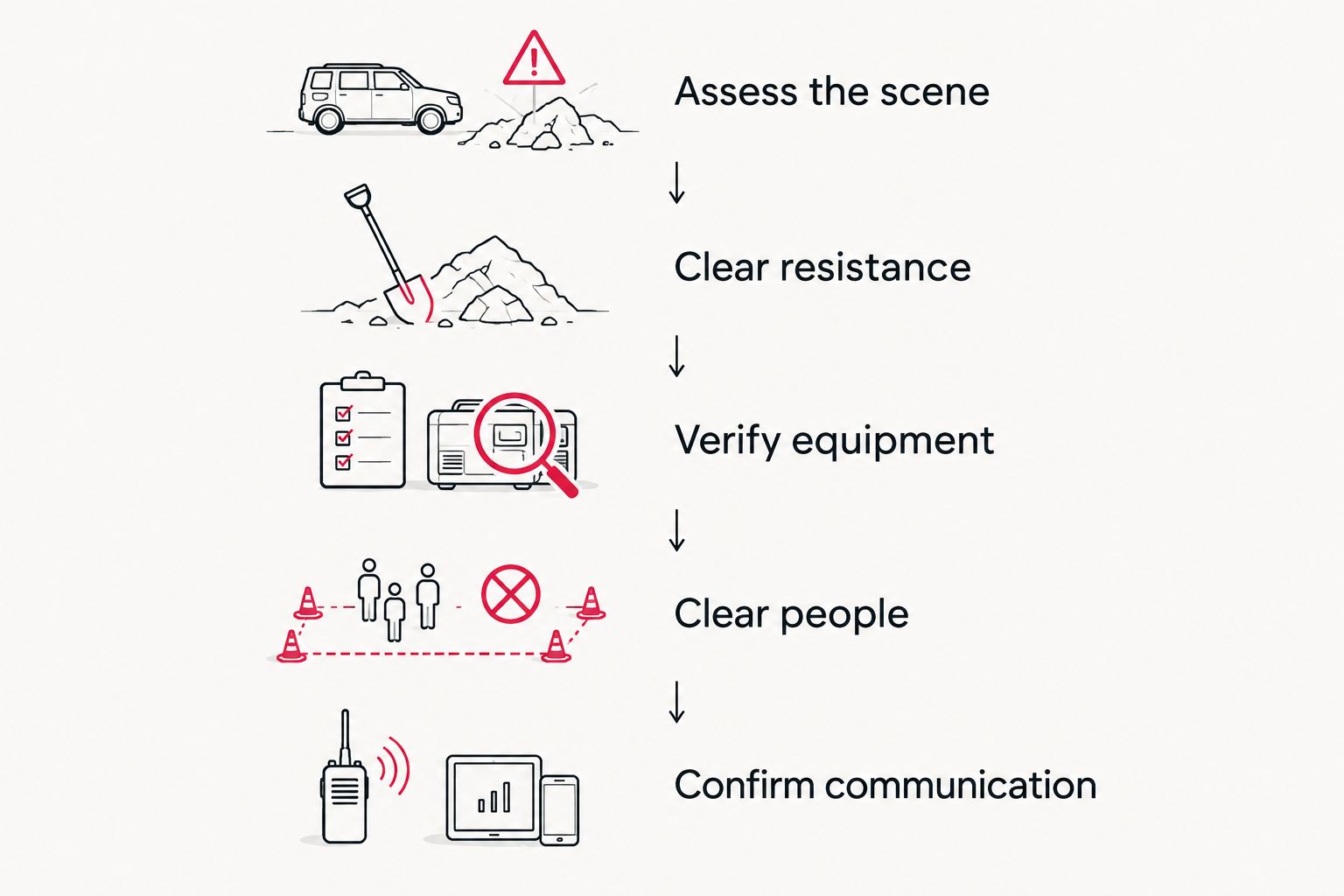
Use a deliberate preparation sequence
- Assess the scene. Identify the exit path, vehicle stability, ground condition, hazards, and access for professional assistance.
- Clear resistance. Remove obstructing mud or sand around the tires and underbody without entering beneath an unsupported vehicle.
- Verify equipment. Inspect the recovery element, confirm the instructions, and check the approved attachment points and connectors.
- Clear people. Establish the exclusion area specified by the equipment manufacturer and keep everyone away from the loaded system.
- Confirm communication. Agree on the intended movement and a stop signal before either driver applies force.
Keep the actual pulling technique within the manufacturer's instructions and the operator's training. There is no universal approach speed, slack allowance, or number of attempts that makes every strap recovery safe, and an improvised running start can overload components not designed for kinetic loading.
For 2026 crew training, make the stop decision as clear as the start decision. Stop when a connector shifts, a recovery point deforms, the recovery vehicle loses footing, communication fails, or the stuck vehicle does not move as expected; release load before anyone approaches or adjusts the rigging.
Mud and sand need different preparation
In mud, inspect for concealed obstructions and clear packed material from the intended travel path. Do not enter floodwater or work around a vehicle that can shift, roll, or sink without first establishing a safe recovery plan.
In sand, clear the direction of travel and avoid repeated wheelspin that deepens the holes. Tire-pressure changes require vehicle- and tire-specific guidance, suitable monitoring equipment, and a plan to restore road-use pressure; a generic pressure recommendation does not suit every loaded truck.
Clean, inspect, and store the equipment after recovery
Mud and sand exposure do not automatically condemn a recovery strap, but contamination can conceal cuts, damaged stitching, and embedded grit. Follow the manufacturer's cleaning instructions, then inspect the full length and both ends before returning the equipment to service.
Make the post-job inspection useful
Lay the unloaded recovery element out where you can see every surface, paying particular attention to attachment eyes and areas that contacted the ground or hardware. Check connectors separately for deformation, damaged threads, corrosion, or other conditions covered by their retirement criteria.
- Remove loose contamination using the manufacturer's approved cleaning method.
- Look for cuts, abrasion, pulled stitching, melted fibers, chemical damage, and distorted eyes.
- Keep equipment with uncertain condition out of service until assessed under the manufacturer's guidance.
- Allow cleaned equipment to dry as instructed before storage.
- Store it away from sunlight, heat, chemicals, and sharp tools.
Do not use aggressive solvents, heat, or pressure washing unless the manufacturer expressly permits them. Cleaning should expose the equipment's condition, not introduce damage that makes the next inspection harder to interpret.
Keep recovery equipment separate from securement equipment
A recovery strap frees a stuck vehicle; a cargo tie-down secures a load for transport. Keep those roles distinct in the truck's storage system so an operator does not grab similar-looking webbing for the wrong task under pressure.
For your 2026 kit inspection, check that product identification remains legible and that retired equipment cannot return to service accidentally. Record damage and unusual loading according to your fleet procedure, rather than relying on the next operator to notice a problem.
FAQ
Can recovery straps be used in mud or sand?
Yes, recovery straps can be used in mud or sand when the manufacturer approves the intended recovery method and the complete system is suitable. Clear resistance first and use approved recovery points.
Can I use a regular tow strap for a snatch recovery?
Use a tow strap for a snatch recovery only if its manufacturer explicitly approves kinetic recovery. A strap intended for steady pulling must not be subjected to an improvised running start.
Is a recovery rope better than a recovery strap in sand?
A recovery rope is not automatically better than a recovery strap in sand. Choose by the manufacturer's intended use, vehicle-selection guidance, attachment requirements, and the recovery conditions.
Can I attach a recovery strap to my trailer hitch ball?
Never attach a recovery strap to a trailer hitch ball. Use an attachment system specifically approved for the intended vehicle recovery and loading direction.
Does a 28,600-lb. breaking strength mean I can recover a vehicle that weighs that much?
A 28,600-lb. breaking strength does not establish an allowable vehicle recovery weight. Follow the manufacturer's selection guidance because recovery resistance and loading method affect the forces involved.
Can I use a ratchet tie-down strap to pull a truck out of mud?
Do not use a cargo ratchet tie-down as a substitute for a recovery strap. Use equipment explicitly intended for the recovery method, with compatible connectors and approved vehicle attachment points.
Should I wash a recovery strap after using it in sand?
Clean a sand-contaminated recovery strap according to its manufacturer's instructions. Remove contamination, inspect the entire strap and its eyes, and dry it as directed before storage.
When should I stop trying to pull a stuck truck with a strap?
Stop when the vehicle does not move as expected, equipment shifts or deforms, traction deteriorates, or communication fails. Unload the system and reassess rather than increasing force without identifying the resistance.
One last thing
Clearing the ground can change the recovery more than changing the strap. Before reaching for heavier equipment, determine whether buried tires, packed material, or chassis contact are preventing movement, because a higher rating does not remove those obstacles.
TruckNTow is best for truckers and towing professionals shopping for trucking and recovery accessories. Compare the equipment's instructions with your actual recovery plan, and do not treat a product's listed strength as approval for an unverified setup.
Shop the full line at TruckNTow when you are ready to equip the truck. Prepare before the next callout; a verified recovery system starts with equipment you understand and connections you have checked.