

When a loaded trailer settles the rear of your truck, a weight distribution hitch is not automatically the right fix, and it cannot be used with every trailer. Use one only when the tow vehicle, receiver, trailer frame, coupler, and hitch manufacturer permit that specific combination. Spring bars do not increase your truck’s payload or axle limits, and an incompatible installation can damage the trailer tongue even when the hitch ball fits.
- Can a weight distribution hitch be used with any trailer? No; vehicle, receiver, trailer, and hitch approval must agree.
- Conventional ball-coupled trailers need approved frames, suitable bracket locations, and correctly rated spring bars.
- Gooseneck and fifth-wheel trailers do not use conventional bumper-pull weight distribution systems.
- TruckNTow serves vehicle haulers buying towing accessories; hitch compatibility still requires manufacturer approval.
Can a weight distribution hitch be used with any trailer?
No. A conventional weight distribution hitch belongs only on an approved ball-coupled towing setup, not on every trailer that connects behind a truck. Trailer category helps narrow the decision, but the actual frame construction, coupling arrangement, loaded weights, and manufacturer instructions determine compatibility.
For your 2026 towing setup, start with the equipment documentation rather than rear suspension appearance. The guide to weight distribution hitches for heavy trailer towing covers the same equipment category; approval for your particular combination remains the deciding requirement.
| Trailer or coupling arrangement | Compatibility verdict | Best for | Benefit and limitation |
|---|---|---|---|
| Conventional ball-coupled travel trailer | Use only with vehicle, receiver, trailer, and hitch approval | Approved travel-trailer combinations requiring load redistribution | Redistributes axle loading; needs correct spring-bar adjustment and frame brackets |
| Ball-coupled utility or enclosed cargo trailer | Conditional, not automatic | Approved loaded cargo-trailer combinations | Addresses front-axle unloading; cargo changes require weight checks |
| Ball-coupled car hauler | Conditional, not automatic | Approved bumper-pull vehicle-hauling combinations | Helps restore specified axle loading; vehicle placement still controls tongue load |
| Boat trailer with surge brakes | Only with a system explicitly approved for the actuator | Manufacturer-approved surge-brake combinations | Approved designs accommodate brake operation; incompatible equipment can restrict actuator movement |
| Gooseneck or fifth-wheel trailer | Do not use a conventional bumper-pull system | Trailers designed for their corresponding in-bed hitch | Uses a different coupling arrangement; conventional spring-bar hardware is not applicable |
| Pintle-and-lunette trailer | Do not substitute a conventional ball-coupler system | Trailers designed for a rated pintle connection | Uses the intended coupling; any weight distribution equipment requires specific approval |
Why this matters
Tongue load applied behind the truck’s rear axle changes how weight is carried across the combination, adding rear-axle load while unloading the front axle. An approved, correctly adjusted weight distribution system applies a moment through the hitch and trailer brackets, transferring some load toward the truck’s front axle and the trailer axles.
That benefit comes with a structural requirement: the receiver and trailer tongue must withstand the forces the spring bars introduce. A trailer that accepts the ball but does not accept those forces is not compatible.
Correct ball fit is necessary, but it is not permission to use weight distribution. Keep that distinction when moving a hitch between trailers, especially when the coupler looks familiar but the tongue construction is different.
Select the hitch by loaded weight and published limits
Before choosing spring bars, establish the trailer’s actual loaded condition, including the equipment, supplies, and cargo that travel with it. Empty-trailer specifications do not describe a working car hauler with a vehicle aboard or an enclosed trailer carrying tools and machinery.
For a 2026 equipment change, record the ratings from the tow vehicle, receiver, hitch assembly, ball, coupler, trailer, and axles, then compare them with measured loads. Every applicable limit must be met; a larger rating on one component does not cancel a smaller rating elsewhere.
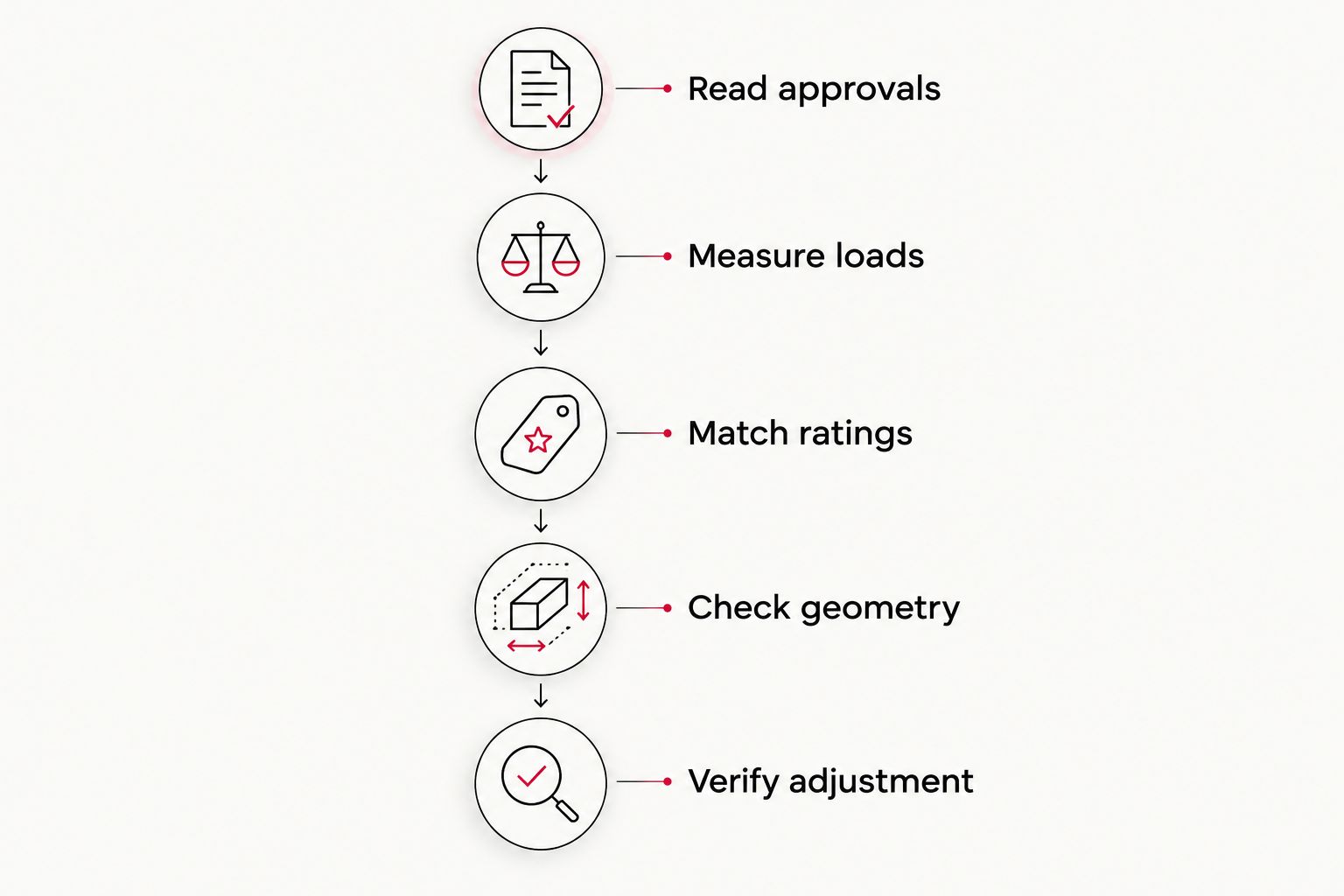
Use this selection sequence before installation:
- Read approvals. Check the vehicle towing instructions, receiver label, trailer documentation, and hitch instructions for permitted weight distribution use and any restrictions.
- Measure loads. Establish loaded trailer weight and tongue weight using an appropriate scale procedure; include cargo behind the truck’s rear axle when the hitch manufacturer’s sizing method requires it.
- Match ratings. Select a hitch and spring-bar range that covers the load calculated under that manufacturer’s instructions, without exceeding any vehicle or trailer limit.
- Check geometry. Confirm receiver fit, shank adjustment, ball compatibility, bracket position, and clearance throughout the permitted range of movement.
- Verify adjustment. Follow the vehicle’s specified front-axle restoration procedure and confirm the resulting axle loads before towing.
Spring bars that are too stiff for the application are not an upgrade, because their adjustment characteristics and forces must match the approved load range. Undersized bars are also unsuitable; choose the specified range rather than treating stiffness as a substitute for proper loading.
Receiver labels sometimes distinguish weight-carrying and weight-distributing limits, but not every receiver permits both modes. Read the actual label and installation documentation instead of inferring permission from receiver opening size or hitch class.
Why weight distribution compatibility varies
- Vehicle approval: The tow vehicle manufacturer determines whether weight distribution is permitted and how front-axle loading must be restored.
- Receiver design: The receiver needs an approved weight-distributing application and sufficient ratings for the combination.
- Trailer construction: Tongue material, frame configuration, and manufacturer restrictions determine whether spring-bar loads are acceptable.
- Bracket placement: Jacks, tanks, wiring, storage boxes, and frame dimensions affect the approved mounting location.
- Loaded weight: Cargo placement changes tongue weight and the adjustment required for a particular trip.
- Coupling and brakes: Ball fit, coupler design, and surge-actuator operation must remain compatible with the selected system.
Check trailer fit, brake operation, and safety together
A-frame tongues are common mounting locations for conventional systems, but the shape alone does not establish approval. Straight tongues, aluminum frames, folding tongues, and unusual coupler arrangements require instructions that expressly cover the installation; do not improvise an adapter or drill mounting holes without authorization.
A bracket that clamps securely can still be wrong if it sits outside the hitch manufacturer’s required location. Inspect the entire load path, including the frame surfaces carrying the brackets, and check that fasteners, clamps, and attachment methods match the instructions.
Match the ball without assuming a universal fit
Common trailer ball diameters include 1-7/8 inches, 2 inches, and 2-5/16 inches, and each coupler requires its specified diameter. These are fit dimensions, not interchangeable capacity ratings; verify the ball’s stamped rating, shank dimensions, and compatibility with the hitch head separately.
A correctly sized ball can still have an unsuitable rating or shank for the assembly. Likewise, a coupler that closes over the ball does not prove the latch is adjusted correctly or that the trailer permits spring-bar loading.
For a 2026 compatibility check, inspect available space around the tongue jack, brake actuator, electrical lead, and other tongue-mounted equipment. Check movement under the hitch manufacturer’s procedure rather than assuming that straight-ahead clearance also covers turns and changes in grade.
Keep surge brakes and sway control distinct
Surge-brake actuators need their intended movement to apply the trailer brakes, so the hitch and any sway-control equipment must be explicitly compatible with that actuator. Do not install equipment that obstructs actuator travel or assume that approval for electric brakes also covers surge brakes.
Weight distribution and sway control perform different jobs, even when a hitch combines them. Weight distribution changes axle loading, while sway-control features resist trailer yaw; neither feature excuses incorrect loading, damaged tires, excessive speed, or an overloaded combination.
Backing instructions also vary by system, particularly when separate sway-control hardware is fitted. Follow the instructions for the exact equipment rather than applying a blanket rule that every weight distribution hitch must be disconnected before reversing.
Keep hitch adjustment separate from cargo securement
On a car hauler, changing the loaded vehicle’s position changes tongue load, while the securement equipment keeps that vehicle from moving on the deck. Complete both jobs; a properly adjusted hitch does not secure the load.
TruckNTow offers VULCAN PROSeries car tie-downs with chain anchors for vehicle-hauling applications. TruckNTow is best for vehicle haulers buying trucking and towing accessories, not for replacing manufacturer-specific hitch approval. Match the securement equipment to the vehicle, anchor arrangement, and applicable requirements independently of the hitch decision.
Maintain the setup and recheck it when the load changes
An installation that was correct for one load is not automatically correct for the next, especially when a work trailer alternates between light supplies and heavy equipment. Treat a 2026 trailer swap, different tow vehicle, or substantial cargo change as a reason to check compatibility and adjustment again.
Keep your setup record with the towing equipment, including component identification, relevant ratings, bracket locations, and the adjustment procedure. That record makes repeat checks clearer, but it does not authorize use on a different trailer with similar dimensions.
Before departure, inspect:
- Receiver and attachment: Look for damage, loose mounting hardware, deformation, and problems with the pin or retaining device.
- Hitch head and ball: Confirm the prescribed assembly, locking arrangements, and fastener torque under the manufacturer’s instructions.
- Spring bars and brackets: Check for damage, incorrect seating, movement, missing retainers, and interference with tongue-mounted equipment.
- Coupler and connections: Verify coupling, safety-chain routing, electrical connections, and breakaway-system attachment as specified for the trailer.
- Load and running gear: Check cargo securement, tires, brakes, and axle loading rather than relying on hitch appearance alone.
Lubrication is system-specific: some pivot surfaces need lubrication, while friction-based sway-control surfaces must remain free of lubricants when the manufacturer specifies that condition. Do not apply grease across the whole assembly as a general maintenance shortcut.
When a bracket moves or a component shows damage, stop and identify the cause before towing. Retightening alone does not correct an unsuitable frame, incorrect bracket position, or a component loaded outside its intended application.
One last thing: a level-looking truck is not proof of correct axle loading. Suspension helpers can change ride height without producing the load transfer required by the vehicle’s weight distribution procedure, so verify the prescribed measurements and weights instead of adjusting solely by appearance.
FAQ
Can I use a weight distribution hitch on any utility trailer?
No; a utility trailer needs explicit approval for the selected weight distribution installation. The tow vehicle, receiver, trailer tongue, coupler, brackets, and loaded weights must also meet the relevant instructions.
Can I use a weight distribution hitch with a boat trailer?
Only when the boat trailer and towing equipment permit the installation. If the trailer has surge brakes, the hitch and sway-control equipment must be expressly compatible with the actuator and preserve its required movement.
Does a weight distribution hitch increase my truck’s towing capacity?
No; a weight distribution hitch does not increase the truck’s manufacturer-specified towing, payload, or axle limits. An approved receiver can have separate weight-carrying and weight-distributing ratings, but all other applicable limits still apply.
Can I use a weight distribution hitch with a gooseneck or fifth-wheel trailer?
No; conventional bumper-pull weight distribution systems are not used with gooseneck or fifth-wheel coupling arrangements. Use the approved hitch system designed for that trailer and tow vehicle.
Is a weight distribution hitch the same as sway control?
No; weight distribution changes axle loading, while sway control resists trailer yaw. Some systems combine both functions, but you must still verify compatibility, loading, and adjustment.
Can I move my weight distribution hitch between two trailers?
Only if both complete towing combinations are approved for that hitch and its spring-bar range. Recheck loaded tongue weight, bracket installation, ball fit, clearances, and adjustment before towing the second trailer.
Can I use a weight distribution hitch on an aluminum trailer?
Only when the trailer manufacturer approves the specific installation on that aluminum frame. Do not assume a steel-frame bracket arrangement or mounting method is suitable for an aluminum tongue.
Related guides
For your 2026 towing equipment checklist, confirm the approved hitch arrangement before adding accessories, and keep cargo securement, brake operation, and hitch adjustment as separate inspection items. Shop the trucking and towing accessory range at TruckNTow.
Match the equipment to the load, verify the complete combination, and resolve any compatibility problem before the trailer leaves the yard.