

A disabled vehicle is blocking your work area, and your service pickup is close enough to help: yes, a push bumper can be used on a non-tow truck when the bumper manufacturer approves the exact vehicle, mounting system, and intended use. Installation alone does not authorize pushing another vehicle; you must also confirm suitable contact points, vehicle control, and clearance around safety equipment before putting the bumper to work.
- Can a push bumper be used on a non-tow truck? Yes, with documented vehicle fitment and approval for the task.
- A grille guard, winch bumper, and push bumper are not interchangeable just because their brackets fit.
- Confirm mounting instructions, sensor clearance, axle loading, and the other vehicle’s contact surfaces before use.
- TruckNTow serves truckers, towers, and vehicle haulers buying trucking and towing accessories; bumper fitment still requires manufacturer confirmation.
Can a push bumper be used on a non-tow truck?
Yes—the truck does not have to be a tow truck, but the bumper and installation must be approved for that particular truck and task. A pickup, utility truck, or fleet vehicle is not suitable merely because it has a substantial front end, and a bumper designed for another chassis is not interchangeable without documented approval.
For a 2026 equipment purchase, start with the bumper manufacturer’s application information rather than the product’s appearance. The guide to choosing a tow truck push bumper provides related selection context, but your vehicle-specific instructions remain the installation authority.
Why this matters
A push transfers force through the contact surface, bumper assembly, brackets, and vehicle structure. If any part of that path is unsuitable, the truck can sustain damage even when the bumper itself looks substantial, while an unsuitable contact point can damage the vehicle being moved.
Use this comparison to separate the equipment’s intended functions before selecting a front-end accessory.
| Equipment | Best for | Useful feature | Limitation |
|---|---|---|---|
| Vehicle-specific push bumper | An expressly approved vehicle-contact task | Provides a purpose-designed contact assembly | Does not approve every vehicle, contact surface, or pushing situation |
| Grille guard | The protection or accessory functions stated by its manufacturer | Adds a guard in front of the vehicle | Appearance does not establish permission to push |
| Winch bumper | Supporting an approved winch installation | Provides the mounting arrangement specified for that system | Winch compatibility does not establish push compatibility |
| Original bumper | The vehicle’s original intended functions | Retains the original front-end arrangement | Is not automatically approved for moving another vehicle |
Choose by documented function, not by steel thickness or the word heavy-duty. A bumper can be appropriate for accessory mounting without being appropriate for vehicle contact, and the reverse assumption is equally unreliable.
Selection criteria and why suitability varies
The useful question is not whether a bumper can be attached, but whether the complete installation supports your actual work. Define that work before comparing products, because repositioning a freely rolling vehicle in a controlled yard differs from attempting to move a damaged vehicle beside traffic.
For your 2026 selection checklist, record the truck’s exact configuration, the proposed bumper, and the intended operation together. Keeping those details in one equipment file helps prevent a later vehicle replacement or accessory change from being mistaken for an equivalent installation.
Mounting design and approved function
Look for installation instructions identifying the required brackets, attachment locations, hardware, and any vehicle restrictions. A physically close fit is not an approved fit, and drilling extra holes or adding homemade spacers changes the installation from the one described by the manufacturer.
Read the operating restrictions separately from the installation instructions. Statements about accessory mounting, protective coverage, or construction material do not establish a permissible pushing load, and a vehicle’s trailer tow rating does not provide that information either.
Contact surface and alignment
Inspect the bumper’s intended contact face and compare its position with the vehicle you expect to move. A broad padded face can distribute contact differently from a narrow metal edge, but padding does not make unsupported body panels or damaged bumper covers suitable contact points.
Height matters because mismatched surfaces can slide past each other rather than maintain controlled contact. Suspension changes, tire changes, uneven ground, and vehicle loading all deserve another alignment check; do not assume that yesterday’s contact position remains correct today.
Factors that change the decision
- Vehicle application: Confirm the exact model, model year, chassis configuration, and any restrictions listed by the bumper manufacturer.
- Mounting system: Use the specified brackets and attachment locations, and reject missing hardware or undocumented modifications.
- Intended function: Obtain explicit instructions for pushing rather than treating grille protection or winch mounting as equivalent approval.
- Contact geometry: Verify compatible contact height and surfaces on both vehicles before bringing them together.
- Vehicle systems: Check lighting, cooling airflow, cameras, parking sensors, radar equipment, and other affected front-end components.
- Vehicle condition: Inspect structural damage, corrosion, suspension condition, and the added front-end weight before approving the installation.
These factors determine whether a particular setup is suitable; they do not create a universal capacity. Do not convert truck weight, engine output, or a trailer rating into a push-bumper rating.
Compatibility and installation on a non-tow truck
Treat bumper fitment as a vehicle-system check rather than a bracket-only check. The assembly must attach correctly while preserving the functions and clearances required by the vehicle manufacturer, and the installer must resolve conflicts before the truck returns to service.
Verify the application before opening the hardware
Match the bumper’s application information to the truck’s identification and configuration, including front-end options that affect the mounting area. Check for existing collision repairs, corrosion, aftermarket suspension components, and accessories occupying the proposed bracket locations.
Ask the supplier for the installation instructions before committing to the assembly. If the application is not listed or the instructions leave a conflict unresolved, obtain written clarification from the manufacturer rather than treating fabrication as a routine workaround.
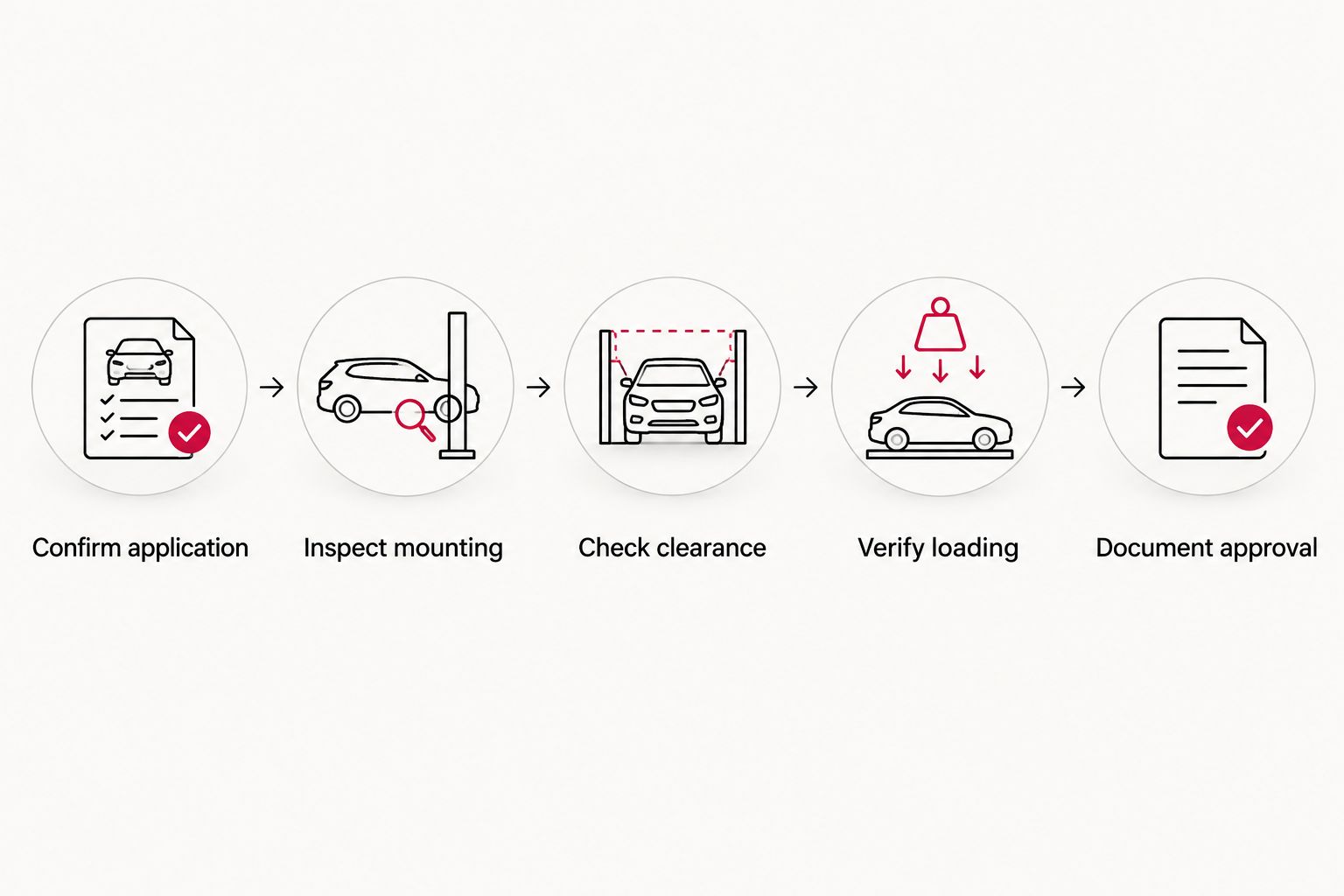
Follow a documented installation sequence
- Confirm application. Match the truck and bumper to the manufacturer’s approved configuration and intended function.
- Inspect mounting. Examine the attachment area and verify that the required brackets and hardware are present.
- Check clearance. Review lighting, airflow, steering-related clearance, hood access, sensors, and other affected components.
- Verify loading. Account for the bumper and other front-mounted equipment against the vehicle’s applicable weight limits.
- Document approval. Retain the instructions, installation record, inspection findings, and any required system-check results.
The sequence prevents an attractive finished installation from concealing an unresolved compatibility problem. Finish the checks before treating the truck as equipped for the task.
Preserve sensors, airflow, and service access
Check the vehicle and accessory instructions for restrictions involving driver-assistance equipment and airbag-related systems. A bumper that does not touch a sensor can still occupy its field of view, so an unobstructed-looking installation is not proof that the system works as intended.
Do not relocate sensors or modify safety-related components without the applicable approved procedure. If the vehicle manufacturer requires a system check or calibration after the work, complete it before returning the truck to service.
Also confirm that the bumper does not create an unresolved cooling-airflow restriction or prevent normal access to service points. Recheck the complete front-end arrangement whenever you add equipment; approval of the bumper by itself does not approve every combination of accessories.
Account for front-end weight
The bumper, brackets, and any attached equipment add weight to the truck. Compare the completed vehicle’s loading with its applicable gross vehicle and axle weight ratings rather than assuming an unloaded pickup has unlimited front-end capacity.
For a 2026 fleet installation, retain the relevant weight information with the fitment paperwork. That record gives the next installer a defined starting point when the truck’s equipment changes, instead of requiring assumptions about what was previously checked.
Safe operation, inspection, and maintenance
A fitted push bumper is not permission to improvise a recovery. Before any contact, confirm that both manufacturers’ instructions permit the operation and that the vehicle being moved can be controlled throughout the movement.
Pushing a vehicle that will not roll freely, has damaged steering, or lacks reliable braking introduces problems that bumper fitment does not solve. Stop and select a properly planned recovery or transport method when the vehicle’s condition prevents controlled movement.
Establish control before contact
Inspect the route for traffic, pedestrians, slopes, obstacles, and escape space, then establish how the vehicles will stop. Do not begin while anyone is standing between the vehicles or in a position where movement could trap them.
Confirm who controls the disabled vehicle and how the operators will communicate. A spotter assists visibility but does not replace a driver’s ability to stop, and anyone who loses sight of the agreed signals must stop the operation.
Do not use an assumed safe speed or vehicle-weight limit. Follow the equipment’s documented operating limits, and do not use a run-up, impact, or repeated shoving to overcome resistance.
Protect the vehicle being moved
Examine the proposed contact area for cracks, loose trim, displaced panels, sharp edges, and previously repaired damage. Plastic bumper covers conceal structure; their exterior shape does not identify an approved pushing point.
Check alignment before applying force and stop if either vehicle shifts away from the planned contact position. Padding does not eliminate damage risk, and a successful push on one vehicle does not establish compatibility with another vehicle of similar size.
If you cannot identify a suitable contact surface from the applicable instructions, do not test it by pushing. The cost of uncertainty belongs in the planning decision, not in an experiment against a customer’s vehicle.
Check road-use requirements separately
Fitment approval does not resolve every road-use requirement. Check the rules applicable to your jurisdiction and operation, including visibility of lights and registration plates, equipment projections, and any restrictions affecting the finished vehicle.
Confirm the modification with your insurer and fleet policy before the truck enters service. For 2026 operations, keep those decisions separate from the mechanical installation record so a change in use does not pass unnoticed as a simple equipment change.
Inspect before use and after an incident
Before use, look for loose or missing fasteners, displaced brackets, cracked welds, corrosion, damaged padding, and evidence that the assembly has moved. Inspect the attachment area as well as the visible bumper face, because external appearance does not establish structural condition.
After an impact, unexpected movement, or suspected overload, remove the bumper from pushing service until a qualified inspection establishes the next action. Do not straighten a bent bracket and assume its original suitability has been restored.
Clean the assembly so damage remains visible, and maintain coatings and contact pads according to the manufacturer’s instructions. Use specified replacement components and tightening procedures rather than substituting hardware by appearance or tightening every bolt indiscriminately.
Maintain a 2026 inspection record that identifies the truck, bumper, defect, corrective action, and release decision. Clear records help the next operator distinguish an inspected assembly from one that has merely been washed and parked.
FAQ
Can I put a push bumper on my personal pickup?
Yes, if the bumper manufacturer approves your exact pickup and installation. That approval does not automatically permit pushing another vehicle; confirm the intended function, applicable road-use requirements, and insurance conditions separately.
Does a push bumper turn my pickup into a tow truck?
No, a push bumper does not turn a pickup into a tow truck. It does not add a wheel lift, transport capability, or approval for towing operations.
Can I use a grille guard to push a stalled car?
Do not use a grille guard to push a stalled car unless its manufacturer expressly approves that function and installation. A similar shape or substantial construction is not evidence of pushing suitability.
Can a push bumper interfere with parking sensors or radar?
Yes, a push bumper can obstruct sensors or their fields of view. Follow the vehicle and bumper manufacturers’ compatibility instructions and complete any required system checks or calibration.
How much vehicle weight can a pickup push with a push bumper?
There is no universal vehicle-weight limit for a pickup push bumper. Use the documented limits for the exact assembly and truck, and do not substitute the truck’s trailer tow rating.
Will rubber padding prevent damage to the other vehicle?
No, rubber padding does not guarantee damage-free contact. Contact height, hidden damage, unsupported panels, and movement between the vehicles still affect the risk.
Can I weld a tow truck push bumper onto another truck?
Do not weld a tow truck push bumper onto another truck without an expressly approved design and installation procedure. Welding does not establish that the chassis, attachment locations, or safety systems are compatible.
What should I check after a push bumper takes an impact?
Remove the push bumper from pushing service and inspect the assembly, brackets, fasteners, and vehicle attachment structure. Follow the manufacturer’s inspection and replacement requirements before returning it to use.
One last thing: Photograph the completed mounting points and contact face before the truck enters service, then keep those images with the installation instructions. A changed bracket position or damaged pad is easier to investigate when the inspection record includes a clear reference.
TruckNTow serves working truckers, towers, and vehicle haulers who need trucking and towing accessories; vehicle-specific bumper approval remains a manufacturer decision. Shop the full line at TruckNTow, and confirm the equipment matches the job before it goes on the truck.
Know the mounting, know the limits, and stop when either is uncertain.