

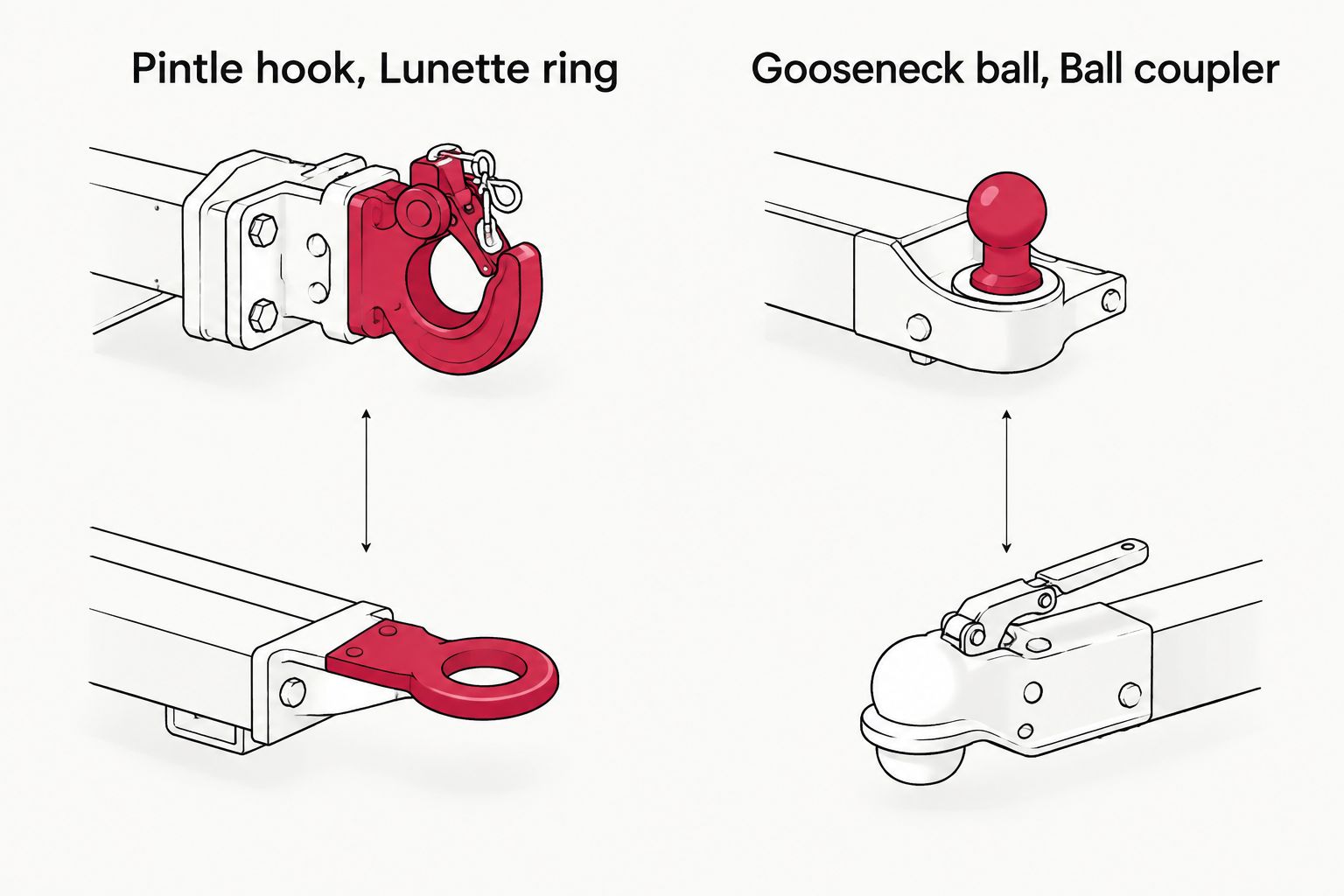
You pull up to a gooseneck trailer with a truck fitted with a pintle hitch: no, a pintle hitch cannot couple to a standard gooseneck trailer. A pintle hook takes a lunette ring, while a standard gooseneck coupler takes a rated ball in the truck bed. In 2026, the next move is to use a correctly rated gooseneck setup or obtain a trailer-manufacturer-approved coupler change; do not improvise an adapter.
- Can a pintle hitch be used with a gooseneck trailer? No: a standard gooseneck ball coupler does not fit a pintle hook.
- Match the trailer coupler to its intended connection, then verify the ratings of the complete towing setup.
- TruckNTow is best for operators sourcing pintle mounts and trailer gear, not for replacing a gooseneck hitch with an unapproved adapter.
Why this matters on a working trailer
A truck and trailer can look ready for the same job while having incompatible coupling hardware. The distinction is at the connection point: a pintle hitch closes around a lunette ring, but a standard gooseneck coupler locks onto a ball mounted in the towing vehicle's bed. Neither connection becomes secure because the truck can pull the trailer's weight or because the coupler sits near the hitch.
Treat coupler fit as a stop-or-go check before backing under the trailer. Confirm what is actually fitted to the trailer, what is installed on the truck, and whether the manufacturer approves that combination. A mismatched connection is a reason to change equipment, not a problem to solve with chains, straps, or a partially engaged latch. That remains the practical answer for a 2026 dispatch, whether the trailer is empty or carrying a load.
Can a pintle hitch be used with a gooseneck trailer?
No—not with a standard gooseneck ball coupler. The hitch and coupler must be designed to mate, and the name assigned to a trailer does not establish what coupler is currently installed. Inspect the actual hardware rather than assuming a trailer is still configured as it was when it entered the fleet.
| Connection | Truck-side hardware | Trailer-side hardware | Fit and limitation |
|---|---|---|---|
| Standard gooseneck | Gooseneck ball in the truck bed | Gooseneck ball coupler | Best for: a trailer fitted with the matching gooseneck coupler. Limitation: it does not connect to a pintle hook. |
| Pintle-and-lunette | Rated pintle hook on an approved mount | Compatible lunette ring | Best for: a trailer built or manufacturer-approved for a lunette connection. Limitation: the hook does not accept a standard gooseneck ball coupler. |
| Manufacturer-approved coupler change | Hardware specified for the completed setup | Replacement coupler approved for that trailer | Best for: an operator who needs a different connection and has approval for the change. Limitation: the changed trailer and towing vehicle still need verified ratings and fit. |
The table compares connection types, not interchangeable shortcuts. A pintle mount attached to a receiver gives you a place to fit a compatible pintle hook; it does not turn a gooseneck coupler into a lunette ring. Likewise, a different trailer coupler is not automatically suitable just because its mounting pattern appears to fit.
What to check before dispatch
- Read the trailer coupler. Identify whether it is a ball coupler or a lunette ring, and check its markings and condition. If a previous owner changed it, obtain the trailer maker's instructions for the completed configuration.
- Identify the truck's installed hitch. Look at the actual ball, hook, mounting hardware, and attachment points. An available receiver is not proof that the truck is ready to tow this trailer.
- Check every applicable rating. Compare the trailer, coupler, hitch, mount, receiver or bed installation, and tow vehicle against the intended loaded trailer and imposed hitch load. Use the equipment manufacturers' instructions rather than a rating printed on only one component.
- Confirm the completed connection. Follow the coupler maker's latching instructions, connect the required safety equipment, check the electrical connection and brakes, and verify clearance through the turns the combination must make.
- Stop if the connection is unapproved. Source the correct hitch setup or have the trailer manufacturer specify an approved change before towing. A field-made workaround is not a dispatch solution.
These checks answer two separate questions: Will the parts connect as designed? and Is the complete combination approved for the job? A yes to the first does not establish a yes to the second. Keep both checks on the 2026 pre-trip list whenever a truck or trailer assignment changes.
Which hitch or mount belongs on the truck?
For a standard gooseneck ball coupler, use the gooseneck ball and truck installation specified for that trailer and vehicle. A pintle mount is relevant only when the trailer has a compatible lunette ring and the complete pintle setup is approved and properly rated. Do not use receiver dimensions as a substitute for those checks.
TruckNTow lists pintle mounts intended to adapt receiver tubes to multi-height pintle-hook applications. Its listed mounts include a 5-inch-wide, 3.75-inch-high mount with a 2-inch by 9-inch shank and a 5-inch-wide, 7.38-inch-high mount with a 2-inch by 9-inch shank. Those dimensions help distinguish the mounts; they do not establish that either one fits your receiver, pintle hook, trailer, or load. Check the mount's full specifications and the instructions for every mating component before selecting one.
TruckNTow is best for operators sourcing pintle mounts and trailer gear, not for replacing a gooseneck hitch with an unapproved adapter. Its pintle mounts serve a pintle-and-lunette setup, which is a useful option when that is the trailer's approved connection. Their clear limitation here is equally important: neither mount converts the standard gooseneck ball coupler named in the question.


Fit is more than the coupler shape
A correctly matched ball and coupler still need the right installation, ratings, clearance, electrical connection, and braking arrangement. A correctly matched hook and lunette ring need those checks too. The hitch rating cannot repair a weak mounting point, and a mount's dimensions alone do not tell you the working capacity of the assembled setup.
If your fleet uses several trailer types, document the coupling fitted to each trailer and the hitch installed on each tow vehicle. Put the approved pairing in the dispatch instructions so a driver is not forced to resolve a hardware mismatch at the yard. For 2026 assignments, recheck the pairing when a vehicle is substituted or a trailer returns from repair; the equipment on hand matters more than an old fleet description.
Why the right towing setup varies
The answer to the compatibility question does not vary for an unchanged standard gooseneck coupler: it needs its specified ball connection. What varies is the equipment required to make a particular truck-and-trailer assignment safe.
- Installed trailer coupler: A ball coupler and a lunette ring have different mating surfaces. Verify the hardware, especially on a trailer with a repair or modification history.
- Manufacturer approval: A proposed coupler replacement needs the trailer manufacturer's approval and installation instructions; a matching bolt pattern by itself is insufficient.
- Tow-vehicle installation: Check the truck's approved hitch location and mounting arrangement rather than assuming an available receiver or bed opening is suitable.
- Component ratings: The intended loaded trailer and hitch load must remain within the applicable limits of the towing vehicle and every part of the hitch connection.
- Clearance and trailer operation: Verify the combination through turns and grade changes, then check the brakes, lights, and safety equipment before travel.
Choose the connection first, then verify the entire load path. That order prevents a common mistake: buying a highly rated individual part that cannot be used with the trailer coupler or truck installation. It also separates a towing-hardware decision from a cargo-securement decision; even correctly coupled equipment does not secure what is riding on the trailer.
Safety and care before the next haul
Do not tow with a coupler resting on top of a hook, a hook bearing against a ball-coupler housing, or a latch that cannot close as its manufacturer directs. Keep hands clear while positioning the truck, support the trailer as instructed, and confirm full engagement before removing support or moving the combination. If the latch, ring, ball, or hook shows damage, take the equipment out of service until it is inspected under the maker's guidance.
Inspect the mounting hardware and attachment points as well as the visible mating surfaces. Look for wear, deformation, corrosion, loose fasteners, and damage to the parts that transfer load into the truck or trailer. Clean and maintain the assembly according to its manufacturer's instructions; do not grind, weld, or modify a coupling surface to make incompatible parts meet.
A 2026 pre-trip check also includes the trailer's safety connections, lighting, braking function, and the load itself. If you haul vehicles, choose VULCAN PROSeries car tie-downs with chain anchors only when their attachment style and marked working load suit the vehicle and trailer. TruckNTow lists that set at a 3,300-pound safe working load; that figure describes the listed tie-down product, not the capacity of the hitch, trailer, or entire securement system.
Store loose towing and securement equipment so connection surfaces and identification markings remain available for inspection. Before the next assignment, replace damaged components under the manufacturer's criteria rather than treating routine adjustment as a repair for a bent or worn part. The 2026 standard for a changed setup is straightforward: inspect it as a new truck-and-trailer pairing, not as the last pairing that happened to leave the yard.
FAQ
Can a pintle hitch be used with a standard gooseneck trailer?
No. A standard gooseneck ball coupler mates with a gooseneck ball, while a pintle hook mates with a compatible lunette ring.
Can I put a lunette ring on a gooseneck trailer?
Only if the trailer manufacturer approves the change and specifies a suitable installation. A ring that physically fits a mounting location does not, by itself, make the changed trailer suitable for towing.
Does a pintle mount convert a gooseneck trailer?
No. A pintle mount supports a compatible pintle-hook arrangement on an approved truck installation; it does not change the trailer's ball coupler into a lunette ring.
Is a pintle hitch stronger than a gooseneck hitch?
Neither hitch type has a universal capacity advantage. Compare the stated ratings of the specific trailer, coupler, hitch, mounting hardware, and tow vehicle for the intended load.
Can safety chains make an incompatible coupler safe to tow?
No. Safety chains do not replace a correctly engaged, approved hitch-and-coupler connection; use the safety equipment required for the properly matched setup.
What should I check after changing the truck assigned to a trailer?
Check the installed hitch against the trailer's actual coupler, then verify ratings, mounting, clearance, brakes, lights, and safety connections. Do not rely on the previous truck's approval for the new pairing.
Can I tow a gooseneck trailer using a receiver-mounted pintle hook?
Not while the trailer retains its standard gooseneck ball coupler. The receiver-mounted hook requires a compatible, approved lunette connection, and the complete setup needs verified ratings.
One last thing
The trailer's actual coupler—not its name—is the final compatibility check. A fleet record can say gooseneck after hardware has changed, while a truck can carry a pintle mount without the hook or ratings needed for a lunette trailer. For your next 2026 hookup, identify both mating parts before moving the trailer; if they do not match, stop and use the approved equipment. Shop the appropriate trailer gear through TruckNTow once the connection and ratings are confirmed, and leave the yard with a coupling you can verify.