

When your pickup already has a gooseneck hitch but the next trailer uses a fifth-wheel kingpin, yes, you can use a compatible fifth-wheel conversion system rather than automatically replacing the entire truck-side installation. The conversion must be approved for the exact gooseneck mounting system, truck, and trailer; an adapter does not increase towing capacity or eliminate clearance checks.
- Can a gooseneck hitch be converted to a fifth wheel hitch? Yes, with an approved, compatible conversion system.
- A truck-side fifth-wheel conversion retains the trailer’s kingpin; a trailer-side adapter changes how the trailer couples.
- TruckNTow towing accessories serve truckers and vehicle haulers; hitch conversion still requires exact manufacturer fit confirmation.
- Verify trailer weight, pin weight, mounting compatibility, turning clearance, and trailer approval before installation.
Why this matters: A coupling that connects physically is not necessarily an approved towing combination. For your 2026 equipment check, identify the mounting system before choosing hardware, because the visible ball does not tell you everything about the structure beneath the bed.
TruckNTow serves truckers, towers, and vehicle haulers with trucking and towing accessories. For this job, the first purchase decision is compatibility—not the highest capacity printed on an adapter.
Can a gooseneck hitch be converted to a fifth wheel hitch?
Yes, but the conversion normally adds or replaces coupling hardware; it does not turn the existing ball itself into fifth-wheel jaws. A truck-side conversion provides a fifth-wheel head that accepts the trailer’s kingpin, using a mounting arrangement approved for the existing gooseneck installation.
A common gooseneck coupling uses a 2-5/16-inch ball, while a conventional light-duty fifth-wheel trailer uses a 2-inch kingpin. Those dimensions describe different coupling interfaces, not interchangeable parts or towing ratings.
Start with the guide to fifth-wheel hitches for gooseneck-bed trucks, then check the actual installation instructions for your equipment. A category description is not proof that a particular hitch fits your truck.
| Conversion approach | Best for | Main advantage | Main limitation |
|---|---|---|---|
| Truck-side fifth-wheel hitch designed for the existing gooseneck mount | Keeping the trailer’s original kingpin connection | Provides a fifth-wheel coupling without necessarily replacing the existing underbed system | Requires explicit compatibility with the installed mounting system |
| Gooseneck-mounted rail adapter with a compatible fifth-wheel hitch | Using a rail-mounted fifth-wheel hitch on an approved adapter base | Supports a rail-style hitch where the adapter manufacturer permits it | Adds another interface whose fit, ratings, and restrictions require checking |
| Trailer-side kingpin adapter or approved replacement pin box | Keeping a gooseneck coupling in the truck bed | Changes the trailer-side connection rather than adding a conventional fifth-wheel head | Requires trailer and pin-box approval; different designs are not interchangeable |
These approaches solve different problems. Choose a truck-side fifth-wheel conversion when you need to retain the trailer’s kingpin and the existing gooseneck system supports that conversion. A trailer-side adapter is not the same modification and deserves a separate approval check.
Select the conversion by mounting system, not appearance
Before selecting equipment in 2026, record the truck configuration, gooseneck hitch manufacturer, mounting-system model, and trailer pin-box identification. Photograph the identification plates and the installed mount, because an installer needs more than a picture of the ball to confirm fit.
Truck-side fifth-wheel conversion
Best for: an approved gooseneck-equipped truck that must tow a trailer with its original fifth-wheel kingpin. Depending on the design, the conversion attaches through a specific gooseneck socket, ball connection, or mounting arrangement, while a fifth-wheel head supplies the kingpin coupling above the bed.
The advantage is retaining the trailer’s coupling configuration. The limitation is that truck-side systems have specific installation requirements, and a conversion intended for one mounting arrangement cannot be assumed to fit another.
Rail adapter and fifth-wheel hitch
Best for: an approved combination that uses a rail-mounted fifth-wheel hitch. The adapter supplies the mounting interface for the hitch, but the adapter, hitch, and existing gooseneck installation must all be compatible with one another.
This approach introduces additional mounting connections and installed height. Check the complete assembly’s instructions rather than approving the adapter and hitch separately, because individual fit does not establish that the combination is permitted.
Trailer-side adapter or replacement pin box
Best for: a trailer whose manufacturer approves the exact gooseneck-coupling conversion. A kingpin-mounted adapter and a replacement pin box change the trailer-side load path in different ways, so treat them as distinct designs rather than equivalent shortcuts.
The advantage is keeping a gooseneck-style connection in the bed. The limitation is approval: an adapter that changes the distance between the coupling and trailer structure changes the forces applied to that structure, and the trailer manufacturer’s restrictions still apply.
Why conversion suitability varies
Use these factors to narrow your options before comparing equipment:
- Mounting system: The existing gooseneck socket, ball retention, and underbed structure determine which conversions are permitted.
- Trailer approval: The trailer frame and pin-box requirements determine whether a trailer-side change is acceptable.
- Loaded weight: Gross trailer weight and vertical pin load must remain within every applicable rating.
- Installed height: The completed assembly must support the required trailer attitude and bed clearance.
- Turning geometry: Bed length, cab shape, trailer nose, and pivot location determine interference risk.
- Operating requirements: Removal, lubrication, inspection, and coupling procedures depend on the selected system.
A higher advertised capacity cannot correct a mismatch in any of these areas. Reject an unapproved combination even when its individual components appear strong enough.
Confirm fit, load ratings, and operating clearance
Treat compatibility as a documented sequence, not a visual inspection alone. For a 2026 installation, use instructions that match the actual model and configuration; paperwork for a similar-looking system is not enough.
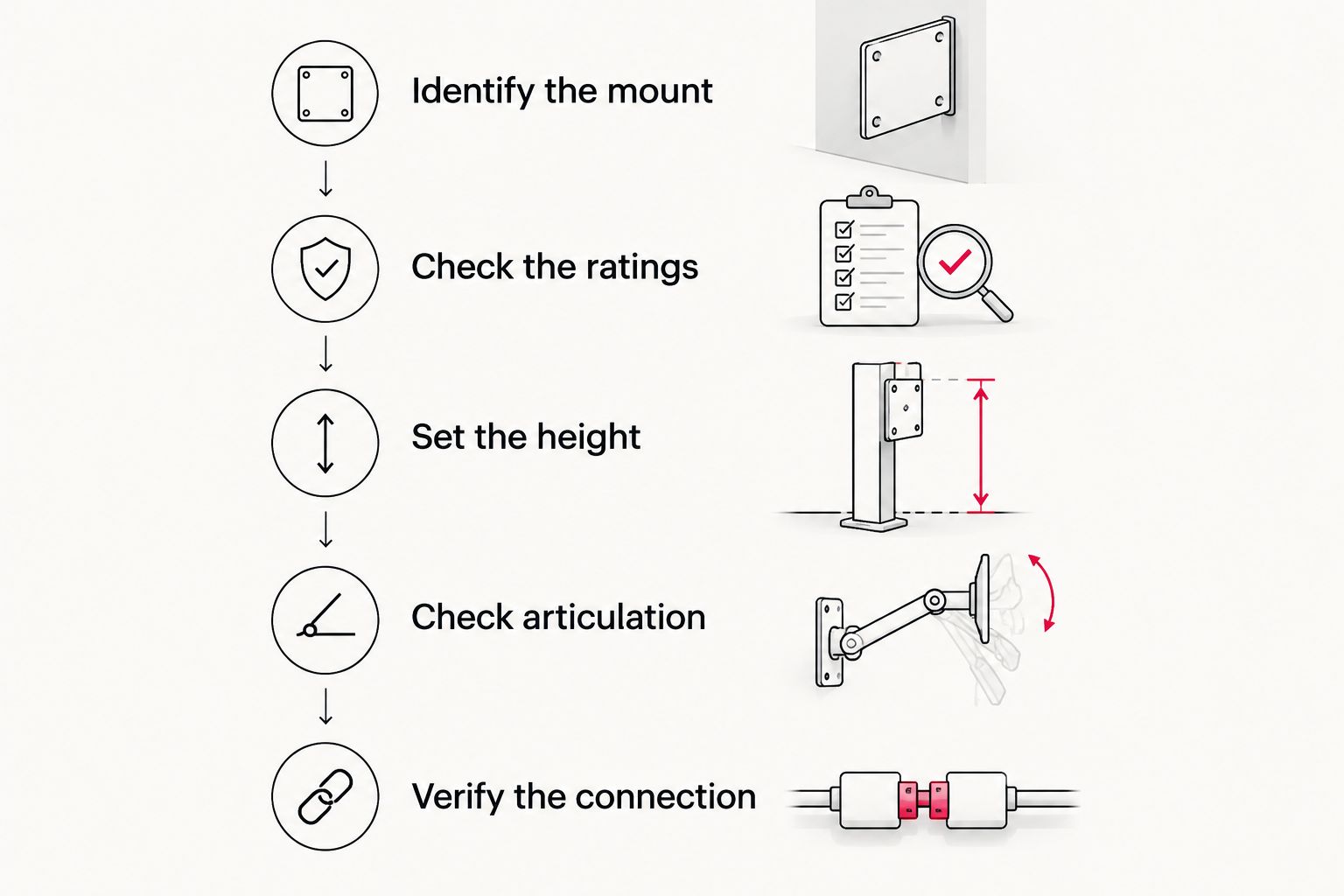
- Identify the mount. Confirm the existing gooseneck system and the conversion manufacturer’s approved application, including any bed-liner or mounting-surface restrictions.
- Check the ratings. Compare loaded trailer weight and pin weight with the truck, hitch, adapter, mounting system, and trailer limits.
- Set the height. Establish the manufacturer-required towing attitude and clearance with the truck and trailer in their operating configuration.
- Check articulation. Verify cab, bed-rail, tailgate, pin-box, and hitch clearance through the permitted turning and pitch movements.
- Verify the connection. Inspect the completed mounting and coupling arrangement using the manufacturer’s procedure before moving into service.
Check both trailer weight and pin weight
Gross trailer capacity and vertical-load capacity are separate limits. Your pickup must also remain within its payload, axle, tire, and combination ratings, so a hitch with adequate trailer capacity does not automatically make the truck suitable.
Use actual loaded weights when confirming the final setup. Passengers, tools, bed cargo, and the installed conversion equipment all contribute to the truck’s load, while the trailer transfers pin weight through the hitch.
Measure clearance in the operating configuration
A trailer that clears the bed rails while parked straight ahead can still contact the truck during a turn or when crossing uneven ground. Check the manufacturer’s required clearances with the installed hitch height and the trailer’s actual operating attitude.
Do not assign a universal clearance number to every conversion. A short-bed truck, recessed flatbed mounting location, or extended pin box changes the geometry, and an offset component is not an automatic substitute for an approved clearance solution.
Confirm electrical compatibility separately
Many pickup towing setups use a 7-way trailer connector, but the connector alone does not verify brake operation or circuit condition. Check the brake controller, lighting, wiring routing, and breakaway system according to the truck and trailer instructions.
The mechanical conversion does not repair electrical faults. Leave enough wiring movement for the approved articulation range without allowing the cable to snag, drag, or become pinched by the hitch.
Install and couple the conversion without shortcuts
A 2026 pre-tow check should verify the complete load path, from the trailer coupling through the conversion and into the truck’s mounting structure. Tightening visible fasteners is only part of the work; the installation must also satisfy the manufacturer’s seating, retention, and support requirements.
Follow the exact installation procedure
Use the specified hardware, fastener sequence, and torque values for the selected equipment. Do not substitute a generic torque figure, add improvised spacers, or modify a mount to make incompatible hardware fit.
Where installation requires structural work or the compatibility documentation is unclear, use a qualified hitch installer. Stop the installation until the manufacturer confirms the combination rather than treating a successful test fit as approval.
Inspect the coupling before transferring the load
For a fifth-wheel head, confirm that the kingpin enters at the prescribed height and that the locking mechanism captures it as the hitch manufacturer specifies. A closed handle alone is not sufficient evidence of correct engagement.
Keep the trailer supported and chocked during the required coupling checks, and complete any prescribed pull test using the manufacturer’s procedure. Check that handles, pins, and retainers are secured before retracting supports and preparing to travel.
Keep safety equipment independent of the adapter choice
Follow applicable safety-chain requirements and the instructions for the specific coupling arrangement. Do not assume that changing from a ball connection to fifth-wheel jaws automatically resolves every legal or equipment requirement.
Route the breakaway cable as directed by the trailer and hitch manufacturers, with enough movement for normal operation. Confirm the brakes and lights before departure, because a mechanically correct conversion still requires a functioning trailer braking and electrical system.
Separate hitch capacity from cargo securement
For vehicle hauling, the hitch connects the trailer to the pickup; it does not secure the vehicle carried on the deck. Load placement and cargo restraint remain separate checks after the conversion is installed.
TruckNTow cargo-control equipment serves vehicle haulers, but cargo-restraint ratings do not establish hitch capacity. Approve the towing connection and the carried load independently before dispatch.
FAQ
Can I tow a fifth-wheel trailer with a gooseneck hitch already in my truck?
Yes, if an approved conversion system matches the existing gooseneck installation, truck, and trailer. A fifth-wheel kingpin cannot couple directly to a gooseneck ball.
Is a truck-side fifth-wheel conversion better than a trailer-side adapter?
A truck-side conversion is the appropriate choice when you need to retain the trailer’s original kingpin connection and the truck mounting system supports it. A trailer-side adapter requires its own trailer and pin-box approval.
Will a gooseneck-to-fifth-wheel adapter increase my towing capacity?
No, an adapter does not increase the truck’s or trailer’s ratings. The completed combination must satisfy every applicable gross-load, vertical-load, axle, tire, and mounting limit.
Can I use a conversion hitch in a short-bed pickup?
Yes, but only when the exact combination is approved and provides the required operating clearance. Confirm cab-to-trailer clearance through the permitted turning range rather than assuming an offset guarantees clearance.
Does a trailer-side adapter affect the trailer warranty?
Warranty treatment depends on the trailer manufacturer’s terms and approval of the exact modification. Obtain written confirmation for the trailer, pin box, and adapter before installation.
Do I need safety chains after converting to a fifth-wheel connection?
Safety-chain requirements depend on the actual coupling arrangement, applicable law, and equipment instructions. Do not remove existing safety equipment solely because the conversion includes a fifth-wheel head.
Maintain the conversion and close out the pre-tow check
Keep the coupling, mounting surfaces, and retention points clean enough to inspect, and lubricate only where the equipment manufacturer specifies. Different hitch designs have different lubrication requirements, so adding grease everywhere is not a maintenance procedure.
Inspect for cracks, deformation, corrosion, missing retainers, loose mounting hardware, and unusual movement before towing. If the connection develops new noise or visible movement, stop and identify the cause rather than tightening parts without a diagnosis.
Keep the installation instructions and equipment identification with your 2026 maintenance records, particularly when several drivers share the truck. Recheck compatibility whenever the trailer, pin box, truck bed, or mounting equipment changes.
One last thing: The ball diameter is only the coupling dimension; it does not identify the mounting system beneath it. Photograph the mount identification before shopping, because that detail determines which conversion instructions apply.
Shop the full line at TruckNTow for your trucking and towing accessory needs after confirming the conversion requirements. Match the equipment, verify the connection, and complete the inspection before the trailer moves.
Related guides