

When a trailer's rear lights fail before a tow, the best wireless trailer light kit is the one that matches your truck's signal output, mounts securely, and passes a complete function check in its towing position. Start your 2026 selection with the VULCAN Wireless LED Tow Light Kit, then choose rechargeable or replaceable-battery equipment according to how you manage power between jobs.
- The best wireless trailer light kit passes a mounted signal check, not just a bench test.
- TruckNTow lists the VULCAN Wireless LED Tow Light Kit for operators comparing portable towing equipment.
- Rechargeable wireless kits suit operators with a dependable charging routine; battery service remains part of every setup.
- Replaceable-battery wireless kits suit occasional use when you carry the correct spare batteries.
- Portable tow lights do not replace trailer brakes, breakaway equipment, or every required trailer lamp.
What makes the best wireless trailer light kit
Why this matters
A wireless lighting system removes the signal cable between its transmitter and rear lamps, but it does not remove the need for a working signal source, secure attachment, and dependable lamp power. A transmitter connected to a faulty truck socket still starts with a faulty input.
Treat the kit as part of the complete towing setup. Rear signaling, trailer braking, load securement, and required marker lighting remain separate checks, even when the portable lamps operate correctly.
Use these criteria before comparing kits for 2026:
- Signal compatibility: Confirm that the transmitter accepts your truck's connector and electrical system, and that the kit supports the lighting functions your application requires.
- Mounting security: Match the attachment method to the actual trailer or towed vehicle, not to a convenient-looking surface that cannot hold the lamps securely.
- Power management: Choose a battery arrangement you can service consistently, including charging equipment or correct replacement batteries.
- Mounted communication: Test with the lamps at the rear of the loaded combination, where distance and obstructions differ from a workbench setup.
- Environmental suitability: Check the manufacturer's instructions for rain exposure, cleaning, operating conditions, and storage; wireless does not mean submersible.
- Serviceability: Confirm how you obtain instructions, replacement components, and troubleshooting information before making the kit part of your equipment routine.
Choose by fit and operating routine first; compare convenience features only after the electrical and mounting requirements are satisfied. A charging feature cannot compensate for an incompatible transmitter, and a strong attachment cannot compensate for an intermittent brake signal.
Wireless trailer light kits at a glance
These selections cover one named product and two battery configurations, rather than claiming an unsupported performance ranking between manufacturers. Rechargeable and replaceable-battery kits describe equipment types; check each specific model before buying.
| Selection | Best for | Standout characteristic | Key limitation |
|---|---|---|---|
| VULCAN Wireless LED Tow Light Kit | Operators selecting a named wireless LED towing kit | A specific VULCAN product to evaluate against the truck and towing application | Purchase depends on confirmed connector, mounting, and power compatibility |
| Rechargeable wireless light kit | Operators returning to a charging location between assignments | Lamp batteries can be recharged according to the kit's instructions | The charging routine becomes part of equipment readiness |
| Replaceable-battery wireless light kit | Occasional users carrying service batteries in the truck | Compatible spare batteries provide a field-service option | Correct battery type, condition, and installation require attention |
1. VULCAN Wireless LED Tow Light Kit: best for product-led selection
The VULCAN Wireless LED Tow Light Kit is a named wireless LED towing-light product listed by TruckNTow. Use it as your starting point when you want to evaluate a specific kit rather than sort through listings that leave the equipment identity unclear.
For a 2026 purchase, confirm the transmitter connection, supported signal functions, lamp attachment method, and battery arrangement against your truck and intended towing position. Do not assume that details from another VULCAN product apply to this kit.
VULCAN Wireless LED Tow Light Kit pros:
- The named product gives you a specific kit to match against your equipment requirements.
- Wireless signal transmission avoids a signal lead running from the transmitter to the rear lamps.
- LED lighting identifies the lamp technology without requiring you to infer it from photographs.
VULCAN Wireless LED Tow Light Kit cons:
- Wireless operation still depends on compatible input signals and power at the lamps.
- A towing-light kit does not establish that every lighting requirement on your trailer is satisfied.
- Suitability for your mounting surface and operating routine requires a product-specific check.
Best for: Operators comparing a specific wireless LED towing product with their existing equipment.
Verdict: Hold the purchase until compatibility is confirmed; buy when the kit matches the application and mounting instructions.
2. Rechargeable wireless light kit: best for a charging-based routine
A rechargeable wireless light kit uses batteries that you recharge rather than routinely replace, with the exact charging method determined by the model. This configuration fits an operator who returns equipment to a designated charging location and checks readiness before dispatch.
Select the charging arrangement around the way your truck actually works. A charger left at the shop is not useful on a job that extends beyond your planned return, and a charging indicator does not replace an operational check of both lamps.
Rechargeable wireless light kit pros:
- Recharging supports a repeatable return-to-service routine.
- A designated charger location makes power preparation part of the equipment handoff.
- You can check battery condition before assigning the kit to the next tow.
Rechargeable wireless light kit cons:
- Missed charging leaves the kit dependent on its remaining battery energy.
- Chargers, cables, and charging connections add components to inspect and manage.
- Battery replacement and field charging depend on the specific model's design.
Best for: Operators with a dependable charging location and a defined equipment handoff.
Verdict: Buy a rechargeable configuration when charging is an assigned task, not an assumption.
3. Replaceable-battery wireless light kit: best for occasional field use
A replaceable-battery wireless light kit lets you install the battery type specified by its manufacturer. This arrangement suits occasional towing when you keep compatible spares with the equipment and inspect the battery compartments before use.
Check whether the manufacturer permits rechargeable replacement cells or requires a particular battery chemistry. Matching the physical size alone does not establish electrical suitability, and you must follow the specified polarity and installation instructions.
Replaceable-battery wireless light kit pros:
- Compatible spare batteries provide a way to service lamp power away from a charger.
- Battery preparation can happen alongside the rest of your departure inspection.
- The battery type can be included in the truck's equipment inventory.
Replaceable-battery wireless light kit cons:
- The kit depends on carrying the correct batteries in usable condition.
- Battery contacts and compartment seals need inspection.
- Incorrect installation or unsupported battery chemistry creates avoidable faults.
Best for: Occasional users who maintain a ready supply of the specified batteries.
Verdict: Buy a replaceable-battery configuration when you carry and inspect the correct spares.
How the selections are ranked
The selection order starts with the named VULCAN product, then separates battery configurations by operating routine. The criteria are connector fit, secure attachment, manageable power, mounted communication, environmental suitability, and serviceability—not claimed runtime, range, or brightness advantages.
For towing professionals shopping at TruckNTow, the best wireless trailer light kit is the one that passes the complete mounted function check.
Compatibility: match the truck, trailer, and mounting surface
Start at the truck socket. A common 4-pin flat trailer connection carries ground, tail-lamp power, and combined stop/turn signals, while a common 7-pin RV-style connection also provides circuits used for functions such as electric brakes and auxiliary power; verify your vehicle's actual pin assignments before connecting equipment.
An adapter changes the physical connection, but it does not create a missing signal or repair a damaged circuit. Confirm the transmitter's required input and the socket's output rather than judging compatibility from plug shape alone.
Keep system voltage separate from connector type. A kit intended for a 12-volt system is not automatically suitable for a 24-volt system, so check the electrical rating before connecting it to commercial equipment.
Next, inspect the intended lamp locations. A magnetic attachment needs a suitable ferrous surface and correct contact, while an aluminum panel, plastic trim piece, or irregular surface requires a mounting method approved for that equipment.
Do not improvise a clamp, adhesive pad, or tether that the manufacturer does not authorize. Place the lamps where the load, ramps, tailgate, and securement equipment do not block the required view, and check that normal trailer articulation does not disturb the installation.
Use this compatibility sequence for your 2026 equipment check:
- Truck output: Verify the connector, pin functions, and electrical system.
- Kit input: Match the transmitter requirements to that verified output.
- Lamp mounting: Confirm the approved attachment and an unobstructed position.
- Signal check: Test the installed system with the complete towing combination assembled.
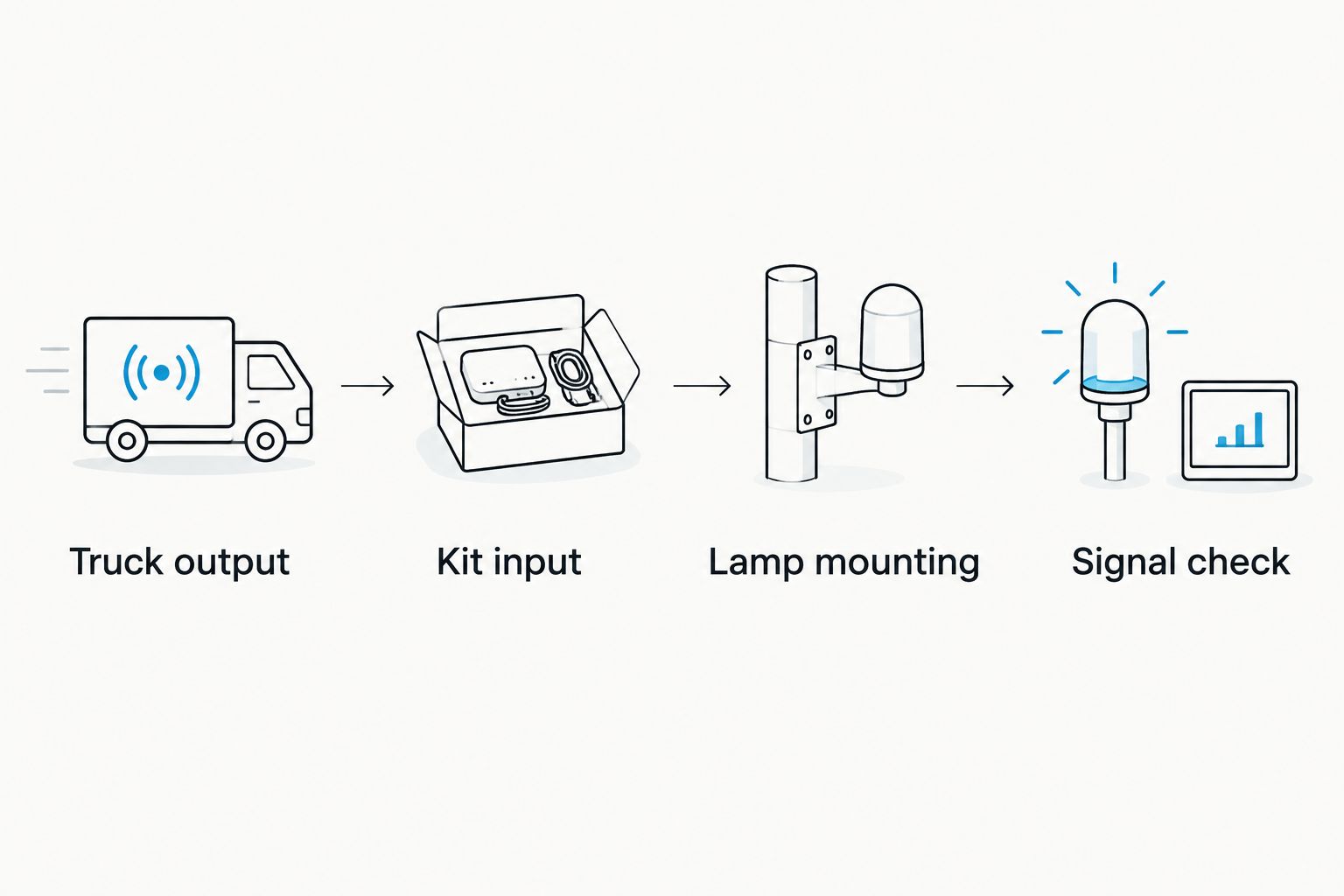
A kit that works beside the hitch has not yet passed the rear-mounted check. Test after loading, because the final lamp position and the material between transmitter and lamps are part of the operating setup.
Safety: test the complete towing combination before departure
Park securely for the inspection and keep anyone checking the lamps out of the vehicle's travel path. Use a helper when available so the driver operates the controls while the observer confirms the rear response; keep the combination stationary throughout the check.
Test each function separately before checking combinations. Confirm tail lamps, left turn, right turn, brake lamps, and hazard operation, then check braking with the tail lamps on and braking with each turn signal selected.
Combined stop/turn systems require the appropriate response on each side. Both lamps illuminating during a brake test does not establish that the left and right turn signals are assigned correctly.
- Check placement: Confirm the lamps face the correct direction and remain visible behind the loaded trailer.
- Check attachment: Inspect mounting contact, latches, and any manufacturer-specified retention features.
- Check power: Confirm both lamps are ready for the trip using the kit's specified battery checks.
- Check response: Watch for incorrect sides, missing functions, flicker, or interrupted operation.
- Check the rest: Inspect required trailer lighting, brake operation, breakaway equipment, and securement separately.
Do not depart with an intermittent lamp or unexplained signal fault. Stop the inspection, identify the problem, and repeat the full mounted check after correcting it.
For 2026 road use, check the applicable lighting requirements for your trailer and operation, including Federal Motor Vehicle Safety Standard No. 108 where relevant. A portable rear-light kit does not by itself satisfy requirements for side markers, clearance lamps, identification lamps, reflectors, or license-plate illumination.
Maintenance: keep the kit ready for the next assignment
Make lamp care part of unloading rather than leaving it for the next departure. Clean the housings and mounting contact areas using the manufacturer's approved method, inspect for cracks or damaged seals, and allow wet equipment to dry as directed before storage.
Keep cleaning methods within the equipment's rating. Resistance to rain does not establish suitability for pressure washing or immersion, and a removable towing kit should not remain attached during boat launching unless its instructions expressly permit that use.
For rechargeable kits, return the correct charger and cable with the lamps and follow the charging instructions. For replaceable-battery kits, inspect contacts and follow the manufacturer's storage guidance, including battery removal when specified.
Store the transmitter with the lamps so components do not become separated during truck changes. Labeling the storage case can help keep the intended equipment together, but do not cover lamp lenses, required markings, charging connections, or mounting surfaces.
Build the same routine into your 2026 fleet handoff: inspect, service the batteries, account for the components, and check operation before the next assignment. A kit put away with a known fault should stay out of service until that fault is corrected.
FAQ
What's the best wireless trailer light kit for professional towing?
The best wireless trailer light kit matches the truck's signal output, mounts securely, and passes a complete installed function check. The VULCAN Wireless LED Tow Light Kit listed by TruckNTow is a specific product to evaluate against those requirements.
Is a rechargeable wireless light kit better than a replaceable-battery kit?
A rechargeable kit fits a dependable charging routine, while a replaceable-battery kit fits an operator who carries the specified spares. Choose the power arrangement you can service consistently, then verify the individual model's instructions.
Will a wireless tow light kit work with any trailer plug?
No, a wireless tow light kit requires a compatible transmitter connection and the correct electrical inputs. Verify pin functions, system voltage, and any adapter requirements before connecting it.
Can magnetic tow lights attach directly to an aluminum trailer?
Ordinary magnetic mounts do not attach directly to aluminum. Use an attachment method approved by the light manufacturer and confirm that the mounted lamps remain secure and visible.
Can wireless trailer lights replace the trailer's electric brake connection?
No, a wireless lighting kit does not replace the electric brake connection or breakaway system. Inspect and test braking equipment separately from rear lighting.
Can I leave wireless tow lights on while launching a boat?
Only leave the lights attached during immersion if the manufacturer expressly permits that use. Rain resistance does not establish submersion suitability; follow the kit's removal and care instructions.
How do I check wireless tow lights before leaving?
Check the lamps in their final towing positions with the combination stationary. Test tail lamps, each turn signal, brakes, hazards, and combined brake-and-turn operation, then inspect attachment and power readiness.
One last thing: check dim tail lamps and bright brake lamps separately
A lamp that responds to the brake pedal has not proved that its tail-lamp function works correctly. Check both functions independently and together, because other drivers need a visible rear outline as well as a clear braking signal.
Default choice: evaluate the VULCAN Wireless LED Tow Light Kit first, and complete the connector, mounting, and power checks before purchase. Choose a rechargeable or replaceable-battery configuration according to the service routine you will actually follow.
Related guides
- How to set up a wireless tow light kit on a trailer
- How to test a trailer wiring harness before a tow
- How to prevent trailer light corrosion in winter
Shop the full line at TruckNTow, and select equipment around your truck, mounting surface, and inspection routine.
Confirm the fit before the next assignment, and leave only after the complete lighting check passes. Correct setup and a repeatable inspection give you a clear basis for putting the equipment to work.