

When a loose cord bundle starts tangling with the gear in your service compartment, reusable velcro straps are the best choice for organizing it—not for anchoring cargo during transport. For your 2026 setup, choose pre-cut wraps for repeat bundles, cut-to-length material for mixed sizes, buckle-style wraps for larger bundles, and captive wraps for cords that need their organizer attached.
- Pre-cut velcro straps are the default choice for organizing cords and small accessory bundles.
- Cut-to-length hook-and-loop material suits mixed bundle sizes without committing to one strap length.
- Buckle-style wraps help you adjust larger bundles, but buckle hardware does not establish a cargo rating.
- TruckNTow vehicle tie-down equipment serves a different job: securing vehicles rather than organizing loose accessories.
What makes the best velcro straps for lightweight cargo
The first selection decision is whether you are organizing items together or restraining them against vehicle movement. A wrap around an extension cord performs the first job; attaching a tool case to a trailer requires a restraint selected for the load, anchor points, and operating conditions.
That distinction matters even when the item feels light in your hands. Braking, cornering, vibration, and airflow create demands that a tidy bundle on the shop floor does not demonstrate, so use purpose-built ratchet straps for cargo restraint when the application requires them.
Judge your 2026 hook-and-loop selection against these criteria before choosing a format:
- Intended use: Look for instructions that explicitly cover your task, rather than treating a general-purpose organizer as a transport restraint.
- Closure engagement: The hook and loop must meet across the overlap required by the manufacturer, without leaving the end barely attached.
- Bundle fit: Select enough length to wrap the actual bundle, including its irregular shape, without excessive loose material.
- Release access: Position the opening tab where you can reach it without pulling apart the whole compartment.
- Surface compatibility: Check whether exposed hooks, a buckle, or trapped debris will contact cables, upholstery, or finished surfaces.
- Care requirements: Follow the product's cleaning and exposure instructions, especially around grit, oil, moisture, and outdoor storage.
VELCRO is a brand name; hook-and-loop describes the fastening mechanism. Search results often mix those terms, but the name alone does not establish dimensions, material, weather resistance, or an allowable load.
Best velcro strap formats at a glance
These recommendations rank organizer formats by task, not named products by unverified strength claims. Each format has a separate use case, and none earns a cargo-restraint recommendation simply because its closure feels difficult to pull apart.
| Rank and format | Best for | Standout feature | Key limitation |
|---|---|---|---|
| 1. Pre-cut reusable wraps | Repeat-size cord and accessory bundles | Ready-to-use length without cutting | Fixed length limits bundle fit |
| 2. Cut-to-length hook-and-loop material | Mixed-size bundles in a workshop or fleet compartment | Length selected for each bundle | Requires cutting and checking permitted construction |
| 3. Buckle-style hook-and-loop wraps | Larger bundles needing an adjustable return path | Strap feeds through a buckle before closing | Hardware adds bulk and potential contact points |
| 4. Captive hook-and-loop cable wraps | Individual cords that are repeatedly deployed | Organizer stays attached to its assigned cord | Attachment design must suit the cord |
1. Pre-cut reusable wraps: best for repeat-size bundles
Pre-cut wraps are the default when you repeatedly coil the same extension cords or organize similar accessory bundles. You choose a suitable length, wrap the bundle, and engage the closure without preparing a piece from a roll.
Pre-cut wrap pros:
- No cutting step during routine packing.
- Consistent length for a standardized compartment layout.
- Reusable closure for frequently accessed bundles.
Pre-cut wrap cons:
- A fixed length does not fit every bundle.
- Excess length needs controlled placement rather than a dangling tail.
Best for: Operators packing the same cords and accessories after each job. For a 2026 compartment refresh, standardize only after checking your largest and smallest bundles. Verdict: Buy for repeat organization tasks.
2. Cut-to-length material: best for mixed bundle sizes
Cut-to-length hook-and-loop material lets you prepare different lengths from the same roll, provided the product is designed for that use. It suits a workbench where a small cable bundle and a coiled hose require different wrap lengths.
Cut-to-length material pros:
- Length tailored to the actual bundle.
- Useful for organizing equipment with varied dimensions.
- Replacement pieces prepared as the compartment layout changes.
Cut-to-length material cons:
- Cutting adds preparation work.
- Not every hook-and-loop construction closes against itself or permits arbitrary cutting.
Best for: Shop staff organizing varied accessory sizes. Check the fastening arrangement before cutting, because separate hook and loop strips do not function like self-mating wrap material. Verdict: Buy for mixed-size organization.
3. Buckle-style wraps: best for larger adjustable bundles
A buckle-style wrap passes through a buckle or slot before folding back onto its mating surface. That arrangement gives you a defined return path while adjusting the wrap around a larger bundle.
Buckle-style wrap pros:
- Defined routing through the buckle.
- Adjustable fit within the strap's designed range.
- A return section you can position for access.
Buckle-style wrap cons:
- The buckle adds bulk against nearby equipment.
- A buckle is not proof of a transport rating.
Best for: Larger stored bundles where buckle contact will not damage adjacent surfaces. Inspect the complete assembly rather than judging it by the hardware alone. Verdict: Buy for suitable storage bundles; skip as an unrated cargo anchor.
4. Captive cable wraps: best for frequently deployed cords
A captive wrap uses an attachment feature that keeps the organizer with its assigned cord when the bundle is open. Choose this format when loose organizers routinely become separated from the equipment they belong to.
Captive cable wrap pros:
- Organizer remains with the assigned cord.
- Convenient for repeated deployment and packing.
- Keeps the wrap available without separate storage.
Captive cable wrap cons:
- Attachment must fit without pinching or damaging the cord.
- The retained wrap can snag if positioned poorly.
Best for: Individual cords used repeatedly during service work. Keep the attachment away from connectors and strain-relief areas unless the manufacturer's instructions specify otherwise. Verdict: Buy for frequently handled cords.
How the formats rank
Pre-cut wraps take the default position because they remove preparation from a repeat task; cut-to-length material wins when bundle sizes vary. Buckle-style and captive wraps solve narrower routing and handling problems, so choose them for those features rather than assuming they hold more cargo.
Compatibility: match the wrap to the complete bundle
Fit your velcro straps around the equipment as it will actually be stored, not around a loosely estimated diameter. Coiled cords, plugs, hose fittings, and protective sleeves create irregular shapes, and those shapes affect where the closure meets and whether the opening tab remains accessible.
Use this sequence when setting up a compartment:
- Form the bundle. Follow the equipment manufacturer's guidance for coiling, bending, and storage.
- Check the route. Keep the wrap clear of connectors, sharp edges, and moving compartment hardware.
- Check the closure. Confirm the required overlap and full contact between mating surfaces.
- Stow the bundle. Place the organized item inside an appropriate storage or restraint system.
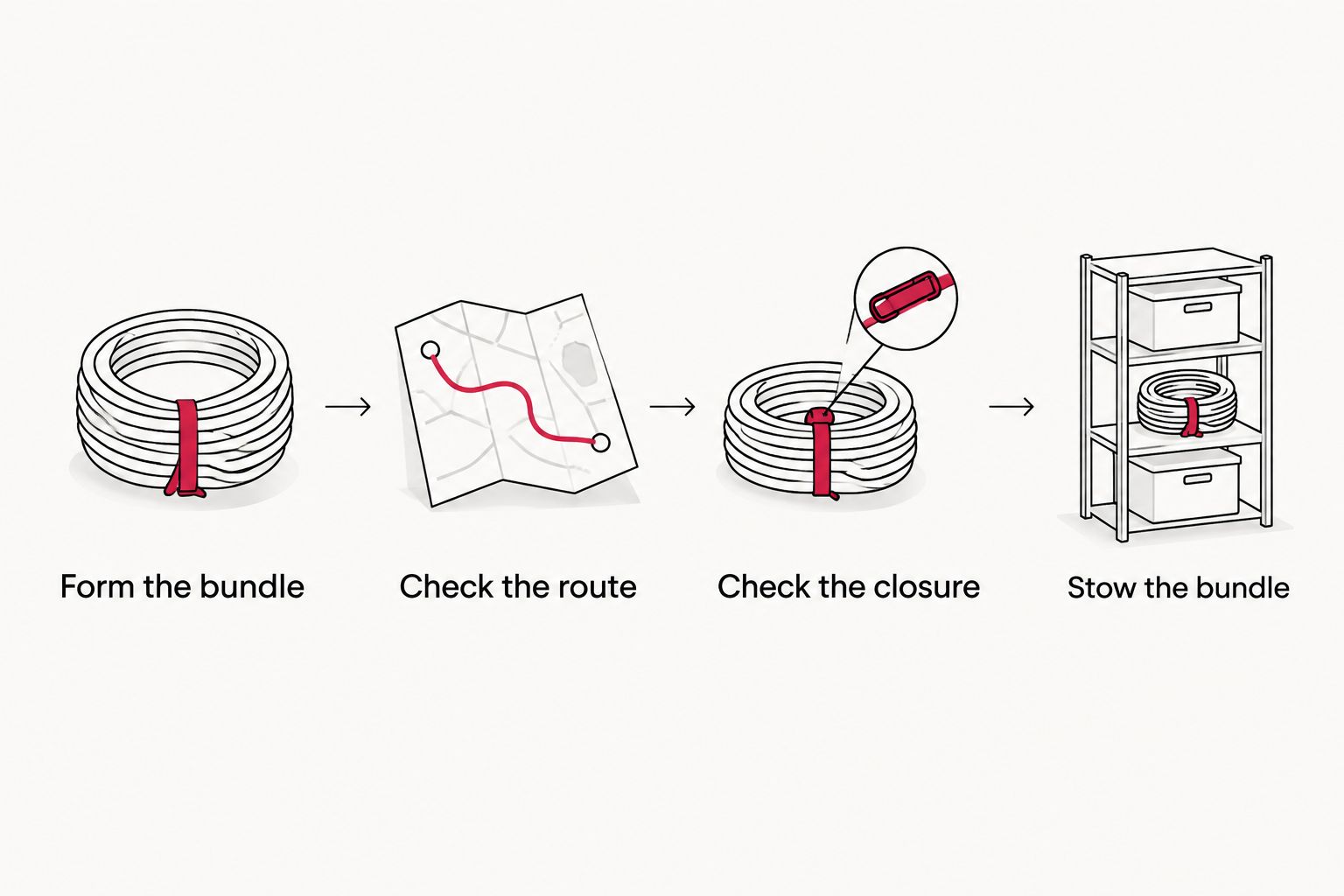
Inspect the surrounding compartment as well. A correctly closed wrap does not prevent the whole bundle from sliding across a shelf, falling against a door, or reaching a control when the vehicle moves.
For a 2026 fleet setup, assign each wrap format to a specific storage task and document that use in your packing routine. This keeps an organizer from migrating into a restraint job simply because it happens to be close at hand.
Safety: separate bundling from cargo restraint
Do not assign a working load limit to velcro straps from their width, appearance, or hand-pull resistance. Use the manufacturer's stated rating and instructions for the exact assembly and application; an organizer without an applicable rating is not your primary transport restraint.
Closure loading also matters. Hook-and-loop resists forces differently depending on whether the mating surfaces are pulled along one another or peeled apart, which is why a hand test in one direction does not establish performance in every installation.
Keep these distinctions clear:
- Organization: Holding a cord coil together inside suitable storage.
- Restraint: Preventing an item from moving relative to the vehicle.
- Cover retention: Holding a cover in place according to its intended system.
- Vehicle securement: Securing a vehicle with equipment and attachment methods selected for that application.
TruckNTow's vehicle tie-down gear is for haulers securing vehicles; velcro straps serve accessory-organization tasks. Neither a familiar brand nor a convenient fastening mechanism removes the need to match the equipment to the job.
For a concrete comparison, the VULCAN Ratchet Straps with Wire J Hooks listed for cargo transport measure 2 inches wide by 15 feet long and carry a stated 3,300-pound safe working load. Those specifications describe that product, not hook-and-loop wraps, and they do not establish the suitability of an anchor point or a complete load arrangement.
VULCAN PROSeries is another named product line, but line names do not replace application checks. A vehicle tie-down assembly remains a vehicle-specific choice rather than an automatic upgrade for organizing a cord bundle.
For your 2026 pre-trip routine, inspect both systems separately: verify that bundles remain organized, then verify that stored equipment and cargo have the required containment or restraint. Stop and correct an uncertain installation before travel.
Maintenance: keep closures clean and replace damaged wraps
Hook-and-loop depends on contact between its mating surfaces, so debris caught in the closure interferes with engagement. Close unused wraps against their mating surfaces, keep them away from loose shop debris, and follow the manufacturer's cleaning method rather than applying an unapproved solvent.
Inspect each wrap while packing equipment:
- Remove it from use if the strap, stitching, buckle, or attachment feature is damaged.
- Check for contamination or flattened fastening surfaces that prevent normal closure.
- Confirm the opening tab and free end remain controlled after packing.
- Recheck fit when you change the contents of a bundle.
Do not tighten a wrap to compensate for damaged fastening surfaces, and do not treat repeated opening and closing as a repair. Replace an organizer that no longer closes as intended.
During a 2026 storage review, separate organizers from rated restraint equipment so both remain easy to identify. TruckNTow cargo-control equipment and small accessory wraps perform different jobs, and clear storage helps you choose deliberately instead of using whichever strap is nearest.
FAQ
What's the best type of velcro strap for cords in a service truck?
Pre-cut reusable wraps are the default choice for repeat-size cord bundles. Select a length that provides the manufacturer's required closure engagement, then place the bundle in suitable storage.
Can I use velcro straps to secure lightweight cargo in a pickup bed?
Do not use an unrated organizer as the primary restraint for cargo in a pickup bed. Choose equipment whose instructions and rating cover the load and installation; light weight alone does not establish suitability.
Are buckle-style velcro straps stronger than ordinary wraps?
A buckle alone does not establish a higher allowable load. Compare the manufacturer's ratings and intended uses for the complete assemblies rather than judging strength from the hardware.
Can I cut hook-and-loop straps to fit my equipment?
Cut only material designed for cut-to-length use. Confirm that the cut piece retains the required fastening arrangement and enough closure engagement for the intended task.
How much weight can velcro straps hold?
There is no single weight rating for all hook-and-loop straps. Use the exact product's published rating for the intended application, and do not convert a hand-pull test into a working load limit.
When should I replace reusable hook-and-loop wraps?
Replace wraps when damage, contamination, or worn fastening surfaces prevent them from closing as intended. Follow the manufacturer's inspection and replacement instructions rather than relying on a universal service interval.
One last thing
A neatly wrapped item can still be unsecured cargo. Pre-cut wraps remain the default for repeat cord bundles, but the final check is where the entire bundle goes and what prevents it from moving—not simply whether its closure stays shut.
Related guides
- Cam buckle straps for lightweight cargo securement
- How to measure for the right size ratchet strap
- How to anchor cargo using truck bed tie-down rails
Shop the full line of trucking and towing accessories at TruckNTow, and match the equipment to the task before your next departure.
Keep bundles organized, cargo restrained, and every fastening system working within its intended use.