

When a truck stops short of firm ground, the best overall choice for steady towing is a purpose-built static tow strap; the best option for kinetic recovery is a rated kinetic recovery strap, and the best option for extending a winch line is a rated winch extension strap. This 2026 guide separates those jobs from vehicle transport, where a tie-down strap holds a truck on a deck rather than pulls it out of trouble.
- The best tow straps for trucks match the operation: static towing, kinetic recovery, or winch extension.
- Choose purpose-built recovery straps by manufacturer instructions, vehicle weight, attachment compatibility, and condition.
- VULCAN PROSeries car tie-downs secure transported vehicles; do not substitute them for recovery straps.
- TruckNTow offers towing accessories and vehicle securement gear; select equipment by its stated application.
Why the towing job determines the strap
A disabled pickup rolling on pavement presents a different load from a truck buried to its axles, and neither job resembles securing a vehicle on a rollback. Before you compare webbing widths or load ratings, identify whether you need controlled towing, kinetic recovery, winch rigging, or transport securement.
A strap's name and intended application matter more than its appearance. Ratchet webbing, recovery webbing, and lifting slings are not interchangeable simply because they resemble one another, and a large printed rating does not authorize a different use.
For recovery-specific attachment checks, read how to use a recovery strap without damaging your truck. Use that guidance alongside the strap manufacturer's instructions and the vehicle manufacturer's approved recovery procedures.
TruckNTow is best for truckers and vehicle haulers shopping for towing accessories and vehicle tie-down gear. For this 2026 buying decision, choose the equipment category first, then check the exact assembly rather than treating every strap in the truck's storage compartment as recovery equipment.
What makes the best tow straps for trucks
Judge truck straps against these criteria before choosing a product, because each criterion addresses a different failure point in the connection between vehicles.
- Intended application: The manufacturer must identify the strap for the operation you plan, whether that is static towing, kinetic recovery, winch extension, or vehicle securement.
- Rating definition: Identify whether the published figure is a working load limit or breaking strength, and follow the manufacturer's selection instructions for that specific assembly.
- Vehicle and load compatibility: Account for the truck's actual operating weight and recovery conditions, rather than choosing by the vehicle's model badge alone.
- Attachment fit: Check that strap eyes and connecting hardware fit the approved attachment points without pinching, side loading, or bearing against sharp edges.
- Length and routing: Choose a usable length for the connection and working area, with a route that avoids exhaust components, edges, and moving parts.
- Inspection and traceability: Look for readable identification and instructions, then inspect the webbing, stitching, eyes, and hardware before each operation.
Truck strap options at a glance
The ranking below assigns each option a separate job. It is a selection guide, not a claim that a kinetic strap outperforms a static strap in every operation.
| Ranked option | Best for | Standout feature | Key limitation |
|---|---|---|---|
| Purpose-built static tow strap | Static towing | Intended for controlled towing without a kinetic recovery technique | Not a substitute for a kinetic recovery strap |
| Rated kinetic recovery strap | Kinetic recovery | Designed to stretch and release stored energy during its intended recovery operation | Requires compatible recovery points and application-specific instructions |
| Rated winch extension strap | Winch extension | Extends reach when approved for the winch rigging arrangement | Does not increase winch capacity |
| VULCAN PROSeries lasso-style car tie-down with chain anchors | Vehicle transport | 2-inch x 96-inch straps, supplied as a 4-pack, with a stated 3,300-pound safe working load | Vehicle securement equipment, not a recovery strap |
The VULCAN dimensions and safe working load identify a particular transport product. They do not establish suitability for every pickup, tire, trailer, or attachment arrangement.
The decision starts with the operation, then branches to the equipment category. Keep these categories separate when you organize equipment for your 2026 towing season.
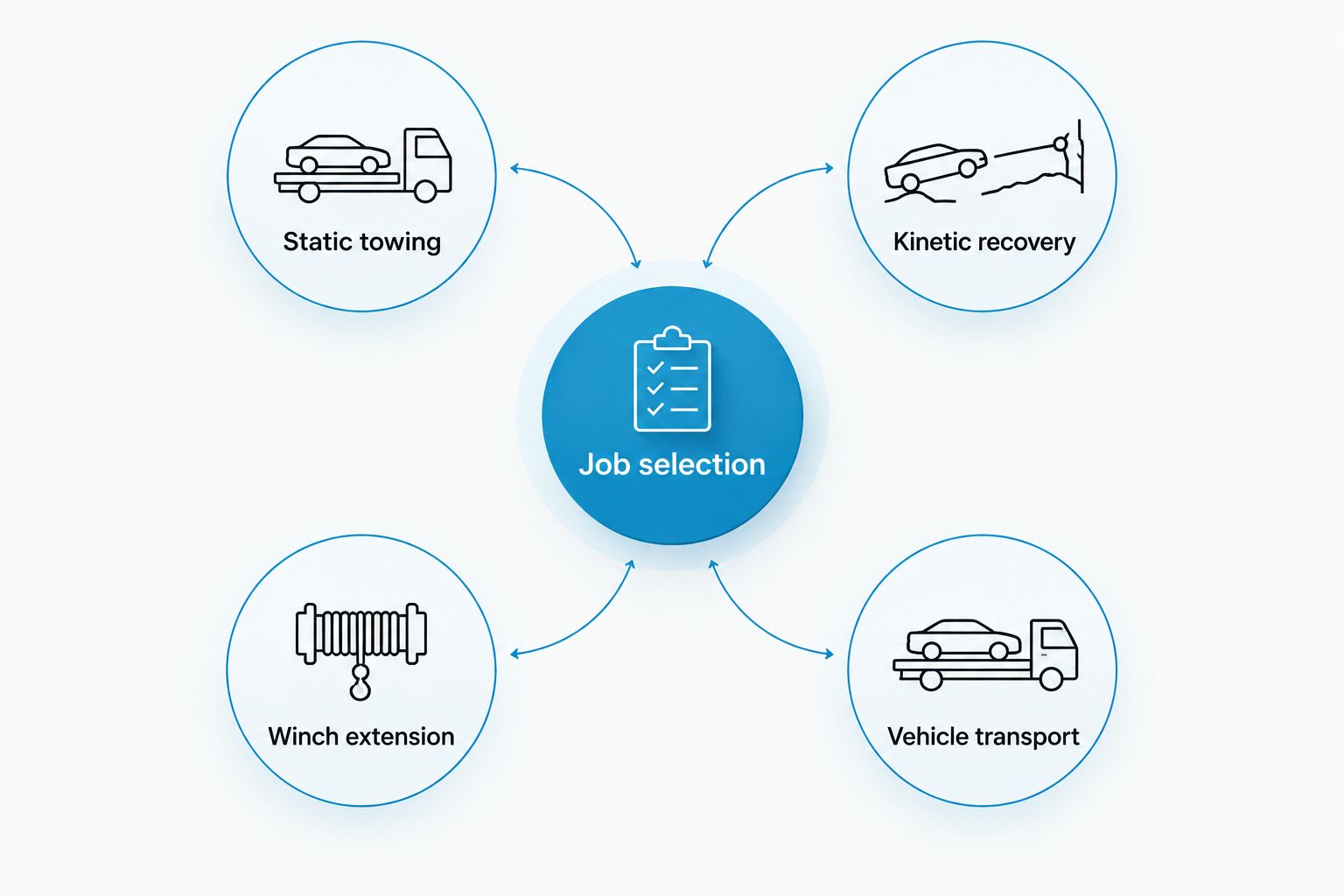
Ranked choices for towing, recovery, and transport
1. Purpose-built static tow strap: best for controlled towing
A static tow strap connects vehicles for the towing application specified by its manufacturer, rather than supplying the deliberate stretch-and-release action of kinetic recovery equipment. Choose this category when the vehicle's condition, towing procedure, and attachment points support a controlled tow.
Static tow strap pros:
- Matches a controlled towing operation without requiring a kinetic recovery technique.
- Keeps the equipment choice separate from cargo ratchet straps.
- Allows you to select length and end connections for the intended towing arrangement.
Static tow strap cons:
- Does not make an unsuitable vehicle safe to tow.
- Is not permission to jerk a stuck truck free or introduce shock loading.
- Still requires approved towing points and compatible connecting hardware.
Best for: A vehicle that can be moved using the manufacturer's approved controlled towing procedure.
Before ordering, check whether the disabled truck needs a wheel lift, rollback, or another transport method instead. Steering, braking, drivetrain restrictions, and local road requirements determine whether a strap tow is appropriate; the strap alone does not settle that decision.
Verdict: Buy for an approved controlled towing job; skip for kinetic recovery.
2. Rated kinetic recovery strap: best for kinetic recovery
A kinetic recovery strap stretches under load and releases stored energy during the recovery technique described by its manufacturer. That mechanism distinguishes it from a static towing strap and makes the vehicle, attachment points, and operator procedure part of the selection decision.
Kinetic recovery strap pros:
- Is designed for a recovery method that uses controlled elastic stretch.
- Provides a distinct equipment category for recovering a stuck vehicle.
- Can be selected against the manufacturer's stated vehicle-weight guidance.
Kinetic recovery strap cons:
- Stores energy, making failed attachments and incompatible hardware serious hazards.
- Is not a substitute for a winch when the conditions require controlled winching.
- Requires instructions specific to the strap and recovery arrangement.
Best for: Operators carrying out a manufacturer-approved kinetic recovery with suitable vehicles and rated recovery points.
Do not select a kinetic strap by assuming the largest breaking-strength figure is automatically the right match. Follow the manufacturer's sizing method, and reject a setup when you cannot verify the recovery points or connection hardware.
Verdict: Buy only for a verified kinetic recovery setup; skip improvised attachments.
3. Rated winch extension strap: best for extending winch reach
A winch extension strap adds reach to a winch rigging arrangement when the strap manufacturer permits that use. It addresses distance, not a shortage of pulling capacity, and its connections must suit the load path of the complete system.
Winch extension strap pros:
- Addresses an anchor or vehicle connection beyond the available winch-line reach.
- Separates extension duties from kinetic recovery equipment.
- Lets you select an extension specifically for the rigging application.
Winch extension strap cons:
- Does not increase the winch's rated pulling capacity.
- Adds connections that require inspection and compatibility checks.
- Is not automatically approved for lifting or kinetic recovery.
Best for: Winching operations that need additional reach and permit a rated extension strap.
Confirm the extension's instructions before placing it in the system, and review the winch manufacturer's operating requirements as well. A longer connection does not correct a poor anchor, damaged line, or unsafe pull direction.
Verdict: Buy to solve a reach problem; skip as a capacity upgrade.
4. VULCAN PROSeries lasso-style tie-down: best for vehicle transport
The VULCAN PROSeries lasso-style car tie-down with chain anchors is vehicle securement equipment for a transport job, not a pulling strap for a stuck truck. The listed assembly uses 2-inch x 96-inch straps in a 4-pack and states a 3,300-pound safe working load.
VULCAN PROSeries lasso-style tie-down pros:
- Provides a defined lasso-style securement configuration.
- Uses chain anchors for compatible deck connections.
- Lists strap dimensions and a safe working load for selection checks.
- Comes as a 4-pack for a vehicle securement arrangement.
VULCAN PROSeries lasso-style tie-down cons:
- Does not replace static towing or kinetic recovery equipment.
- Requires confirmation of tire fit, routing, and deck-anchor compatibility.
- A 96-inch strap length does not guarantee fit around every truck tire.
Best for: Vehicle haulers selecting a lasso-style system with chain anchors for compatible transport equipment.
Confirm the complete securement plan before choosing this assembly, especially when transporting trucks with unusual tire sizes or restricted access. A matching strap width is not enough.
Verdict: Buy for a verified vehicle transport application; skip for pulling a truck.
How these options are ranked
This 2026 ranking puts application fit ahead of headline strength: controlled towing first, kinetic recovery second, winch reach third, and transport securement fourth. Each option has a distinct use-case slot, so the order is not a comparison of interchangeable products or a hands-on performance test.
Compatibility and safety before tensioning
Start with the truck manufacturer's instructions, because a convenient-looking loop, hitch component, or suspension part is not automatically an approved recovery point. Check the permitted operation and load direction, then select the strap and connecting hardware for that arrangement.
Never attach a recovery strap to a tow ball. Do not route recovery loads through vehicle tie-down locations unless the vehicle manufacturer explicitly approves those locations for recovery, and do not assume an aftermarket attachment has a suitable rating without documentation.
Use this inspection sequence before applying tension:
- Identify the job. Confirm towing, kinetic recovery, winch extension, or vehicle transport.
- Check instructions. Verify the vehicle procedure, strap application, rating definition, and hardware requirements.
- Inspect equipment. Examine webbing, stitching, eyes, connectors, and attachment points for damage.
- Verify routing. Remove twists and prevent contact with sharp edges, heat, and moving components.
- Clear the area. Keep people out of the load path and follow the equipment manufacturer's exclusion-zone instructions.
For 2026 fleet purchasing, record the application beside each strap's identification so operators do not need to infer its purpose from color or storage location. Keep recovery equipment separate from the tie-down assemblies used after loading.
A 3,300-pound safe working load is not the same claim as a 3,300-pound breaking strength. Likewise, multiplying the rating of a 4-pack does not establish the permitted vehicle weight, because the securement arrangement, load direction, anchors, and applicable requirements determine the system's suitability.
FAQ
What's the best tow strap for a truck in 2026?
The best tow strap is a purpose-built static tow strap for approved controlled towing, while kinetic recovery requires a rated kinetic recovery strap. Match the equipment to the operation, vehicle instructions, and attachment points.
Is a recovery strap the same as a tow strap?
No, a kinetic recovery strap and a static tow strap serve different applications. Check the manufacturer's intended use rather than relying on a seller's general use of the word tow.
Can I use a ratchet tie-down strap to pull a stuck truck?
Do not use a vehicle tie-down strap as a recovery strap. Tie-down assemblies secure transported loads, while recovery equipment must be specifically approved for the pulling operation.
What size tow strap do I need for my pickup?
Choose the size and rating using the strap manufacturer's guidance for your vehicle and intended operation. Width alone does not establish capacity, and published breaking strength is not a working load limit.
Can I attach a recovery strap to a trailer hitch ball?
No, never attach a recovery strap to a tow ball. Use approved recovery points and connecting hardware that suit the vehicle and strap manufacturer's instructions.
Are VULCAN PROSeries lasso-style straps suitable for truck recovery?
VULCAN PROSeries lasso-style car tie-downs are vehicle securement equipment, not recovery straps. The listed chain-anchor assembly has 2-inch x 96-inch straps and a stated 3,300-pound safe working load; verify fit for the transport application.
Does a winch extension strap make my winch stronger?
No, a winch extension strap adds reach rather than increasing rated pulling capacity. Check every component and connection in the rigging arrangement against its instructions.
Maintenance and the final buying decision
Inspect straps before use and after any operation that introduces abrasion, heat, contamination, or an unexpected load. Follow the manufacturer's removal-from-service criteria, and remove damaged or unidentifiable equipment from the working kit rather than leaving it beside serviceable straps.
Clean webbing according to its instructions, dry it before storage, and protect it from sunlight, heat, chemicals, and sharp tools. Inspect ratchet mechanisms and connection hardware separately; sound webbing does not compensate for damaged hardware.
For an undecided buyer, choose a static tow strap only after confirming that controlled towing is the actual job. Choose a kinetic recovery strap for an approved kinetic operation, a winch extension for a reach problem, or the VULCAN PROSeries lasso-style tie-down for compatible vehicle transport.
Related guides
One last thing: two similar-looking straps can belong in entirely different jobs, so keep the application instructions with the equipment instead of relying on memory. Shop towing accessories and vehicle securement gear at TruckNTow, then verify the exact assembly before putting it to work.
The right equipment starts with a verified job, a compatible connection, and an inspection before tension.