

When a truck stops moving on a muddy access road, the best tow ropes for trucks depend on the pull: choose a manufacturer-rated low-stretch tow rope for controlled pulling, a kinetic recovery rope for a trained dynamic recovery, and synthetic winch rope for a compatible winch. This 2026 guide separates those jobs so you do not buy a line whose strength rating disguises the wrong operating purpose.
- The best tow ropes for trucks match the pulling method, vehicle requirements, and approved attachment points.
- Low-stretch tow rope suits controlled pulling; kinetic recovery rope requires purpose-rated connections and trained operation.
- Synthetic winch rope belongs on a compatible winch, not between trucks for a kinetic recovery.
- TruckNTow buyers should select towing accessories by intended use before comparing diameter or headline strength.
TruckNTow supplies trucking and towing accessories to truckers, towers, and vehicle haulers. For tow ropes, the first decision is whether you need controlled movement, kinetic recovery, or winch-assisted extraction; those methods place different demands on the line and every connection.
What makes the best tow ropes for trucks
A useful tow rope has a documented purpose, readable identification, and connections that fit the truck's approved recovery points. In 2026, those checks matter more than a generic heavy-duty description, because a large breaking-strength figure does not establish suitability for every pulling method.
- Intended use: The manufacturer must identify whether the line is for towing, kinetic recovery, or winching; do not treat those labels as interchangeable.
- Rating definition: Identify whether the published figure is minimum breaking strength, working load limit, or another specified rating, then follow that product's selection instructions.
- Load behavior: Compare a line designed to limit stretch with one designed to stretch during recovery, rather than assuming every rope absorbs shock safely.
- Connection compatibility: Check eye dimensions, connector requirements, and the vehicle manufacturer's approved attachment points before selecting the line.
- Length and clearance: Choose a length that supports the planned setup without routing the rope across sharp edges, underneath tires, or through obstacles.
- Inspection and care: Favor clear retirement criteria and maintenance instructions, because damage changes whether a previously suitable line belongs in service.
Why this matters
A rolling truck on firm ground and a truck buried in mud do not present the same resistance. A truck's weight alone does not describe the force required to move it, particularly when tires are trapped, the chassis is grounded, or the pull runs uphill.
For TruckNTow buyers choosing tow ropes for trucks, intended use comes before diameter or headline strength. Keep that rule attached to every purchase decision, including replacement lines for an existing fleet kit.
Tow rope options at a glance: ranked by working task
This 2026 ranking assigns each line type a separate job rather than declaring one rope suitable for everything. The order starts with controlled pulling, then covers specialist kinetic recovery and powered winching; it does not rank specific rope models or claim field-test results.
| Ranked option | Best for | Standout feature | Key limitation |
|---|---|---|---|
| Low-stretch tow rope | Controlled pulling of a movable vehicle | Designed to limit elongation during its specified towing use | Not a substitute for purpose-rated kinetic recovery equipment |
| Kinetic nylon recovery rope | Trained dynamic recovery of a stuck truck | Designed to stretch and release stored energy during its specified recovery use | Requires a suitable vehicle pairing, approved connections, and specialist operating instructions |
| Synthetic winch rope | Controlled extraction with a compatible powered winch | Works as the winch's pulling line | Not intended to serve as a vehicle-to-vehicle kinetic recovery rope |
1. Low-stretch tow rope: best for controlled pulling
A purpose-rated low-stretch tow rope suits a controlled pull when the vehicle can move and the manufacturer permits the intended operation. You take up slack deliberately and maintain communication between operators, rather than using vehicle momentum to jerk against a tight line.
Best for: Moving a rolling vehicle within the rope manufacturer's towing instructions and the vehicle manufacturer's restrictions. Do not interpret this recommendation as approval for public-road flat towing.
Low-stretch tow rope pros:
- Matches a pulling method that avoids deliberate kinetic loading.
- Limits elongation compared with a rope designed for kinetic recovery.
- Provides a clear purchasing category when your task is controlled vehicle movement.
Low-stretch tow rope cons:
- Does not remove the need to assess resistance and connection suitability.
- Is the wrong selection for a momentum-based recovery unless expressly rated for that purpose.
- Cannot compensate for disabled brakes, steering problems, or prohibited towing configurations.
Before buying, read the towing procedure rather than stopping at the advertised strength. Confirm that the manufacturer permits your vehicle class, attachment arrangement, and operating method, and keep those instructions with the recovery kit.
Verdict: Buy a documented low-stretch tow rope for controlled pulling; skip it for kinetic extraction.
2. Kinetic nylon recovery rope: best for trained dynamic recovery
A kinetic nylon recovery rope stretches under load and releases stored energy as part of a purpose-designed recovery method. That behavior separates it from a conventional low-stretch tow line, but it also makes connection selection and operating discipline critical.
Best for: Trained operators carrying out a manufacturer-approved dynamic recovery of a stuck truck. The truck, recovery vehicle, connectors, and attachment points must all suit that method.
Kinetic nylon recovery rope pros:
- Provides elastic behavior specifically intended for kinetic recovery.
- Gives you a distinct line category for recoveries involving controlled vehicle momentum.
- Separates dynamic recovery equipment from ordinary towing lines in your kit.
Kinetic nylon recovery rope cons:
- Stores energy that creates a serious hazard if a connection or attachment fails.
- Requires more than a simple comparison between rope strength and truck weight.
- Does not suit every stuck vehicle, site layout, or recovery point.
Do not choose the largest diameter automatically. Follow the rope manufacturer's vehicle-weight guidance and operating instructions, because selecting a rope outside its intended range changes its behavior during the recovery.
Verdict: Buy only for a planned, trained kinetic recovery system; hold the purchase if attachment suitability is unresolved.
3. Synthetic winch rope: best for powered winch extraction
Synthetic winch rope operates as a line on a compatible winch, where the winch controls the pull rather than vehicle momentum. Selection includes the winch manufacturer's requirements for line size, length, termination, drum attachment, and fairlead compatibility.
Best for: Operators extracting a truck with a winch and a planned rigging arrangement. Synthetic winch rope is a different equipment decision from selecting a tow rope to connect moving vehicles.
Synthetic winch rope pros:
- Supports controlled pulling through a powered winch.
- Lets you match the replacement line to the winch's documented requirements.
- Fits a recovery method that does not depend on a deliberate vehicle-to-vehicle jerk.
Synthetic winch rope cons:
- Requires compatible winch components and correct installation.
- Needs protection from abrasion, sharp edges, and damaging heat.
- Must not be repurposed as a kinetic rope simply because it is synthetic.
Check the complete winch setup before replacing the line, including the fairlead condition and the manufacturer's spooling procedure. A suitable rope on damaged or incompatible hardware is not a suitable recovery system.
Verdict: Buy for a compatible winch; skip synthetic winch rope as a substitute for kinetic recovery rope.
How the options are ranked
The ranking follows intended use, rating clarity, load behavior, connection fit, and inspection requirements. The default is a low-stretch tow rope only when the task is controlled pulling; a stuck truck requiring a different method changes the recommendation.
Compatibility and safety: check the complete load path
Before putting a tow rope into service in 2026, trace the load path from the recovery vehicle to the disabled truck. The rope is only one component, and its published strength does not certify the truck's attachment points or the connectors between them.
Match the connection to the vehicle
Read the vehicle manufacturer's towing and recovery instructions, because a transport tie-down point is not automatically a recovery point. Likewise, an installed receiver does not make every accessory inserted into it suitable for recovery, and a trailer hitch ball must never serve as a recovery attachment.
Check that a rope eye seats correctly on the specified connector without pinching, cutting, or loading it against an unsuitable edge. Use soft shackles only where the connector manufacturer permits the contact geometry, and use metal shackles according to their loading and installation instructions.
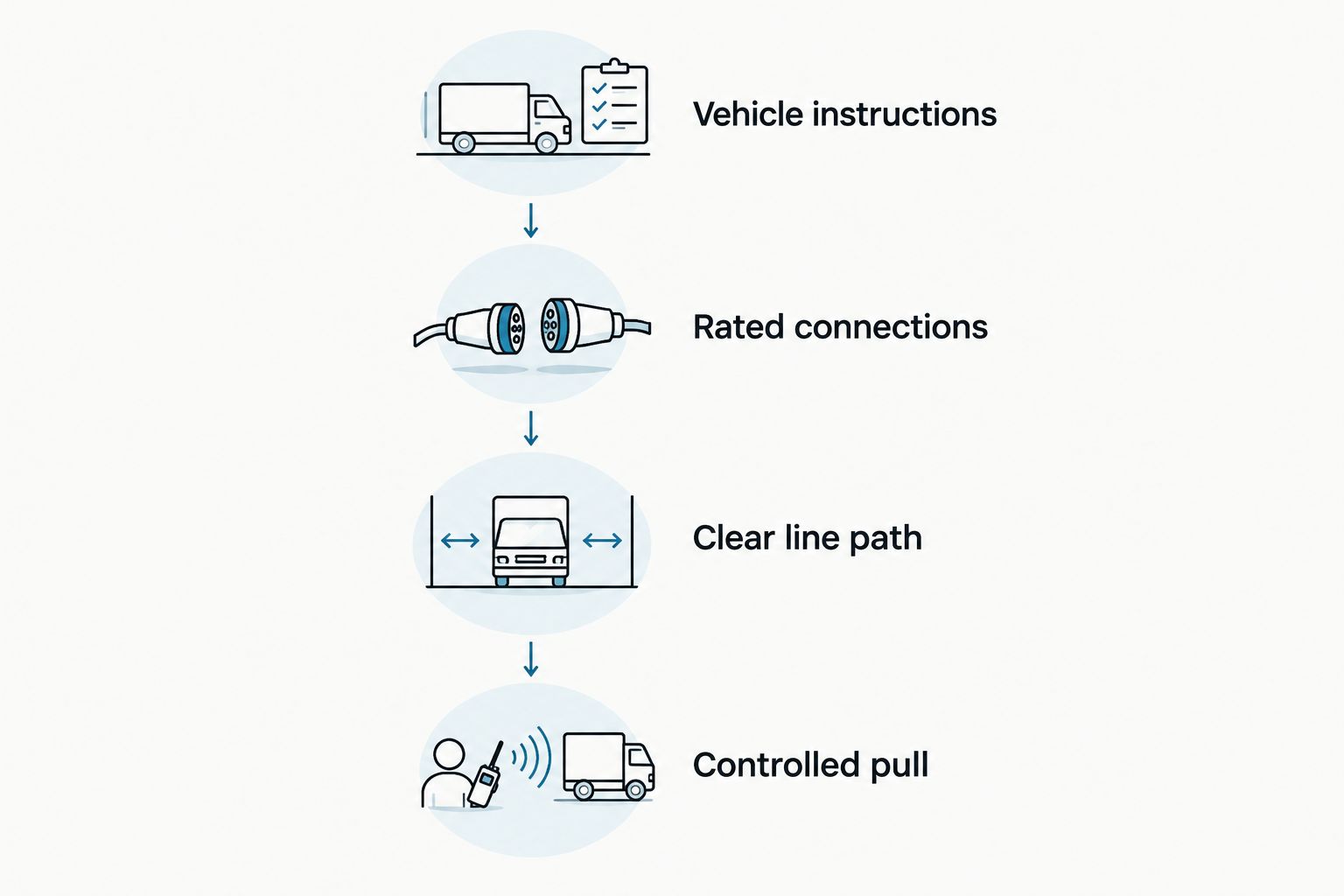
- Vehicle instructions: Confirm the permitted towing or recovery method.
- Rated connections: Check every connector and approved attachment point.
- Clear line path: Remove edge contact and identify obstacles before loading.
- Controlled pull: Establish operator communication and stop conditions.
Keep unlike ratings separate
The VULCAN Alloy Tow Chain with Forged Long J Hook — Grade 80, 3/8 Inch x 10 Foot, PROSeries identifies a 7,100-pound safe working load. Those specifications describe that chain assembly; they do not establish a suitable rope diameter, authorize kinetic loading, or rate a truck's recovery point.
The 3/8-inch dimension describes the chain size, while the 10-foot dimension describes its length. Neither dimension is a substitute for application approval, and a rope's breaking-strength figure must not be compared directly with that chain's safe working load as though the terms mean the same thing.
Control the work area
Keep people out of the line's path and away from loaded rigging, following the equipment manufacturer's exclusion-zone instructions. Do not stand over a tensioned rope, reach into a loaded connection, or allow an observer to direct the operation from beside the attachment point.
Take up slack according to the selected method and stop when the vehicle does not respond as planned. Do not escalate repeated unsuccessful pulls into harder jerks; unload the system, reassess resistance, and change the recovery plan with qualified assistance.
A buried axle, damaged vehicle, uncertain attachment point, or unstable recovery vehicle changes the job. Call a qualified recovery operator when the equipment or site conditions exceed your training, rather than treating another pull as a diagnostic test.
Maintenance and care: keep usable ropes separate from damaged gear
Make inspection part of every recovery setup and repeat it after use, because damage can occur where the rope contacted a surface or where an eye carried load. For your 2026 equipment checks, keep each rope's instructions and identification with the kit so another operator can verify its intended use.
Inspect before cleaning and storage
Check the full accessible length, the eyes, protective sleeves, and terminations for cuts, significant abrasion, melted or glazed areas, and damaged stitching where present. Apply the manufacturer's retirement criteria rather than judging serviceability from color or appearance alone.
- Remove contamination: Follow the rope manufacturer's cleaning instructions; do not improvise with solvents or aggressive cleaners.
- Dry before storage: Dry the rope as directed and avoid putting wet equipment into a closed storage space.
- Protect the line: Keep it away from sharp tools, damaging chemicals, and heat sources.
- Quarantine damage: Separate questionable equipment from serviceable gear until its condition is resolved under the manufacturer's criteria.
Do not hide a cut beneath tape or treat an improvised repair as permission to keep pulling. A replacement decision belongs to the product's inspection criteria, not to the amount of work remaining on the job.
Which tow rope should you choose in 2026?
Choose a manufacturer-rated low-stretch tow rope when your actual task is controlled pulling of a movable vehicle. Choose kinetic nylon recovery rope only for an approved dynamic setup operated by trained personnel, and choose synthetic winch rope when you are equipping a compatible powered winch.
TruckNTow buyers comparing tow ropes for trucks should write the intended task on the purchasing list before adding dimensions or ratings. That keeps a general towing purchase from becoming an unsupported recovery recommendation.
FAQ
What's the best tow rope for a pickup truck?
The best tow rope for a pickup truck is one rated by its manufacturer for your intended pulling method and vehicle requirements. Low-stretch tow rope suits controlled pulling, while kinetic recovery rope requires a separately approved dynamic recovery setup.
Is a kinetic recovery rope better than a regular tow rope?
A kinetic recovery rope is better suited to a manufacturer-approved dynamic recovery, not ordinary controlled towing. Its elastic behavior requires suitable recovery points, connectors, vehicle pairing, and trained operation.
Can I use synthetic winch rope as a tow rope?
Do not use synthetic winch rope as a vehicle-to-vehicle tow rope unless its manufacturer explicitly approves that application. A winch line is selected for compatible winch equipment and must not be treated as a kinetic recovery rope.
What strength tow rope do I need for my truck?
Select tow rope strength using the rope manufacturer's application and vehicle-weight guidance. Truck weight alone does not establish recovery resistance, and breaking strength is not interchangeable with working load limit.
Can I attach a recovery rope to a trailer hitch ball?
Never attach a recovery rope to a trailer hitch ball. Use vehicle-manufacturer-approved recovery points and connectors rated and approved for the chosen recovery method.
Is a tow chain's safe working load the same as a rope's breaking strength?
A tow chain's safe working load is not the same rating as a rope's breaking strength. Compare equipment only after identifying each rating's definition and the manufacturer's permitted application.
When should I replace a truck recovery rope?
Replace a truck recovery rope when it meets its manufacturer's retirement criteria. Remove questionable equipment from service while you assess cuts, abrasion, heat damage, and damaged eyes or terminations.
One last thing
An oversized strength figure can distract you from an incompatible connection, and the connection is part of the same loaded system. Before the next job, check the truck's approved points and the rope's intended use together; neither check replaces the other.
Shop the full line of trucking and towing accessories at TruckNTow, and select each component for the job it is documented to perform. Prepare the complete setup before you need the pull; confidence starts with verified fit, readable ratings, and serviceable equipment.