

When a disabled vehicle is sitting below the rollback deck, the best tow hooks are the hooks that match its approved attachment points and the planned pull: a long J-hook for compatible vehicle connections, a vehicle-specific frame hook for designated slots, or a rated clevis slip hook for compatible rigging hardware. For transport securement rather than recovery, choose a snap-hook tie-down assembly that fits the deck anchors; these jobs require different equipment, even when the hooks look similar.
- The best tow hooks match the vehicle attachment point, loading direction, and complete assembly rating.
- TruckNTow’s VULCAN PROSeries long J-hook chain is a candidate for compatible vehicle connections, not a universal attachment.
- Vehicle-specific frame hooks suit designated slots; clevis slip hooks suit compatible rated rigging connections.
- Snap-hook car tie-downs secure vehicles for transport; do not substitute them for recovery equipment.
Why this matters: what makes the best tow hooks
A hook can fit through an opening without being suitable for the force you intend to apply. Your 2026 equipment selection should start with the vehicle’s towing instructions and the assembly manufacturer’s permitted applications, because hook shape alone does not establish an approved connection.
Use these criteria before comparing options:
- Attachment fit: The hook must match the designated vehicle point or rated rigging connector, with room to seat correctly.
- Permitted application: Separate controlled loading, recovery, transport securement, and lifting; approval for one does not establish approval for another.
- Assembly rating: Check the complete assembly’s working load limit, not just the chain grade or the largest component.
- Loading direction: The connection must keep force in the manufacturer’s permitted direction without tip loading or side loading.
- Inspection access: You need a clear view of the hook, its attachment, and any retaining mechanism before loading it.
Best tow hooks at a glance in 2026
| Rank and option | Best for | Standout feature | Key limitation |
|---|---|---|---|
| 1. VULCAN PROSeries alloy tow chain with forged long J-hook | Compatible vehicle connections requiring a long J-hook | Grade 80 chain with a forged long J-hook | Requires an approved attachment point and permitted loading direction |
| 2. Vehicle-specific frame hook | Designated vehicle frame slots | Hook profile selected for the specified slot | Slot fit does not establish recovery approval |
| 3. Rated clevis slip hook | Compatible chain-to-rigging connections | Clevis attachment joins the hook to matching chain | Chain size, grade, connector fit, and application must agree |
| 4. VULCAN PROSeries lasso-style car tie-down with snap hooks | Vehicle transport with compatible deck anchors | Snap-hook ends on a lasso-style tie-down assembly | Transport securement is not recovery approval |
1. Long J-hook chain: best tow hook option for compatible vehicle connections
A long J-hook provides an extended hook profile for vehicle connections that permit that geometry. The VULCAN PROSeries assembly pairs a forged long J-hook with Grade 80 chain; the listed configuration is 3/8-inch chain, 10 feet long, with a 7,100-pound safe working load.
Those specifications describe the assembly, not every vehicle point you can reach with it. Check the vehicle instructions and the equipment instructions before treating an accessible axle or structural opening as an attachment point, and stop if the hook cannot seat in the permitted orientation.
Long J-hook chain pros:
- The extended profile suits attachment locations designed to accept a long J-hook.
- Chain provides a metal connection between the hook and the rest of the approved rigging.
- The listed assembly gives you a specific chain size, length, grade, and safe working load to check against the job.
Long J-hook chain cons:
- The hook’s reach does not make an unapproved vehicle component suitable for pulling.
- Restricted access can prevent you from confirming that the hook is seated correctly.
- The assembly rating does not establish the strength of the vehicle attachment point.
Best for: Operators whose vehicle instructions and rigging requirements call for a long J-hook connection.
Verdict: Buy for verified long J-hook applications; skip as a universal vehicle attachment.
2. Vehicle-specific frame hook: best tow hook for designated frame slots
Vehicle-specific frame hooks connect to designated slots using the profile specified for that vehicle and application. Select the required hook from the vehicle’s towing information rather than choosing whichever hook enters the opening most easily.
This option is about matching the interface, not reaching around an obstruction. A hook that appears to engage a slot can still be wrong if it bears on the wrong surface, cannot turn into its working position, or is approved only for securement rather than pulling.
Vehicle-specific frame hook pros:
- The correct profile matches a designated slot instead of relying on an improvised connection.
- Vehicle instructions give you a defined basis for selecting the attachment.
- Different profiles let an operator address specified interfaces without forcing one hook into every opening.
Vehicle-specific frame hook cons:
- A profile approved for one vehicle is not automatically approved for another.
- Damage or corrosion at the slot requires assessment before applying force.
- A transport attachment point is not automatically a recovery attachment point.
Best for: Operators working with vehicles that specify frame-slot hook connections.
Verdict: Buy the specified profile; hold the job when the attachment instructions are unresolved.
3. Rated clevis slip hook: best tow hook for compatible rigging connections
A clevis slip hook joins to matching chain through a clevis and pin, while its hook opening accepts a compatible connector within the manufacturer’s limits. Use it where the rigging design calls for that connection, not as a substitute for a vehicle-specific hook.
Check the hook’s chain-size and grade requirements along with its working load limit and permitted applications. If the hook includes a latch, the latch retains the connection; it is not the surface that should carry the load.
Rated clevis slip hook pros:
- The clevis provides a defined attachment method for compatible chain.
- The hook opening accommodates matching rated rigging hardware.
- You can inspect the hook body, clevis, pin, and retaining parts as separate connection details.
Rated clevis slip hook cons:
- A hook and chain of similar apparent size can still have incompatible ratings or specifications.
- An oversized connector can prevent proper seating in the hook bowl.
- A retaining latch does not correct side loading, tip loading, or an unsuitable attachment point.
Best for: Operators assembling manufacturer-approved chain-to-rigging connections.
Verdict: Buy only after matching the chain, connector, rating, and application.
4. Snap-hook tie-down assembly: best hook option for transport securement
Snap-hook tie-down assemblies connect securement straps to compatible anchors, with the retaining mechanism helping keep the connection engaged during setup. The listed VULCAN PROSeries lasso-style configuration uses 2-inch by 96-inch straps and carries a 3,300-pound safe working load.
This is the transport choice in the comparison, not another recovery hook. TruckNTow’s snap-hook car tie-down option belongs in a vehicle-securement plan that follows the strap instructions, deck-anchor requirements, and vehicle transport instructions.
Snap-hook tie-down assembly pros:
- Snap-hook ends provide a retained connection when correctly seated in compatible anchors.
- Lasso-style straps provide a distinct vehicle-securement approach.
- The listed dimensions and safe working load give you concrete specifications to compare with your setup.
Snap-hook tie-down assembly cons:
- Anchor geometry must allow the hook to seat without bearing on its gate or tip.
- Webbing requires inspection for cuts, abrasion, and other damage.
- The tie-down rating does not authorize winching, kinetic recovery, or lifting.
Best for: Vehicle haulers securing a vehicle for transport on compatible equipment.
Verdict: Buy for approved transport securement; skip for recovery pulls.
How the options rank
The order follows the task: compatible vehicle attachment first, designated frame-slot attachment second, rigging connection third, and transport securement fourth. It is not a strongest-to-weakest ranking, because these options serve different connections and their ratings do not establish interchangeable uses.
For your 2026 truck inventory, use the comparison as a selection sequence. Identify the task and attachment point before choosing the hook, then verify the complete assembly rather than purchasing by appearance or chain grade alone.
Compatibility: check the whole connection before applying force
Hook compatibility includes more than the opening width. You need enough access to install the hook, verify its seating, establish the permitted loading direction, and confirm that nearby bodywork, brake lines, wiring, or steering components will not become part of the load path.
Inspect the vehicle point before connecting anything. Collision damage changes the assessment: a normally designated point that is torn, distorted, or obstructed requires a different approved plan rather than a stronger hook attached to the same damaged location.
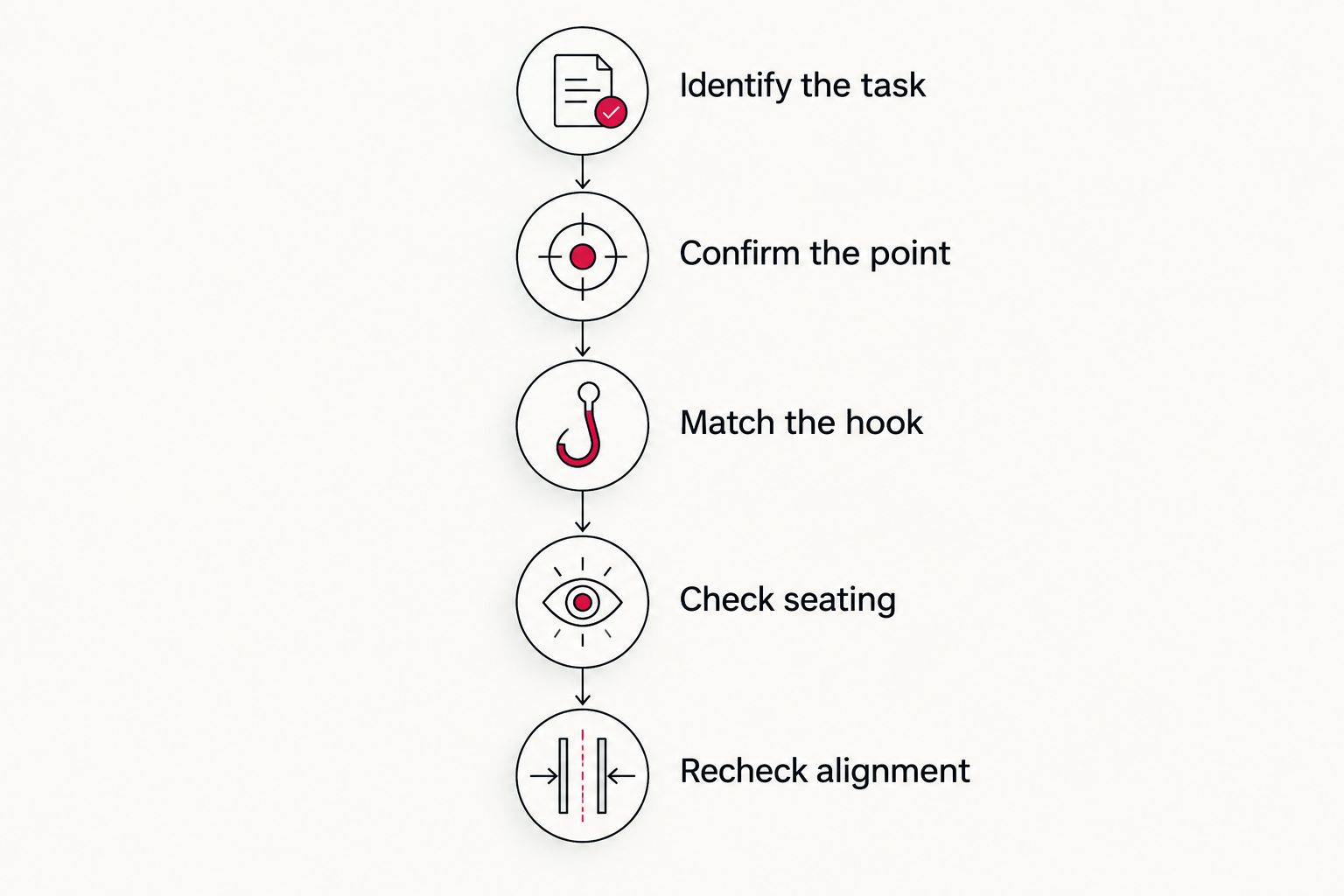
Use this sequence at the vehicle:
- Identify the task. Establish whether you are loading, recovering, securing, or lifting, and select equipment approved for that operation.
- Confirm the point. Find the specified vehicle attachment point and check its condition.
- Match the hook. Confirm the required profile, connector fit, chain compatibility, and assembly rating.
- Check seating. Verify the hook’s working position, loading direction, and clearance before taking up tension.
- Recheck alignment. Pause during initial tensioning to confirm that the connection has not shifted into an incorrect position.
Do not force a connector into a hook or modify hardware to make the connection fit. Grinding a hook opening, replacing a clevis pin with an unspecified bolt, or attaching through the retaining gate changes the connection from the manufacturer’s design.
TruckNTow’s best tow hooks selection starts with the approved connection, not the highest listed rating. Keep recovery hardware and transport-securement hardware identified separately in your 2026 equipment records so a familiar-looking hook does not enter the wrong job.
Safety and maintenance: keep the rating attached to the right job
A working load limit applies under the manufacturer’s stated conditions. It is not a breaking-strength figure, a vehicle-weight allowance, or permission to shock-load the assembly; vehicle resistance and rigging geometry must be assessed as part of the recovery plan.
The 7,100-pound safe working load listed for the long J-hook chain does not mean every vehicle below that weight is an approved pull. Likewise, the 3,300-pound figure listed for the snap-hook tie-down does not turn the strap into recovery equipment, and adding component ratings together does not establish a system rating.
Before applying force, confirm these details:
- The hook carries load on the manufacturer’s intended bearing surface, not its tip or retaining mechanism.
- The chain, hook, connector, winch connection, and vehicle point suit the planned operation.
- Personnel remain outside the danger area established for the operation.
- Initial tension is applied under control, with a stop available if the attachment shifts.
- Transport securement is completed as a separate task after loading.
For maintenance, clean hardware enough to inspect its load-bearing surfaces and markings, then follow the manufacturer’s care instructions. Remove equipment from service when inspection finds cracks, distortion, excessive wear, damaged retaining parts, or other rejection conditions specified by the manufacturer.
Do not straighten, weld, or heat a damaged hook to return it to service. Keep questionable equipment separate from usable assemblies, and record the reason for removal so another operator does not put it back on the truck.
Which tow hooks should you choose in 2026?
Choose the long J-hook assembly only when the vehicle connection calls for it; choose the specified frame hook when the vehicle requires a frame-slot interface. A rated clevis slip hook serves compatible rigging connections, while a snap-hook tie-down assembly serves transport securement.
For an undecided buyer, the next move is to identify the vehicles and attachment instructions the truck routinely handles. That information determines the useful hook profiles and assemblies; a larger rating cannot resolve an incorrect fit.
FAQ
What are the best tow hooks for tow trucks in 2026?
The best tow hooks match the approved vehicle attachment point and intended operation. Long J-hooks, vehicle-specific frame hooks, and rated clevis slip hooks serve different connections; snap-hook tie-downs serve transport securement.
Is a long J-hook better than a frame hook?
A long J-hook is better only when the approved attachment requires its geometry. Use a frame hook when the vehicle instructions specify that profile and slot for the intended operation.
Can I use snap-hook ratchet straps to recover a stuck vehicle?
Do not use transport tie-down straps for recovery unless the manufacturer explicitly approves that application. A securement working load limit does not establish a recovery rating.
Does Grade 80 chain make a tow hook suitable for lifting?
Grade 80 chain alone does not establish lifting approval for the complete assembly. The hook, connections, assembly rating, and manufacturer’s instructions must all permit lifting.
Can I attach a tow hook to any axle or frame opening?
Use only attachment points approved for the vehicle and operation. Accessibility and apparent strength do not establish an approved towing or recovery point.
Does a safety latch carry the load on a hook?
A retaining latch is not the hook’s load-bearing surface. Seat the connector on the intended bearing surface and follow the hook manufacturer’s instructions.
When should I replace a tow hook?
Remove a tow hook from service when it meets the manufacturer’s rejection criteria. Cracks, distortion, excessive wear, and damaged retaining components require inspection and action before reuse.
One last thing
A retaining mechanism does not make a hook connection correctly loaded; the connector still has to sit on the intended bearing surface. Inspect the loaded position, not just whether the gate closes. Review TruckNTow’s hook and securement options against your attachment requirements before the next dispatch, and keep each assembly assigned to the job its instructions permit.