

When an inner dual valve sits beyond a short chuck's reach, the best tire pressure gauge for semi truck inspections is a dual-head mechanical stick gauge that fits the wheel and covers the required pressure. Best for low-light readings: a digital dual-head hose gauge; best for bench-side checks: an analog dial hose gauge; best for inflation work: a dual-head inflator gauge.
- The best tire pressure gauge for semi truck checks has dual-head access, suitable range, and documented accuracy.
- Choose a mechanical stick gauge for independent pre-trip checks without batteries or an air supply.
- Choose a digital hose gauge for low-light readability, but verify its accuracy specification and valve access.
- TruckNTow's semi-truck tire pressure gauge guide prioritizes usable equipment and a repeatable inspection routine.
What makes the best semi-truck tire pressure gauge
A gauge belongs in your inspection kit only if it reaches the valves, seals without persistent leakage, and produces a reading you can trust. A readable display does not compensate for poor chuck alignment, and a long pressure scale does not establish accuracy. For your 2026 equipment selection, start with these criteria rather than the display format:
- Valve access: A dual-head chuck provides push-on and pull-on approaches for differently oriented valves; confirm both approaches work on your wheels.
- Pressure range: The gauge must cover the cold inflation pressures specified for your tire, load, and vehicle application.
- Documented accuracy: Look for a stated accuracy tolerance and the conditions under which it applies, not just small display increments.
- Repeatability: A properly seated gauge should return consistent readings when checked against a suitable reference.
- Readability: Choose markings or a display you can read at the wheel without changing the chuck's seating angle.
- Serviceability: Check how you will inspect seals, protect the chuck, replace batteries where applicable, and arrange accuracy checks.
Record pressure defects through your fleet's inspection process rather than relying on memory. A Carbonless Driver's Vehicle Inspection Report provides a paper format for recording inspection findings; follow your carrier's instructions for entries and corrective action.
Semi-truck tire pressure gauges at a glance
These recommendations rank gauge configurations by working task, not individual models by tested performance. TruckNTow's tire pressure gauge recommendations separate independent inspection tools from inflation tools because their jobs differ.
| Rank and configuration | Best for | Standout feature | Key limitation |
|---|---|---|---|
| Mechanical dual-head stick gauge | Daily independent pre-trip checks | Battery-free reading with dual-valve access | Sliding scale requires careful reading |
| Digital dual-head hose gauge | Low-light inspection rounds | Electronic display with a flexible connection | Battery condition and environmental limits require attention |
| Analog dial hose gauge | Workshop verification checks | Dial face can be positioned separately from the chuck | Dial mechanism needs protection from impact |
| Dual-head inflator gauge | Controlled inflation at a service position | Combines pressure checking and air delivery | Requires an appropriate air supply and safe inflation procedure |
1. Mechanical dual-head stick gauge: best for daily pre-trip checks
A mechanical stick gauge uses tire pressure to move a graduated indicator, so you can inspect tires without batteries or a compressor connection. The dual-head chuck gives you alternative seating approaches, which matters when inner and outer dual valves point in different directions.
Mechanical dual-head stick gauge pros:
- Operates independently of electrical power.
- Keeps the inspection tool separate from the inflation system.
- Provides push-on and pull-on access when the chuck design supports both.
Mechanical dual-head stick gauge cons:
- The sliding scale requires enough light and a clear viewing angle.
- Dirt, seal wear, or damage can affect operation.
- A suitable pressure range does not guarantee a suitable accuracy tolerance.
Best for: Drivers who need a straightforward pressure check before departure and during scheduled inspections. Verdict: Buy a mechanical dual-head stick gauge when its reach, range, and accuracy specification match your truck.
2. Digital dual-head hose gauge: best for low-light inspection rounds
A digital hose gauge separates the display from the valve connection, allowing you to position the readout while keeping the chuck seated. For night work, select a model with a specified illuminated display rather than assuming every digital gauge has backlighting.
Digital dual-head hose gauge pros:
- Displays pressure without interpreting a graduated stick or dial.
- Allows display positioning independently of the chuck.
- Supports low-light reading when illumination is a stated feature.
Digital dual-head hose gauge cons:
- Depends on serviceable batteries.
- Requires attention to the manufacturer's temperature and moisture limits.
- Fine display increments can look more precise than the stated accuracy supports.
Best for: Drivers conducting dark-yard inspections who need an easily positioned display. Verdict: Buy a digital dual-head hose gauge for readability, not because digital automatically means more accurate.
3. Analog dial hose gauge: best for workshop verification checks
An analog dial hose gauge places the pressure scale in a separate housing connected to the chuck, so the technician can face the dial toward a comfortable viewing position. Choose the hose length and chuck geometry around the actual wheel arrangement, then verify the gauge against your workshop reference procedure.
Analog dial hose gauge pros:
- Does not require display batteries.
- Separates dial positioning from valve seating.
- Provides a dedicated checking tool outside the inflation circuit.
Analog dial hose gauge cons:
- Impact can damage the dial mechanism.
- Reading the dial at an angle introduces parallax error.
- A large housing and hose need protected storage.
Best for: Technicians who prefer a visible mechanical scale during workshop checks. Verdict: Buy an analog dial hose gauge when you have suitable storage and a defined accuracy-check process.
4. Dual-head inflator gauge: best for controlled service-position inflation
An inflator gauge combines a pressure readout with an air-delivery control, allowing a technician to adjust pressure at the service position. It is not a substitute for an independent inspection gauge, and the chuck must still reach and seal on the valve correctly.
Dual-head inflator gauge pros:
- Combines adjustment and measurement in one tool.
- Reduces switching between a separate air chuck and checking gauge.
- Provides dual-valve access when equipped with the appropriate head.
Dual-head inflator gauge cons:
- Needs a compatible, appropriate air supply.
- Requires correct use to distinguish inflation flow from stabilized tire pressure.
- Does not remove commercial-tire inflation hazards.
Best for: Trained personnel adjusting pressure in a controlled service environment. Verdict: Buy a dual-head inflator gauge for inflation work; skip it as your only independent inspection tool.
How these choices are ranked: Valve access comes first, followed by usable range, documented accuracy, readability, and maintenance requirements. The 2026 default recommendation is the mechanical dual-head stick configuration because routine checking does not require electrical power or an air connection; specialized reading and inflation tasks justify the other configurations.
Match the chuck, range, and units to your truck
Inspect the actual valve arrangement before choosing a gauge, including the inner dual valve, outer dual valve, steer-wheel valve, and any extension fitted to the assembly. A tool that works on the steer axle is not automatically suitable for every dual-wheel position. Reject a gauge that requires bending a valve stem or forcing the chuck sideways to get a reading.
A dual-head chuck normally offers different approach directions, but head angle, stem length, wheel openings, and available hand clearance still determine fit. Valve extensions also need inspection because a damaged or leaking extension can create a problem that changing gauges will not solve. Compare the chuck's dimensions and the manufacturer's instructions with your actual installation.
Read the pressure specification correctly
Use the specified cold inflation pressure for the application, supported by the tire manufacturer's load-and-inflation information and the vehicle or fleet instructions. Do not treat the tire sidewall marking as a universal operating target, and do not select pressure from the gauge's maximum range.
Keep the gauge, inflation instruction, and inspection record in the same unit system. The established pressure conversions are 1 psi = approximately 6.895 kPa and 1 bar = 100 kPa; these are unit conversions, not recommended semi-truck tire pressures. A gauge that switches units requires a deliberate unit check before you record or adjust anything.
A display resolving small increments does not prove that the measurement is accurate to those increments. Read whether the accuracy tolerance applies to the displayed reading or to the full scale, and check any stated operating conditions. For a 2026 fleet purchase, that specification is more useful than an unsupported claim of professional accuracy.
Check pressure safely and investigate abnormal readings
Perform routine pressure checks with the vehicle secured in a safe inspection location, following your fleet's parking and wheel-restraint procedures. Traffic exposure, unstable positioning, and damaged tire assemblies are not problems a better gauge can correct. Arrange the work area before reaching between wheels.
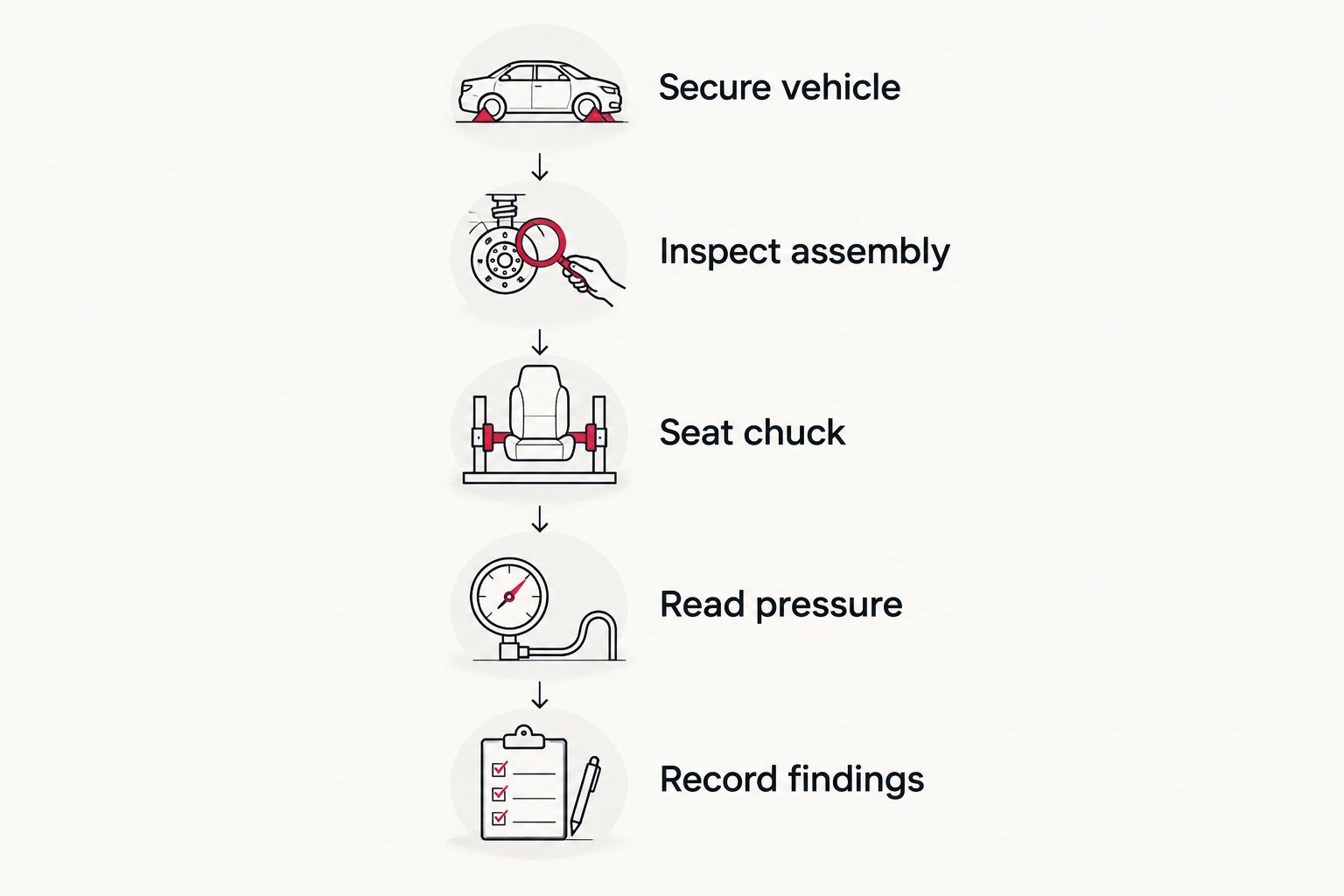
Use a repeatable checking sequence
- Secure vehicle: Park safely and apply the required parking and restraint procedures.
- Inspect assembly: Look for visible tire damage, valve damage, and signs of leakage before checking.
- Seat chuck: Remove the cap, keep contamination away from the valve, and align the chuck without side-loading the stem.
- Read pressure: Obtain a stabilized reading according to the gauge instructions; reseat the chuck if the connection leaks persistently.
- Record findings: Compare with the approved cold-pressure target, document defects, and replace the valve cap.
A brief release of air while seating or removing a chuck differs from a connection that keeps leaking throughout the measurement. Persistent leakage calls for checking the seating angle, chuck seal, valve condition, and extension rather than accepting whichever reading appears first.
Check cold inflation pressure under the conditions specified by the tire manufacturer or fleet procedure. Pressure rises as a tire heats during operation, so bleeding a hot tire down to a cold-pressure target can leave it underinflated after cooling. In 2026, the correct target still comes from the application instructions, not a universal number printed in a buying guide.
Treat low pressure as a condition to diagnose
An abnormal reading requires more than adding air. Check for leakage and refer suspected tire or wheel damage to qualified personnel; a severely underinflated tire can have internal damage that is not obvious externally. Do not reinflate a suspect assembly simply to get the truck moving.
Commercial-tire servicing requires the applicable training, equipment, and inflation precautions. A hose-mounted gauge or clip-on chuck does not replace those requirements, and this selection guide is not an inflation procedure for damaged tires.
Maintain the gauge and choose your default
Protect the chuck from grit and keep the gauge in a clean, dry storage location rather than loose beneath other equipment. Inspect the seal, body, hose where fitted, and readable markings before relying on the tool. Follow the manufacturer’s maintenance instructions, including battery replacement and environmental limits for electronic gauges.
A gauge dropped onto concrete or showing inconsistent readings needs an accuracy check before further use. Comparing two unknown gauges establishes disagreement, not which instrument is correct; use a suitable reference and your organization's verification procedure. Do not average conflicting readings to make the problem disappear.
Which semi-truck tire pressure gauge should you choose?
Choose the mechanical dual-head stick gauge as the default for independent driver checks, then choose digital, dial, or inflator equipment for a defined additional task. Confirm access at every wheel position before issuing the tool across a fleet, and keep the instructions with the inspection equipment so replacement tools meet the same requirements.
TruckNTow serves truckers, towing operators, and vehicle haulers; the practical tire pressure gauge choice is the configuration that fits the work without obscuring the measurement. Keep the selection process focused on valve reach, documented accuracy, and a pressure record that leads to corrective action.
One last thing: Two matching readings from the same gauge show consistency, but they do not independently establish accuracy. Make reference checks part of your 2026 equipment-care procedure rather than waiting for an obviously implausible result.
FAQ
What's the best tire pressure gauge for a semi truck?
A mechanical dual-head stick gauge is the default configuration for independent semi-truck pressure checks. Choose one with suitable valve reach, sufficient pressure range, and a documented accuracy specification.
Is a digital tire pressure gauge better than a mechanical gauge?
A digital gauge is better for your task when its display improves readability, but digital operation does not establish better accuracy. Compare the stated tolerances, valve access, and operating conditions of the actual gauges.
Do I need a dual-head gauge for semi-truck tires?
Choose a dual-head gauge when the valve arrangement requires push-on and pull-on access. Verify that the head angle and stem reach work on both inner and outer dual positions without forcing the valve.
What pressure should I put in my semi-truck tires?
Use the approved cold inflation pressure for the tire, load, and vehicle application. Consult the tire manufacturer's load-and-inflation information and your vehicle or fleet instructions rather than applying one pressure to every axle.
Can I lower a hot tire to its cold inflation pressure?
Do not bleed a hot tire down to its specified cold-pressure target. Tire pressure rises with operating temperature, and reducing it to the cold target while hot can leave the tire underinflated after cooling.
Does a tire thumper replace a pressure gauge?
A tire thumper does not replace a pressure gauge because it does not provide a measured inflation pressure. Use a suitable gauge to compare the tire's pressure with the approved target.
How do I know whether my tire pressure gauge is accurate?
Check the gauge against a suitable reference using the manufacturer's or fleet's verification procedure. Repeated readings from one gauge establish repeatability, not independent accuracy.
Can an inflator gauge be my only inspection gauge?
Keep an independent checking gauge even when you use an inflator gauge for pressure adjustments. Separate checking equipment lets you inspect without an air-supply connection and supports verification of questionable readings.
Related guides
- Best tire gauges for semi-truck pre-trip inspection
- How to inflate a semi-truck tire with a portable compressor
- How to fill out a driver vehicle inspection report
Shop the full line of trucking and towing accessories at TruckNTow. Choose the correct tool, verify the reading, and resolve pressure defects before the next departure.
Keep your equipment ready and your inspection decisions grounded in measured pressure.