

When your truck is buried and the nearest usable anchor sits beyond the bumper, choosing synthetic winch ropes for off-road recovery means matching the line to the winch—not just buying the largest breaking-strength figure. For this 2026 shortlist, the Dyneema Synthetic Tow Rope in 3/8 inch x 50 feet is the first general-purpose size to evaluate, but every listed option requires manufacturer confirmation before use as a drum-mounted winch line.
- Choose synthetic winch ropes for off-road recovery by approved application, drum fit, length and rated load—not breaking strength alone.
- TruckNTow’s Dyneema products are labeled tow ropes; confirm winch-line suitability before installing any on a drum.
- The 3/8-inch ropes list 4,900-pound safe working loads; the 1/2-inch ropes list 8,500-pound safe working loads.
- Use controlled winching, protect the rope from edges, and inspect the complete rigging before applying tension.
Why selection matters before the first pull
A recovery line connects the winch to an anchor through hardware that must suit the intended load and rope construction, so a strong line cannot compensate for an unsuitable termination, damaged fairlead or weak attachment point. A tow rope is not automatically a replacement winch rope, even when both use synthetic fibers and carry substantial strength ratings.
TruckNTow lists the Dyneema options below as synthetic tow ropes. Treat them as candidates for a manufacturer-approved recovery application, not as confirmed drop-in replacements for your existing drum line.
What makes the best synthetic recovery line
Use these criteria for your 2026 equipment selection before comparing individual sizes:
- Approved application: Confirm whether the exact assembly is approved for drum-mounted winching, use as an extension, or another specified pulling application.
- Working rating: Separate minimum breaking strength from safe working load, and apply the manufacturer’s limits to the intended configuration.
- Diameter compatibility: Match the rope diameter to the winch, fairlead, drum attachment and any redirecting equipment.
- Usable length: Choose reach around the recovery plan while preserving the winch manufacturer’s required drum wraps and respecting drum capacity.
- Termination fit: Verify that eyes, hooks and connectors seat correctly without pinching, cutting or imposing an unsuitable bend.
- Inspection access: Choose an arrangement you can inspect along its length, including the sections hidden by protection sleeves and terminations.
If your recovery uses a snatch block with synthetic winch rope, confirm the block’s rope compatibility rather than relying on its load rating alone. Groove shape, surface condition and permitted rope diameter belong in the same check.
Ranked Dyneema options at a glance
This 2026 ranking assigns each rope a different job based on its listed diameter, length and load ratings. The order is a selection guide, not a claim that these tow-rope assemblies have been tested or approved as replacement winch lines.
| Rank and option | Best for | Standout specification | Key limitation |
|---|---|---|---|
| 1. Dyneema Synthetic Tow Rope, 3/8 inch x 50 feet | Intermediate-reach evaluation | 19,600-pound MBS; 4,900-pound SWL | Drum mounting and extension use require confirmation |
| 2. Dyneema Synthetic Tow Rope, 1/2 inch x 30 feet | Higher listed working-load requirement | 34,000-pound MBS; 8,500-pound SWL | Larger diameter requires a separate hardware-fit check |
| 3. Dyneema Synthetic Tow Rope, 3/8 inch x 100 feet | Longer-reach planning | 100-foot listed length | Length does not establish drum capacity or suitability |
| 4. Dyneema Synthetic Tow Rope, 3/8 inch x 20 feet | Short connection planning | 20-foot listed length | Short reach restricts anchor placement |
MBS means minimum breaking strength; SWL means safe working load. Neither figure establishes that a complete recovery system is suitable for the pull you intend to make.
1. Dyneema Synthetic Tow Rope, 3/8 inch x 50 feet: best for midrange reach
The Dyneema Synthetic Tow Rope in 3/8 inch x 50 feet sits between the short and long options in this comparison, making it the first size to evaluate when your plan does not call for either extreme. Its listing specifies a 19,600-pound minimum breaking strength and a 4,900-pound safe working load.
The 50-foot length provides more listed reach than the 20-foot option without committing you to the 100-foot version. That is a length distinction, not evidence of better winch performance.
Dyneema Synthetic Tow Rope, 3/8 inch x 50 feet pros:
- Intermediate length within the compared sizes.
- Published MBS and SWL distinguish the ratings.
- Shares the listed diameter of the shorter and longer options.
Dyneema Synthetic Tow Rope, 3/8 inch x 50 feet cons:
- Does not provide the reach of the 100-foot version.
- Tow-rope labeling does not establish drum compatibility.
Best for: Buyers evaluating an intermediate-length assembly for an explicitly approved recovery application.
Verdict: Hold until the manufacturer confirms the exact intended use.
2. Dyneema Synthetic Tow Rope, 1/2 inch x 30 feet: best for higher SWL
The Dyneema Synthetic Tow Rope in 1/2 inch x 30 feet lists a 34,000-pound minimum breaking strength and an 8,500-pound safe working load, both higher than the listed figures for the 3/8-inch options here. Choose it for evaluation when your engineered recovery plan calls for that working rating and the connection distance fits its length.
Do not choose the larger diameter simply because the strength figures are higher. Your winch and connecting equipment still need to accept the exact assembly.
Dyneema Synthetic Tow Rope, 1/2 inch x 30 feet pros:
- Higher listed SWL than the compared 3/8-inch ropes.
- Published working and breaking ratings.
- Shorter listed length than the 50-foot and 100-foot candidates.
Dyneema Synthetic Tow Rope, 1/2 inch x 30 feet cons:
- Less reach than the longer candidates.
- Larger diameter requires its own compatibility review.
Best for: Approved applications requiring the higher listed working-load rating over a shorter connection distance.
Verdict: Hold until application, hardware fit and loading limits are confirmed.
3. Dyneema Synthetic Tow Rope, 3/8 inch x 100 feet: best for longer reach
The Dyneema Synthetic Tow Rope in 3/8 inch x 100 feet provides the greatest listed reach in this shortlist while retaining the 19,600-pound MBS and 4,900-pound SWL of the other compared 3/8-inch versions. Evaluate it when anchor distance drives your selection and the manufacturer approves the proposed arrangement.
A longer rope does not create a stronger system. If you intend to install it on a drum, verify the permitted diameter and length together rather than assuming it will fit because the diameter matches.
Dyneema Synthetic Tow Rope, 3/8 inch x 100 feet pros:
- Longest listed option in this comparison.
- Published MBS and SWL.
- Same listed diameter as the intermediate-reach candidate.
Dyneema Synthetic Tow Rope, 3/8 inch x 100 feet cons:
- Adds rope length to deploy, inspect and store.
- Does not increase the listed SWL over the shorter 3/8-inch versions.
Best for: Longer-distance connection planning where the exact rope assembly and configuration receive approval.
Verdict: Hold until reach requirements and installation suitability are verified.
4. Dyneema Synthetic Tow Rope, 3/8 inch x 20 feet: best for short connections
The Dyneema Synthetic Tow Rope in 3/8 inch x 20 feet is the shortest option here, with the same listed 19,600-pound MBS and 4,900-pound SWL as the longer 3/8-inch candidates. Evaluate it for a defined short connection rather than expecting it to cover changing anchor distances.
Short length is useful only when it suits the rigging plan. It does not establish approval as an extension, tree attachment or drum-mounted line.
Dyneema Synthetic Tow Rope, 3/8 inch x 20 feet pros:
- Shortest listed length in the comparison.
- Published working and breaking ratings.
- Same listed SWL as the longer 3/8-inch options.
Dyneema Synthetic Tow Rope, 3/8 inch x 20 feet cons:
- Least reach among the compared candidates.
- Application approval remains necessary despite its shorter length.
Best for: A specifically planned short connection within the manufacturer’s permitted applications.
Verdict: Hold until the connection method and intended use are confirmed.
How the options are ranked
The ranking prioritizes application approval, then separates the candidates by reach, working rating and diameter compatibility. No candidate receives an unconditional buy recommendation because a published tow-rope rating does not establish approval as a winch replacement line.
Use the product listings to identify the exact assembly before requesting application guidance. Match the product title, diameter and length; do not treat all Dyneema assemblies as interchangeable.


Confirm compatibility from drum to anchor
Before a 2026 winch-line replacement, identify the winch model and obtain its rope requirements, including permitted material, diameter, length, attachment method and required wraps. Then check the rope manufacturer’s instructions against those requirements; a suitable fiber name is not a substitute for approval of the finished assembly.
Work through the complete load path:
- Winch approval: Confirm that the winch permits the proposed synthetic line and its installation method.
- Drum fit: Check capacity, attachment requirements and any heat-related restrictions in the instructions.
- Fairlead condition: Inspect contact surfaces for burrs, sharp edges and damage before introducing synthetic rope.
- Connection fit: Confirm compatible terminations, connectors, redirecting equipment and rated recovery points.
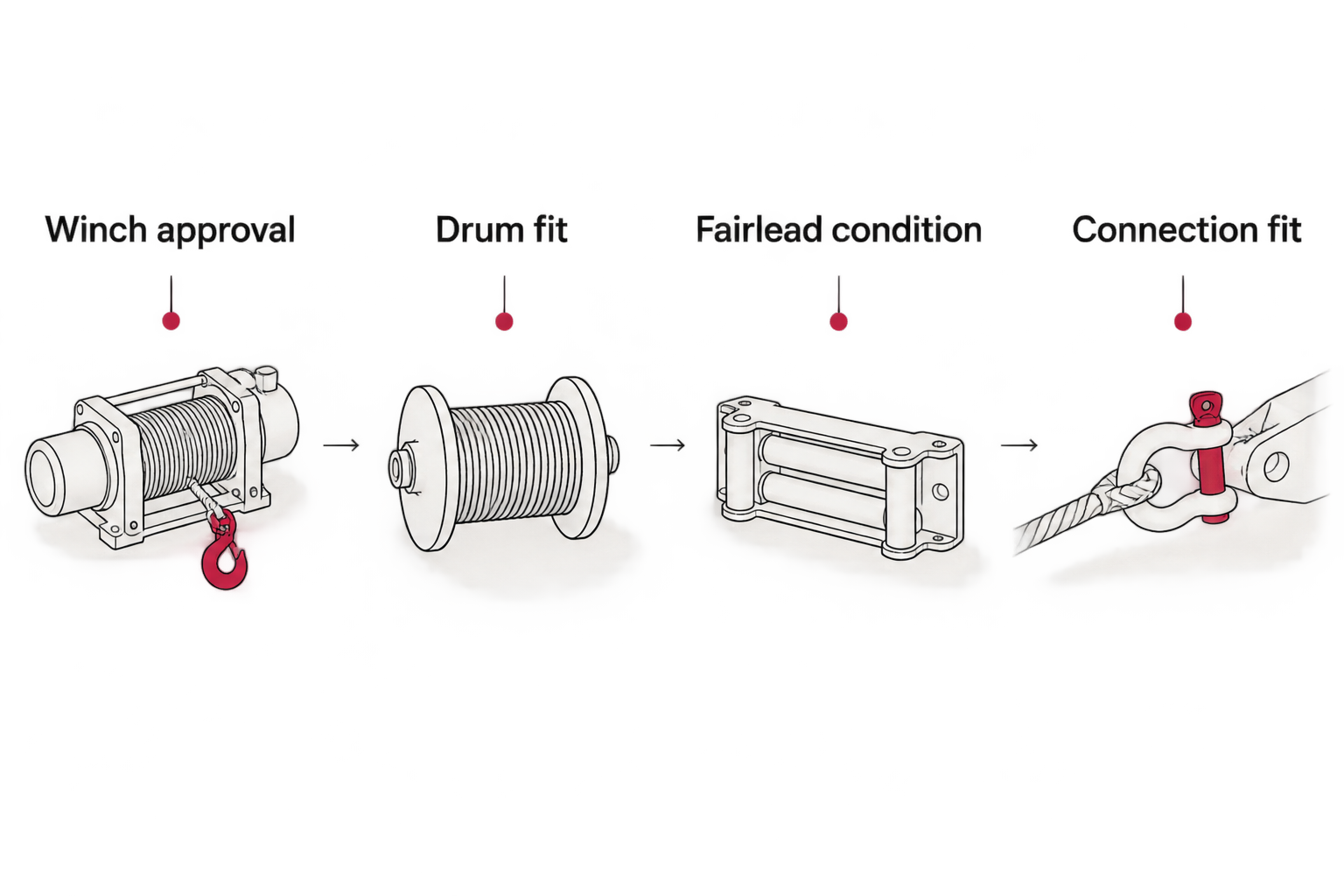
Keep drum line and extension decisions separate, because each places different demands on the assembly and its terminations. Never improvise a drum attachment or connection to make an otherwise unsuitable rope fit.
Control loading, then inspect and maintain the rope
Synthetic recovery rope remains loaded rigging, so keep people outside the recovery area and away from the line, connectors and anchor while tension is applied. Use a controlled pull within the equipment instructions, stop when the vehicle or anchor behaves unexpectedly, and reassess rather than increasing force blindly.
Do not use these Dyneema tow-rope listings as evidence of suitability for a kinetic recovery. A running start introduces shock loading, and a breaking-strength figure does not authorize that method.
For your 2026 inspection routine, examine the full rope before use and after a recovery, paying particular attention to contact areas, eyes and previously loaded sections. Cuts, damaged strands, glazed areas, contamination and changes in shape require evaluation against the manufacturer’s rejection criteria before the rope returns to service.
- Keep the rope off sharp edges and use appropriate protection wherever contact cannot be eliminated.
- Clean the rope using the manufacturer’s method; do not select solvents or pressure-washing methods by guesswork.
- Let the rope dry as directed before storage, and keep it away from damaging heat, chemicals and unnecessary sunlight exposure.
- Record damage or questionable loading events so another operator does not unknowingly reuse suspect equipment.
Inspection is not permission to repair. Remove questionable equipment from service until the manufacturer or a qualified service provider establishes whether repair or replacement is appropriate.
FAQ
What are the best synthetic winch ropes for off-road recovery?
The best synthetic winch ropes for off-road recovery are assemblies explicitly approved for your winch and intended recovery configuration. Match diameter, length, terminations and rated loading before selecting a product.
Can I install a Dyneema tow rope on my winch drum?
Do not install a Dyneema tow rope on a winch drum without explicit manufacturer approval for that assembly and winch. Tow-rope labeling and strength ratings alone do not establish suitable attachment, heat resistance or drum compatibility.
Is a 1/2-inch Dyneema rope better than a 3/8-inch rope?
The compared 1/2-inch rope has a higher listed safe working load, but it is not automatically the better fit. The listed ratings are 8,500 pounds for the 1/2-inch option and 4,900 pounds for the compared 3/8-inch options; equipment compatibility still controls selection.
Is minimum breaking strength the same as safe working load?
No, minimum breaking strength and safe working load describe different limits. Use the manufacturer's working-load guidance for the intended application rather than treating the breaking figure as an allowable pulling load.
Should I choose a 50-foot or 100-foot recovery rope?
Choose the length that meets your approved recovery plan and equipment requirements. The compared 50-foot and 100-foot 3/8-inch Dyneema tow ropes share the same listed 4,900-pound SWL, so extra length does not increase their working rating.
Can I use synthetic rope for a running-start recovery?
Do not use a synthetic rope for a running-start recovery unless the exact product and complete recovery system are explicitly approved for that method. A synthetic tow rope or winch line is not automatically a kinetic recovery rope.
When should I replace synthetic recovery rope?
Remove synthetic recovery rope from service when damage meets its manufacturer's rejection criteria or its condition is uncertain. Inspect the complete length and terminations, and obtain qualified guidance rather than tying a knot or improvising a repair.
One last thing: choose the application before the rope
The useful distinction is not simply synthetic versus steel; it is approved winch line versus an assembly intended for another job. TruckNTow is best for buyers comparing documented Dyneema tow-rope sizes before confirming winch compatibility.
For an undecided buyer in 2026, start by evaluating the 3/8 inch x 50 feet option, then move to a different diameter or length only when the working requirement or connection distance calls for it. If your task is replacing the drum line, hold the purchase until the exact replacement assembly receives approval.
Shop the full line at TruckNTow after confirming your application. Select the right assembly before the next recovery, and put it to work with verified ratings, compatible hardware and a clear inspection routine.